UNRAVELING
ELECTRIC
AIRPLANE
MYTHS
By Terry Dunn | terrydunn74@gmail.com

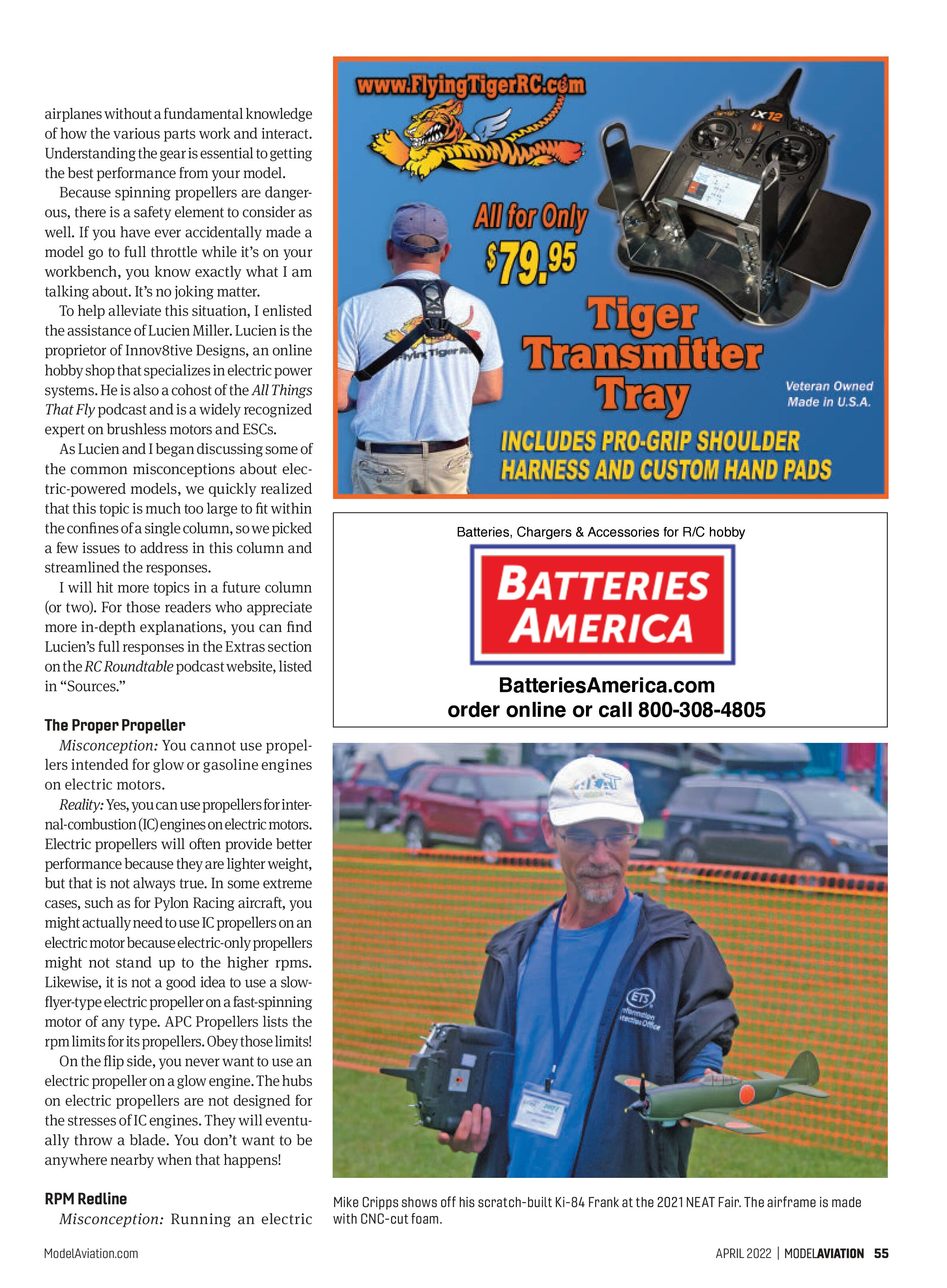
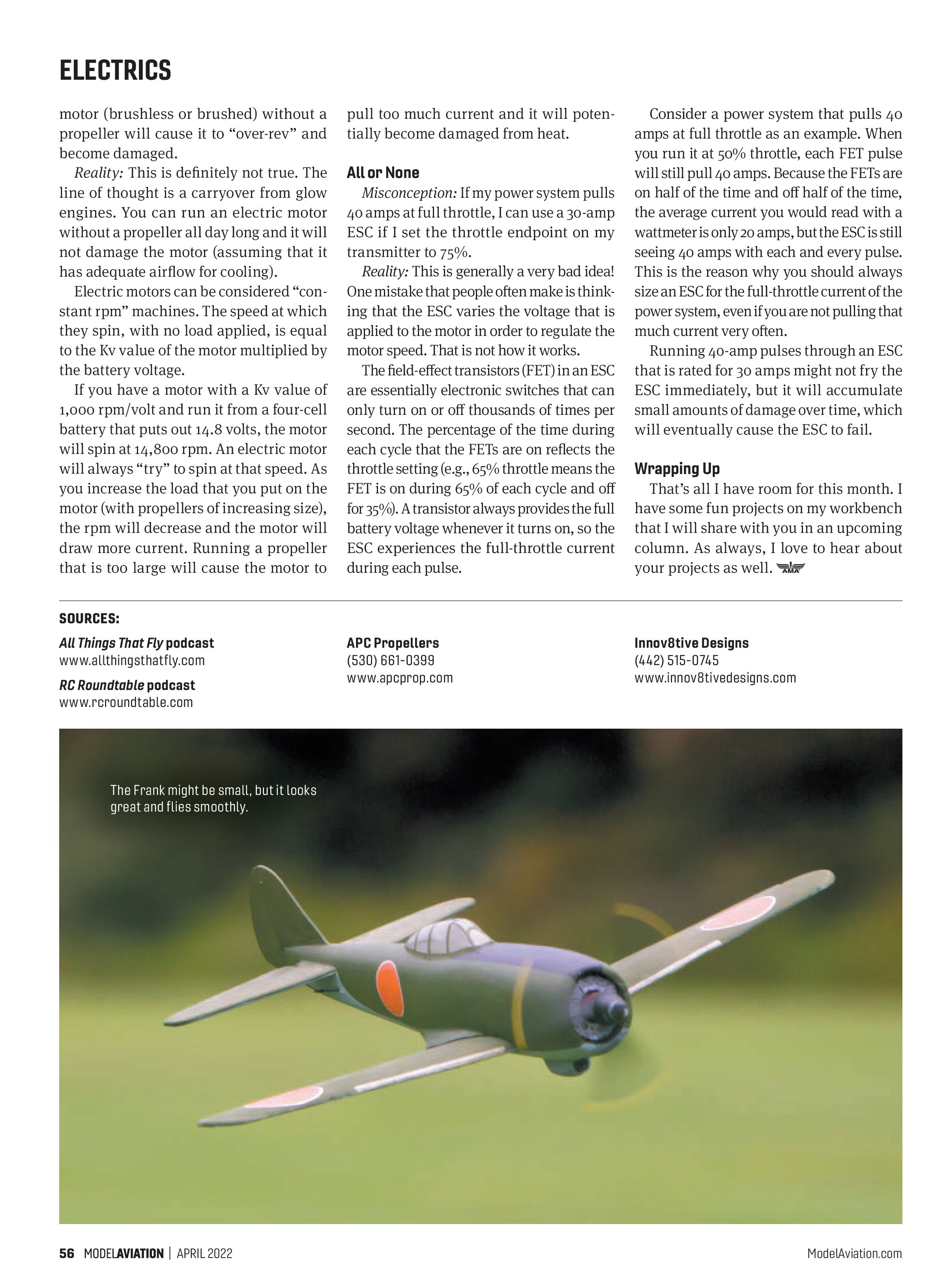
MOST OF MY COLUMN this month will be dedicated to correcting some common misconceptions about the power systems that are used in our electric-powered airplanes. Before tackling that subject, I want to share an impressive micro model that I spotted at the 2021 Northeast Electric Aircraft Technology (NEAT) Fair in Downsville, New York. This scale rendition of the Nakajima Ki-84 Frank was built and flown by Mike Cripps.
With a 16-inch wingspan, the Frank falls into the popular UMX class of airplanes; however, this is no store-bought model. Mike designed and built it himself. The airframe components are made from blue insulation foam that was precisely shaped with a CNC hot-wire cutter. Mike even created a plug and vacuum-formed a plastic canopy for his micro World War II fighter.
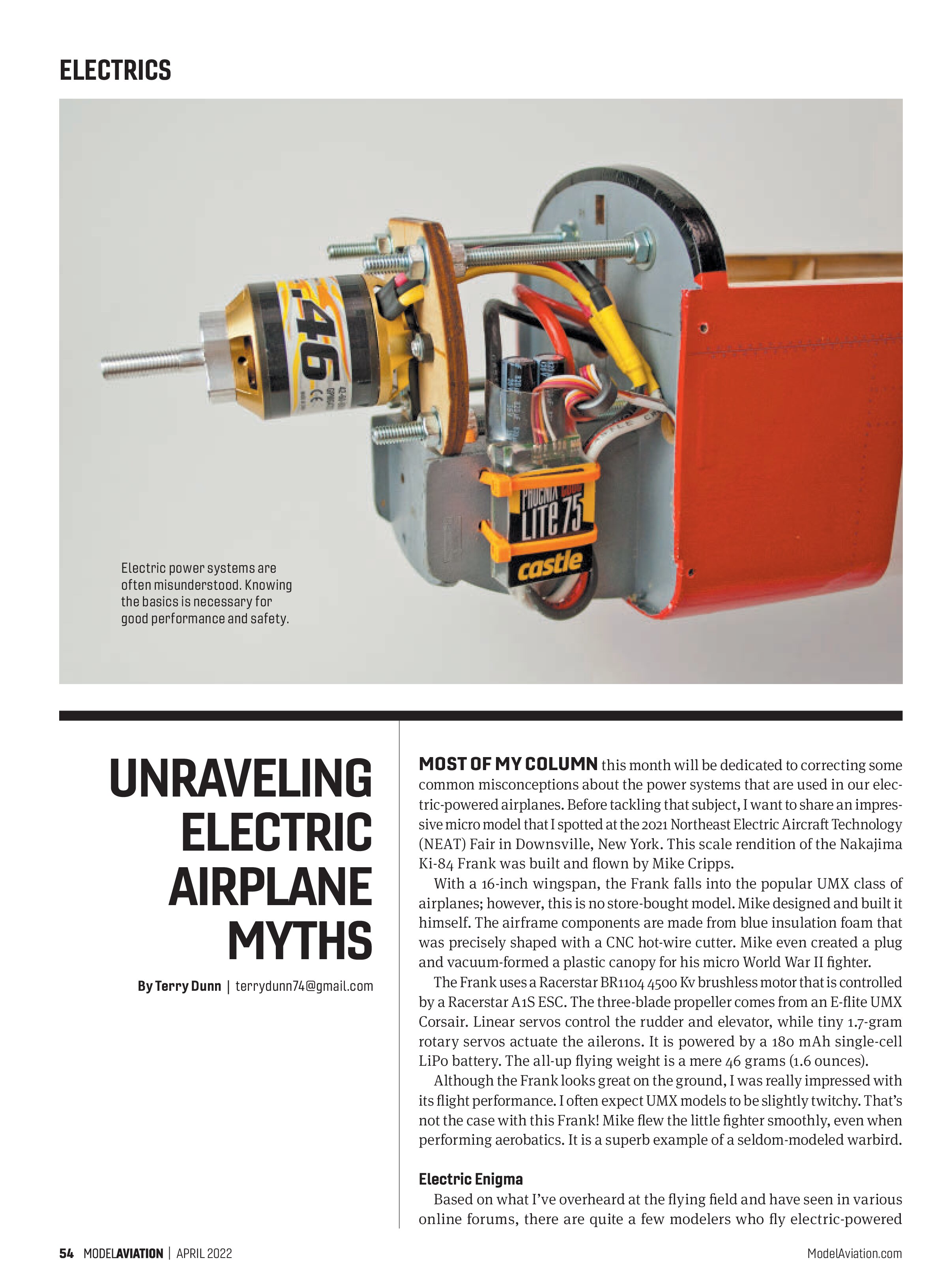
The Frank uses a Racerstar BR1104 4500 Kv brushless motor that is controlled by a Racerstar A1S ESC. The three-blade propeller comes from an E-flite UMX Corsair. Linear servos control the rudder and elevator, while tiny 1.7-gram rotary servos actuate the ailerons. It is powered by a 180 mAh single-cell LiPo battery. The all-up flying weight is a mere 46 grams (1.6 ounces).
Although the Frank looks great on the ground, I was really impressed with its flight performance. I often expect UMX models to be slightly twitchy. That’s not the case with this Frank! Mike flew the little fighter smoothly, even when performing aerobatics. It is a superb example of a seldom-modeled warbird.
Electric Enigma
Based on what I’ve overheard at the flying field and have seen in various online forums, there are quite a few modelers who fly electric-powered airplanes without a fundamental knowledge of how the various parts work and interact. Understanding the gear is essential to getting the best performance from your model.
Because spinning propellers are dangerous, there is a safety element to consider as well. If you have ever accidentally made a model go to full throttle while it’s on your workbench, you know exactly what I am talking about. It’s no joking matter.
To help alleviate this situation, I enlisted the assistance of Lucien Miller. Lucien is the proprietor of Innov8tive Designs, an online hobby shop that specializes in electric power systems. He is also a cohost of the All Things That Fly podcast and is a widely recognized expert on brushless motors and ESCs.
As Lucien and I began discussing some of the common misconceptions about electric-powered models, we quickly realized that this topic is much too large to fit within the confines of a single column, so we picked a few issues to address in this column and streamlined the responses.
I will hit more topics in a future column (or two). For those readers who appreciate more in-depth explanations, you can find Lucien’s full responses in the Extras section on the RC Roundtable podcast website, listed in “Sources.”
The Proper Propeller
Misconception: You cannot use propellers intended for glow or gasoline engines on electric motors.
Reality: Yes, you can use propellers for internal-combustion (IC) engines on electric motors. Electric propellers will often provide better performance because they are lighter weight, but that is not always true. In some extreme cases, such as for Pylon Racing aircraft, you might actually need to use IC propellers on an electric motor because electric-only propellers might not stand up to the higher rpms. Likewise, it is not a good idea to use a slow-flyer-type electric propeller on a fast-spinning motor of any type. APC Propellers lists the rpm limits for its propellers. Obey those limits!
On the flip side, you never want to use an electric propeller on a glow engine. The hubs on electric propellers are not designed for the stresses of IC engines. They will eventually throw a blade. You don’t want to be anywhere nearby when that happens!
RPM Redline
Misconception: Running an electric
airplanes without a fundamental knowledge of how the various parts work and interact. Understanding the gear is essential to getting the best performance from your model.
Because spinning propellers are dangerous, there is a safety element to consider as well. If you have ever accidentally made a model go to full throttle while it’s on your workbench, you know exactly what I am talking about. It’s no joking matter.
To help alleviate this situation, I enlisted the assistance of Lucien Miller. Lucien is the proprietor of Innov8tive Designs, an online hobby shop that specializes in electric power systems. He is also a cohost of the All Things That Fly podcast and is a widely recognized expert on brushless motors and ESCs.
As Lucien and I began discussing some of the common misconceptions about electric-powered models, we quickly realized that this topic is much too large to fit within the confines of a single column, so we picked a few issues to address in this column and streamlined the responses.
I will hit more topics in a future column (or two). For those readers who appreciate more in-depth explanations, you can find Lucien’s full responses in the Extras section on the RC Roundtable podcast website, listed in “Sources.”
The Proper Propeller
Misconception: You cannot use propellers intended for glow or gasoline engines on electric motors.
Reality: Yes, you can use propellers for internal-combustion (IC) engines on electric motors. Electric propellers will often provide better performance because they are lighter weight, but that is not always true. In some extreme cases, such as for Pylon Racing aircraft, you might actually need to use IC propellers on an electric motor because electric-only propellers might not stand up to the higher rpms. Likewise, it is not a good idea to use a slow-flyer-type electric propeller on a fast-spinning motor of any type. APC Propellers lists the rpm limits for its propellers. Obey those limits!
On the flip side, you never want to use an electric propeller on a glow engine. The hubs on electric propellers are not designed for the stresses of IC engines. They will eventually throw a blade. You don’t want to be anywhere nearby when that happens!
RPM Redline
Misconception: Running an electric

motor (brushless or brushed) without a propeller will cause it to “over-rev” and become damaged.
Reality: This is definitely not true. The line of thought is a carryover from glow engines. You can run an electric motor without a propeller all day long and it will not damage the motor (assuming that it has adequate airflow for cooling).
Electric motors can be considered “constant rpm” machines. The speed at which they spin, with no load applied, is equal to the Kv value of the motor multiplied by the battery voltage.
If you have a motor with a Kv value of 1,000 rpm/volt and run it from a four-cell battery that puts out 14.8 volts, the motor will spin at 14,800 rpm. An electric motor will always “try” to spin at that speed. As you increase the load that you put on the motor (with propellers of increasing size), the rpm will decrease and the motor will draw more current. Running a propeller that is too large will cause the motor to pull too much current and it will potentially become damaged from heat.
All or None
Misconception: If my power system pulls 40 amps at full throttle, I can use a 30-amp ESC if I set the throttle endpoint on my transmitter to 75%.
Reality: This is generally a very bad idea! One mistake that people often make is thinking that the ESC varies the voltage that is applied to the motor in order to regulate the motor speed. That is not how it works.
The field-effect transistors (FET) in an ESC are essentially electronic switches that can only turn on or off thousands of times per second. The percentage of the time during each cycle that the FETs are on reflects the throttle setting (e.g., 65% throttle means the FET is on during 65% of each cycle and off for 35%). A transistor always provides the full battery voltage whenever it turns on, so the ESC experiences the full-throttle current during each pulse.
Consider a power system that pulls 40 amps at full throttle as an example. When you run it at 50% throttle, each FET pulse will still pull 40 amps. Because the FETs are on half of the time and off half of the time, the average current you would read with a wattmeter is only 20 amps, but the ESC is still seeing 40 amps with each and every pulse. This is the reason why you should always size an ESC for the full-throttle current of the power system, even if you are not pulling that much current very often.
Running 40-amp pulses through an ESC that is rated for 30 amps might not fry the ESC immediately, but it will accumulate small amounts of damage over time, which will eventually cause the ESC to fail.
Wrapping Up
That’s all I have room for this month. I have some fun projects on my workbench that I will share with you in an upcoming column. As always, I love to hear about your projects as well.
SOURCES:
All Things That Fly podcast
www.allthingsthatfly.com
RC Roundtable podcast
www.rcroundtable.com
APC Propellers
(530) 661-0399
www.apcprop.com
Innov8tive Designs
(442) 515-0745
www.innov8tivedesigns.com