UNRAVELING
ELECTRIC
AIRPLANE
MYTHS
By Terry Dunn | terrydunn74@gmail.com

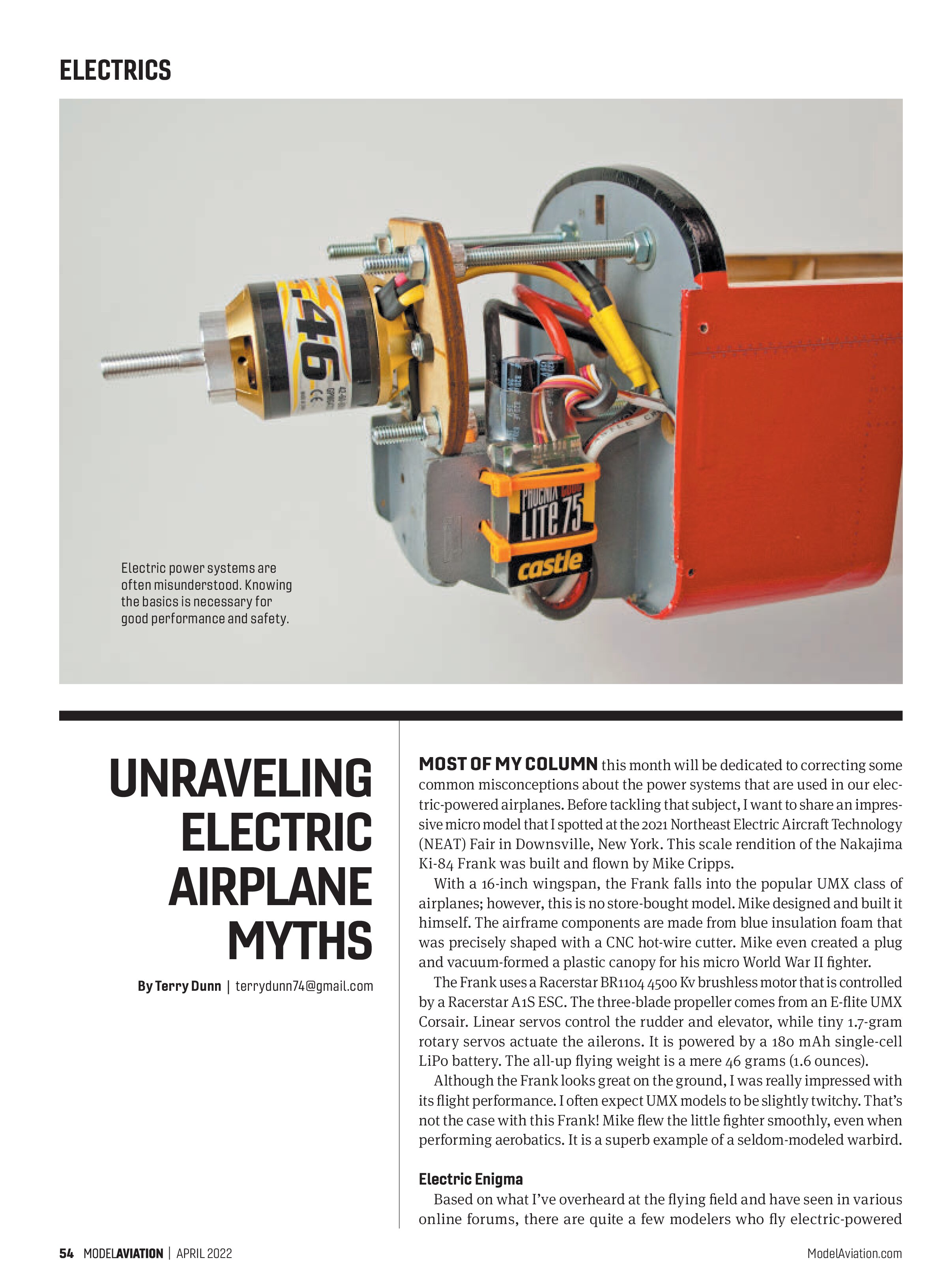
MOST OF MY COLUMN this month will be dedicated to correcting some common misconceptions about the power systems that are used in our electric-powered airplanes. Before tackling that subject, I want to share an impressive micro model that I spotted at the 2021 Northeast Electric Aircraft Technology (NEAT) Fair in Downsville, New York. This scale rendition of the Nakajima Ki-84 Frank was built and flown by Mike Cripps.
With a 16-inch wingspan, the Frank falls into the popular UMX class of airplanes; however, this is no store-bought model. Mike designed and built it himself. The airframe components are made from blue insulation foam that was precisely shaped with a CNC hot-wire cutter. Mike even created a plug and vacuum-formed a plastic canopy for his micro World War II fighter.
The Frank uses a Racerstar BR1104 4500 Kv brushless motor that is controlled by a Racerstar A1S ESC. The three-blade propeller comes from an E-flite UMX Corsair. Linear servos control the rudder and elevator, while tiny 1.7-gram rotary servos actuate the ailerons. It is powered by a 180 mAh single-cell LiPo battery. The all-up flying weight is a mere 46 grams (1.6 ounces).
Although the Frank looks great on the ground, I was really impressed with its flight performance. I often expect UMX models to be slightly twitchy. That’s not the case with this Frank! Mike flew the little fighter smoothly, even when performing aerobatics. It is a superb example of a seldom-modeled warbird.
Electric Enigma
Based on what I’ve overheard at the flying field and have seen in various online forums, there are quite a few modelers who fly electric-powered