THE DEAL WITH DRONES
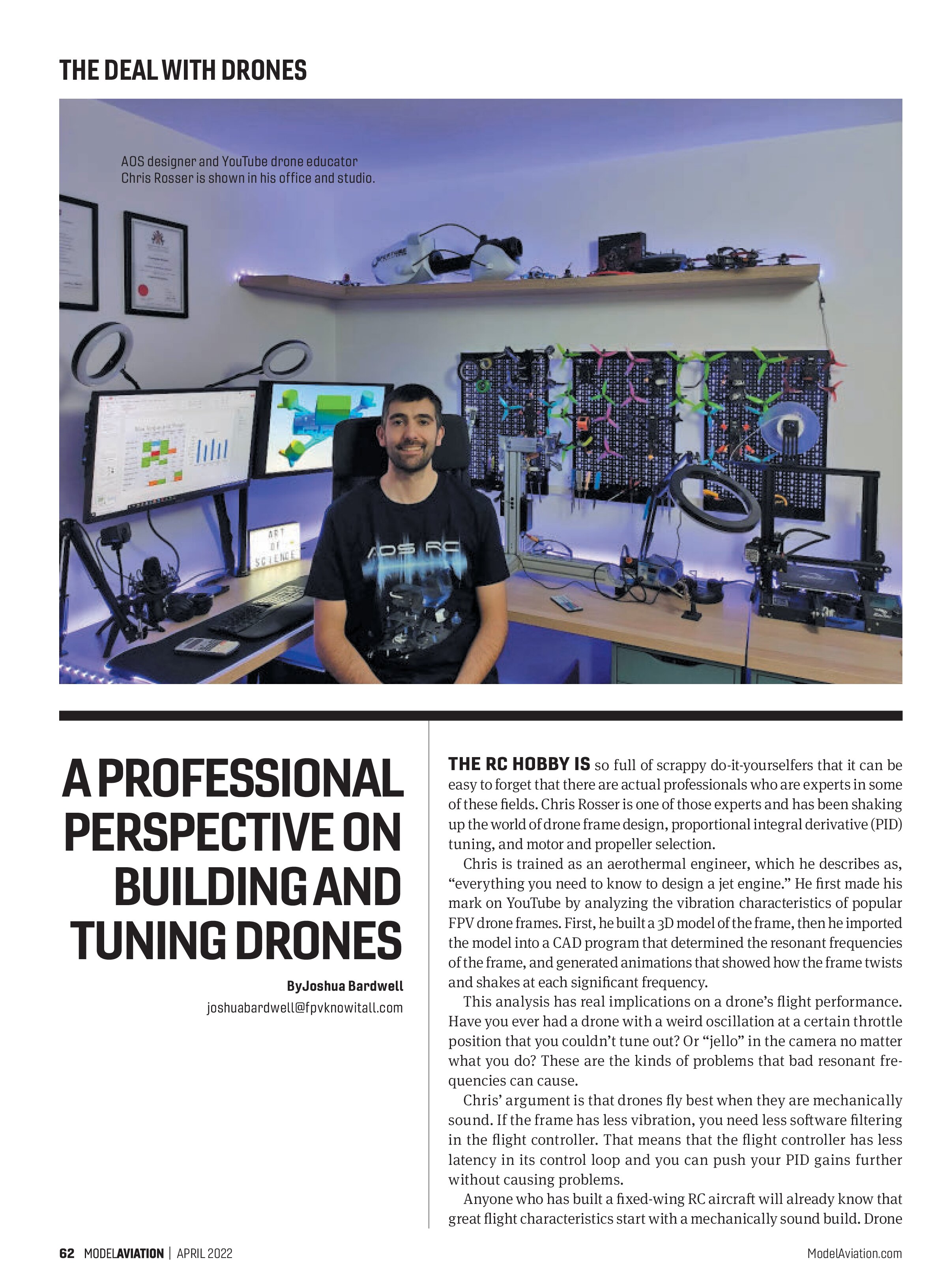
AOS designer and YouTube drone educator Chris Rosser is shown in his office and studio.
A PROFESSIONAL PERSPECTIVE ON BUILDING AND TUNING DRONES
By Joshua Bardwell
joshuabardwell@fpvknowitall.com
THE RC HOBBY IS so full of scrappy do-it-yourselfers that it can be easy to forget that there are actual professionals who are experts in some of these fields. Chris Rosser is one of those experts and has been shaking up the world of drone frame design, proportional integral derivative (PID) tuning, and motor and propeller selection.
Chris is trained as an aerothermal engineer, which he describes as, “everything you need to know to design a jet engine.” He first made his mark on YouTube by analyzing the vibration characteristics of popular FPV drone frames. First, he built a 3D model of the frame, then he imported the model into a CAD program that determined the resonant frequencies of the frame, and generated animations that showed how the frame twists and shakes at each significant frequency.
This analysis has real implications on a drone’s flight performance. Have you ever had a drone with a weird oscillation at a certain throttle position that you couldn’t tune out? Or “jello” in the camera no matter what you do? These are the kinds of problems that bad resonant frequencies can cause.
Chris’ argument is that drones fly best when they are mechanically sound. If the frame has less vibration, you need less software filtering in the flight controller. That means that the flight controller has less latency in its control loop and you can push your PID gains further without causing problems.
Anyone who has built a fixed-wing RC aircraft will already know that great flight characteristics start with a mechanically sound build. Drone

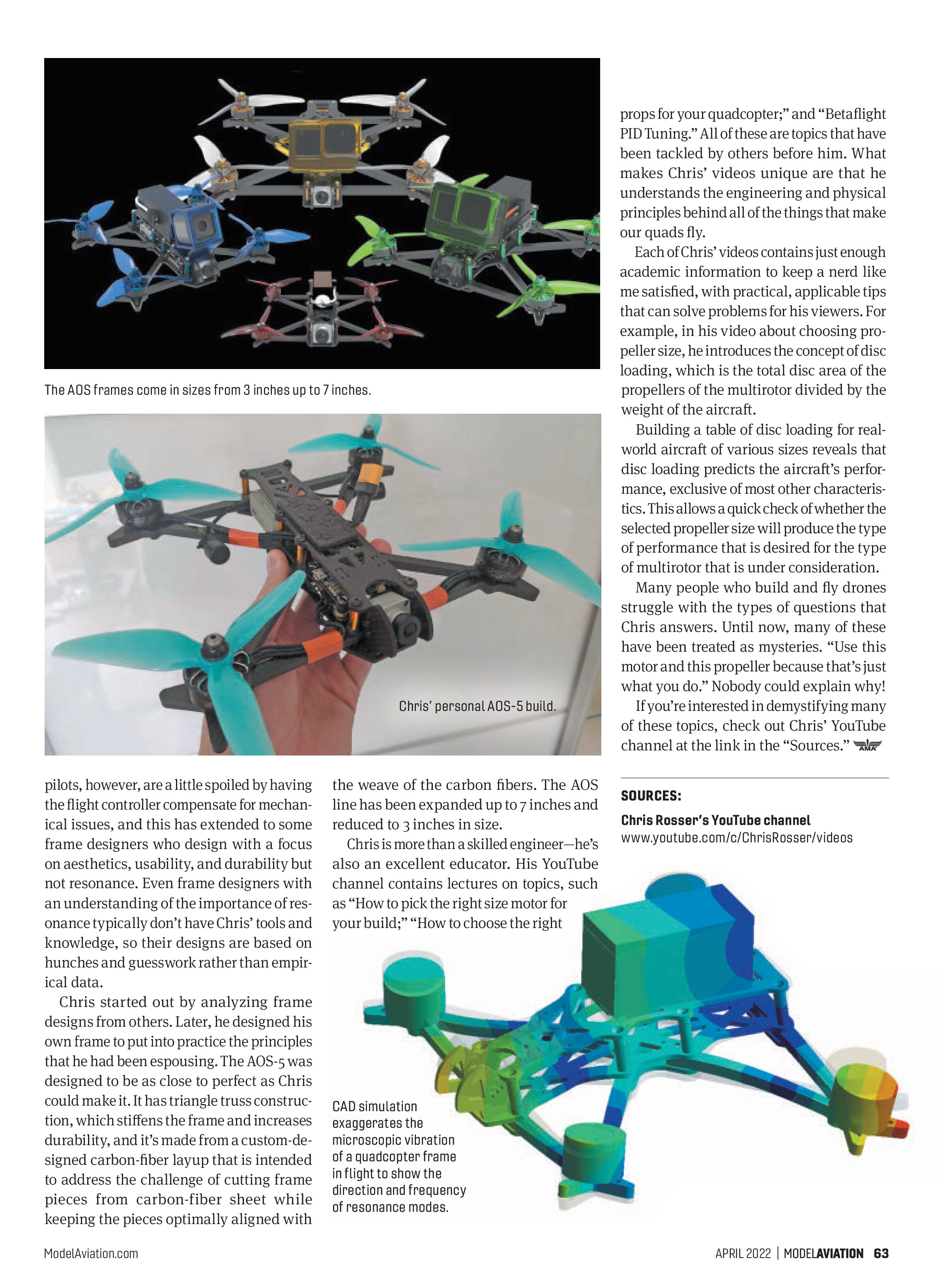
The AOS frames come in sizes from 3 inches up to 7 inches.

Chris’ personal AOS-5 build.
pilots, however, are a little spoiled by having the flight controller compensate for mechanical issues, and this has extended to some frame designers who design with a focus on aesthetics, usability, and durability but not resonance. Even frame designers with an understanding of the importance of resonance typically don’t have Chris’ tools and knowledge, so their designs are based on hunches and guesswork rather than empirical data.
Chris started out by analyzing frame designs from others. Later, he designed his own frame to put into practice the principles that he had been espousing. The AOS-5 was designed to be as close to perfect as Chris could make it. It has triangle truss construction, which stiffens the frame and increases durability, and it’s made from a custom-designed carbon-fiber layup that is intended to address the challenge of cutting frame pieces from carbon-fiber sheet while keeping the pieces optimally aligned with the weave of the carbon fibers. The AOS line has been expanded up to 7 inches and reduced to 3 inches in size.

CAD simulation exaggerates the microscopic vibration of a quadcopter frame in flight to show the direction and frequency of resonance modes.
Chris is more than a skilled engineer—he’s also an excellent educator. His YouTube channel contains lectures on topics, such as “How to pick the right size motor for your build;” “How to choose the right props for your quadcopter;” and “Betaflight PID Tuning.” All of these are topics that have been tackled by others before him. What makes Chris’ videos unique are that he understands the engineering and physical principles behind all of the things that make our quads fly.
Each of Chris’ videos contains just enough academic information to keep a nerd like me satisfied, with practical, applicable tips that can solve problems for his viewers. For example, in his video about choosing propeller size, he introduces the concept of disc loading, which is the total disc area of the propellers of the multirotor divided by the weight of the aircraft.
Building a table of disc loading for real-world aircraft of various sizes reveals that disc loading predicts the aircraft’s performance, exclusive of most other characteristics. This allows a quick check of whether the selected propeller size will produce the type of performance that is desired for the type of multirotor that is under consideration.
Many people who build and fly drones struggle with the types of questions that Chris answers. Until now, many of these have been treated as mysteries. “Use this motor and this propeller because that’s just what you do.” Nobody could explain why!
If you’re interested in demystifying many of these topics, check out Chris’ YouTube channel at the link in the “Sources.”
SOURCES:
Chris Rosser’s YouTube channel
www.youtube.com/c/ChrisRosser/videos