VINTAGE VIEWPOINT

DECEMBER
1971 MAGAZINE
CONTENT
By Bob Noll | bobrc@aol.com
ONCE AGAIN, I WILL take a look back at what the magazines were publishing 50 years ago. This meant going into my file cabinets and searching for the December 1971 issues of Radio Control Modeler (RCM), Flying Models (FM), American Aircraft Modeler (AAM), and Model Airplane News (MAN).
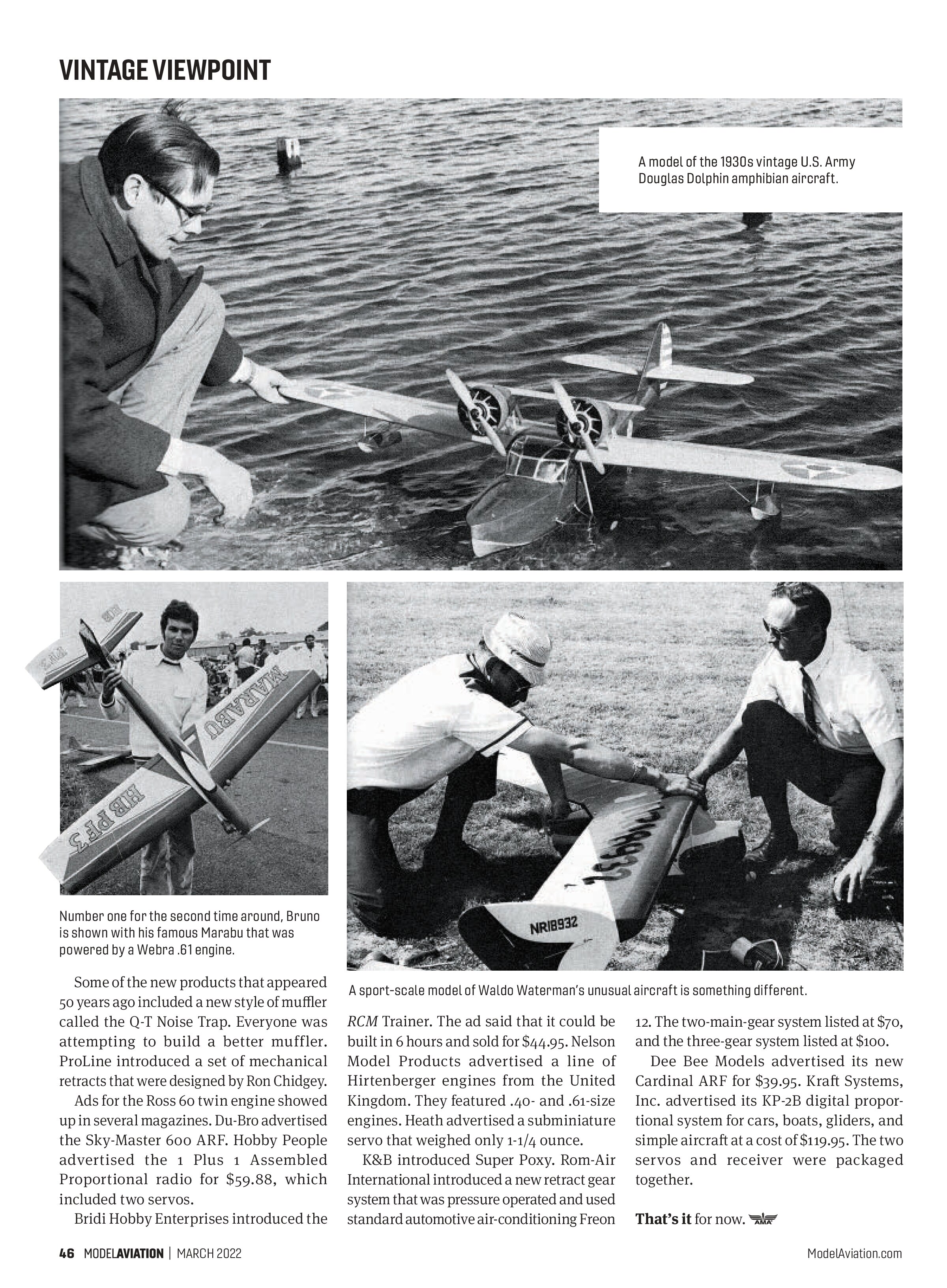
RCM had a great construction article about Eric Fearnley’s Douglas Dolphin. Eric chose this airplane for several reasons. Foremost was that it was an amphibian twin. It was flown by the U.S. Army in the early 1930s, by the U.S. Navy shortly thereafter, and even by the U.S. Coast Guard, so there was a large selection of paint jobs.
The positions of the two O.S. .19 engines were very close to each other so that single-engine performance would not lead to a disaster.
The Waterman Arrowbile, by Earl Witte, was a sport-scale model of Waldo Waterman’s unusual aircraft that certainly stopped the action at any field. It was powered by a Merco .60 engine.
RCM had a great article about the League of Silent Flight Soaring Tournament that was held at Ted Nelson’s Hummingbird Haven Gliderport near Livermore, California. This event attracted 103 contestants and 200 sailplanes—most pilots brought along a spare.
The front piece in RCM had a great photo of the Beagle Pup, an all-metal beauty powered by a Ross engine. It was twin-fitted with RCS digital equipment from the United Kingdom.
All of the magazines had articles about the 1971 RC World Championships that included RC Aerobatics (Pattern), Pylon Racing, and Scale. After many years, two years of proposals and counterproposals, and months of planning, AMA finally brought an RC World Championships to this side of the Atlantic. It was held in Doylestown, Pennsylvania. Bruno Giezendanner, of Switzerland, was a repeat Pattern winner with his famous Marabu. The USA team of Phil Kraft, Jim Whitley, and Ron Chidgey took home the first-place team trophy.
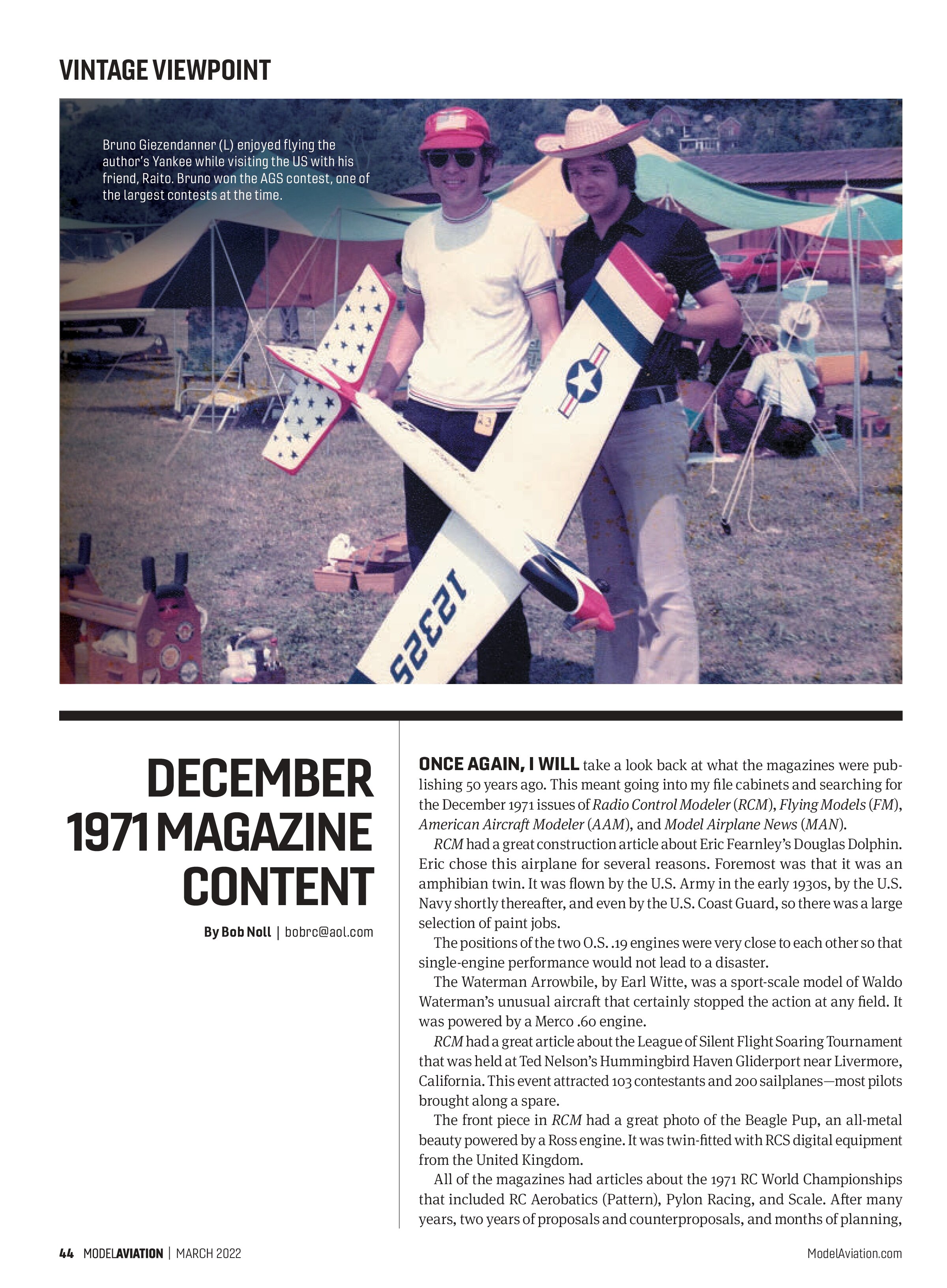
At this time, I will digress to tell you about the time Bruno came to the Aeroguidance Society’s (AGS) contest in Endicott, New York. Bruno, his wife, and his friend, Raito, and his wife, were visiting the states and wanted to attend an RC contest. They learned about the AGS contest from Dick Penrod, with whom they were staying. Bruno wanted to borrow an airplane to fly. I immediately jumped at the chance to have a world champion fly my Yankee.
Bruno and I both flew Mode 1. Bruno wanted longer sticks than the normal ProLine sticks, so Ed Keck, who managed a machine shop in Rochester, New York, made a pair of sticks to Bruno’s specifications. ProLine open-gimbal sticks were easily replaced by simply unscrewing them.
As the contest director for the contest, I allowed Bruno one practice flight with my Yankee before the competition began. He felt comfortable with the way I had set up the controls, and after a few loops and rolling maneuvers, he was ready to compete. Yes, he won first place and said he loved the way the Yankee flew. This was the best endorsement of my design that I could have asked for.
AAM had an article about the Canus, an international airplane for FAI Pattern flying, by Roy Foote. The name Canus is international and is a contraction of Canada and United States.
How Cheap Can It Get, by Ed Sweeney, was a foam, hand-launched glider manufactured as a toy for approximately $3.95. Ed fitted it with a small RC system that cost less than $70.
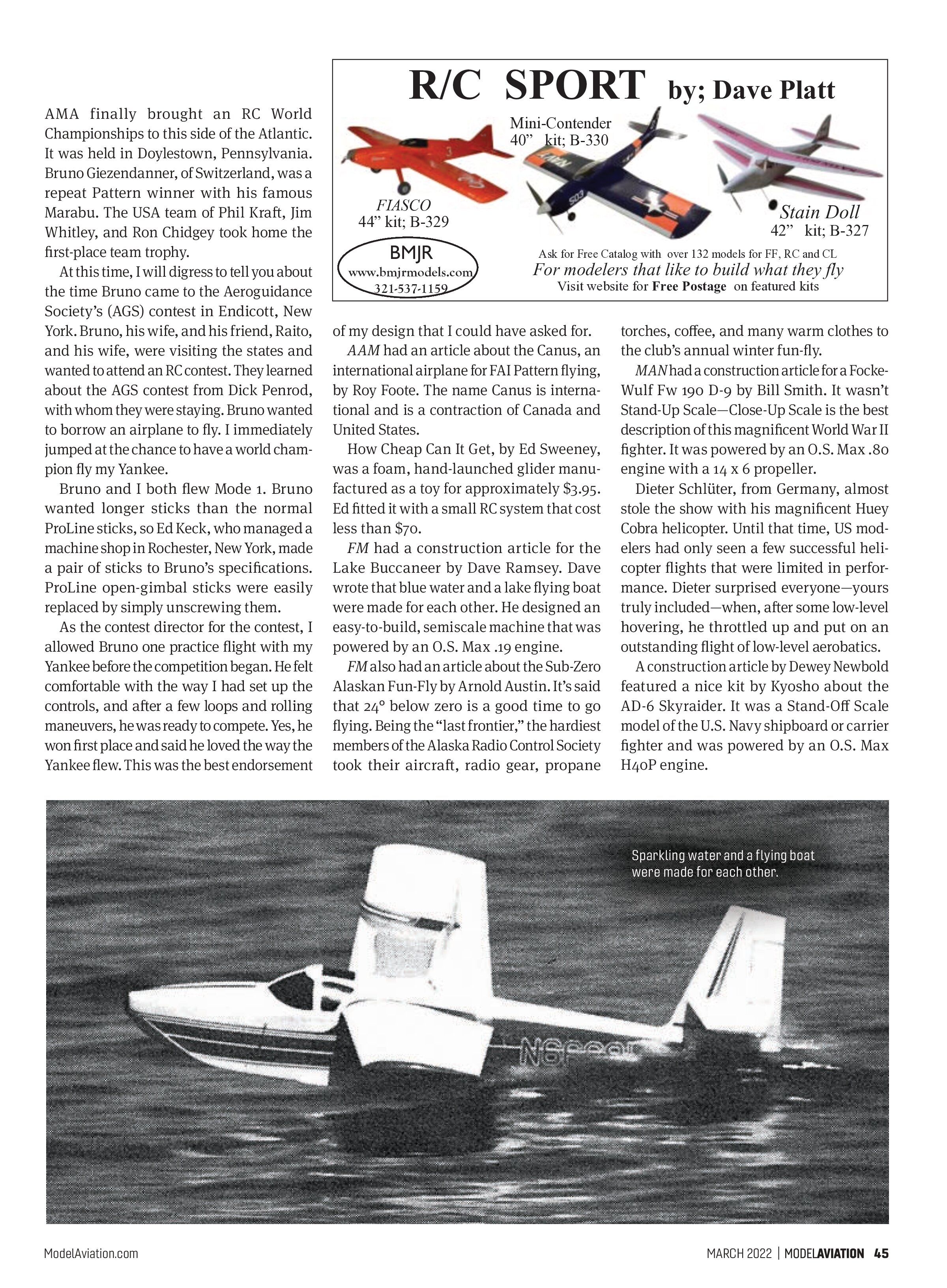
FM had a construction article for the Lake Buccaneer by Dave Ramsey. Dave wrote that blue water and a lake flying boat were made for each other. He designed an easy-to-build, semiscale machine that was powered by an O.S. Max .19 engine.
FM also had an article about the Sub-Zero Alaskan Fun-Fly by Arnold Austin. It’s said that 24° below zero is a good time to go flying. Being the “last frontier,” the hardiest members of the Alaska Radio Control Society took their aircraft, radio gear, propane torches, coffee, and many warm clothes to the club’s annual winter fun-fly.
MAN had a construction article for a Focke-Wulf Fw 190 D-9 by Bill Smith. It wasn’t Stand-Up Scale—Close-Up Scale is the best description of this magnificent World War II fighter. It was powered by an O.S. Max .80 engine with a 14 x 6 propeller.
Dieter Schlüter, from Germany, almost stole the show with his magnificent Huey Cobra helicopter. Until that time, US modelers had only seen a few successful helicopter flights that were limited in performance. Dieter surprised everyone—yours truly included—when, after some low-level hovering, he throttled up and put on an outstanding flight of low-level aerobatics.
A construction article by Dewey Newbold featured a nice kit by Kyosho about the AD-6 Skyraider. It was a Stand-Off Scale model of the U.S. Navy shipboard or carrier fighter and was powered by an O.S. Max H&40P engine.


Some of the new products that appeared 50 years ago included a new style of muffler called the O-T Noise Trap. Everyone was attempting to build a better muffler. ProLine introduced a set of mechanical retracts that were designed by Ron Chidgey.
Ads for the Ross 60 twin engine showed up in several magazines. Du-Bro advertised the Sky-Master 600 ARF. Hobby People advertised the 1 Plus 1 Assembled Proportional radio for $59.88, which included two servos.
Bridi Hobby Enterprises introduced the RCM Trainer. The ad said that it could be built in 6 hours and sold for $44.95. Nelson Model Products advertised a line of Hirtenberger engines from the United Kingdom. They featured .40- and .61-size engines. Heath advertised a subminiature servo that weighed only 1-1/4 ounce.
K&B introduced Super Poxy. Rom-Air International introduced a new retract gear system that was pressure operated and used standard automotive air-conditioning Freon 12. The two-main-gear system listed at $70, and the three-gear system listed at $100.
Dee Bee Models advertised its new Cardinal ARF for $39.95. Kraft Systems, Inc. advertised its KP-2B digital proportional system for cars, boats, gliders, and simple aircraft at a cost of $119.95. The two servos and receiver were packaged together.
That’s it for now.