SAFETY COMES FIRST
EXPECT TROUBLE!
By Dave Gee | safetycolumn@cs.com

I LOVE AVIATION BOOKS about the olden days, especially memoirs of early pilots. Their stories about learning to fly often have a common thread, where the instructor stresses how important it is to constantly scan for a landing area in case the engine quits. Those old engines were unreliable, and without an emergency field, a student could end up in a tree!
These days, it’s hard to imagine not being able to depend on the controls and powerplant of your model flying machine. Even after 120 years of aviation, it is still wise to plan ahead for unexpected problems. We are spoiled by the extreme reliability of modern RC modeling equipment. It is easy to become complacent and never give a thought about what could happen if there was a glitch.
Well, there are glitches, and we do need to be prepared for in-flight emergencies, even if it’s only our models and not ourselves that end up in a tree. This applies to simple models, as well as fancy, electronic ones.
Here’s a semirelevant example. I recently prepared some small, prefabricated gliders for a model-building program at a retirement home. The residents would finish assembling the airplanes and test-fly them in the activity room. Identical Star gliders were used, a proven design made from die-cut balsa. I even built a tabletop catapult device so that the new pilots could get reliable launches and pleasing flights. Easy, right?
It wasn’t easy. The catapult gave uniform launches to each glider, but the airplanes decided to do something different every time and it was never the same trick twice. They would dive to the floor after one launch and would pull up and hit the ceiling the next time. Once in a while, the gliders would sail across the room as intended, but the flight paths were completely unpredictable.
I’m accustomed to models flying the way they are supposed to with reliable power and control systems, so this session deflated my ego. Luckily, the senior citizens loved the wild unpredictability of the tiny gliders. Instead of doing their own launches, they preferred to sit across the room (right in the flight path) and cheer each airplane on. I think they were placing bets at one point.
It reminded me to be aware of the possibilities of unexpected troubles with models. Plan ahead as you fly. Ask yourself what you’d do if the motor quit partway through a turn. Can you keep the aircraft clear of spectators and land safely if your controls became unreliable? Is there a safer way to perform the maneuver, perhaps keeping the nose pointed away from the pits?
After a while, this planning will become second nature. When something actually does go wrong, you’ll be better prepared to make sure that the situation becomes a close call rather than an incident.
Cut the Power, Not the Hand
Aram Schlosberg emailed me about an unpleasant episode with his electric Free Flight (FF) model. He included a picture of the medical treatment, but it was too yucky to print.
The model in question has a 60-watt motor turning a 12-inch propeller. There is a start button on the fuselage that begins a timed motor run, with no remote control of the power system.
Aram’s trouble began with a basic wiring error at the ESC, which made the motor run backward. This mistake wasn’t discovered until the airplane was being launched, at which time, it failed to proceed forward because the propeller was turning backward. The airplane “bounced” right back toward Aram. When he tried to catch it, he was reminded that, unlike a gas engine, an electric motor keeps running even when it encounters an obstacle—an obstacle such as a hand. Even after gashing Aram’s palm, the motor didn’t stop until the power button was pressed again.
There is an existing technology for FF models called a remote derthermalizer (RDT) that will stop the motor and thermalize the model on command. Aram strongly recommends that an assistant be present to hold the RDT transmitter in an on position, ready to intervene if anything goes wrong during the launch.
I will add another suggestion, which is to perform a complete preflight inspection of the model and all of its systems before flight is attempted. Never skip this step! Many problems can be found and corrected if the airplane or helicopter


receives a thorough once-over in the pits. Our models are quite reliable, but you never know when something might go haywire.
Cement Mystery Airplane
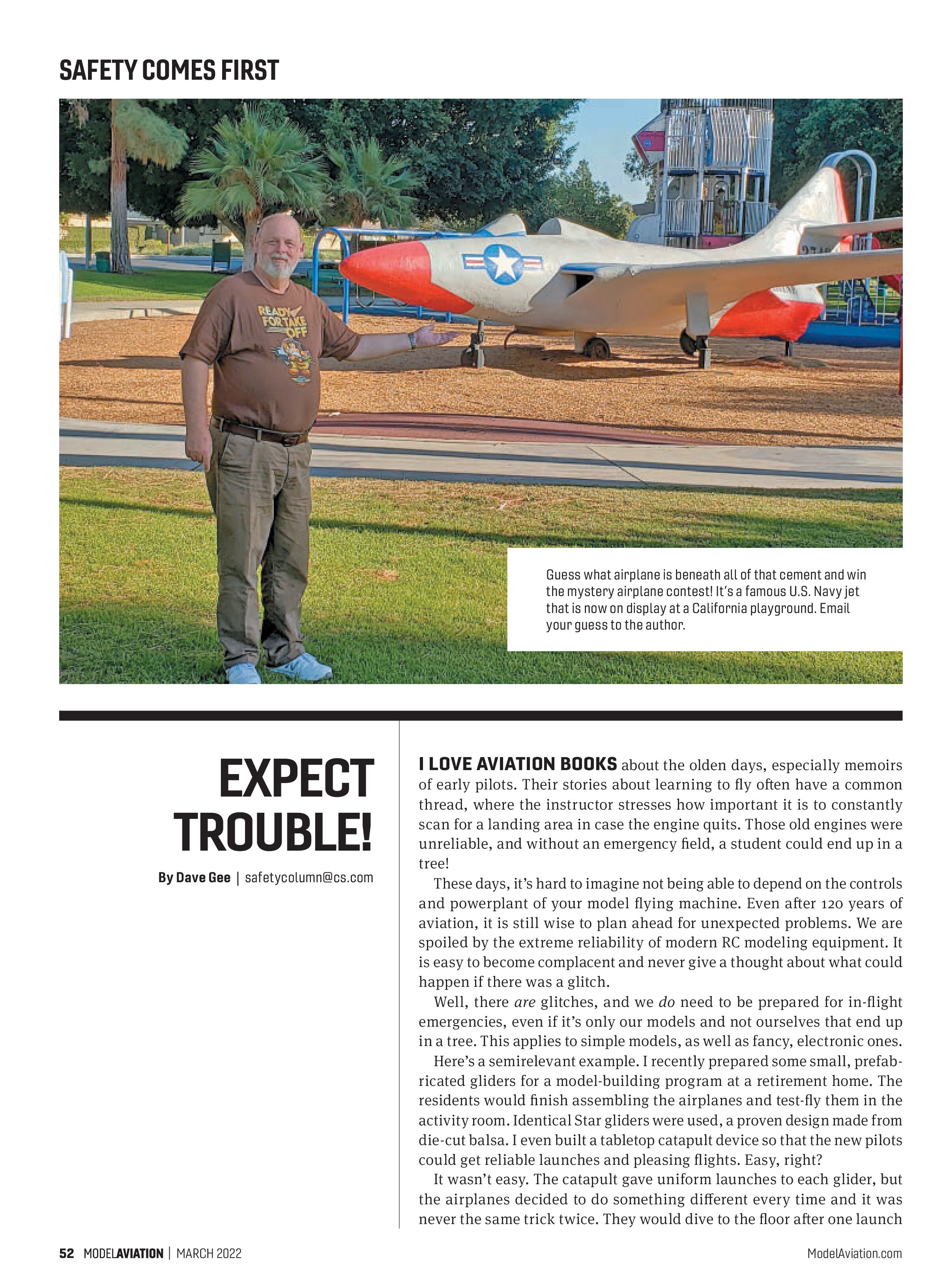
This month’s mystery airplane is a famous U.S. Navy carrier jet that really is covered in cement. It cuts down on corrosion but makes for a terrible glide ratio.
This Korean War-era aircraft was installed in a public park many years ago. As time passed, sharp, metal edges began to appear. To keep park visitors safe, the city coated the entire airframe in cement and repainted it. I’d call it a less-than-museum-quality restoration, but at least the jet is still there for kids to climb on and enjoy.
If you can tell what kind of airplane is under all of that masonry, email me at the address listed at the beginning of my column and win digital plans for the Spinner helicopter.
Ooh—Chopper Plans!
This month’s mystery airplane prize is a set of plans for the Spinner, a FF helicopter. This type of heli is the simplest powered flying machine around, but the flight potential is nothing to sneeze at. Orville and Wilbur Wright became interested in

Helicopter Postal Contest
The Secret Sky Squadron is sponsoring an international Postal Contest for single-rotor, rubber-powered FF helicopters, and the Spinner just happens to be eligible. Commercial FF rubber-powered heli kits are also allowed if you prefer something prefabricated.
The competition window is April 1-10, 2022. Awards will be given in Junior, Senior, and Open classes. There is no entry fee. Details are on the SkyBattle website that is listed in “Sources.”
SOURCES:
SkyBattle
skybattle2021@gmail.com
www.skybattle.org
Spinner model helicopter flight
https://youtu.be/SXEiM4fXTog
StukaDave flies gliders at Brookdale, Will Woods invitation
https://youtu.be/k1IXx9MYpaU