F5J IS IN THE DESERT—AND GROWING IN POPULARITY
By Gordon Buckland | gordon@gatorf3b.com

F5J IS LIKELY the fastest growing segment in US Thermal Duration Soaring, with many opportunities to participate across the country, including the USA F5J Tour events.
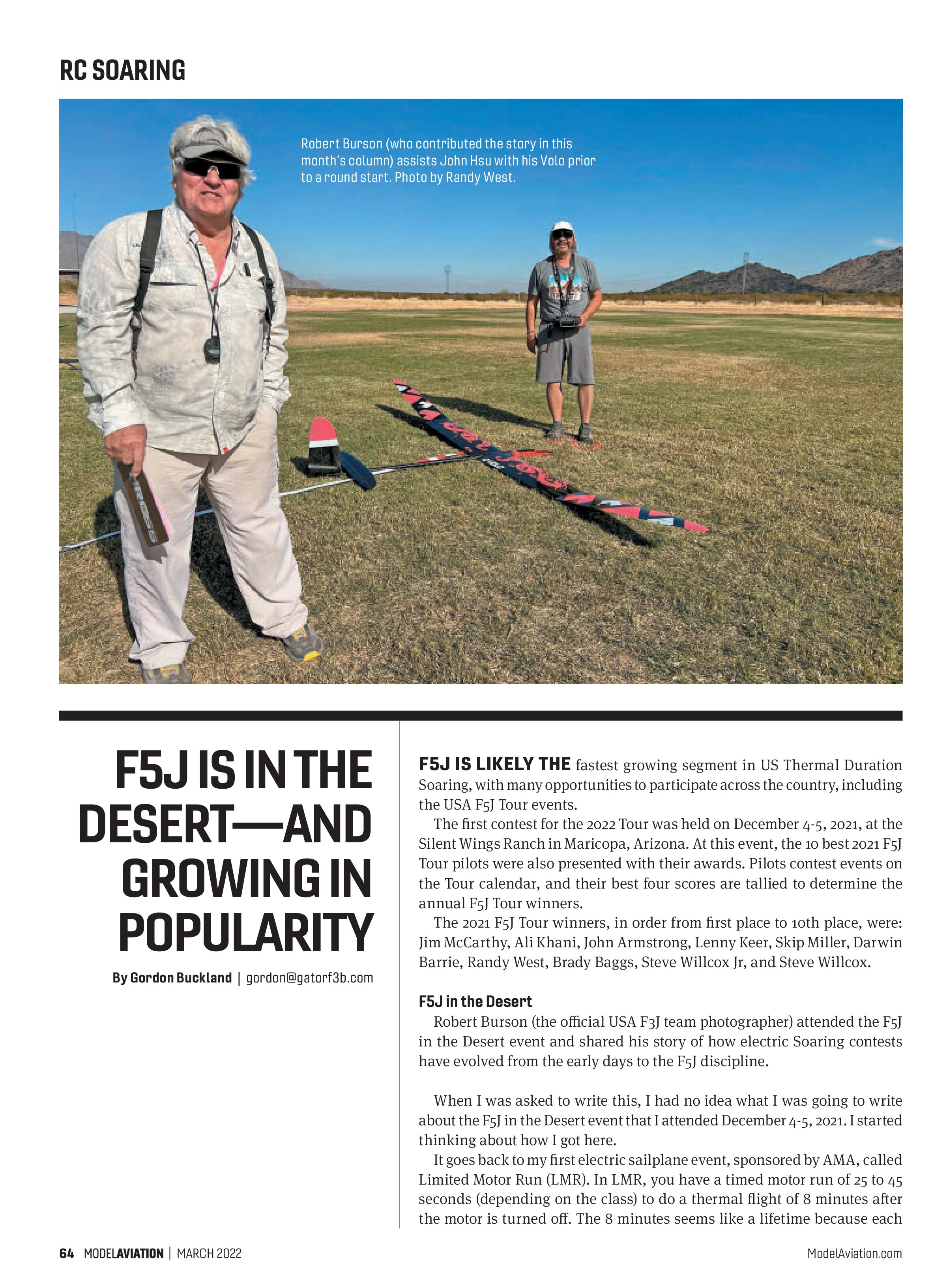
The first contest for the 2022 Tour was held on December 4-5, 2021, at the Silent Wings Ranch in Maricopa, Arizona. At this event, the 10 best 2021 F5J Tour pilots were also presented with their awards. Pilots contest events on the Tour calendar, and their best four scores are tallied to determine the annual F5J Tour winners.
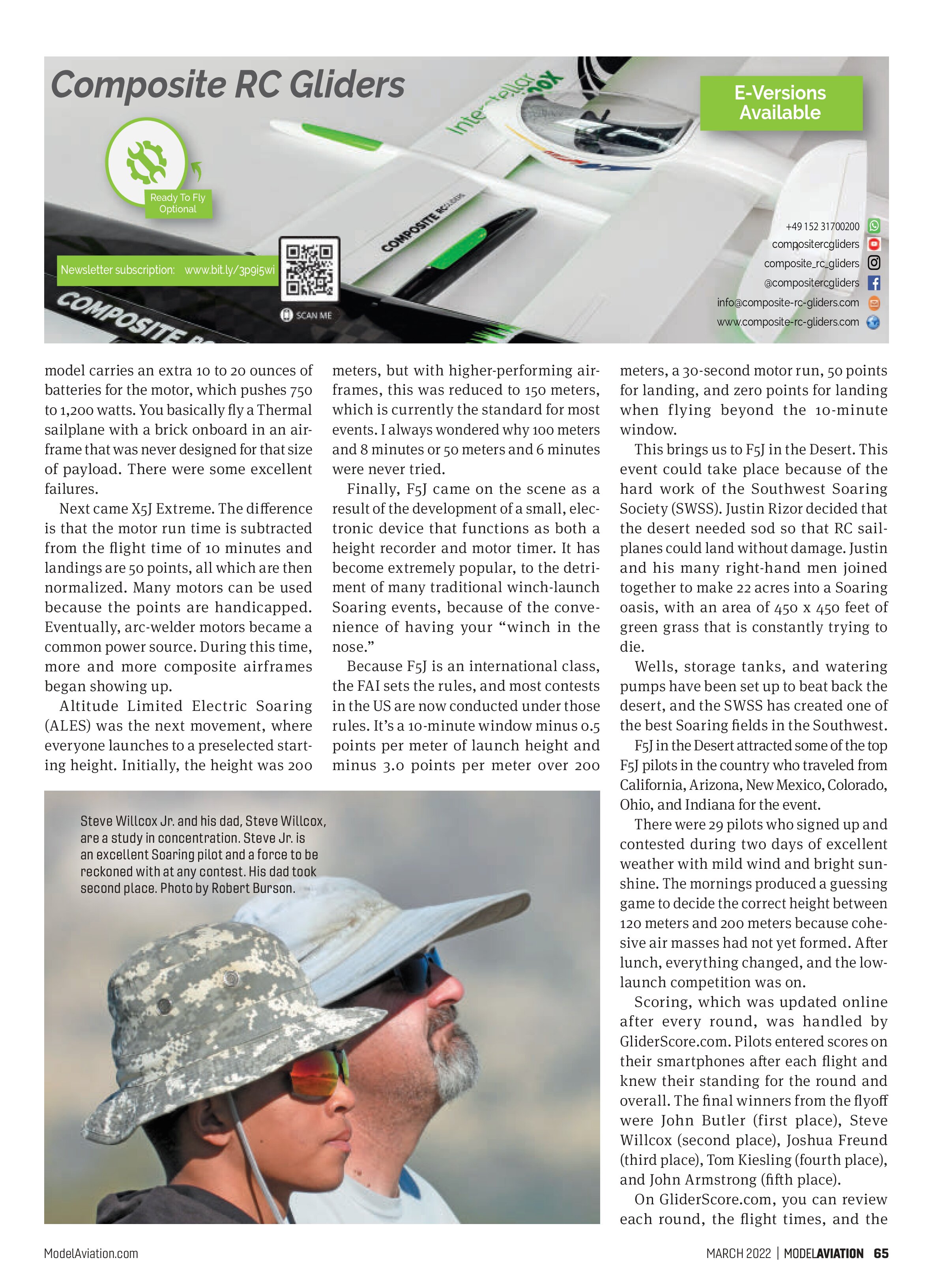
The 2021 F5J Tour winners, in order from first place to 10th place, were: Jim McCarthy, Ali Khani, John Armstrong, Lenny Keer, Skip Miller, Darwin Barrie, Randy West, Brady Baggs, Steve Willcox Jr, and Steve Willcox.
F5J in the Desert
Robert Burson (the official USA F3J team photographer) attended the F5J in the Desert event and shared his history of how electric Soaring contests have evolved from the early days to the F5J discipline.
When I was asked to write this, I had no idea what I was going to write about the F5J in the Desert event that I attended December 4-5, 2021. I started thinking about how I got here.
It goes back to my first electric sailplane event, sponsored by AMA, called Limited Motor Run (LMR). In LMR, you have a timed motor run of 25 to 45 seconds (depending on the class) to do a thermal flight of 8 minutes after the motor is turned off. The 8 minutes seems like a lifetime because each model carries an extra 10 to 20 ounces of batteries for the motor, which pushes 750 to 1,200 watts. You basically fly a Thermal sailplane with a brick onboard in an airframe that was never designed for that size of payload. There were some excellent failures.
Next came X5J Extreme. The difference is that the motor run time is subtracted from the flight time of 10 minutes and landings are 50 points, all which are then normalized. Many motors can be used because the points are handicapped. Eventually, arc-welder motors became a common power source. During this time, more and more composite airframes began showing up.
Altitude Limited Electric Soaring (ALES) was the next movement, where everyone launches to a preselected starting height. Initially, the height was 200 meters, but with higher-performing airframes, this was reduced to 150 meters, which is currently the standard for most events. I always wondered why 100 meters and 8 minutes or 50 meters and 6 minutes were never tried.
Finally, F5J came on the scene as a result of the development of a small, electronic device that functions as both a height recorder and motor timer. It has become extremely popular, to the detriment of many traditional winch-launch Soaring events, because of the convenience of having your “winch in the nose.”
Because F5J is an international class, the FAI sets the rules, and most contests in the US are now conducted under those rules. It’s a 10-minute window minus 0.5 points per meter of launch height and minus 3.0 points per meter over 200 meters, a 30-second motor run, 50 points for landing, and zero points for landing when flying beyond the 10-minute window.
This brings us to F5J in the Desert. This event could take place because of the hard work of the Southwest Soaring Society (SWSS). Justin Rizor decided that the desert needed sod so that RC sailplanes could land without damage. Justin and his many right-hand men joined together to make 22 acres into a Soaring oasis, with an area of 450 x 450 feet of green grass that is constantly trying to die.
Wells, storage tanks, and watering pumps have been set up to beat back the desert, and the SWSS has created one of the best Soaring fields in the Southwest.
F5J in the Desert attracted some of the top F5J pilots in the country who traveled from California, Arizona, New Mexico, Colorado, Ohio, and Indiana for the event.
There were 29 pilots who signed up and contested during two days of excellent weather with mild wind and bright sunshine. The mornings produced a guessing game to decide the correct height between 120 meters and 200 meters because cohesive air masses had not yet formed. After launch, everything changed, and the low-launch competition was on.
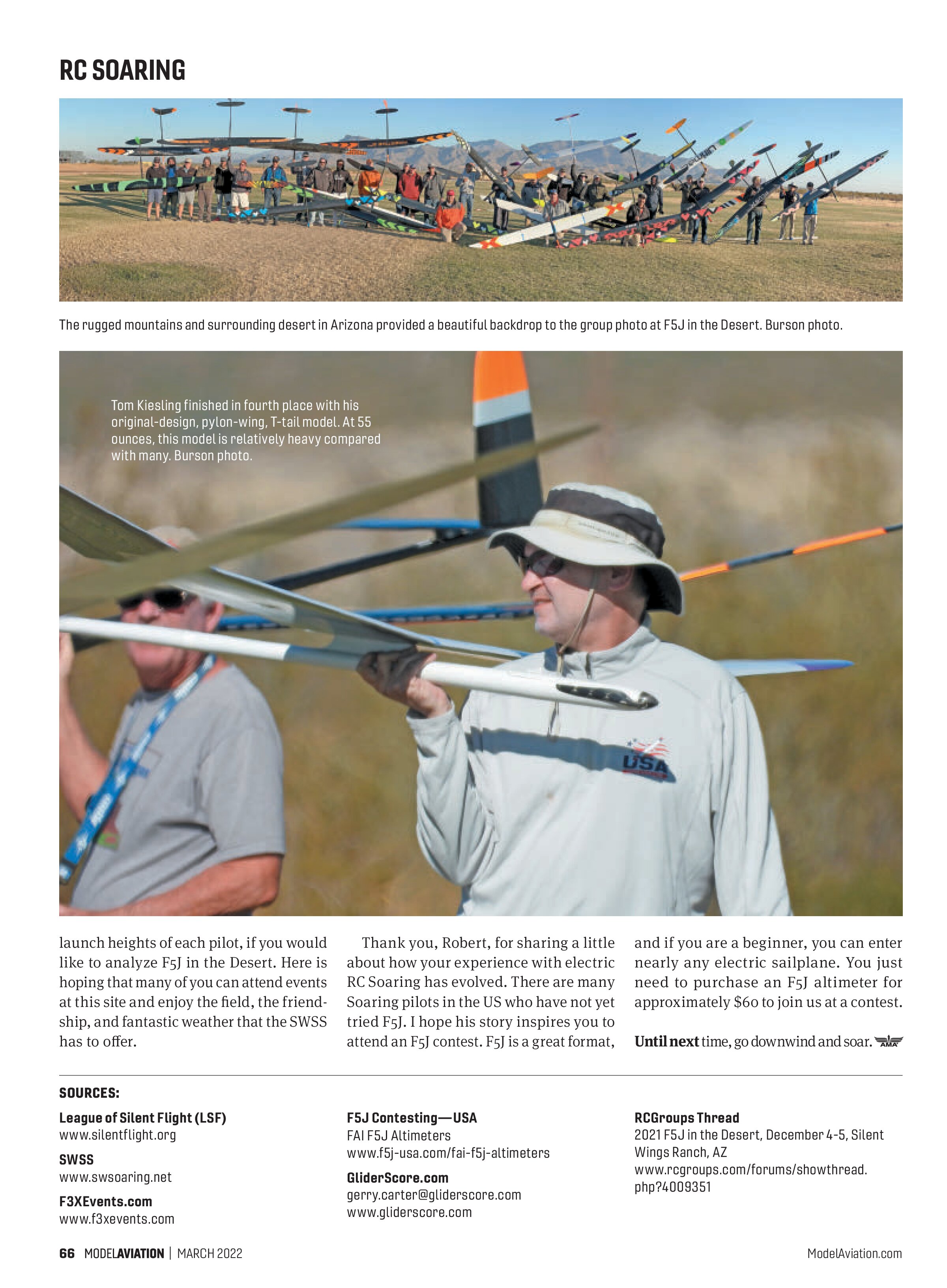
Scoring, which was updated online after every round, was handled by GliderScore.com. Pilots entered scores on their smartphones after each flight and knew their standing for the round and overall. The final winners from the flyoff were John Butler (first place), Steve Willcox (second place), Joshua Freund (third place), Tom Kiesling (fourth place), and John Armstrong (fifth place).
On GliderScore.com, you can review each round, the flight times, and the


launch heights of each pilot, if you would like to analyze F5J in the Desert. Here is hoping that many of you can attend events at this site and enjoy the field, the friendship, and fantastic weather that the SWSS has to offer.
Thank you, Robert, for sharing a little about how your experience with electric RC Soaring has evolved. There are many Soaring pilots in the US who have not yet tried F5J. I hope his story inspires you to attend an F5J contest. F5J is a great format,
and if you are a beginner, you can enter nearly any electric sailplane. You just need to purchase an F5J altimeter for approximately $60 to join us at a contest.
Until next time, go downwind and soar.
SOURCES:
- League of Silent Flight (LSF)
www.silentflight.org - SWSS
www.swsoaring.net - F3XEvents.com
www.f3xevents.com - F5J Contesting—USA
FAI F5J Altimeters
www.f5j-usa.com/fai-f5j-altimeters - GliderScore.com
gerry.carter@gliderscore.com
www.gliderscore.com - RCGroups Thread
2021 F5J in the Desert, December 4-5, Silent Wings Ranch, AZ
www.rcgroups.com/forums/showthread.php?4009351