RC PYLON RACING

ELECTRIC POWER AND EF1 BATTERIES
By Tim Lampe | tim.lampe@hotmail.com
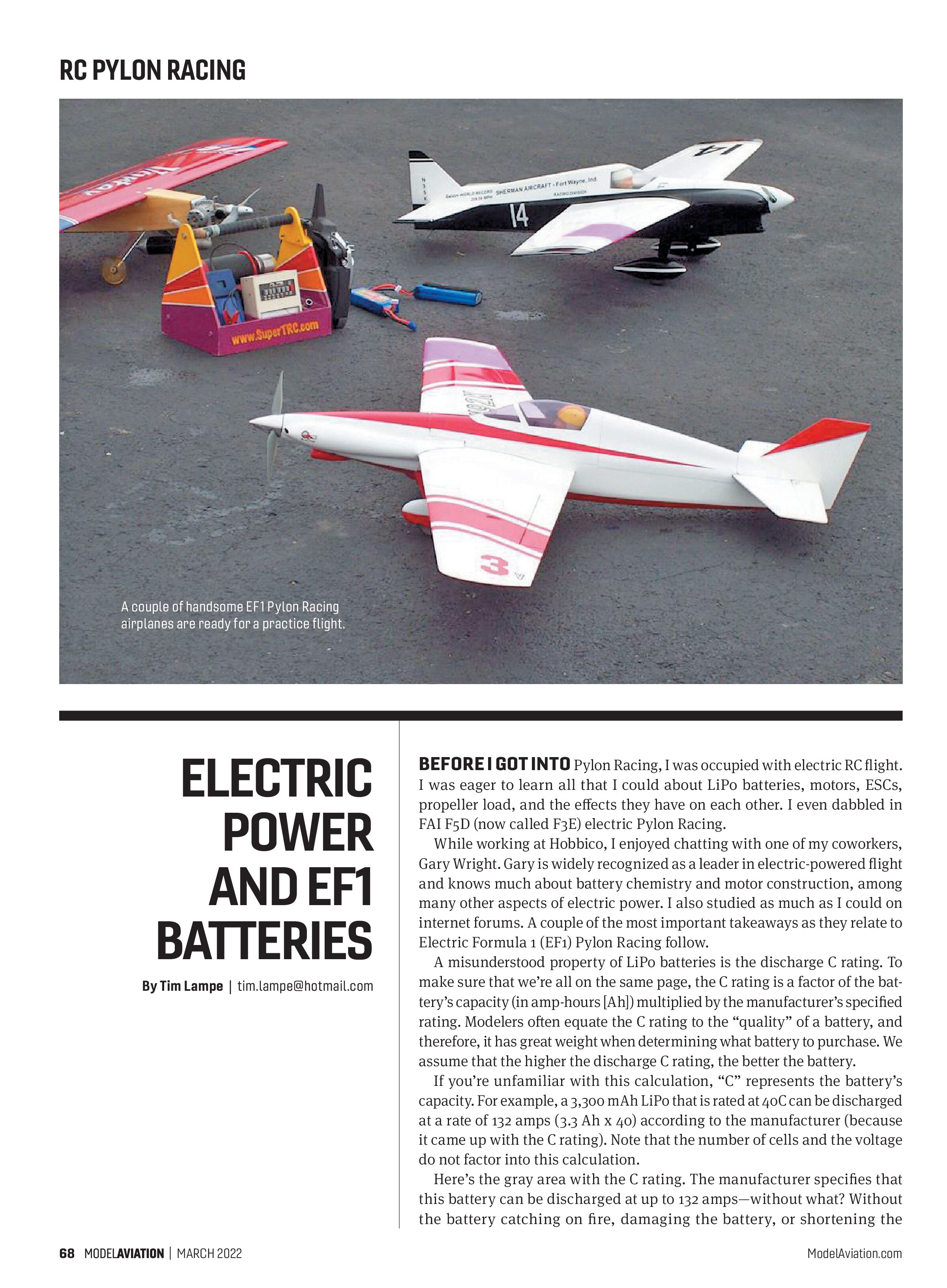
BEFORE I GOT INTO Pylon Racing, I was occupied with electric RC flight. I was eager to learn all that I could about LiPo batteries, motors, ESCs, propeller load, and the effects they have on each other. I even dabbled in FAI F5D (now called F3E) electric Pylon Racing.
While working at Hobbico, I enjoyed chatting with one of my coworkers, Gary Wright. Gary is widely recognized as a leader in electric-powered flight and knows much about battery chemistry and motor construction, among many other aspects of electric power. I also studied as much as I could on internet forums. A couple of the most important takeaways as they relate to Electric Formula 1 (EF1) Pylon Racing follow.
A misunderstood property of LiPo batteries is the discharge C rating. To make sure that we’re all on the same page, the C rating is a factor of the battery’s capacity (in amp-hours [Ah]) multiplied by the manufacturer’s specified rating. Modelers often equate the C rating to the “quality” of a battery, and therefore, it has great weight when determining what battery to purchase. We assume that the higher the discharge C rating, the better the battery.
If you’re unfamiliar with this calculation, “C” represents the battery’s capacity. For example, a 3,300 mAh LiPo that is rated at 40C can be discharged at a rate of 132 amps (3.3 Ah x 40) according to the manufacturer (because it came up with the C rating). Note that the number of cells and the voltage do not factor into this calculation.
Here’s the gray area with the C rating. The manufacturer specifies that this battery can be discharged at up to 132 amps—without what? Without the battery catching on fire, damaging the battery, or shortening the battery’s expected number of cycles?

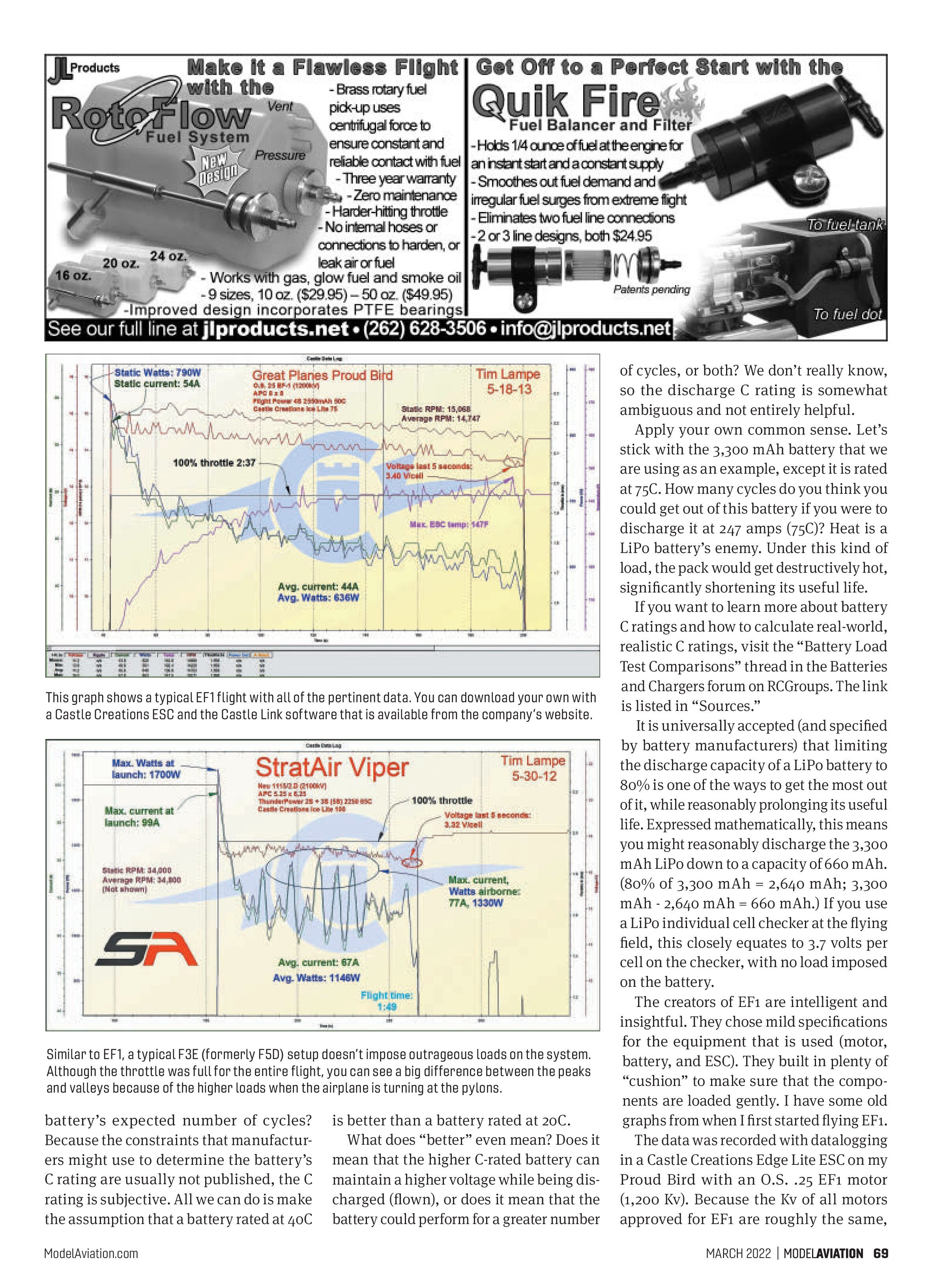
This graph shows a typical EF1 flight with all of the pertinent data. You can download your own with a Castle Creations ESC and the Castle Link software that is available from the company’s website.

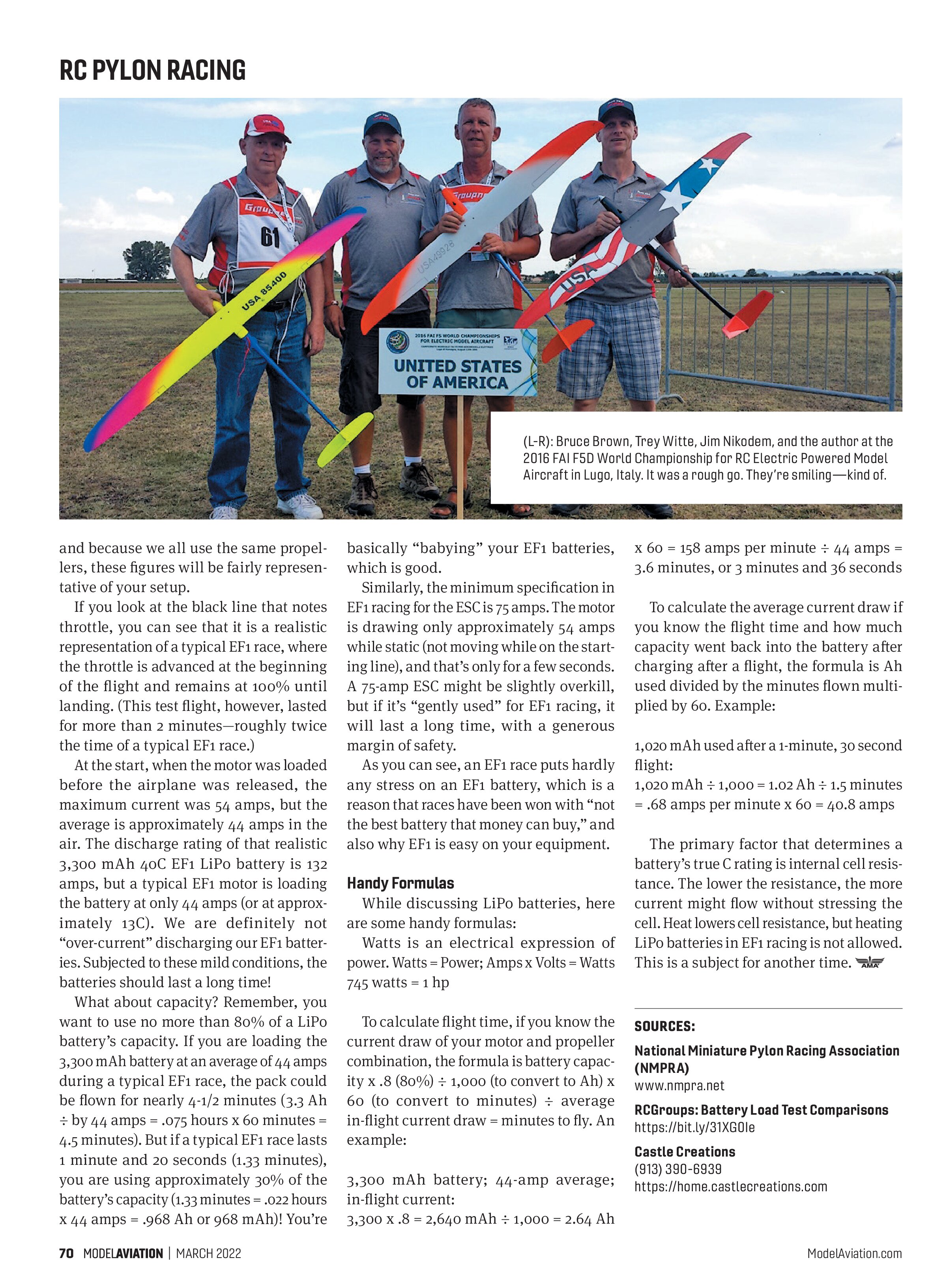
Similar to EF1, a typical F3E (formerly F5D) setup doesn’t impose outrageous loads on the system. Although the throttle was full for the entire flight, you can see a big difference between the peaks and valleys because of the higher loads when the airplane is turning at the pylons.
Because the constraints that manufacturers might use to determine the battery’s C rating are usually not published, the C rating is subjective. All we can do is make the assumption that a battery rated at 40C is better than a battery rated at 20C.
What does “better” even mean? Does it mean that the higher C-rated battery can maintain a higher voltage while being discharged (flown), or does it mean that the battery could perform for a greater number of cycles, or both? We don’t really know, so the discharge C rating is somewhat ambiguous and not entirely helpful.
Apply your own common sense. Let’s stick with the 3,300 mAh battery that we are using as an example, except it is rated at 75C. How many cycles do you think you could get out of this battery if you were to discharge it at 247 amps (75C)? Heat is a LiPo battery’s enemy. Under this kind of load, the pack would get destructively hot, significantly shortening its useful life.
If you want to learn more about battery C ratings and how to calculate real-world, realistic C ratings, visit the “Battery Load Test Comparisons” thread in the Batteries and Chargers forum on RCGroups. The link is listed in “Sources.”
It is universally accepted (and specified by battery manufacturers) that limiting the discharge capacity of a LiPo battery to 80% is one of the ways to get the most out of it, while reasonably prolonging its useful life. Expressed mathematically, this means you might reasonably discharge the 3,300 mAh LiPo down to a capacity of 660 mAh. (80% of 3,300 mAh = 2,640 mAh; 3,300 mAh - 2,640 mAh = 660 mAh.) If you use a LiPo individual cell checker at the flying field, this closely equates to 3.7 volts per cell on the checker, with no load imposed on the battery.
The creators of EF1 are intelligent and insightful. They chose mild specifications for the equipment that is used (motor, battery, and ESC). They built in plenty of “cushion” to make sure that the components are loaded gently. I have some old graphs from when I first started flying EF1. The data was recorded with datalogging in a Castle Creations Edge Lite ESC on my Proud Bird with an O.S. .25 EF1 motor (1,200 Kv). Because the Kv of all motors approved for EF1 are roughly the same,
and because we all use the same propellers, these figures will be fairly representative of your setup.
If you look at the black line that notes throttle, you can see that it is a realistic representation of a typical EF1 race, where the throttle is advanced at the beginning of the flight and remains at 100% until landing. (This test flight, however, lasted for more than 2 minutes—roughly twice the time of a typical EF1 race.)
At the start, when the motor was loaded before the airplane was released, the maximum current was 54 amps, but the average is approximately 44 amps in the air. The discharge rating of that realistic 3,300 mAh 40C EF1 LiPo battery is 132 amps, but a typical EF1 motor is loading the battery at only 44 amps (or at approximately 13C). We are definitely not “over-current” discharging our EF1 batteries. Subjected to these mild conditions, the batteries should last a long time!
What about capacity? Remember, you want to use no more than 80% of a LiPo battery’s capacity. If you are loading the 3,300 mAh battery at an average of 44 amps during a typical EF1 race, the pack could be flown for nearly 4-1/2 minutes (3.3 Ah ÷ by 44 amps = .075 hours x 60 minutes = 4.5 minutes). But if a typical EF1 race lasts 1 minute and 20 seconds (1.33 minutes), you are using approximately 30% of the battery’s capacity (1.33 minutes = .022 hours x 44 amps = .968 Ah or 968 mAh)! You’re basically “babying” your EF1 batteries, which is good.
Similarly, the minimum specification in EF1 racing for the ESC is 75 amps. The motor is drawing only approximately 54 amps while static (not moving while on the starting line), and that’s only for a few seconds. A 75-amp ESC might be slightly overkill, but if it’s “gently used” for EF1 racing, it will last a long time, with a generous margin of safety.
As you can see, an EF1 race puts hardly any stress on an EF1 battery, which is a reason that races have been won with “not the best battery that money can buy,” and also why EF1 is easy on your equipment.
Handy Formulas
While discussing LiPo batteries, here are some handy formulas:
Watts is an electrical expression of power. Watts = Power; Amps x Volts = Watts
745 watts = 1 hp
To calculate flight time, if you know the current draw of your motor and propeller combination, the formula is battery capacity x .8 (80%) ÷ 1,000 (to convert to Ah) x 60 (to convert to minutes) ÷ average in-flight current draw = minutes to fly. An example:
3,300 mAh battery; 44-amp average; in-flight current:
3,300 x .8 = 2,640 mAh ÷ 1,000 = 2.64 Ah
x 60 = 158 amps per minute ÷ 44 amps = 3.6 minutes, or 3 minutes and 36 seconds
To calculate the average current draw if you know the flight time and how much capacity went back into the battery after charging after a flight, the formula is Ah used divided by the minutes flown multiplied by 60. Example:
1,020 mAh used after a 1-minute, 30 second flight:
1,020 mAh ÷ 1,000 = 1.02 Ah ÷ 1.5 minutes = .68 amps per minute x 60 = 40.8 amps
The primary factor that determines a battery’s true C rating is internal cell resistance. The lower the resistance, the more current might flow without stressing the cell. Heat lowers cell resistance, but heating LiPo batteries in EF1 racing is not allowed. This is a subject for another time.
SOURCES:
National Miniature Pylon Racing Association (NMPRA)
www.nmpra.net
RCGroups: Battery Load Test Comparisons
https://bit.ly/31XG0le
Castle Creations
(913) 390-6939
https://home.castlecreations.com