MARK FEIST'S SKYMASTER F-16 SCHEME
By Jim Hiller | jetmodeler@earthlink.net

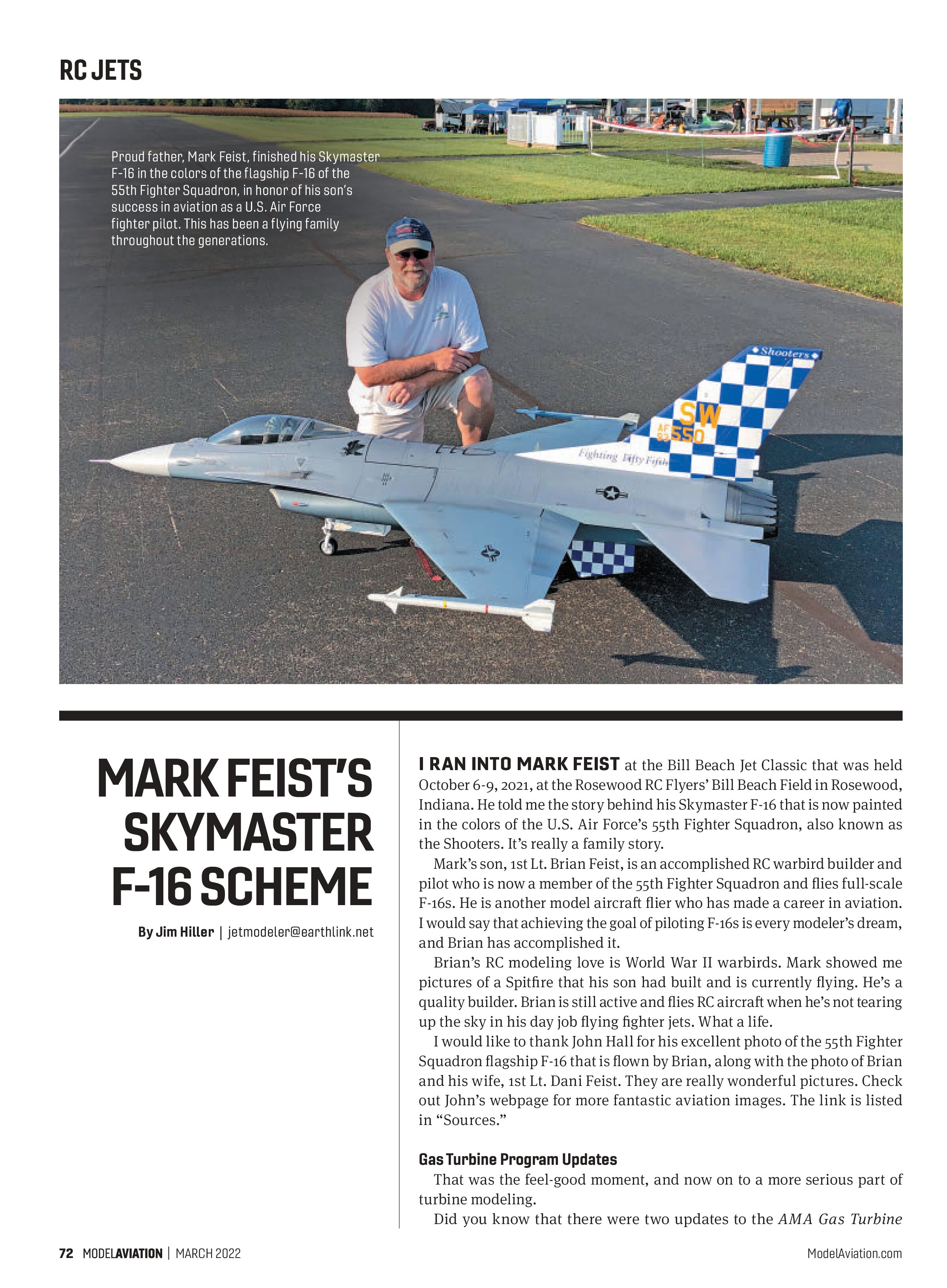
I RAN INTO MARK FEIST at the Bill Beach Jet Classic that was held October 6-9, 2021, at the Rosewood RC Flyers’ Bill Beach Field in Rosewood, Indiana. He told me the story behind his Skymaster F-16 that is now painted in the colors of the U.S. Air Force’s 55th Fighter Squadron, also known as the Shooters. It’s really a family story.
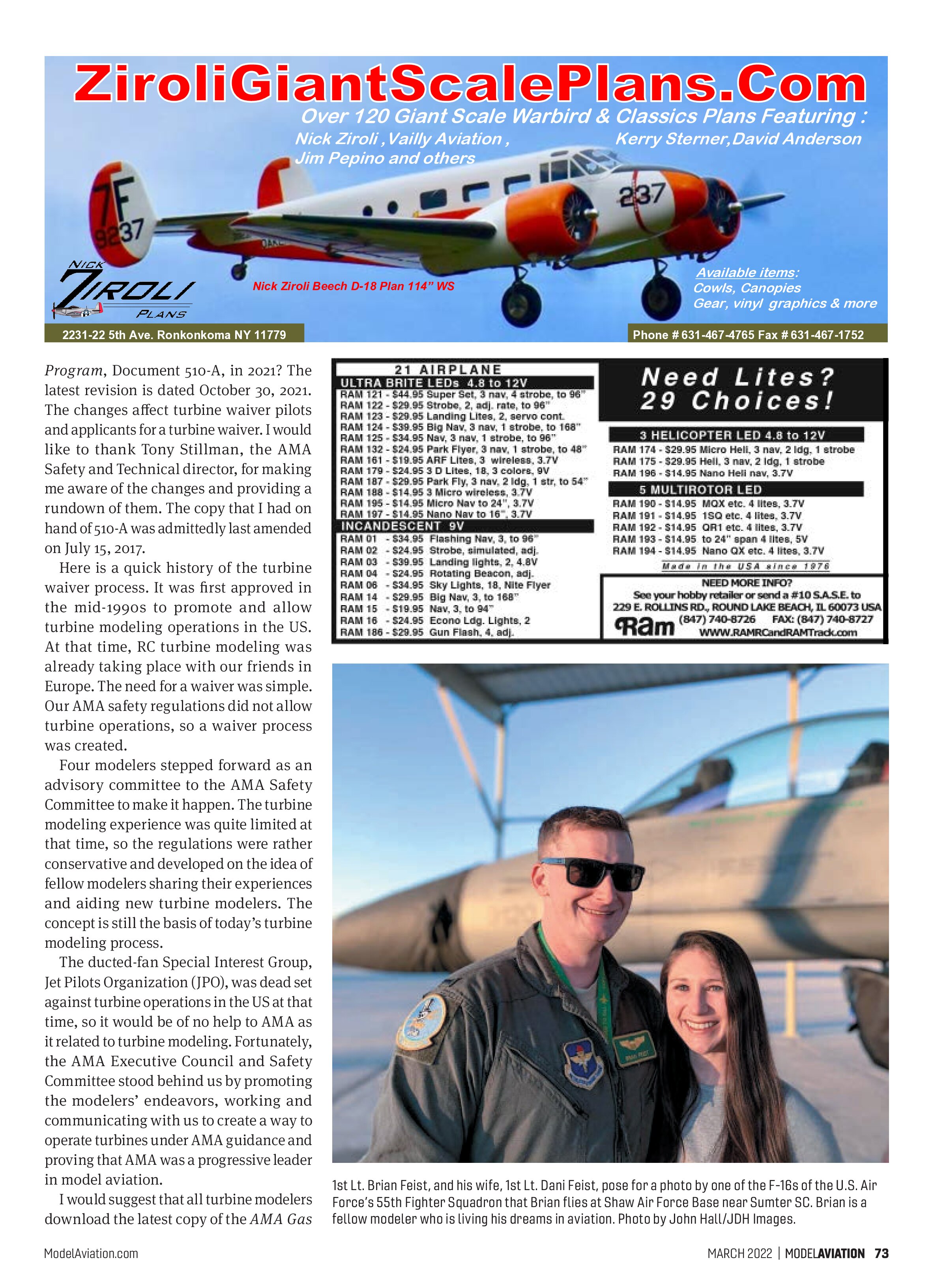
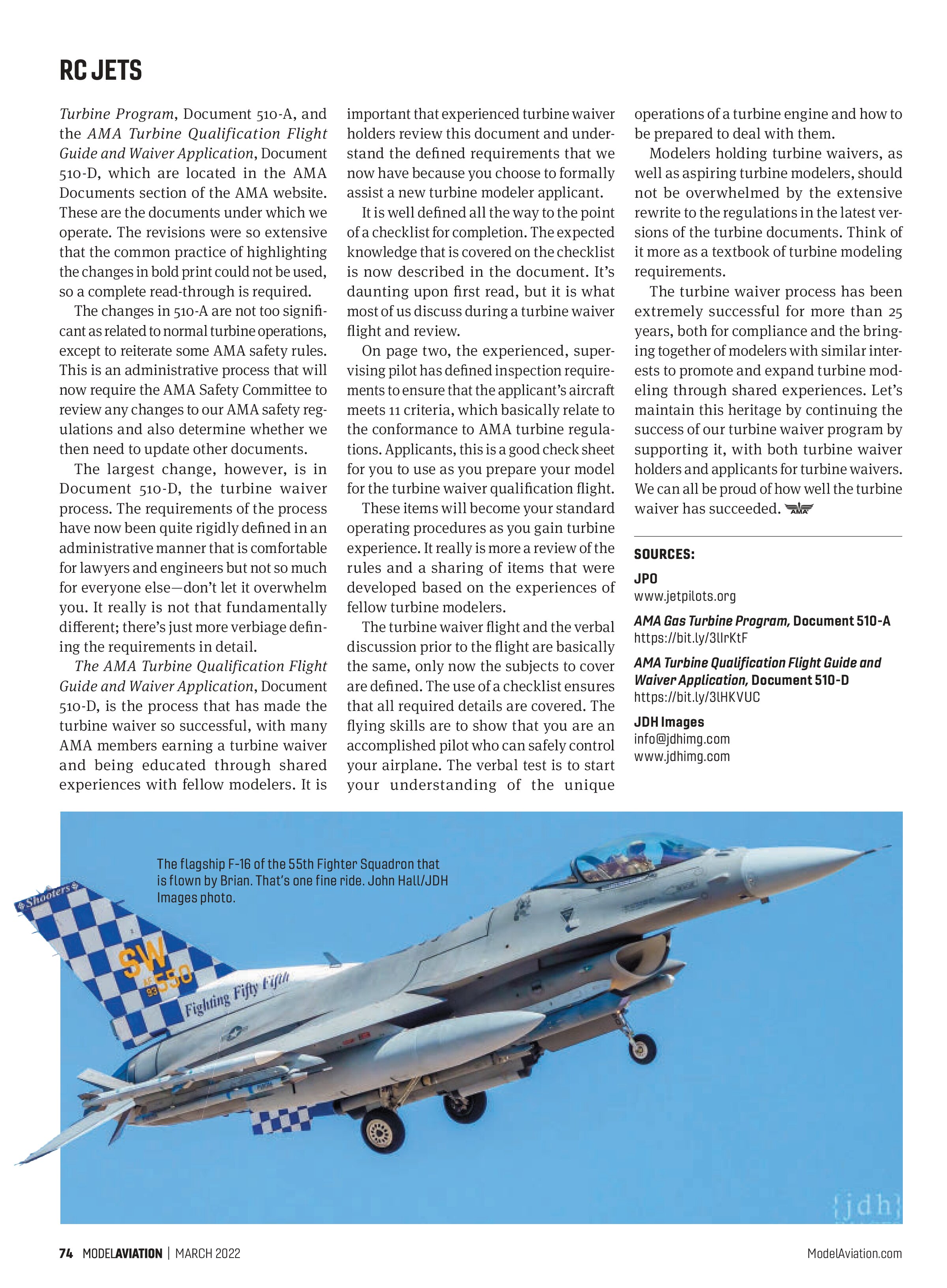
Mark’s son, 1st Lt. Brian Feist, is an accomplished RC warbird builder and pilot who is now a member of the 55th Fighter Squadron and flies full-scale F-16s. He is another model aircraft flier who has made a career in aviation. I would say that achieving the goal of piloting F-16s is every modeler’s dream, and Brian has accomplished it.
Brian’s RC modeling love is World War II warbirds. Mark showed me pictures of a Spitfire that his son had built and is currently flying. He’s a quality builder. Brian is still active and flies RC aircraft when he’s not tearing up the sky in his day job flying fighter jets. What a life.
I would like to thank John Hall for his excellent photo of the 55th Fighter Squadron flagship F-16 that is flown by Brian, along with the photo of Brian and his wife, 1st Lt. Dani Feist. They are really wonderful pictures. Check out John’s webpage for more fantastic aviation images. The link is listed in “Sources.”
Gas Turbine Program Updates
That was the feel-good moment, and now on to a more serious part of turbine modeling.
Did you know that there were two updates to the AMA Gas Turbine Program, Document 510-A, in 2021? The latest revision is dated October 30, 2021. The changes affect turbine waiver pilots and applicants for a turbine waiver. I would like to thank Tony Stillman, the AMA Safety and Technical director, for making me aware of the changes and providing a rundown of them. The copy that I had on hand of 510-A was admittedly last amended on July 15, 2017.
Here is a quick history of the turbine waiver process. It was first approved in the mid-1990s to promote and allow turbine modeling operations in the US. At that time, RC turbine modeling was already taking place with our friends in Europe. The need for a waiver was simple. Our AMA safety regulations did not allow turbine operations, so a waiver process was created.
Four modelers stepped forward as an advisory committee to the AMA Safety Committee to make it happen. The turbine modeling experience was quite limited at that time, so the regulations were rather conservative and developed on the idea of fellow modelers sharing their experiences and aiding new turbine modelers. The concept is still the basis of today’s turbine modeling process.
The ducted-fan Special Interest Group, Jet Pilots Organization (JPO), was dead set against turbine operations in the US at that time, so it would be of no help to AMA as it related to turbine modeling. Fortunately, the AMA Executive Council and Safety Committee stood behind us by promoting the modelers’ endeavors, working and communicating with us to create a way to operate turbines under AMA guidance and proving that AMA was a progressive leader in model aviation.
I would suggest that all turbine modelers download the latest copy of the AMA Gas

Turbine Program, Document 510-A, and the AMA Turbine Qualification Flight Guide and Waiver Application, Document 510-D, which are located in the AMA Documents section of the AMA website. These are the documents under which we operate. The revisions were so extensive that the common practice of highlighting the changes in bold print could not be used, so a complete read-through is required.
The changes in 510-A are not too significant as related to normal turbine operations, except to reiterate some AMA safety rules. This is an administrative process that will now require the AMA Safety Committee to review any changes to our AMA safety regulations and also determine whether we then need to update other documents.
The largest change, however, is in Document 510-D, the turbine waiver process. The requirements of the process have now been quite rigidly defined in an administrative manner that is comfortable for lawyers and engineers but not so much for everyone else—don’t let it overwhelm you. It really is not that fundamentally different; there’s just more verbiage defining the requirements in detail.
The AMA Turbine Qualification Flight Guide and Waiver Application, Document 510-D, is the process that has made the turbine waiver so successful, with many AMA members earning a turbine waiver and being educated through shared experiences with fellow modelers. It is important that experienced turbine waiver holders review this document and understand the defined requirements that we now have because you choose to formally assist a new turbine modeler applicant.
It is well defined all the way to the point of a checklist for completion. The expected knowledge that is covered on the checklist is now described in the document. It’s daunting upon first read, but it is what most of us discuss during a turbine waiver flight and review.
On page two, the experienced, supervising pilot has defined inspection requirements to ensure that the applicant’s aircraft meets 11 criteria, which basically relate to the conformance to AMA turbine regulations. Applicants, this is a good check sheet for you to use as you prepare your model for the turbine waiver qualification flight.
These items will become your standard operating procedures as you gain turbine experience. It really is more a review of the rules and a sharing of items that were developed based on the experiences of fellow turbine modelers.
The turbine waiver flight and the verbal discussion prior to the flight are basically the same, only now the subjects to cover are defined. The use of a checklist ensures that all required details are covered. The flying skills are to show that you are an accomplished pilot who can safely control your airplane. The verbal test is to start your understanding of the unique operations of a turbine engine and how to be prepared to deal with them.
Modelers holding turbine waivers, as well as aspiring turbine modelers, should not be overwhelmed by the extensive rewrite to the regulations in the latest versions of the turbine documents. Think of it more as a textbook of turbine modeling requirements.
The turbine waiver process has been extremely successful for more than 25 years, both for compliance and the bringing together of modelers with similar interests to promote and expand turbine modeling through shared experiences. Let’s maintain this heritage by continuing the success of our turbine waiver program by supporting it, with both turbine waiver holders and applicants for turbine waivers. We can all be proud of how well the turbine waiver has succeeded.
SOURCES:
AMA Gas Turbine Program, Document 510-A
https://bit.ly/3lRkTf
AMA Turbine Qualification Flight Guide and Waiver Application, Document 510-D
https://bit.ly/3LHKVUC
JDH Images
info@jdhimages.com
www.jdhimg.com