RC AEROBATICS
MEET THE NEW “RC AEROBATICS” COLUMNIST
By Justin Wells | justinwells@mac.com

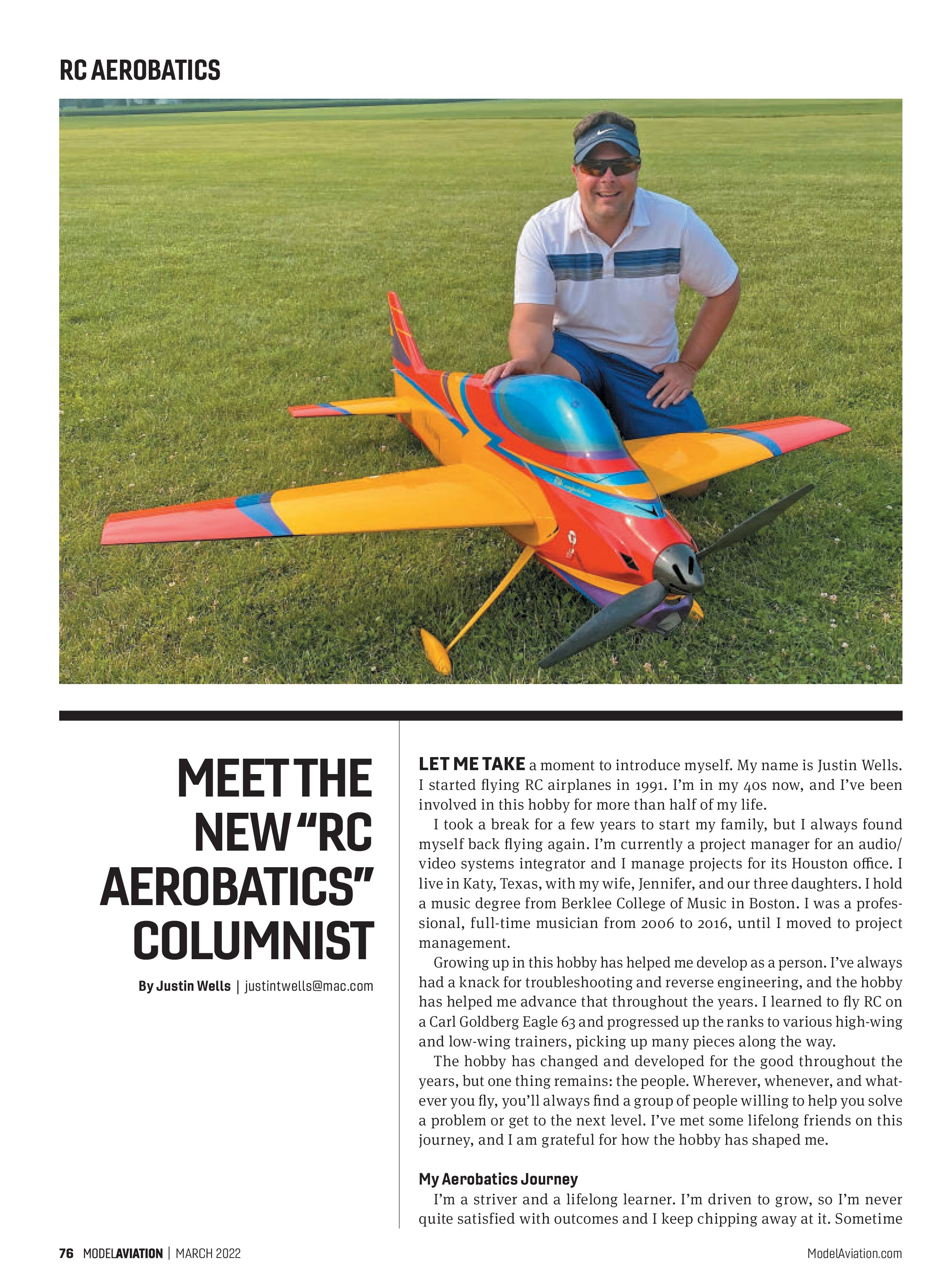
LET ME TAKE a moment to introduce myself. My name is Justin Wells. I started flying RC airplanes in 1991. I’m in my 40s now, and I’ve been involved in this hobby for more than half of my life.
I took a break for a few years to start my family, but I always found myself back flying again. I’m currently a project manager for an audio/video systems integrator and I manage projects for its Houston office. I live in Katy, Texas, with my wife, Jennifer, and our three daughters. I hold a music degree from Berklee College of Music in Boston. I was a professional, full-time musician from 2006 to 2016, until I moved to project management.
Growing up in this hobby has helped me develop as a person. I’ve always had a knack for troubleshooting and reverse engineering, and the hobby has helped me advance that throughout the years. I learned to fly RC on a Carl Goldberg Eagle 63 and progressed up the ranks to various high-wing and low-wing trainers, picking up many pieces along the way.
The hobby has changed and developed for the good throughout the years, but one thing remains: the people. Wherever, whenever, and whatever you fly, you’ll always find a group of people willing to help you solve a problem or get to the next level. I’ve met some lifelong friends on this journey, and I am grateful for how the hobby has shaped me.
My Aerobatics Journey
I’m a striver and a lifelong learner. I’m driven to grow, so I’m never quite satisfied with outcomes and I keep chipping away at it. Sometimes around 1996, a friend of mine loaned me his Dave Patrick Wring It Out videos (VHS tapes, if you are wondering). Volume one started with the very basics—the best practices for takeoff and landing and some simple aerobatic maneuvers, such as loops, rolls, the Split-S, etc. The goal was to show you how to do the basics with the best practices. By the time I saw this video, I had some bad habits to overcome, so I needed to go back and relearn fundamentals.
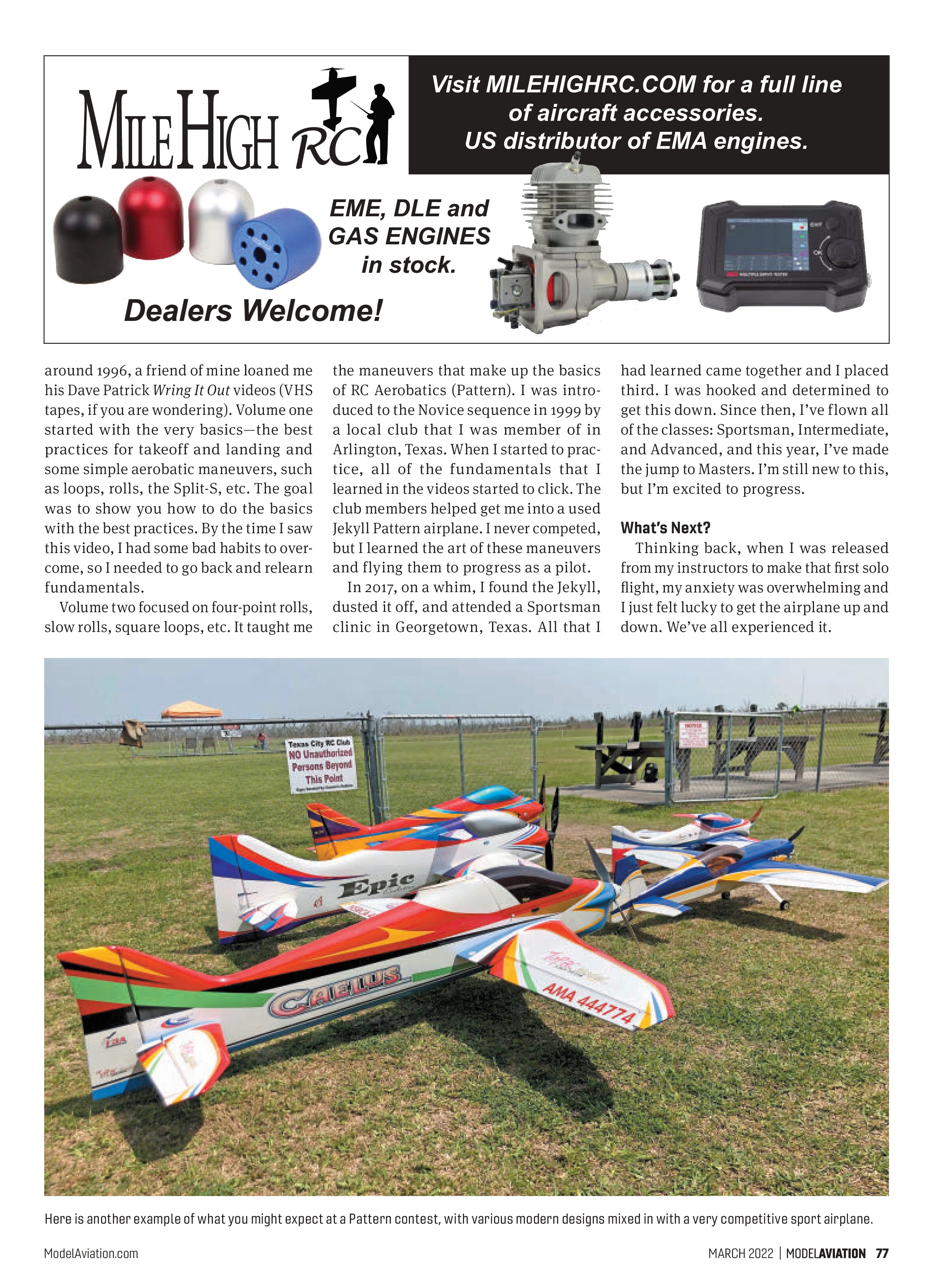
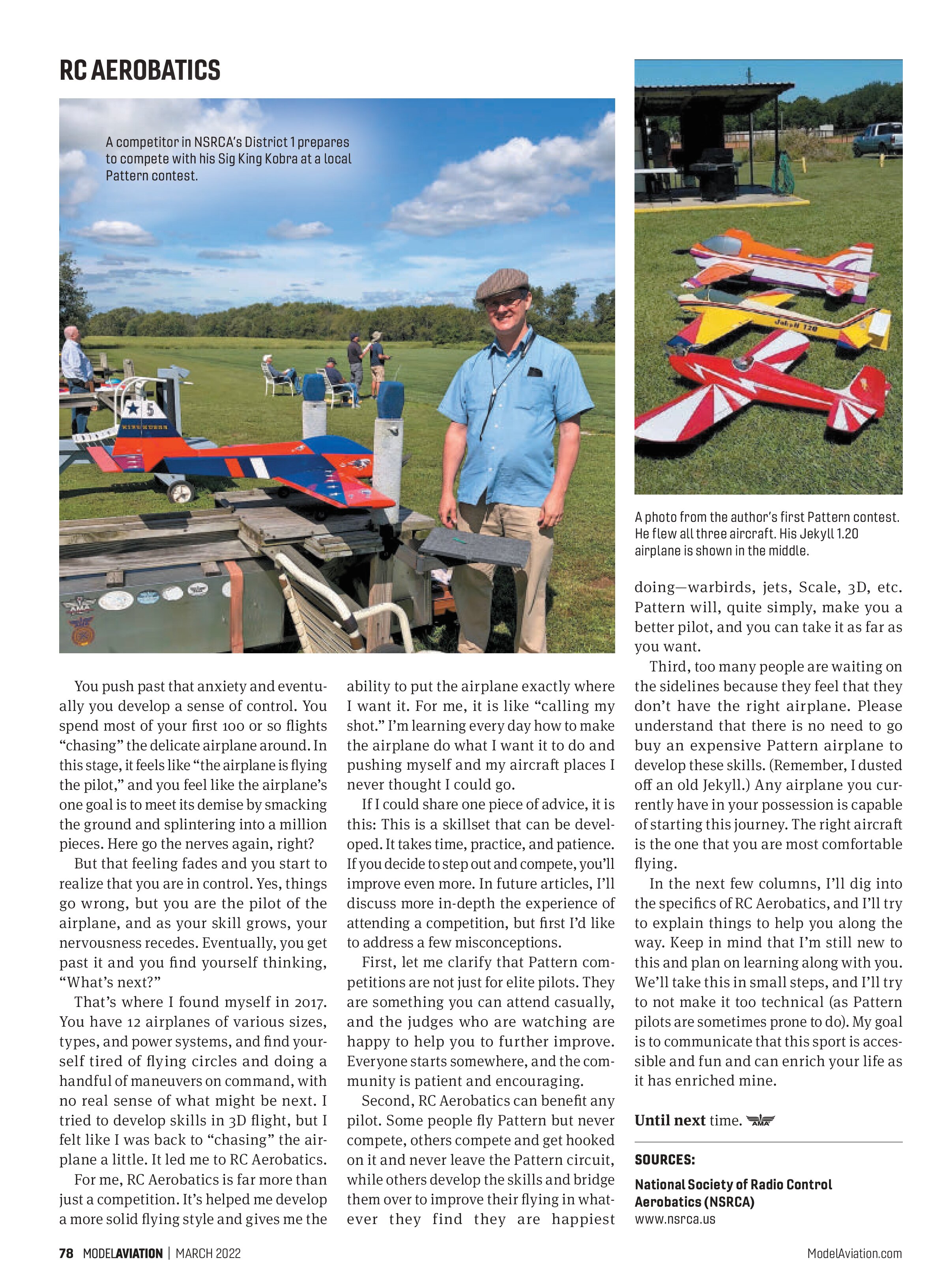
Volume two focused on four-point rolls, slow rolls, square loops, etc. It taught me the maneuvers that make up the basics of RC Aerobatics (Pattern). I was introduced to the Novice sequence in 1999 by a local club that I was member of in Arlington, Texas. When I started to practice, all of the fundamentals that I learned in the videos started to click. The club members helped get me into a used Jekyll Pattern airplane. I never competed, but I learned the art of these maneuvers and flying them to progress as a pilot.
In 2017, on a whim, I found the Jekyll, dusted it off, and attended a Sportsman clinic in Georgetown, Texas. All that I had learned came together and I placed third. I was hooked and determined to get this down. Since then, I’ve flown all of the classes: Sportsman, Intermediate, and Advanced, and this year, I’ve made the jump to Masters. I’m still new to this, but I’m excited to progress.
What’s Next?
Thinking back, when I was released from my instructors to make that first solo flight, my anxiety was overwhelming and I just felt lucky to get the airplane up and down. We’ve all experienced it.


You push past that anxiety and eventually you develop a sense of control. You spend most of your first 100 or so flights “chasing” the delicate airplane around. In this stage, it feels like “the airplane is flying the pilot,” and you feel like the airplane’s one goal is to meet its demise by smacking the ground and splintering into a million pieces. Here go the nerves again, right?
But that feeling fades and you start to realize that you are in control. Yes, things go wrong, but you are the pilot of the airplane, and as your skill grows, your nervousness recedes. Eventually, you get past it and you find yourself thinking, “What’s next?”
That’s where I found myself in 2017. You have 12 airplanes of various sizes, types, and power systems, and find yourself tired of flying circles and doing a handful of maneuvers on command, with no real sense of what might be next. I tried to develop skills in 3D flight, but I felt like I was back to “chasing” the airplane a little. It led me to RC Aerobatics.
For me, RC Aerobatics is far more than just a competition. It’s helped me develop a more solid flying style and gives me the ability to put the airplane exactly where I want it. For me, it is like “calling my shot.” I’m learning every day how to make the airplane do what I want it to do and pushing myself and my aircraft places I never thought I could go.
If I could share one piece of advice, it is this: This is a skillset that can be developed. It takes time, practice, and patience. If you decide to step out and compete, you’ll improve even more. In future articles, I’ll discuss more in-depth the experience of attending a competition, but first I’d like to address a few misconceptions.
First, let me clarify that Pattern competitions are not just for elite pilots. They are something you can attend casually, and the judges who are watching are happy to help you to further improve. Everyone starts somewhere, and the community is patient and encouraging.
Second, RC Aerobatics can benefit any pilot. Some people fly Pattern but never compete, others compete and get hooked on it and never leave the Pattern circuit, while others develop the skills and bridge them over to improve their flying in whatever they find they are happiest doing—warbirds, jets, Scale, 3D, etc. Pattern will, quite simply, make you a better pilot, and you can take it as far as you want.
Third, too many people are waiting on the sidelines because they feel that they don’t have the right airplane. Please understand that there is no need to go buy an expensive Pattern airplane to develop these skills. (Remember, I dusted off an old Jekyll.) Any airplane you currently have in your possession is capable of starting this journey. The right aircraft is the one that you are most comfortable flying.
In the next few columns, I’ll dig into the specifics of RC Aerobatics, and I’ll try to explain things to help you along the way. Keep in mind that I’m still new to this and plan on learning along with you. We’ll take this in small steps, and I’ll try to not make it too technical (as Pattern pilots are sometimes prone to do). My goal is to communicate that this sport is accessible and fun and can enrich your life as it has enriched mine.
Until next time.
SOURCES:
National Society of Radio Control Aerobatics (NSRCA)
www.nsrca.us