RESTORATION FORCE
New Products That Are Worth a Closer Look
THE FIRST TIME I cracked open Gavin Hoffen’s book, it invoked a distant memory from my childhood. In elementary school, I had a teacher named Mrs. Jones. She lived in a log cabin and had an amazing pool. Her husband owned a pool company and it showed, easily being the nicest I’ve ever seen.
The log cabin was fascinating and the pool was impressive, but it was the fuselage of a Cessna underneath a carport that drew my attention, and I found myself sitting in the pilot’s seat, imagining piloting this very aircraft above the clouds.
When I came across Restoration Force and its stories of people referred to as “cockpiters” who restore full-scale aircraft cockpits for display in their homes, garages, sheds, and gardens, I could appreciate someone wanting to own and restore the human interface of the aircraft. I also could understand that a typical person likely doesn’t have room for the rest of the metal, electronics, etc., that would encompass an entire aircraft.
Gavin previously owned the cockpit of a Chipmunk that he reluctantly had to part with after several years of ownership. Fortunately, its current owner was happy to share photos of his grounded piece of history. The new owner actually has some history with the aircraft/cockpit that he bought, so that is a really interesting story.
The author shared that many were reluctant to share their collection, so details about each person and his or her profiled aircraft are kept at a minimum. I’m sure many cockpiters would be happy to discuss their project, but having a stranger show up at their aircraft’s location, wanting a chance to sit in the cockpit, might be off limits.
I also found it quite interesting that of the 23 people and aircraft featured in the book, most of the cockpits belonged to jets. Propeller-driven aircraft are greatly outnumbered, but in particular, a Hawker Hurricane that was involved in the Battle of Britain really caught my interest.
The number of pages and photos allotted to each project varies, but each one averages roughly five pages. The author provides a brief overview of each of the aircraft that are presented in the book. Featured aircraft also include a photo of the complete airplane and, in many cases, it is the same aircraft that the cockpit belongs to.
Being a collector myself (just not of aircraft cockpits), I can appreciate what those who are featured in the book are doing. As one person mentioned in it, “Sometimes the journey is more enjoyable than the destination.”

Restoration Force spans 109 pages and although the subject matter might not be for everyone, I found it to be an enjoyable read.
New Products from the Modeler’s Mall


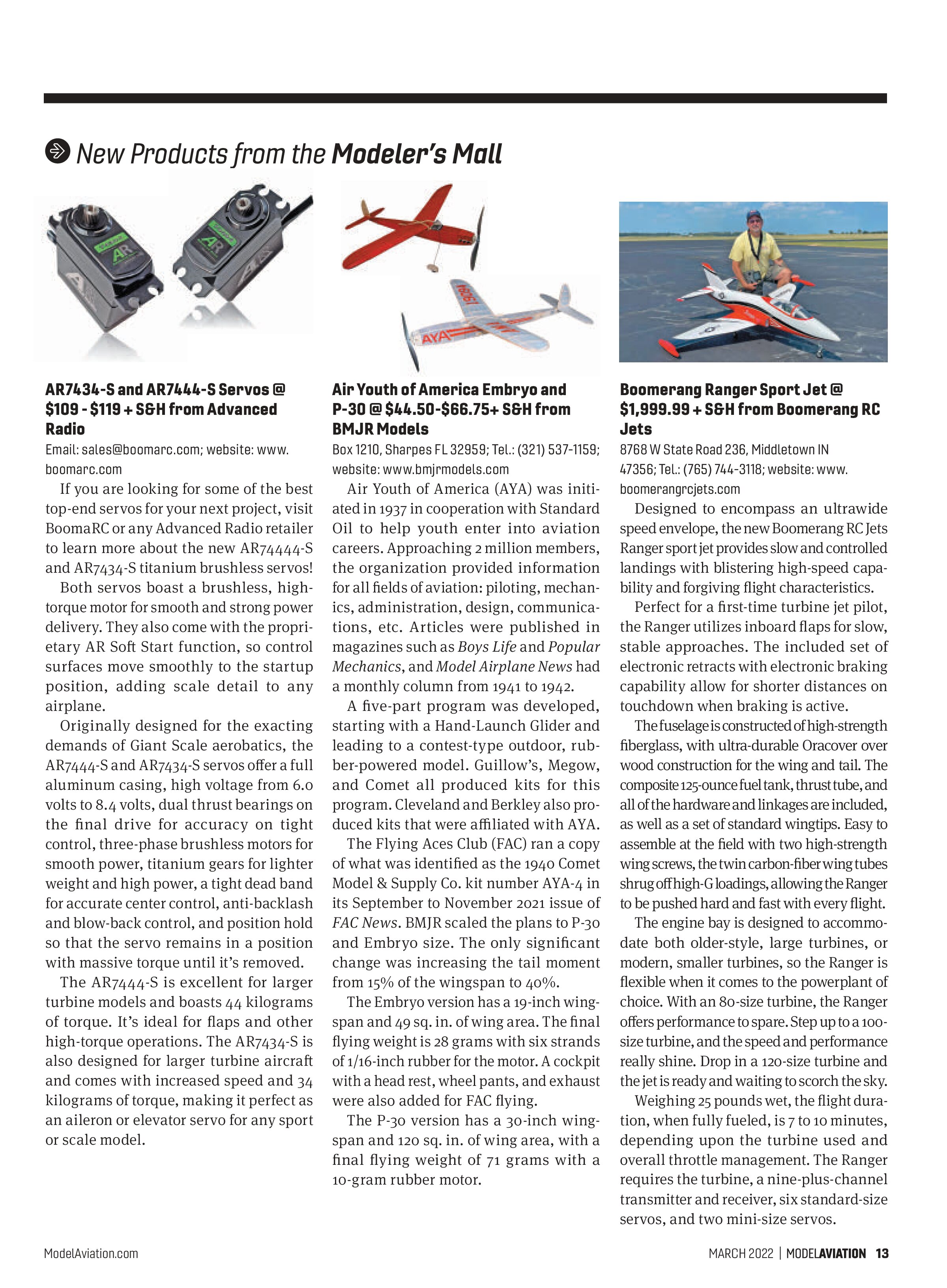
If you are looking for some of the best top-end servos for your next project, visit BoomaRC or any Advanced Radio retailer to learn more about the new AR7444-S and AR7434-S titanium brushless servos!
Both servos boast a brushless, high-torque motor for smooth and strong power delivery. They also come with the proprietary AR Soft Start function, so control surfaces move smoothly to the startup position, adding scale detail to any airplane.
Originally designed for the exacting demands of Giant Scale aerobatics, the AR7444-S and AR7434-S servos offer a full aluminum casing, high voltage from 6.0 volts to 8.4 volts, dual thrust bearings on the final drive for accuracy on tight control, three-phase brushless motors for smooth power, titanium gears for lighter weight and high power, a tight dead band for accurate center control, anti-backlash and blow-back control, and position hold so that the servo remains in a position with massive torque until it’s removed.
The AR7444-S is excellent for larger turbine models and boasts 44 kilograms of torque. It’s ideal for flaps and other high-torque operations. The AR7434-S is also designed for larger turbine aircraft and comes with increased speed and 34 kilograms of torque, making it perfect as an aileron or elevator servo for any sport or scale model.
Air Youth of America (AYA) was initiated in 1937 in cooperation with Standard Oil to help youth enter into aviation careers. Approaching 2 million members, the organization provided information for all fields of aviation: piloting, mechanics, administration, design, communications, etc. Articles were published in magazines such as Boys Life and Popular Mechanics, and Model Airplane News had a monthly column from 1941 to 1942.
A five-part program was developed, starting with a Hand-Launch Glider and leading to a contest-type outdoor, rubber-powered model. Guillows’s, Megow, and Comet all produced kits for this program. Cleveland and Berkley also produced kits that were affiliated with AYA.
The Flying Aces Club (FAC) ran a copy of what was identified as the 1940 Comet Model & Supply Co. kit number AYA-4 in its September to November 2021 issue of FAC News. BMJR scaled the plans to P-30 and Embryo size. The only significant change was increasing the tail moment from 15% of the wingspan to 40%.
The Embryo version has a 19-inch wingspan and 49 sq. in. of wing area. The final flying weight is 28 grams with six strands of 1/16-inch rubber for the motor. A cockpit with a head rest, wheel pants, and exhaust were also added for FAC flying.
The P-30 version has a 30-inch wingspan and 120 sq. in. of wing area, with a final flying weight of 71 grams with a 10-gram rubber motor.
Designed to encompass an ultrawide speed envelope, the new Boomerang RC Jets Ranger sport jet provides slow and controlled landings with blistering high-speed capability and forgiving flight characteristics.
Perfect for a first-time turbine jet pilot, the Ranger utilizes inboard flaps for slow, stable approaches. The included set of electronic retracts with electronic braking capability allow for shorter distances on touchdown when braking is active.
The fuselage is constructed of high-strength fiberglass, with ultra-durable Oracover over wood construction for the wing and tail. The composite 125-ounce fuel tank, thrust tube, and all of the hardware and linkages are included, as well as a set of standard wingtips. Easy to assemble at the field with two high-strength wing screws, the twin carbon-fiber wing tubes shrug off high-G loadings, allowing the Ranger to be pushed hard and fast with every flight.
The engine bay is designed to accommodate both older-style, large turbines, or modern, smaller turbines, so the Ranger is flexible when it comes to the powerplant of choice. With an 80-size turbine, the Ranger offers performance to spare. Step up to a 100-size turbine, and the speed and performance really shine. Drop in a 120-size turbine and the jet is ready and waiting to scorch the sky.
Weighing 25 pounds wet, the flight duration, when fully fueled, is 7 to 10 minutes, depending upon the turbine used and overall throttle management. The Ranger requires the turbine, a nine-plus-channel transmitter and receiver, six standard-size servos, and two mini-size servos.