MICRO-FLYING
13-INCH
CARTOON
SCALE
CORSAIR
By Joe Malinchak | joemal@echoes.net

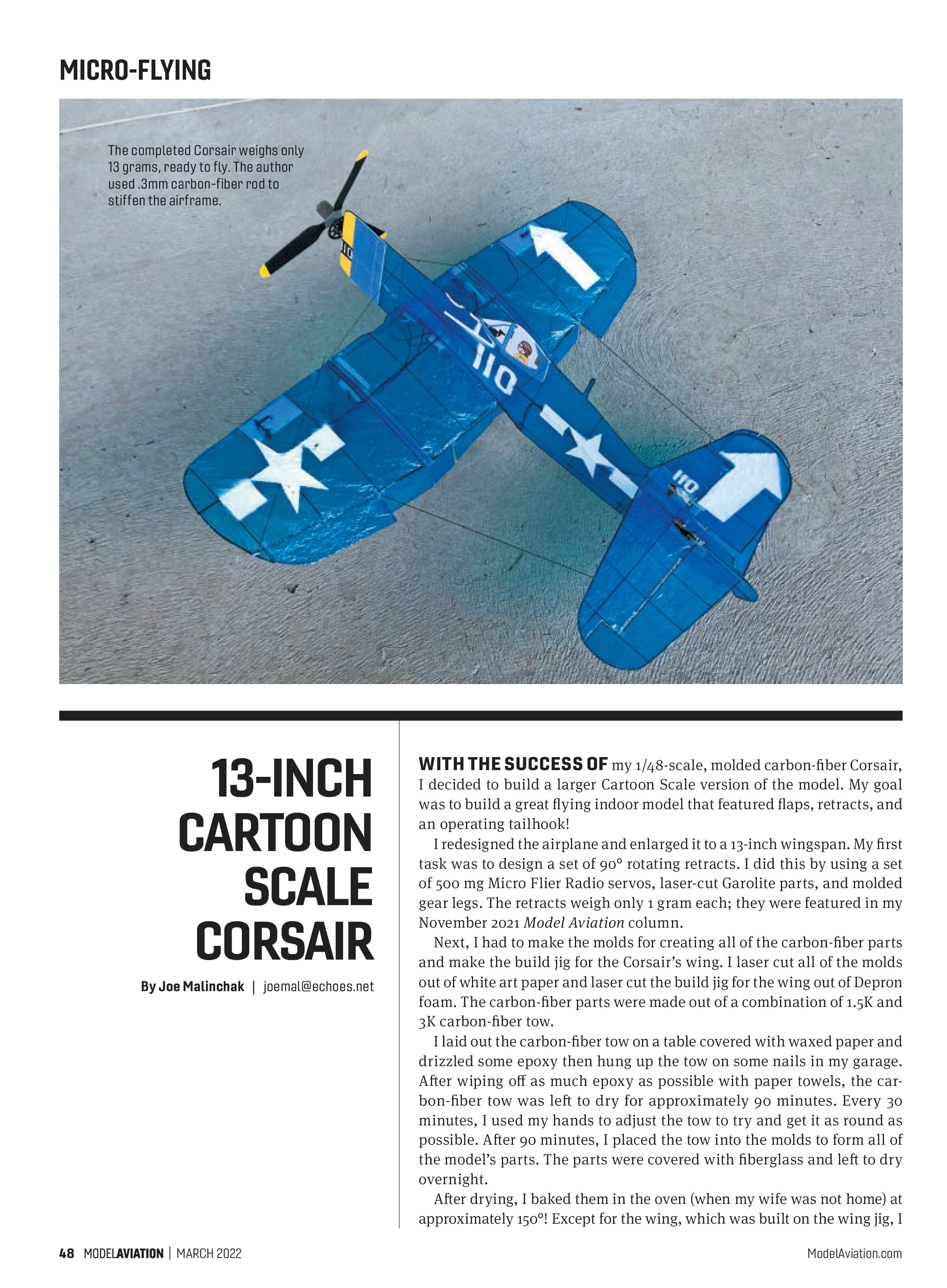
WITH THE SUCCESS OF my 1/48-scale, molded carbon-fiber Corsair, I decided to build a larger Cartoon Scale version of the model. My goal was to build a great flying indoor model that featured flaps, retracts, and an operating tailhook!
I redesigned the airplane and enlarged it to a 13-inch wingspan. My first task was to design a set of 90° rotating retracts. I did this by using a set of 500 mg Micro Flier Radio servos, laser-cut Garolite parts, and molded gear legs. The retracts weigh only 1 gram each; they were featured in my November 2021 Model Aviation column.
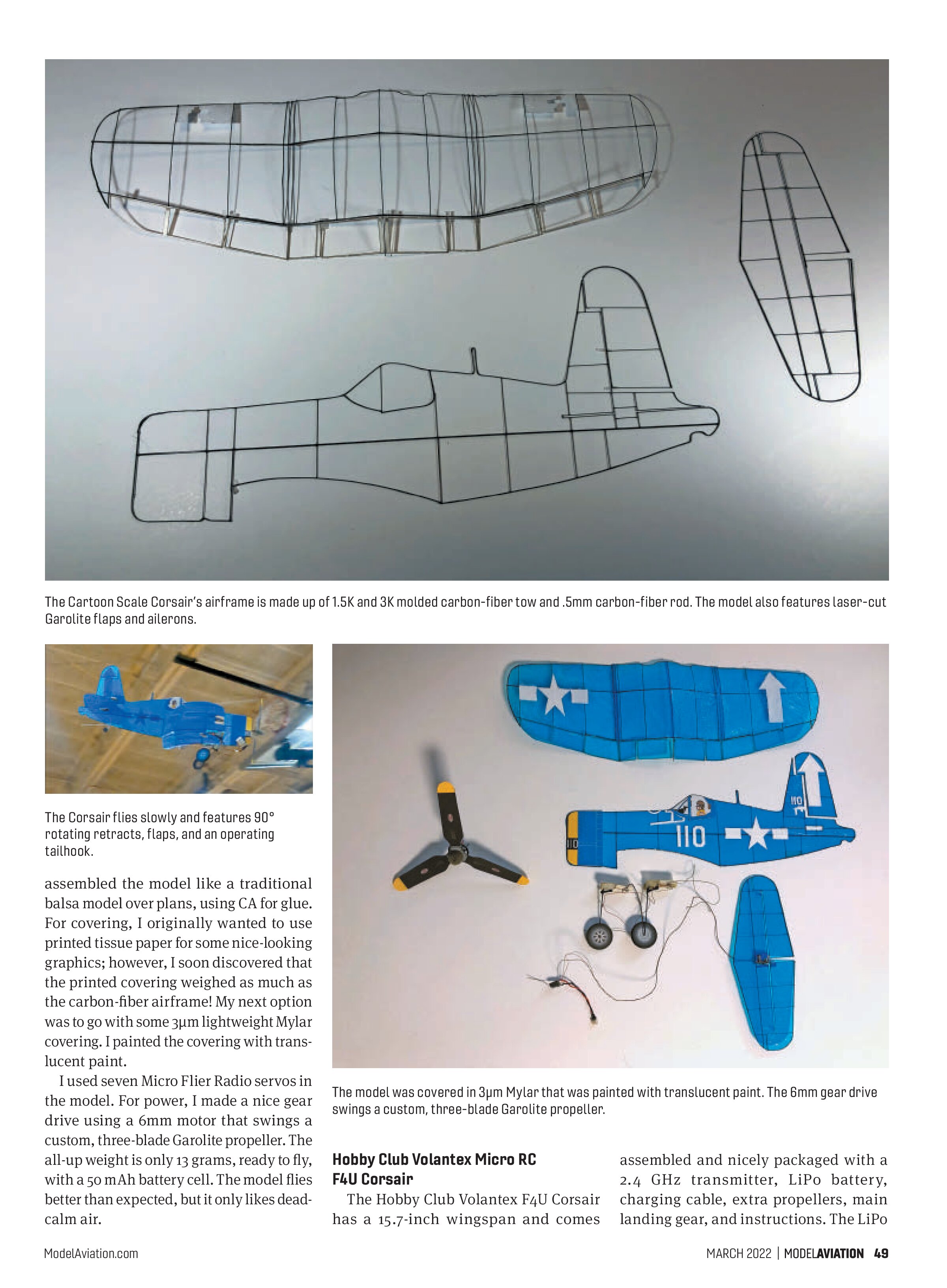
Next, I had to make the molds for creating all of the carbon-fiber parts and make the build jig for the Corsair’s wing. I laser cut all of the molds out of white art paper and laser cut the build jig for the wing out of Depron foam. The carbon-fiber parts were made out of a combination of 1.5K and 3K carbon-fiber tow.
I laid out the carbon-fiber tow on a table covered with waxed paper and drizzled some epoxy then hung up the tow on some nails in my garage. After wiping off as much epoxy as possible with paper towels, the carbon-fiber tow was left to dry for approximately 90 minutes. Every 30 minutes, I used my hands to adjust the tow to try and get it as round as possible. After 90 minutes, I placed the tow into the molds to form all of the model’s parts. The parts were covered with fiberglass and left to dry overnight.
After drying, I baked them in the oven (when my wife was not home) at approximately 150°! Except for the wing, which was built on the wing jig, I assembled the model like a traditional balsa model over plans, using CA for glue. For covering, I originally wanted to use printed tissue paper for some nice-looking graphics; however, I soon discovered that the printed covering weighed as much as the carbon-fiber airframe! My next option was to go with some 3µm lightweight Mylar covering. I painted the covering with translucent paint.
I used seven Micro Flier Radio servos in the model. For power, I made a nice gear drive using a 6mm motor that swings a custom, three-blade Garolite propeller. The all-up weight is only 13 grams, ready to fly, with a 50 mAh battery cell. The model flies better than expected, but it only likes dead-calm air.


Hobby Club Volantex Micro RC F4U Corsair
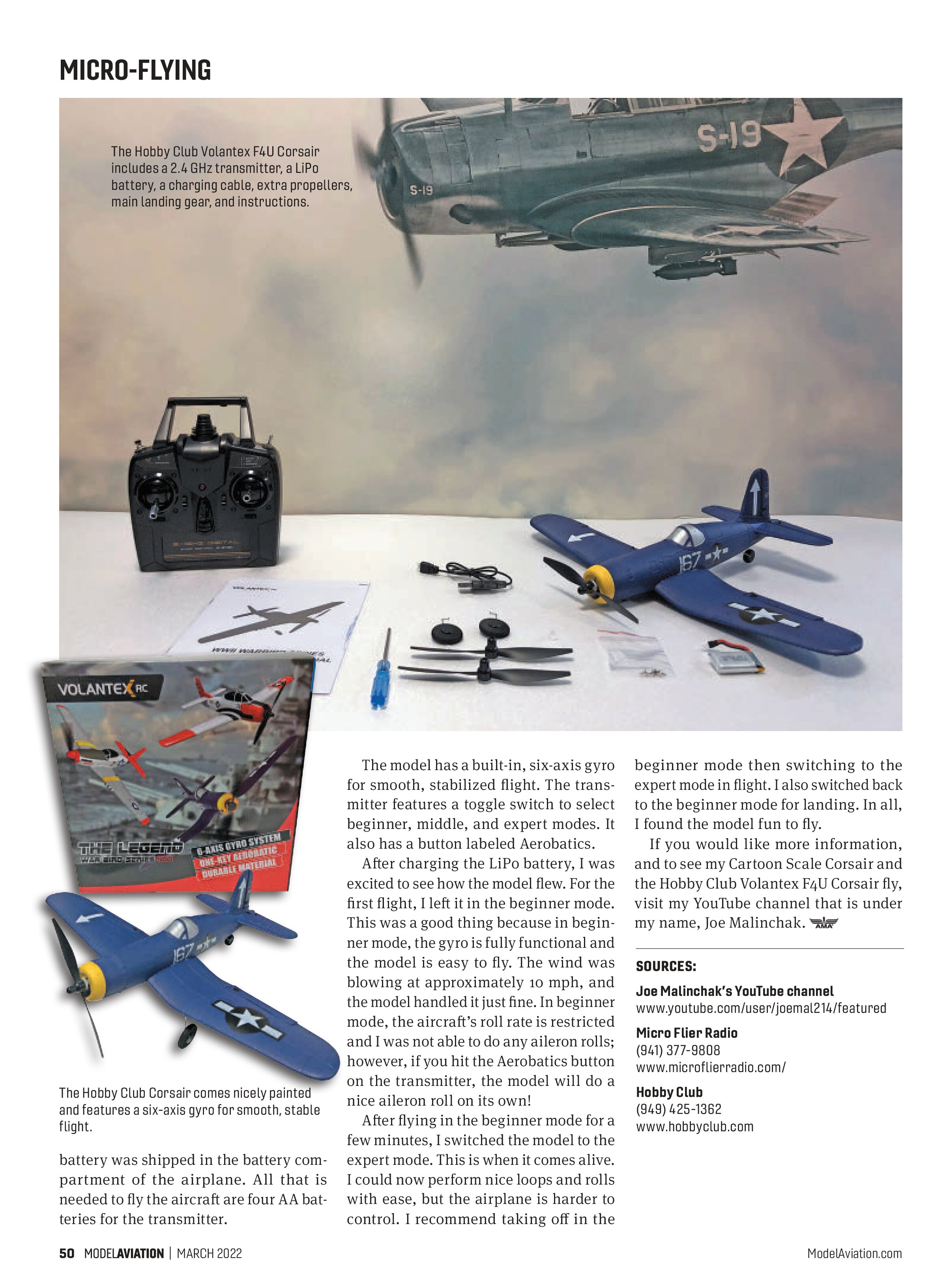
The Hobby Club Volantex F4U Corsair has a 15.7-inch wingspan and comes assembled and nicely packaged with a 2.4 GHz transmitter, LiPo battery, charging cable, extra propellers, main landing gear, and instructions. The LiPo


battery was shipped in the battery compartment of the airplane. All that is needed to fly the aircraft are four AA batteries for the transmitter.
The model has a built-in, six-axis gyro for smooth, stabilized flight. The transmitter features a toggle switch to select beginner, middle, and expert modes. It also has a button labeled Aerobatics.
After charging the LiPo battery, I was excited to see how the model flew. For the first flight, I left it in the beginner mode. This was a good thing because in beginner mode, the gyro is fully functional and the model is easy to fly. The wind was blowing at approximately 10 mph, and the model handled it just fine. In beginner mode, the aircraft’s roll rate is restricted and I was not able to do any aileron rolls; however, if you hit the Aerobatics button on the transmitter, the model will do a nice aileron roll on its own!
After flying in the beginner mode for a few minutes, I switched the model to the expert mode. This is when it comes alive. I could now perform nice loops and rolls with ease, but the airplane is harder to control. I recommend taking off in the beginner mode then switching to the expert mode in flight. I also switched back to the beginner mode for landing. In all, I found the model fun to fly.
If you would like more information, and to see my Cartoon Scale Corsair and the Hobby Club Volantex F4U Corsair fly, visit my YouTube channel that is under my name, Joe Malinchak.
- SOURCES:
- Joe Malinchak’s YouTube channel
www.youtube.com/user/joemal214/featured - Micro Flier Radio
(941) 377-9808
www.microflieradio.com/ - Hobby Club
(949) 425-1362
www.hobbyclub.com