FREE FLIGHT SCALE
SPITFIRE MK XIV
By Dennis Norman

Editor’s note: Dennis Norman, author of Model Aviation’s “Free Flight Scale” column since 2002, passed away in November 2021. In honor of his many contributions to this magazine and Free Flight (FF) modeling, we will include his final columns in this and a future issue. Fly high, Dennis!
ENGLAND’S SUPERMARINE SPITFIRE WAS one of the most graceful and elegant aircraft to emerge from World War II. Designed initially by Reginald J. Mitchell, whose high-performance racing seaplanes inspired a new generation of military fighters, the first Spitfire coincided with the development of the 1,000 hp Rolls Royce engine. More than 23,000 variants of the Spitfire were built in total, and scholarly discussions of subsequent developments of the Spitfire line are what books are made of. Suffice it to say, the Spitfire has been a popular subject for model aircraft builders since the 1930s.
New engines and design alterations produced a variety of Spitfires with longer noses, shorter or longer wings, and varying rudder shapes. As a FF Scale subject, the Spitfire Mk XIV is superb. It incorporates both the proportions and details for good performance.
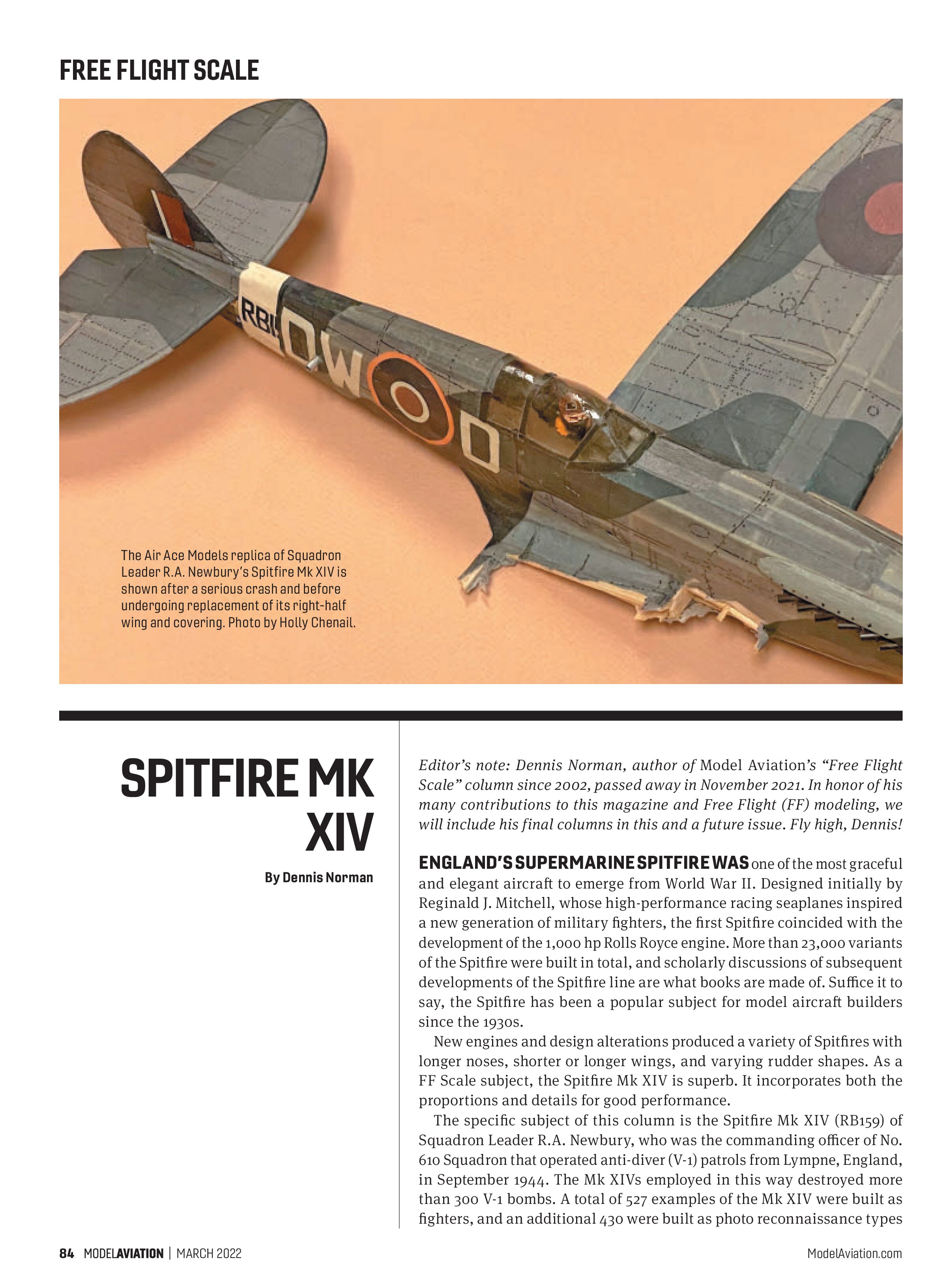
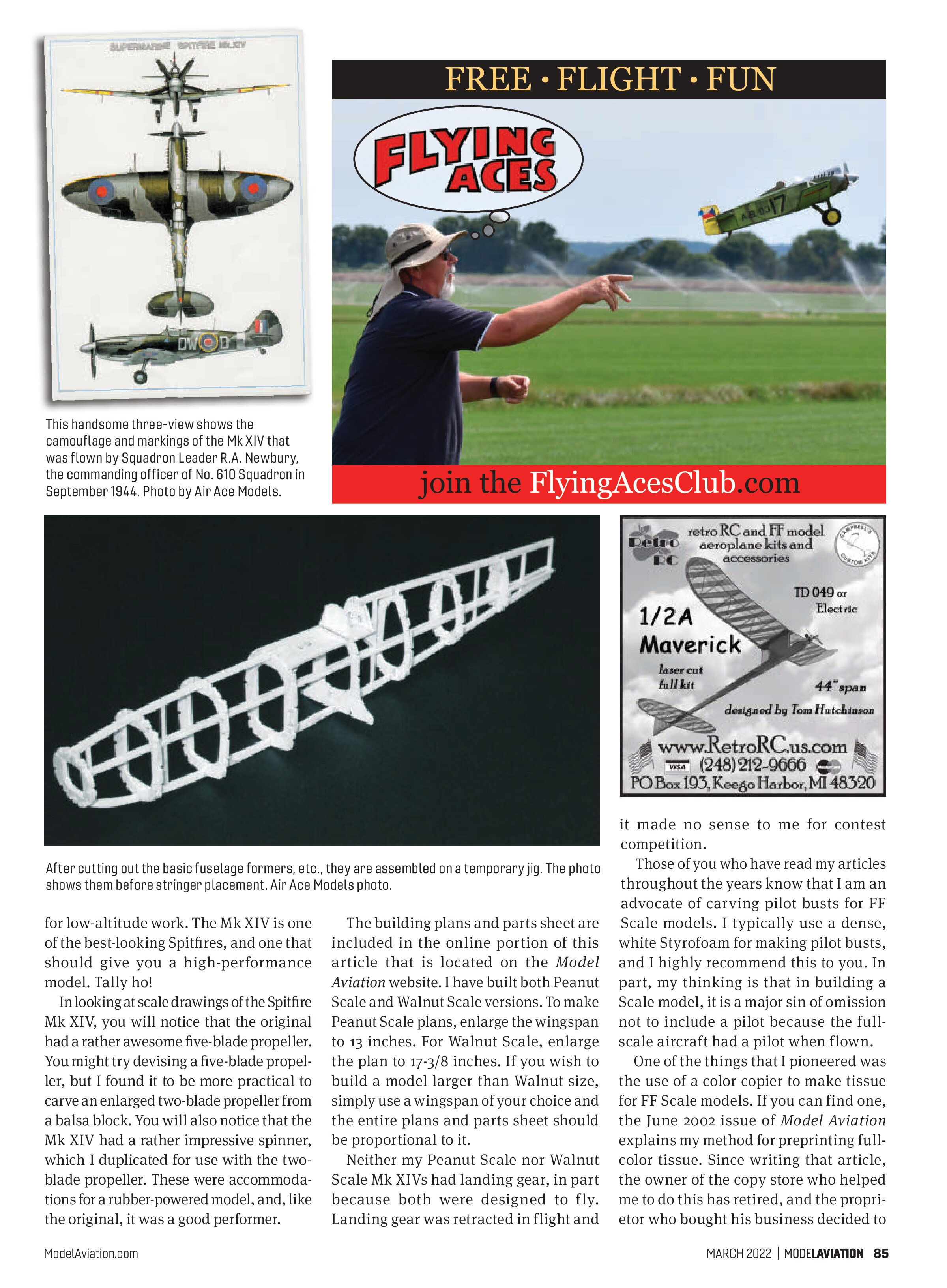
The specific subject of this column is the Spitfire Mk XIV (RB159) of Squadron Leader R.A. Newbury, who was the commanding officer of No. 610 Squadron that operated anti-diver (V-1) patrols from Lympne, England, in September 1944. The Mk XIVs employed in this way destroyed more than 300 V-1 bombs. A total of 527 examples of the Mk XIV were built as fighters, and an additional 430 were built as photo reconnaissance types

for low-altitude work. The Mk XIV is one of the best-looking Spitfires, and one that should give you a high-performance model. Tally ho!
In looking at scale drawings of the Spitfire Mk XIV, you will notice that the original had a rather awesome five-blade propeller. You might try devising a five-blade propeller, but I found it to be more practical to carve an enlarged two-blade propeller from a balsa block. You will also notice that the Mk XIV had a rather impressive spinner, which I duplicated for use with the two-blade propeller. These were accommodations for a rubber-powered model, and, like the original, it was a good performer.

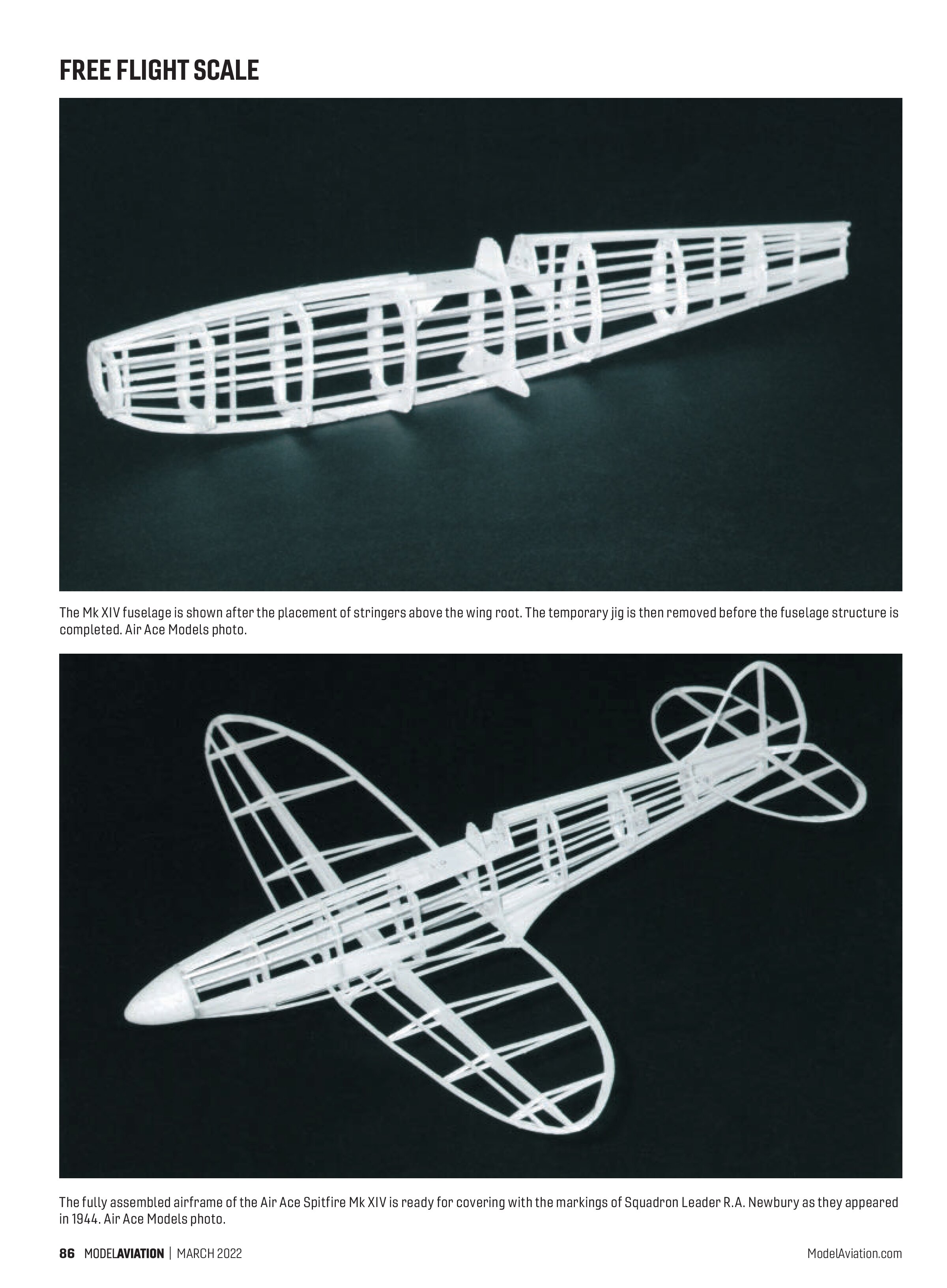
The building plans and parts sheet are included in the online portion of this article that is located on the Model Aviation website. I have built both Peanut Scale and Walnut Scale versions. To make Peanut Scale plans, enlarge the wingspan to 13 inches. For Walnut Scale, enlarge the plan to 17-3/8 inches. If you wish to build a model larger than Walnut size, simply use a wingspan of your choice and the entire plans and parts sheet should be proportional to it.
Neither my Peanut Scale nor Walnut Scale Mk XIVs had landing gear, in part because both were designed to fly. Landing gear was retracted in flight and
it made no sense to me for contest competition.
Those of you who have read my articles throughout the years know that I am an advocate of carving pilot busts for FF Scale models. I typically use a dense, white Styrofoam for making pilot busts, and I highly recommend this to you. In part, my thinking is that in building a Scale model, it is a major sin of omission not to include a pilot because the full-scale aircraft had a pilot when flown.
One of the things that I pioneered was the use of a color copier to make tissue for FF Scale models. If you can find one, the June 2002 issue of Model Aviation explains my method for preprinting full-color tissue. Since writing that article, the owner of the copy store who helped me to do this has retired, and the proprietor who bought his business decided to