FOCAL POINT
Interested in sharing your handiwork? Visit www.ModelAviation.com for submission guidelines.

Fw 190
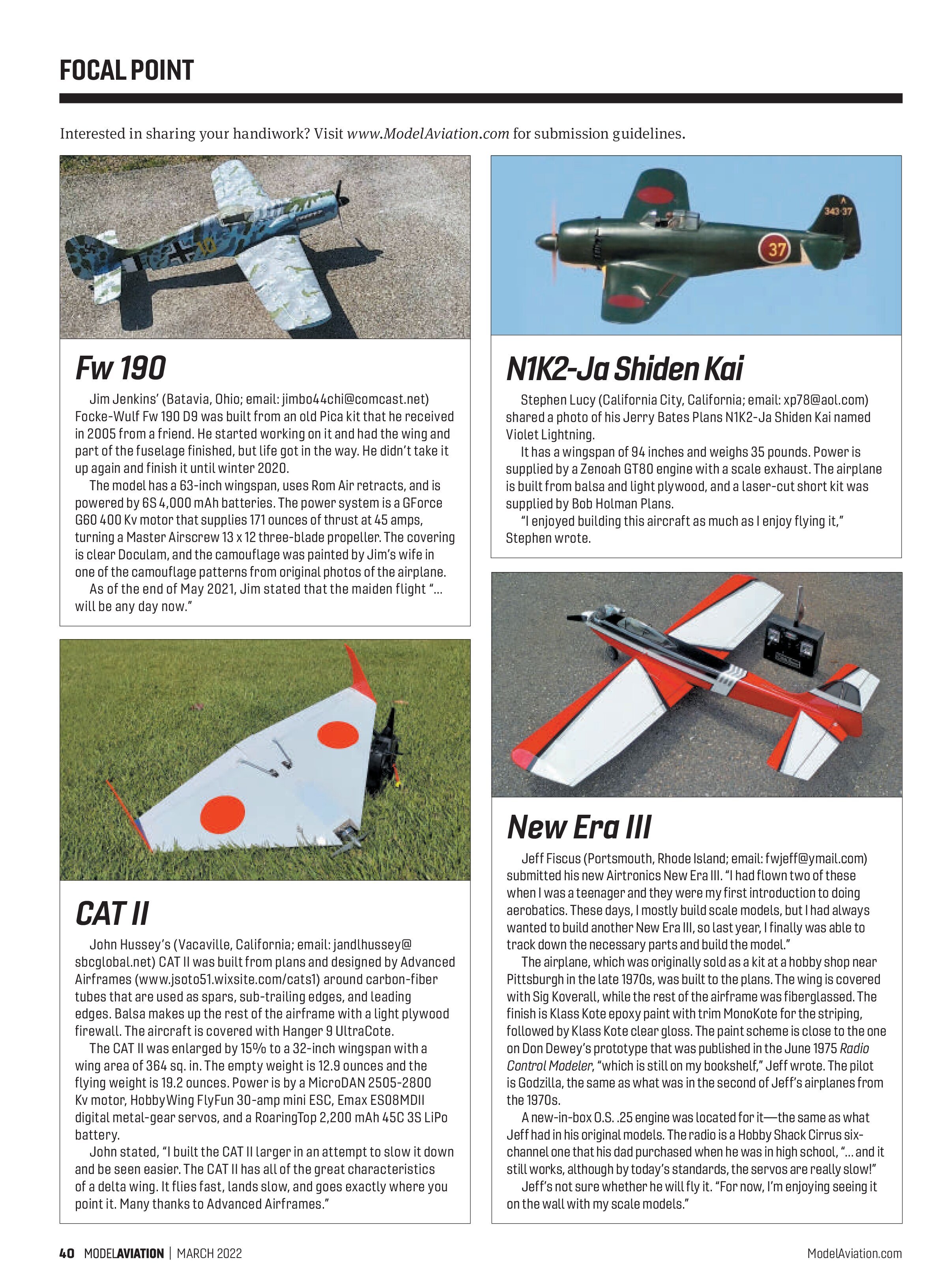
Jim Jenkins’ (Batavia, Ohio; email: jimbo44chic@comcast.net) Focke-Wulf Fw 190 D9 was built from an old Pica kit that he received in 2005 from a friend. He started working on it and had the wing and part of the fuselage finished, but life got in the way. He didn’t take it up again and finish it until winter 2020.
The model has a 63-inch wingspan, uses Rom Air retracts, and is powered by 6S 4,000 mAh batteries. The power system is a GForce G60 400 Kv motor that supplies 171 ounces of thrust at 45 amps, turning a Master Airscrew 13 X 12 three-blade propeller. The covering is clear Doculam, and the camouflage was painted by Jim’s wife in one of the camouflage patterns from original photos of the airplane.
As of the end of May 2021, Jim stated that the maiden flight “... will be any day now.”

CAT II
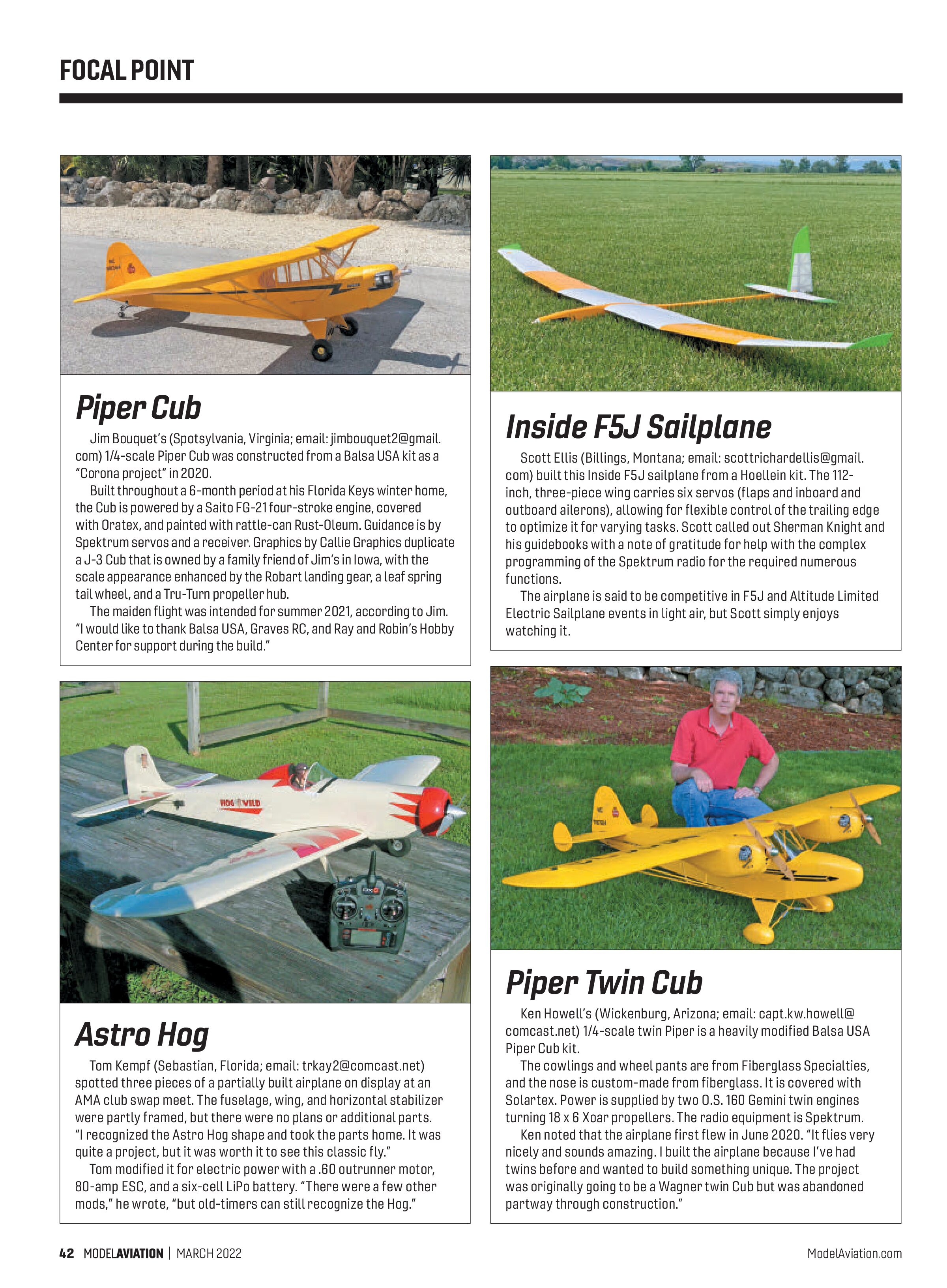
John Hussey’s (Vacaville, California; email: jandlhussey@scholglobal.net) CAT II was built from plans and designed by Advanced Airframes (www.jsoto51.wixsite.com/cats1) around carbon-fiber tubes that are used as spars, sub-trailing edges, and leading edges. Balsa makes up the rest of the airframe with a light plywood firewall. The aircraft is covered with Hangar 9 UltraCote.
The CAT II was enlarged by 15% to a 32-inch wingspan with a wing area of 364 sq. in. The empty weight is 12.9 ounces and the flying weight is 19.2 ounces. Power is by a MicroDAN 2505-2800 Kv motor, HobbyWing FlyFun 30-amp mini ESC, Emax ES08MDII digital metal-gear servos, and a RoaringTop 2,200 mAh 450 3S LiPo battery.
John stated, “I built the CAT II larger in an attempt to slow it down and be seen easier. The CAT II has all of the great characteristics of a delta wing. It flies fast, lands slow, and goes exactly where you point it. Many thanks to Advanced Airframes.”

N1K2-Ja Shiden Kai
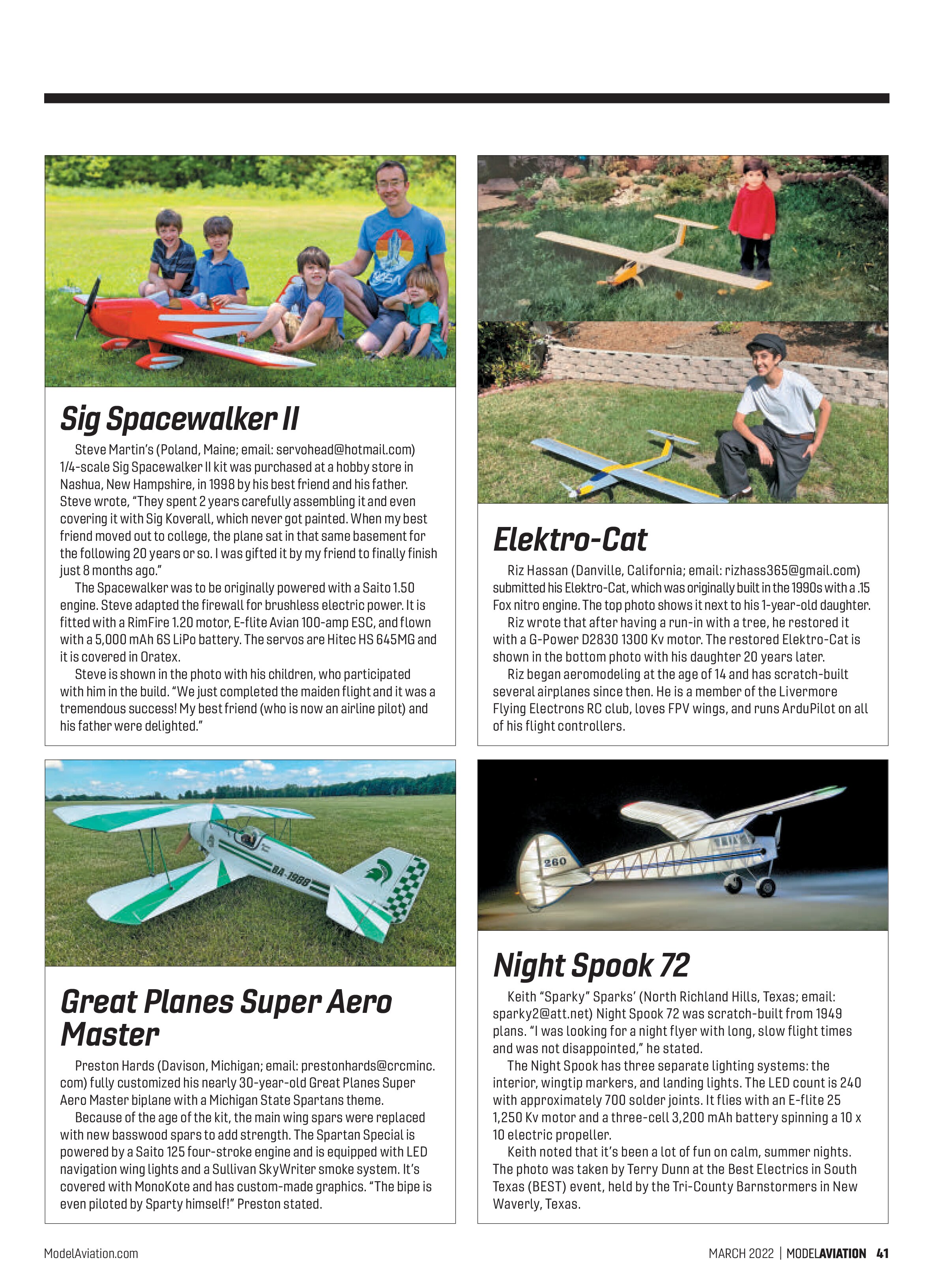
Stephen Lucy (California City, California; email: xpn78@aol.com) shared a photo of his Jerry Bates Plans N1K2-Ja Shiden Kai named Violet Lightning.
It has a wingspan of 94 inches and weighs 35 pounds. Power is supplied by a Zenoah GT80 engine with a scale exhaust. The airplane is built from balsa and light plywood, and a laser-cut short kit was supplied by Bob Holtman Plans.
“I enjoyed building this aircraft as much as I enjoy flying it,” Stephen wrote.

New Era III
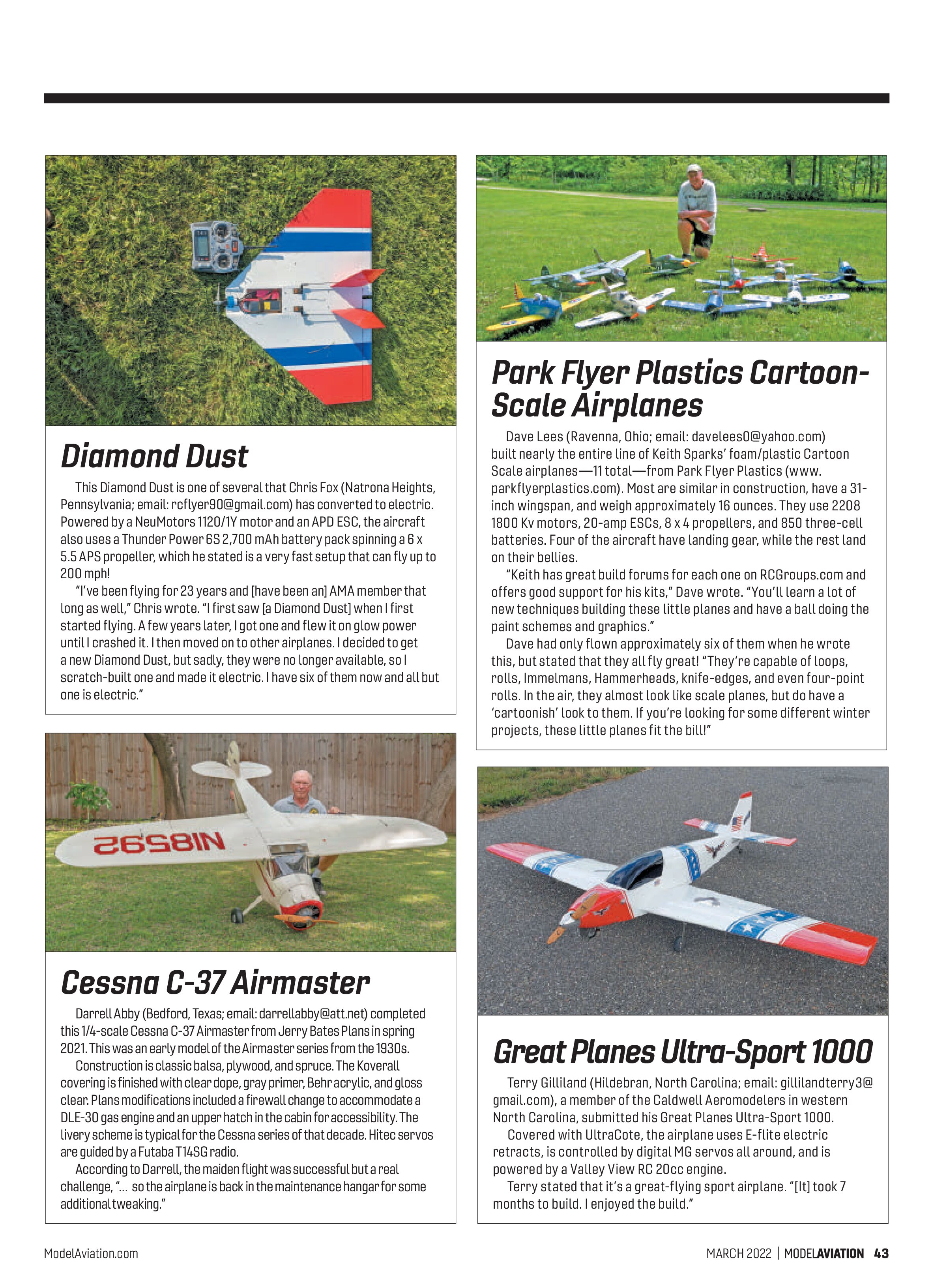
Jeff Fiscus (Portsmouth, Rhode Island; email: fwjeff@ymail.com) submitted his Airtronics New Era III. “I had flown two of these when I was a teenager and they were my first introduction to doing aerobatics. These days, I mostly build scale models, but I had always wanted to build another New Era III, so last year, I finally was able to track down the necessary parts and build the model.”
The airplane, which was originally sold as a kit at a hobby shop near Pittsburgh in the late 1970s, was built to the plans. The wing is covered with Sig Koverall, while the rest of the airframe was fiberglassed. The finish is Klass Kote epoxy paint with trim MonoKote for the striping, followed by Klass Kote clear gloss. The paint scheme is close to the one on Don Dewey’s prototype that was published in the June 1975 Radio Control Modeler, which is still on my bookshelf,” Jeff wrote. The pilot is Godzilla, the same as what was in the second of Jeff’s airplanes from the 1970s.
A new-in-box O.S. .25 engine was located for it—the same as what Jeff had in his original models. The radio is a Hobby Shack Cirrus six-channel one that his dad purchased when he was in high school, “... and it still works, although by today’s standards, the servos are really slow!”
Jeff’s not sure whether he will fly it. “For now, I’m enjoying seeing it on the wall with my scale models.”

Sig Spacewalker II
Steve Martin’s (Poland, Maine; email: servohead@hotmail.com) 1/4-scale Sig Spacewalker II kit was purchased at a hobby store in Nashua, New Hampshire, in 1998 by his best friend and his father. Steve wrote, “They spent 2 years carefully assembling it and even covering it with Sig Koverall, which never got painted. When my best friend moved out to college, the plane sat in that same basement for the following 20 years or so. I was gifted it by my friend to finally finish just 8 months ago.”
The Spacewalker was to be originally powered with a Saito 1.50 engine. Steve adapted the firewall for brushless electric power. It is fitted with a RimFire 1.20 motor, E-flite Avian 100-amp ESC, and flown with a 5,000 mAh 6S LiPo battery. The servos are Hitec HS 645MG and it is covered in Oratex.
Steve is shown in the photo with his children, who participated with him in the build. “We just completed the maiden flight and it was a tremendous success! My best friend (who is now an airline pilot) and his father were delighted.”


Elektro-Cat
Riz Hassan (Danville, California; email: rizhass365@gmail.com) submitted his Elektro-Cat, which was originally built in the 1990s with a .15 Fox nitro engine. The top photo shows it next to his 1-year-old daughter.
Riz wrote that after having a run-in with a tree, he restored it with a G-Power D2830 1300 Kv motor. The restored Elektro-Cat is shown in the bottom photo with his daughter 20 years later.
Riz began aeromodeling at the age of 14 and has scratch-built several airplanes since then. He is a member of the Livermore Flying Electrons RC club, loves FPV wings, and runs ArduPilot on all of his flight controllers.

Great Planes Super Aero Master
Preston Hards (Davison, Michigan; email: prestonhards@rcminc.com) fully customized his nearly 30-year-old Great Planes Super Aero Master biplane with a Michigan State Spartans theme.
Because of the age of the kit, the main wing spars were replaced with new basswood spars to add strength. The Spartan Special is powered by a Saito 125 four-stroke engine and is equipped with LED navigation wing lights and a Sullivan SkyWriter smoke system. It’s covered with MonoKote and has custom-made graphics. “The bipe is even piloted by Sparty himself!” Preston stated.

Night Spook 72
Keith “Sparky” Sparks’ (North Richland Hills, Texas; email: sparky2@att.net) Night Spook 72 was scratch-built from 1949 plans. “I was looking for a night flyer with long, slow flight times and was not disappointed,” he stated.
The Night Spook has three separate lighting systems: the interior, wingtip markers, and landing lights. The LED count is 240 with approximately 700 solder joints. It flies with an E-flite 25 1,250 Kv motor and a three-cell 3,200 mAh battery spinning a 10 x 10 electric propeller.
Keith noted that it’s been a lot of fun on calm, summer nights. The photo was taken by Terry Dunn at the Best Electrics in South Texas (BEST) event, held by the Tri-County Barnstormers in New Waverly, Texas.

Piper Cub
Jim Bouquet’s (Spotsylvania, Virginia; email: jimbouquet2@gmail.com) 1/4-scale Piper Cub was constructed from a Balsa USA kit as a “Corona project” in 2020.
Built throughout a 6-month period at his Florida Keys winter home, the Cub is powered by a Saito FG-21 four-stroke engine, covered with Oratex, and painted with rattle-can Rust-Oleum. Guidance is by Spektrum servos and a receiver. Graphics by Gallie Graphics duplicate a J-3 Cub that is owned by a family friend of Jim’s in Iowa, with the scale appearance enhanced by the Robart landing gear, a leaf spring tail wheel, and a Tru-Turn propeller hub.
The maiden flight was intended for summer 2021, according to Jim. “I would like to thank Balsa USA, Graves RC, and Ray and Robin’s Hobby Center for support during the build.”

Astro Hog
Tom Kempf (Sebastian, Florida; email: trkay2@comcast.net) spotted three pieces of a partially built airplane on display at an AMA club swap meet. The fuselage, wing, and horizontal stabilizer were partly framed, but there were no plans or additional parts. “I recognized the Astro Hog shape and took the parts home. It was quite a project, but it was worth it to see this classic fly.”
Tom modified it for electric power with a .60 outrunner motor, 80-amp ESC, and a six-cell LiPo battery. “There were a few other mods,” he wrote, “but old-timers can still recognize the Hog.”

Inside F5J Sailplane
Scott Ellis (Billings, Montana; email: scottrichardellis@gmail.com) built this Inside F5J sailplane from a Hoellein kit. The 112-inch, three-piece wing carries six servos (flaps and inboard and outboard ailerons), allowing for flexible control of the trailing edge to optimize it for varying tasks. Scott called out Sherman Knight and his guidebooks with a note of gratitude for help with the complex programming of the Spektrum radio for the required numerous functions.
The airplane is said to be competitive in F5J and Altitude Limited Electric Sailplane events in light air, but Scott simply enjoys watching it.

Piper Twin Cub
Ken Howell’s (Wickenburg, Arizona; email: capt.kw.howell@comcast.net) 1/4-scale twin Piper is a heavily modified Balsa USA Piper Cub kit.
The cowlings and wheel pants are from Fiberglass Specialties, and the nose is custom-made from fiberglass. It is covered with Solartex. Power is supplied by two O.S. 160 Gemini twin engines turning 18 x 6 Xoar propellers. The radio equipment is Spektrum.
Ken noted that the airplane first flew in June 2020. “It flies very nicely and sounds amazing. I built the airplane because I’ve had twins before and wanted to build something unique. The project was originally going to be a Wagner twin Cub but was abandoned partway through construction.”

Diamond Dust
This Diamond Dust is one of several that Chris Fox (Natrona Heights, Pennsylvania; email: rcflyer90@gmail.com) has converted to electric. Powered by a Neu Motors 1120/1Y motor and an APD ESC, the aircraft also uses a Thunder Power 6S 2,700 mAh battery pack spinning a 6 x 5.5 APS propeller, which he stated is a very fast setup that can fly up to 200 mph!
“I’ve been flying for 23 years and [have been an] AMA member that long as well,” Chris wrote. “I first saw [a Diamond Dust] when I first started flying. A few years later, I got one and flew it on glow power until I crashed it. I then moved on to other airplanes. I decided to get a new Diamond Dust, but sadly, they were no longer available, so I scratch-built one and made it electric. I have six of them now and all but one is electric.”

Cessna C-37 Airmaster
Darrell Abby (Bedford, Texas; email: darrellabby@att.net) completed this 1/4-scale Cessna C-37 Airmaster from Jerry Bates Plans in spring 2021. This was an early model of the Airmaster series from the 1930s.
Construction is classic balsa, plywood, and spruce. The overall covering is finished with clear dope, gray primer, Behr acrylic, and gloss clear. Plans modifications included a firewall change to accommodate a DLE-30 gas engine and an upper hatch in the cabin for accessibility. The livery scheme is typical for the Cessna series of that decade. Hitec servos are guided by a Futaba T14SG radio.
According to Darrell, the maiden flight was successful but a real challenge, “… so the airplane is back in the maintenance hangar for some additional tweaking.”
Park Flyer Plastics Cartoon-Scale Airplanes
Dave Lees (Ravenna, Ohio; email: davelees0@yahoo.com) built nearly the entire line of Keith Sparks’ foam/plastic Cartoon Scale airplanes—11 total—from Park Flyer Plastics (www.parkflyerplastics.com). Most are similar in construction, have a 31-inch wingspan, and weigh approximately 16 ounces. They use 2208 1800 Kv motors, 20-amp ESCs, 8 x 4 propellers, and 850 three-cell batteries. Four of the aircraft have landing gear, while the rest land on their bellies.
“Keith has great build forums for each one on RCGroups.com and offers good support for his kits,” Dave wrote. “You’ll learn a lot of new techniques building these little planes and have a ball doing the paint schemes and graphics.”
Dave had only flown approximately six of them when he wrote this, but stated that they all fly great! “They’re capable of loops, rolls, Immelmans, Hammerheads, knife-edges, and even four-point rolls. In the air, they almost look like scale planes, but do have a ‘cartoonish’ look to them. If you’re looking for some different winter projects, these little planes fit the bill!”

Great Planes Ultra-Sport 1000
Terry Gilliland (Hildebran, North Carolina; email: gillilandterry3@gmail.com), a member of the Caldwell Aeromodelers in western North Carolina, submitted his Great Planes Ultra-Sport 1000.
Covered with UltraCote, the airplane uses E-flite electric retracts, is controlled by digital MG servos all around, and is powered by a Valley View RC 20cc engine.
Terry stated that it’s a great-flying sport airplane. “[It] took 7 months to build. I enjoyed the build.”