CONTROL LINE COMBAT

BLADDER TIME
By Mark Rudner | mark.s.rudner@gmail.com
WE’VE ALL BEEN THERE. It’s 30 seconds to launch, and pow! A bladder bursts. Or perhaps a minute into the match, your engine suddenly starts lurching, gasping for fuel. It was tuned perfectly back in the pits. You had that needle setting dead-on. What gives?
It looks as though it’s bladder time. It doesn’t matter how lightweight your airplane is, how good your propellers are, or how perfect the taper is in your liner. If there isn’t a steady stream of fuel being supplied to your engine, you’re not going anywhere fast. Ironically, the cheapest part of your whole setup—the bladder—holds the key to drive you to success or to spoil your weekend in an instant.
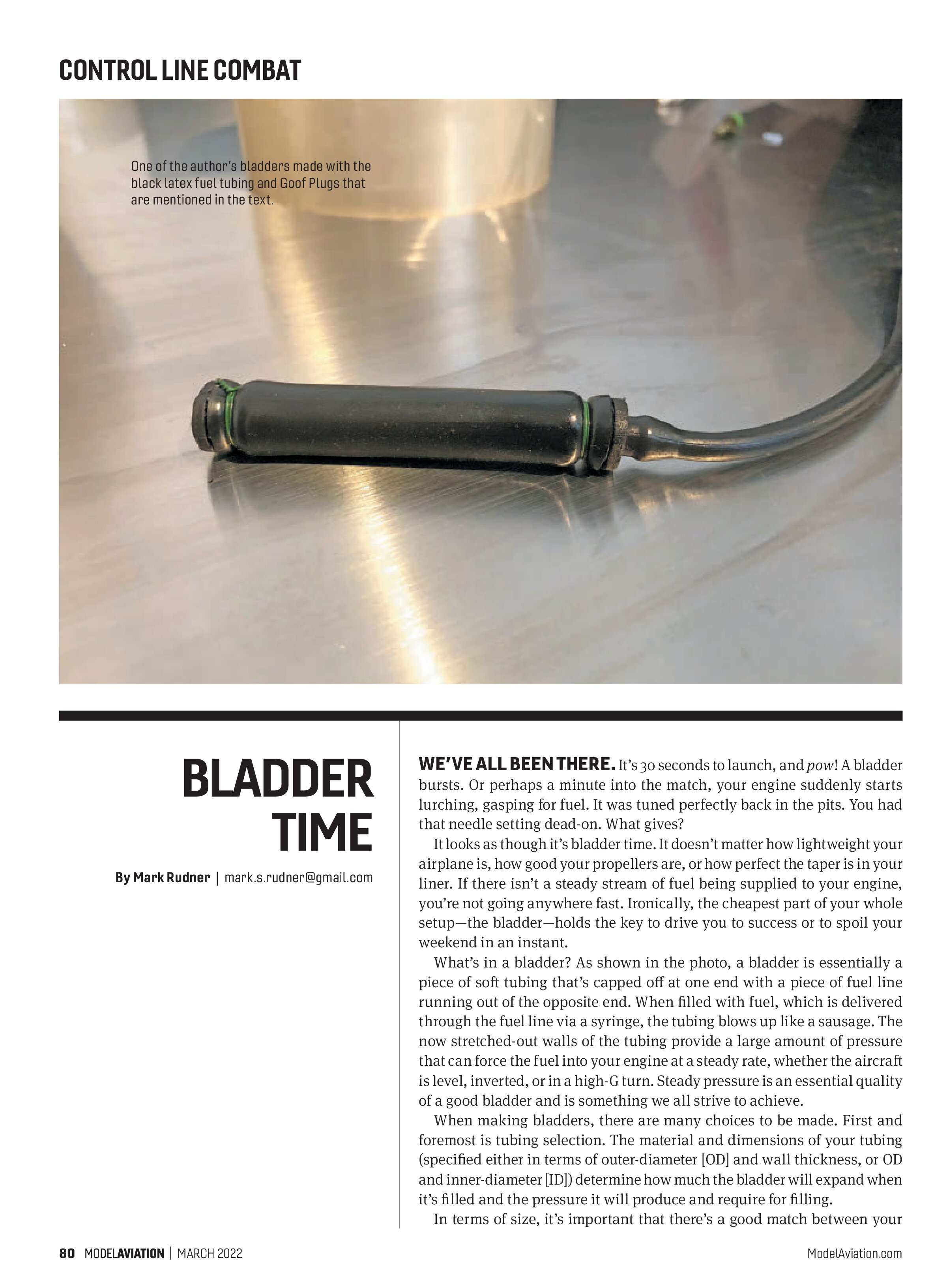
What’s in a bladder? As shown in the photo, a bladder is essentially a piece of soft tubing that’s capped off at one end with a piece of fuel line running out of the opposite end. When filled with fuel, which is delivered through the fuel line via a syringe, the tubing blows up like a sausage. The now stretched-out walls of the tubing provide a large amount of pressure that can force the fuel into your engine at a steady rate, whether the aircraft is level, inverted, or in a high-G turn. Steady pressure is an essential quality of a good bladder and is something we all strive to achieve.
When making bladders, there are many choices to be made. First and foremost is tubing selection. The material and dimensions of your tubing (specified either in terms of outer-diameter [OD] and wall thickness, or OD and inner-diameter [ID]) determine how much the bladder will expand when it’s filled and the pressure it will produce and require for filling.
In terms of size, it’s important that there’s a good match between your model’s bladder compartment and the diameter of the expanded bladder. The bladder should not rattle around loose in the compartment when it’s full, but it also should not try to expand to a larger diameter than the available space. The length of the tubing should also be set so that when you’ve put in a full match’s worth of fuel, there is still some room left—but not a long, excess segment of unexpanded tubing.
When it comes to pressure, there’s some personal preference involved and a wide range of pressures that can work perfectly well. I know some who prefer a slightly lower pressure (as supplied by material with thinner walls), which, for example, makes the bladders easier to fill. Others prefer thicker-walled material that, for example, personal experience might have shown to be consistent and reliable.
More important than the pressure itself is the quality and consistency of the material. There’s plenty of folklore floating around the community about what material is good or bad, but have you ever actually tested your own bladder tubing?
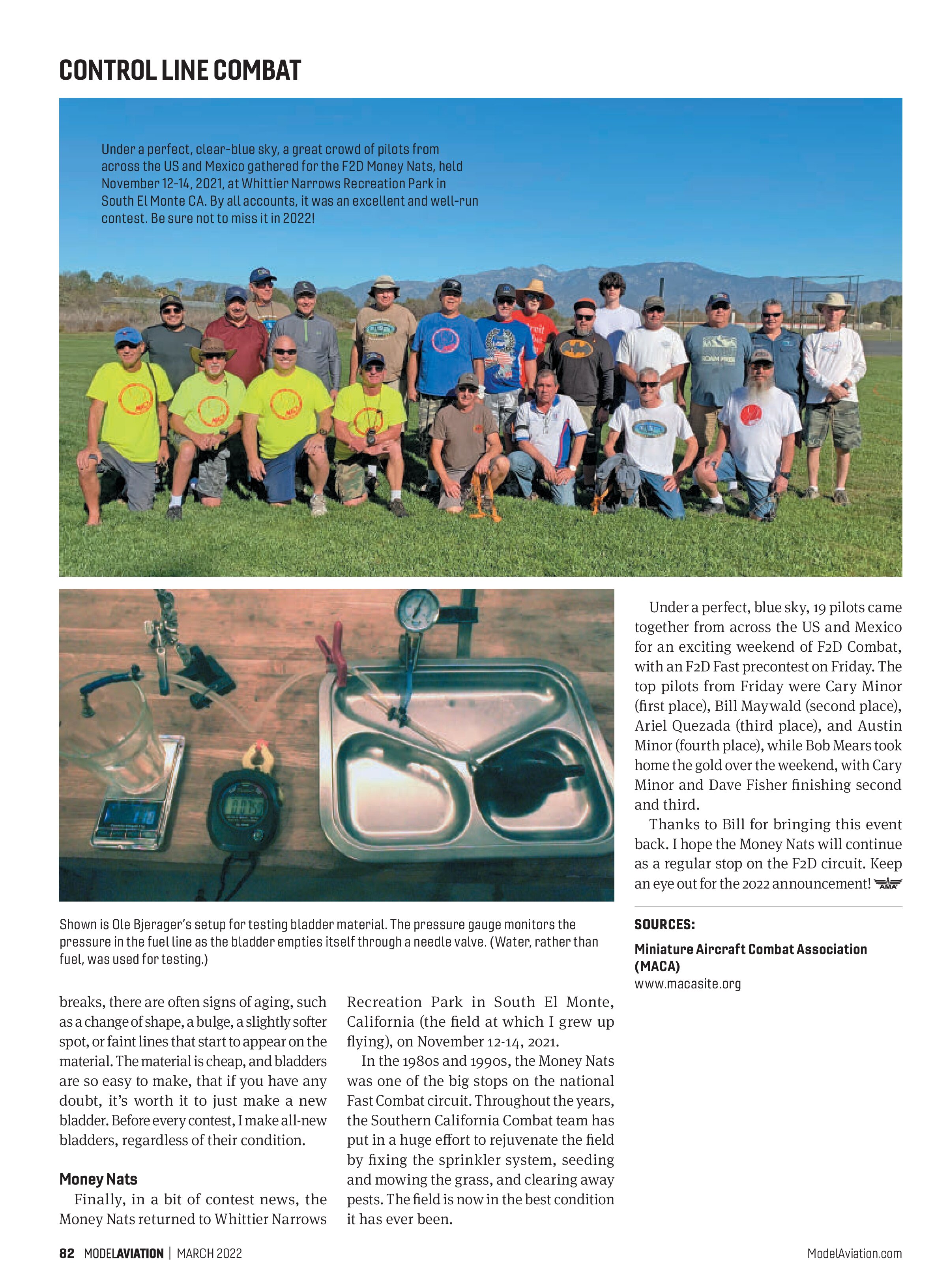
I know a few people who have built bladder test setups using pressure gauges and a needle valve so that they could monitor the pressure in a bladder as it drains all the way from fully filled until empty, at a flow rate comparable to real operating conditions. Ideally, the pressure should be as constant as possible until the very end, when the pressure will spike then drop to zero as the last bit of fuel is emptied.
For years, I have used soft latex rubber tubing from McMaster-Carr (1/4-inch ID; 7/16-inch OD) as my bladder material of choice. The company offers a wide selection of sizes and a choice of black or amber colors.
Although I initially thought that the material for the two colors was the same (apart from the color additive in the black tubing), Ole Bierager, in Denmark, tested both and found that the black tubing held a more consistent pressure. This information should be taken with caution, however, because I have noticed some variations in performance from batch to batch when I have ordered the tubing from year to year.
Aside from the tubing itself, you have various options for how to block off the end of the bladder. Some people tie the tubing in a knot. (This works for soft, not-too-thick tubing.) Others insert a small piece of nylon or aluminum with a diameter close to that of the tubing’s internal diameter then cinch the tubing onto the plug by tying it down tightly with string or metal binding wire.
Many years ago, Rich Lopez found a cool product at Home Depot called Goof Plugs. These nylon plugs (originally intended for drip irrigation systems) fit nicely inside of the tubing. They also come with a barbed end that serves as a perfect attachment point for the fuel line at the opposite end.
The plug itself is solid. In order to use it for the bladder outlet, you need to drill a small hole longitudinally down through the barbed end. The barb itself tends to be slightly sharp and can cause the fuel line to split, so it is worthwhile to take a few seconds to gently file off the sharp corner before connecting the fuel line. For less than $3, you can get a set of five that can be reused and will last you for years.
Making bladders is just the beginning. How do you monitor and maintain your bladders? Where do you store them?
Sunlight is one of your bladder’s worst enemies, with UV rays and heat causing damage that can weaken a bladder and ultimately cause it to fail. Before a bladder
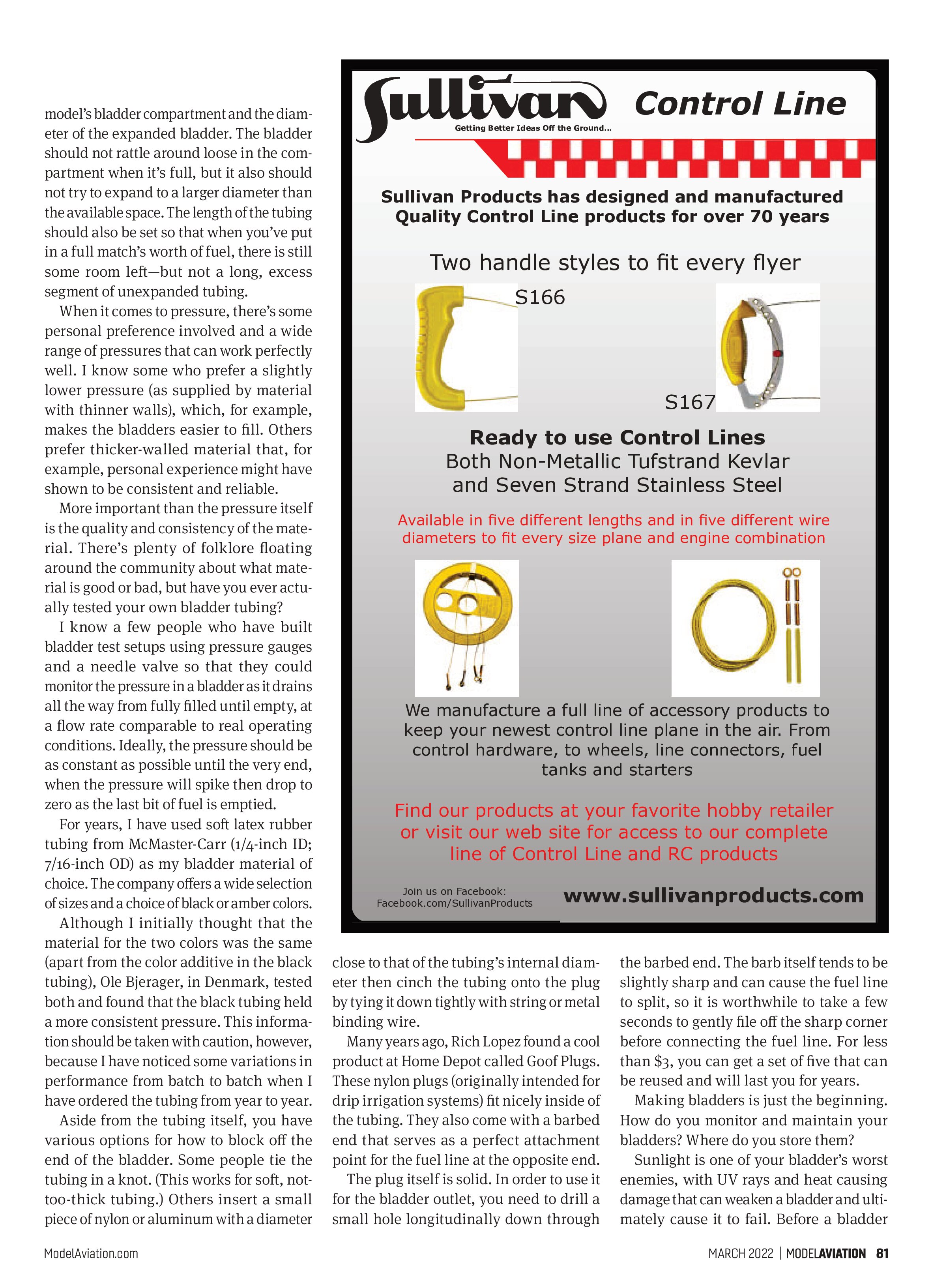
Under a perfect, clear-blue sky, a great crowd of pilots from across the US and Mexico gathered for the F2D Money Nats, held November 12-14, 2021, at Whittier Narrows Recreation Park in South El Monte CA. By all accounts, it was an excellent and well-run contest. Be sure not to miss it in 2022!

Under a perfect, blue sky, 19 pilots came together from across the US and Mexico for an exciting weekend of F2D Combat, with an F2D Fast precontest on Friday. The top pilots from Friday were Cary Minor (first place), Bill Maywald (second place), Ariel Quezada (third place), and Austin Minor (fourth place), while Bob Mears took home the gold over the weekend, with Cary Minor and Dave Fisher finishing second and third.
Thanks to Bill for bringing this event back. I hope the Money Nats will continue as a regular stop on the F2D circuit. Keep an eye out for the 2022 announcement!

Shown is Ole Bleger’s setup for testing bladder material. The pressure gauge monitors the pressure in the fuel line as the bladder empties itself through a needle valve. (Water, rather than fuel, was used for testing.)
breaks, there are often signs of aging, such as a change of shape, a bulge, a slightly softer spot, or faint lines that start to appear on the material. The material is cheap, and bladders are so easy to make, that if you have any doubt, it’s worth it to just make a new bladder. Before every contest, I make all-new bladders, regardless of their condition.
Money Nats
Finally, in a bit of contest news, the Money Nats returned to Whittier Narrows Recreation Park in South El Monte, California (the field at which I grew up flying), on November 12-14, 2021.
In the 1980s and 1990s, the Money Nats was one of the big stops on the national Fast Combat circuit. Throughout the years, the Southern California Combat team has put in a huge effort to rejuvenate the field by fixing the sprinkler system, seeding and mowing the grass, and clearing away pests. The field is now in the best condition it has ever been.
SOURCES:
Miniature Aircraft Combat Association (MACA)
www.macasite.org