Around the Patch

Reader Inspiration
By Thayer Syme | thayer@flying-models.com
THANKS TO ALL WHO have reached out to share their latest building projects. This month, I have two great examples for you. Although both were built from plans that are available from the Flying Models catalog, similar designs, and many more, are also available from the Model Aviation collection and the AMA Plans Service.
CL F4B-4
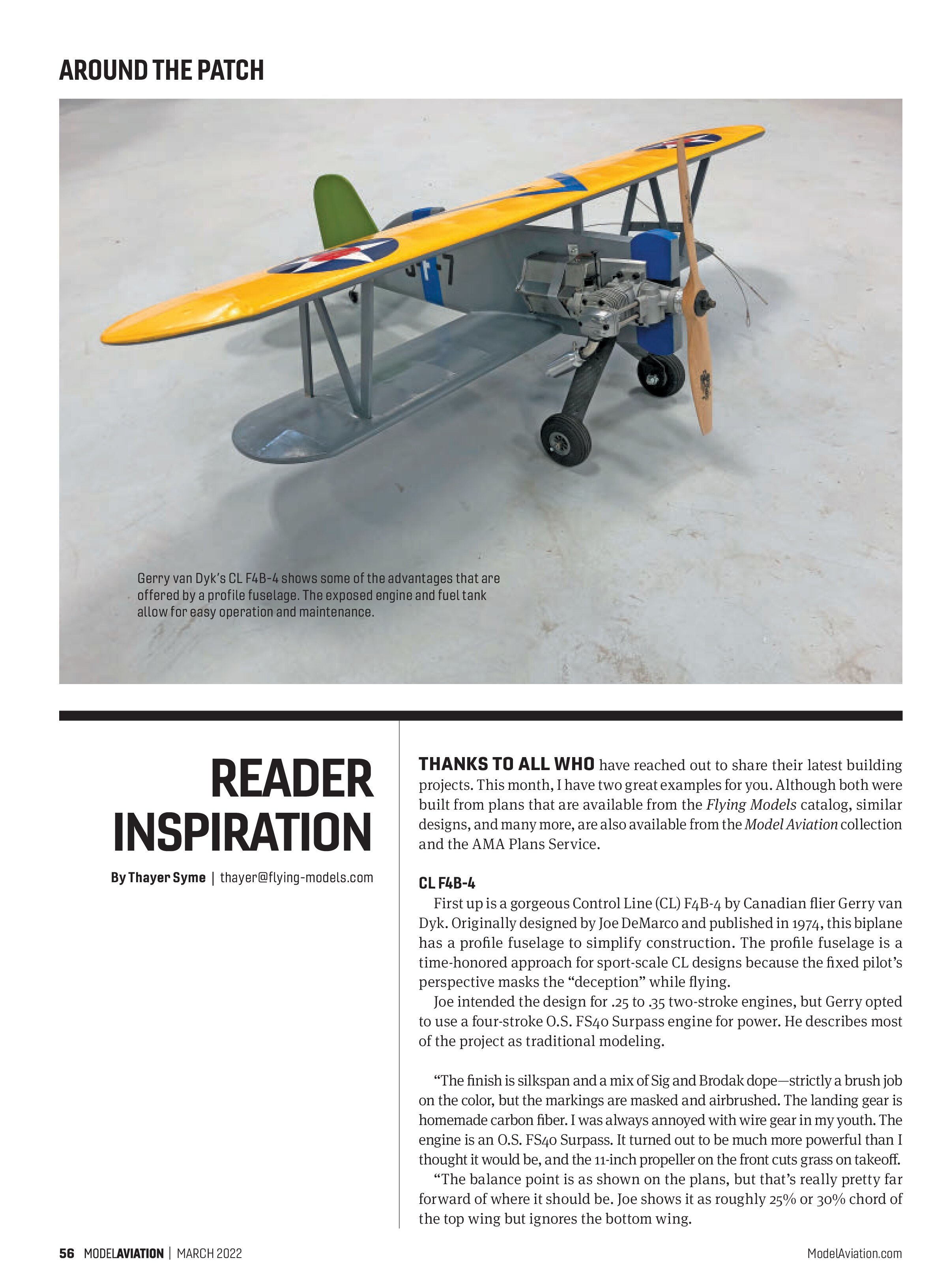
First up is a gorgeous Control Line (CL) F4B-4 by Canadian flier Gerry van Dyk. Originally designed by Joe DeMarco and published in 1974, this biplane has a profile fuselage to simplify construction. The profile fuselage is a time-honored approach for sport-scale CL designs because the fixed pilot’s perspective masks the “deception” while flying.
Joe intended the design for .25 to .35 two-stroke engines, but Gerry opted to use a four-stroke O.S. FS40 Surpass engine for power. He describes most of the project as traditional modeling.
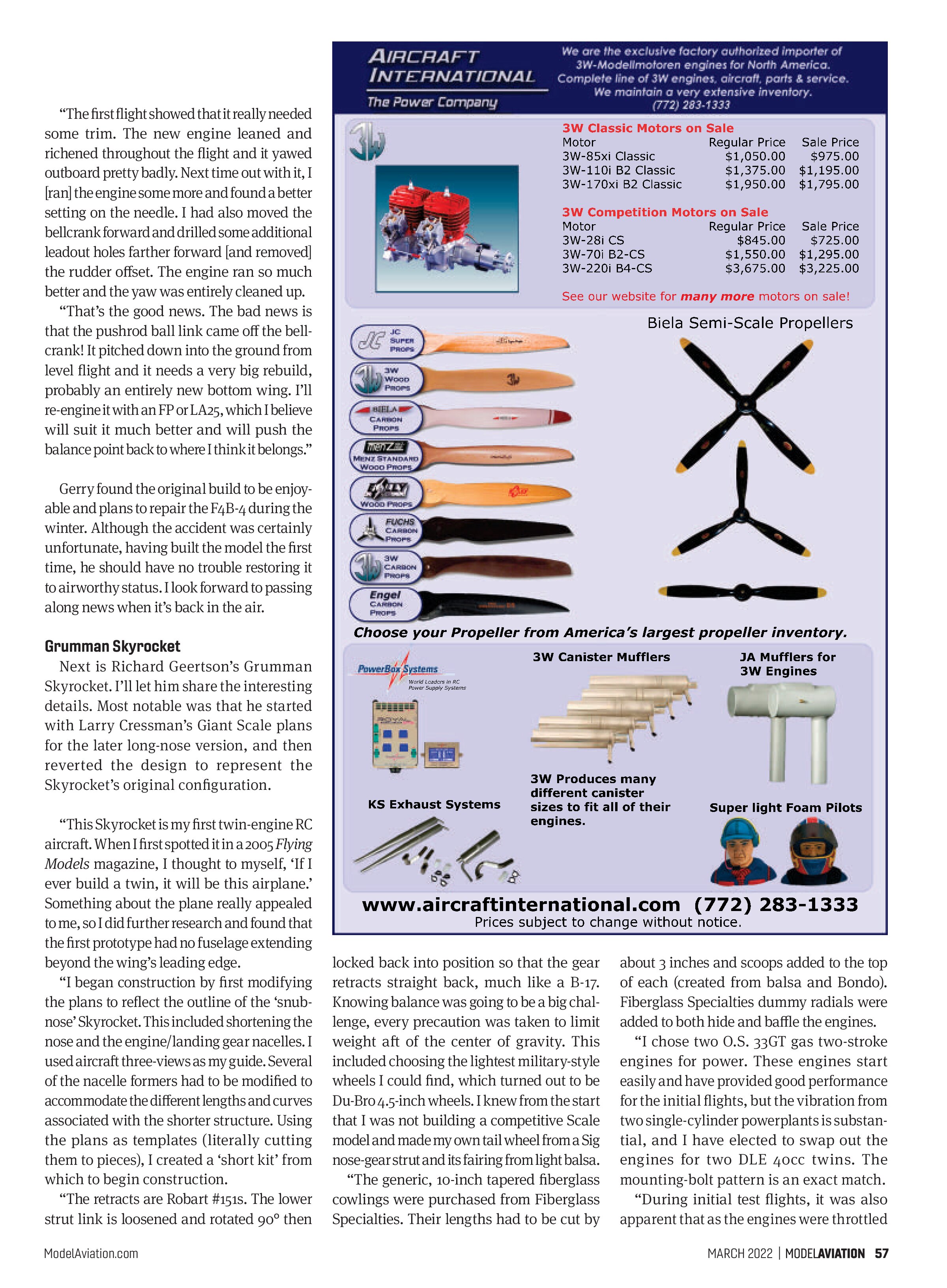
“The finish is silkspan and a mix of Sig and Brodak dope—strictly a brush job on the color, but the markings are masked and airbrushed. The landing gear is homemade carbon fiber. I was always annoyed with wire gear in my youth. The engine is an O.S. FS40 Surpass. It turned out to be much more powerful than I thought it would be, and the 11-inch propeller on the front cuts grass on takeoff.
“The balance point is as shown on the plans, but that’s really pretty far forward of where it should be. Joe shows it as roughly 25% or 30% chord of the top wing but ignores the bottom wing.
“The first flight showed that it really needed some trim. The new engine leaned and richened throughout the flight and it yawed outboard pretty badly. Next time out with it, I [ran] the engine some more and found a better setting on the needle. I had also moved the bellcrank forward and drilled some additional leadout holes farther forward [and removed] the rudder offset. The engine ran so much better and the yaw was entirely cleaned up.
“That’s the good news. The bad news is that the pushrod ball link came off the bellcrank! It pitched down into the ground from level flight and it needs a very big rebuild, probably an entirely new bottom wing. I’ll re-engine it with an FP or LA25, which I believe will suit it much better and will push the balance point back to where I think it belongs.”
Gerry found the original build to be enjoyable and plans to repair the F4B-4 during the winter. Although the accident was certainly unfortunate, having built the model the first time, he should have no trouble restoring it to airworthy status. I look forward to passing along news when it’s back in the air.
Grumman Skyrocket
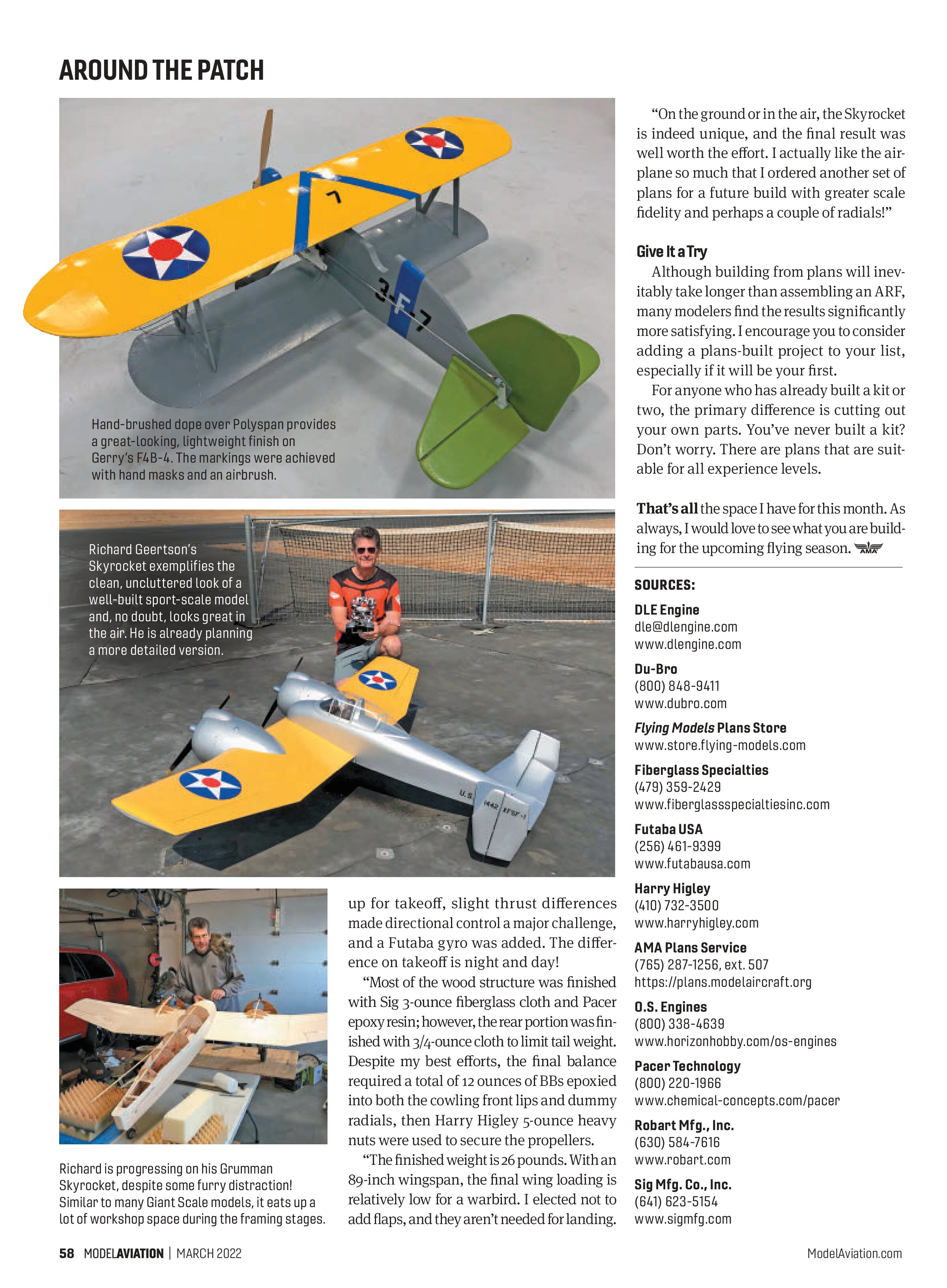
Next is Richard Geertson’s Grumman Skyrocket. I’ll let him share the interesting details. Most notable was that he started with Larry Cressman’s Giant Scale plans for the later long-nose version, and then reverted the design to represent the Skyrocket’s original configuration.
“This Skyrocket is my first twin-engine RC aircraft. When I first spotted it in a 2005 Flying Models magazine, I thought to myself, ‘If I ever build a twin, it will be this airplane.’ Something about the plane really appealed to me, so I did further research and found that the first prototype had no fuselage extending beyond the wing’s leading edge.
“I began construction by first modifying the plans to reflect the outline of the ‘snub-nose’ Skyrocket. This included shortening the nose and the engine/landing gear nacelles. I used aircraft three-views as my guide. Several of the nacelle formers had to be modified to accommodate the different lengths and curves associated with the shorter structure. Using the plans as templates (literally cutting them to pieces), I created a ‘short kit’ from which to begin construction.
“The retracts are Robart #151S. The lower strut link is loosened and rotated 90° then locked back into position so that the gear retracts straight back, much like a B-17. Knowing balance was going to be a big challenge, every precaution was taken to limit weight aft of the center of gravity. This included choosing the lightest military-style wheels I could find, which turned out to be Du-Bro 4.5-inch wheels. I knew from the start that I was not building a competitive Scale model and made my own tail wheel from a Sig nose-gear strut and its fairing from light balsa.
“The generic, 10-inch tapered fiberglass cowlings were purchased from Fiberglass Specialties. Their lengths had to be cut by about 3 inches and scoops added to the top of each (created from balsa and Bondo). Fiberglass Specialties dummy radials were added to both hide and baffle the engines.
“I chose two O.S. 33GT gas two-stroke engines for power. These engines start easily and have provided good performance for the initial flights, but the vibration from two single-cylinder powerplants is substantial, and I have elected to swap out the engines for two DLE 40cc twins. The mounting-bolt pattern is an exact match.
“During initial test flights, it was also apparent that as the engines were throttled
up for takeoff, slight thrust differences made directional control a major challenge, and a Futaba gyro was added. The difference on takeoff is night and day!
“Most of the wood structure was finished with Sig 3-ounce fiberglass cloth and Pacer epoxy resin; however, the rear portion was finished with 3/4-ounce cloth to limit tail weight. Despite my best efforts, the final balance required a total of 12 ounces of BBs epoxied into both the cowling front lips and dummy radials, then Harry Higley 5-ounce heavy nuts were used to secure the propellers.
“The finished weight is 26 pounds. With an 89-inch wingspan, the final wing loading is relatively low for a warbird. I elected not to add flaps, and they aren’t needed for landing.

“On the ground or in the air, the Skyrocket is indeed unique, and the final result was well worth the effort. I actually like the airplane so much that I ordered another set of plans for a future build with greater scale fidelity and perhaps a couple of radials!”
Give It a Try
Although building from plans will inevitably take longer than assembling an ARF, many modelers find the results significantly more satisfying. I encourage you to consider adding a plans-built project to your list, especially if it will be your first.
For anyone who has already built a kit or two, the primary difference is cutting out your own parts. You’ve never built a kit? Don’t worry. There are plans that are suitable for all experience levels.
That’s all
the space I have for this month. As always, I would love to see what you are building for the upcoming flying season.
SOURCES:
DLE Engine
dle@dlengine.com
www.dlengine.com
Du-Bro
(800) 848-9411
www.dubro.com
Flying Models Plans Store
www.store.flying-models.com
Fiberglass Specialties
(479) 359-2429
www.fiberglassspecialtiesinc.com
Futaba USA
(256) 461-9399
www.futabausa.com
Harry Higley
(410) 732-3500
www.harryhigley.com
AMA Plans Service
(765) 287-1256, ext. 507
https://plans.modelaircraft.org
O.S. Engines
(800) 338-4639
www.horizonhobby.com/os-engines
Pacer Technology
(800) 220-1966
www.chemical-concepts.com/pacer
Robart Mfg., Inc.
(630) 584-7616
www.robart.com
Sig Mfg. Co., Inc.
(641) 623-5154
www.sig mfg.com