THE RESURRECTION AIRACOBRA

Photos by Brian Nowicki | brian1@live.com
BRIAN NOWICKI (Stratford, Connecticut) has been building airplanes for the past 15 years. He particularly enjoys scale aircraft, sometimes adding complexity (“and unfortunately, weight”) to his builds.
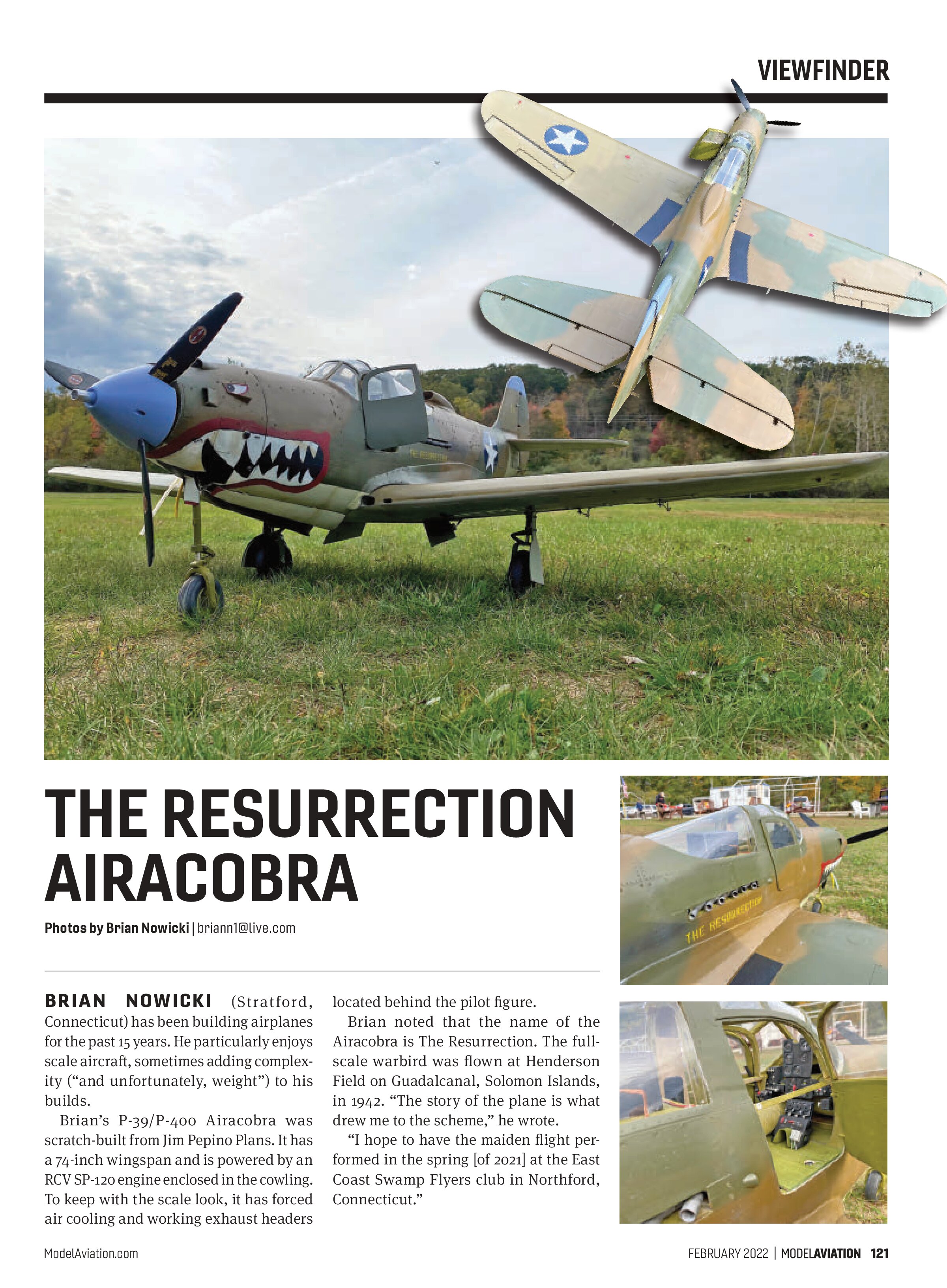
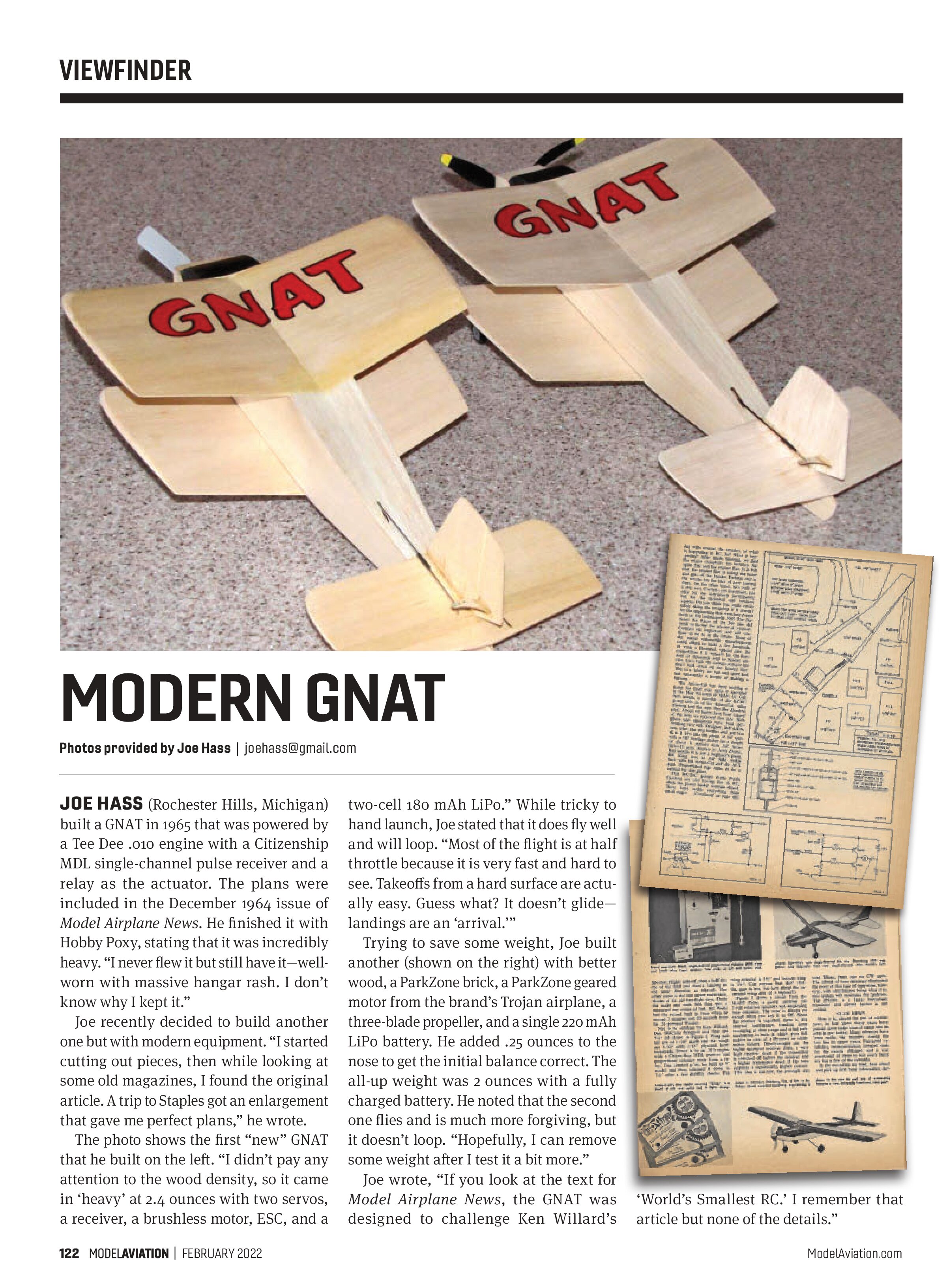
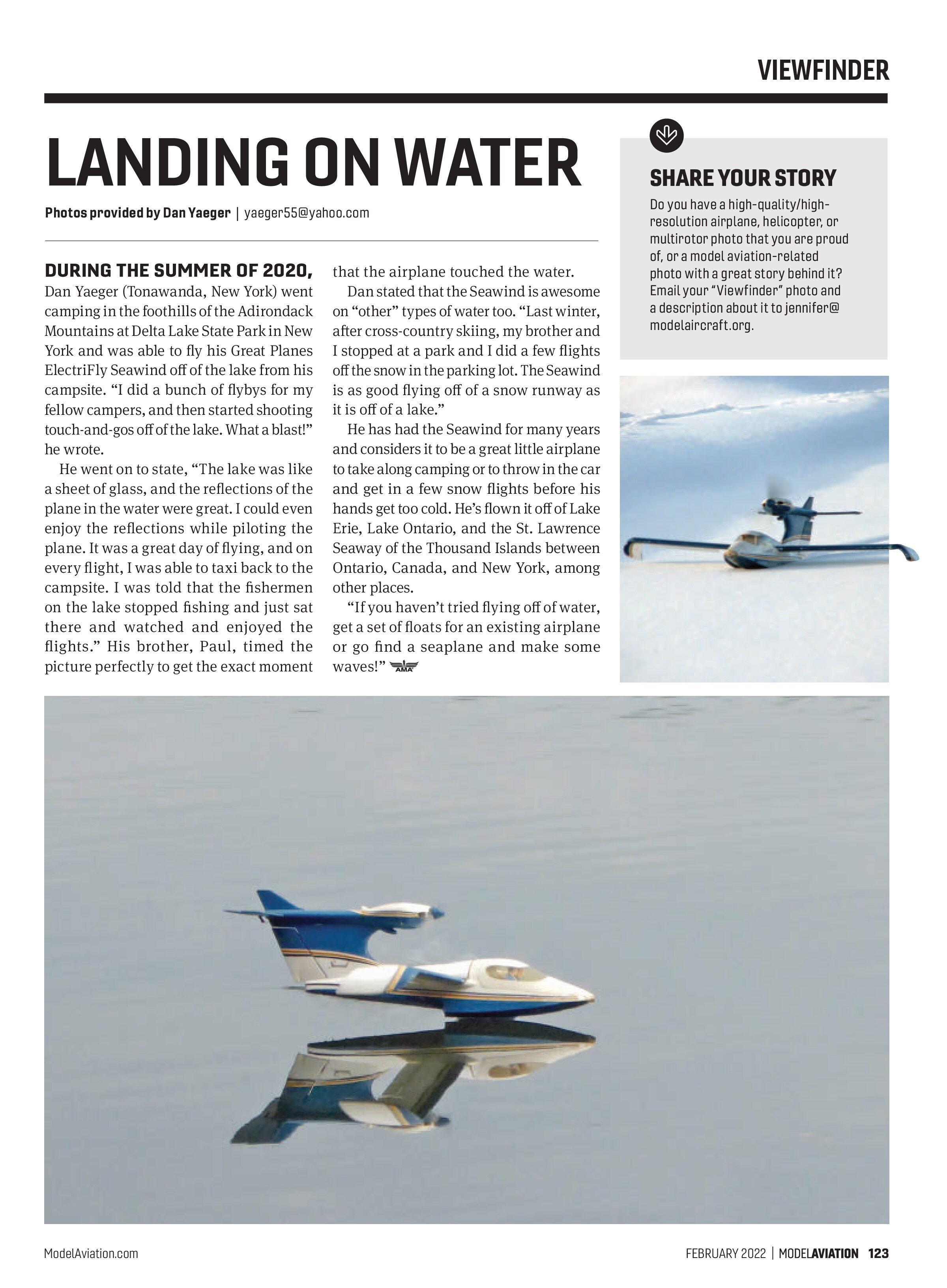
Brian’s P-39/P-400 Airacobra was scratch-built from Jim Pepino Plans. It has a 74-inch wingspan and is powered by an RCV SP-120 engine enclosed in the cowling. To keep with the scale look, it has forced air cooling and working exhaust headers located behind the pilot figure.
Brian noted that the name of the Airacobra is The Resurrection. The full-scale warbird was flown at Henderson Field on Guadalcanal, Solomon Islands, in 1942. “The story of the plane is what drew me to the scheme,” he wrote.
“I hope to have the maiden flight performed in the spring [of 2021] at the East Coast Swamp Flyers club in Northford, Connecticut.”


MODERN GNAT
Photos provided by Joe Hass | joehass@gmail.com
JOE HASS (Rochester Hills, Michigan) built a GNAT in 1965 that was powered by a Tee Dee .010 engine with a Citizenship MDL single-channel pulse receiver and a relay as the actuator. The plans were included in the December 1964 issue of Model Airplane News. He finished it with Hobby Poxy, stating that it was incredibly heavy. “I never flew it but still have it—well-worn with massive hangar rash. I don’t know why I kept it.”
Joe recently decided to build another one but with modern equipment. “I started cutting out pieces, then while looking at some old magazines, I found the original article. A trip to Staples got an enlargement that gave me perfect plans,” he wrote.

The photo shows the first “new” GNAT that he built on the left. “I didn’t pay any attention to the wood density, so it came in ‘heavy’ at 2.4 ounces with two servos, a receiver, a brushless motor, ESC, and a two-cell 180 mAh LiPo.” While tricky to hand launch, Joe stated that it does fly well and will loop. “Most of the flight is at half throttle because it is very fast and hard to see. Takeoffs from a hard surface are actually easy. Guess what? It doesn’t glide—landings are an ‘arrival.’”
Trying to save some weight, Joe built another (shown on the right) with better wood, a ParkZone brick, a ParkZone geared motor from the brand’s Trojan airplane, a three-blade propeller, and a single 220 mAh LiPo battery. He added .25 ounces to the nose to get the initial balance correct. The all-up weight was 2 ounces with a fully charged battery. He noted that the second one flies and is much more forgiving, but it doesn’t loop. “Hopefully, I can remove some weight after I test it a bit more.”
Joe wrote, “If you look at the text for Model Airplane News, the GNAT was designed to challenge Ken Willard’s ‘World’s Smallest RC.’ I remember that article but none of the details.”
LANDING ON WATER
Photos provided by Dan Yaeger | yaeger55@yahoo.com
DURING THE SUMMER OF 2020, Dan Yaeger (Tonawanda, New York) went camping in the foothills of the Adirondack Mountains at Delta Lake State Park in New York and was able to fly his Great Planes ElectriFly Seawind off of the lake from his campsite. “I did a bunch of flybys for my fellow campers, and then started shooting touch-and-gos off of the lake. What a blast!” he wrote.
He went on to state, “The lake was like a sheet of glass, and the reflections of the plane in the water were great. I could even enjoy the reflections while piloting the plane. It was a great day of flying, and on every flight, I was able to taxi back to the campsite. I was told that the fishermen on the lake stopped fishing and just sat there and watched and enjoyed the flights.” His brother, Paul, timed the picture perfectly to get the exact moment that the airplane touched the water.
Dan stated that the Seawind is awesome on “other” types of water too. “Last winter, after cross-country skiing, my brother and I stopped at a park and I did a few flights off the snow in the parking lot. The Seawind is as good flying off of a snow runway as it is off of a lake.”
He has had the Seawind for many years and considers it to be a great little airplane to take along camping or to throw in the car and get in a few snow flights before his hands get too cold. He’s flown it off of Lake Erie, Lake Ontario, and the St. Lawrence Seaway of the Thousand Islands between Ontario, Canada, and New York, among other places.
“If you haven’t tried flying off of water, get a set of floats for an existing airplane or go find a seaplane and make some waves!”