SMALL-FIELD FLYING

BUILDING SUPPLY COMPANIES
By Pat Trittle | patscustommodels@gmail.com
FOR MOST OF US, winter is no doubt in full swing, which means building season is too. That also means that many of us need building supplies, which are often in short supply these days. Where do they come from?
For those who are fortunate enough to have a local hobby shop with a full line of products, please support it. For those of us who once did, I can say without reservation that “you don’t know what you got ’til it’s gone.” Unfortunately, I no longer have the luxury of a full hobby shop, so the internet has become my go-to supplier.
Throughout the years, I’ve used a couple of sources to gather many of the items that I use the most. For those who enjoy building, here are a few of the suppliers that I’ve been using and I’m happy with both the quality of their products and their service.
There are a couple of sources for balsa wood. I’ve ordered from National Balsa. The company also carries full lines of basswood and spruce, and a number of hardwood sticks and sheets for those who also build boats. Another choice is Bud Nosen Models.
For scratch- and short-kit builders, a good source for wire and tubing and other related items—and my personal favorite—is Hobbylinc.com. As an all-around modeler, this is the best source that I’ve found. The company offers a full line of wood, wire, tubing, sheet styrene, modeling tools, glue, paint, and a number of Free Flight (FF) and park flyer kits from Guillows and Dumas, as well as plastic model kits, which make terrific references for scale projects.
For power gear, Altitude Hobbies is my go-to company for servos, motors, ESCs, propellers, and other park flyer-related small parts. For wheels, wheel collars, iron-on covering, and other small parts, Tower Hobbies is hard to beat.
Finally, Peck-Polymers is a great source for FF supplies, and for those who still prefer traditional-type coverings, good sources for dope are Brodak Manufacturing and Sig Mfg. Co.
The contact information for these companies is listed in “Sources.”
A Look at What Builders Are Up To
The dust has been flying, and the results are in. We have a nice variety again this time around, so let’s get started.
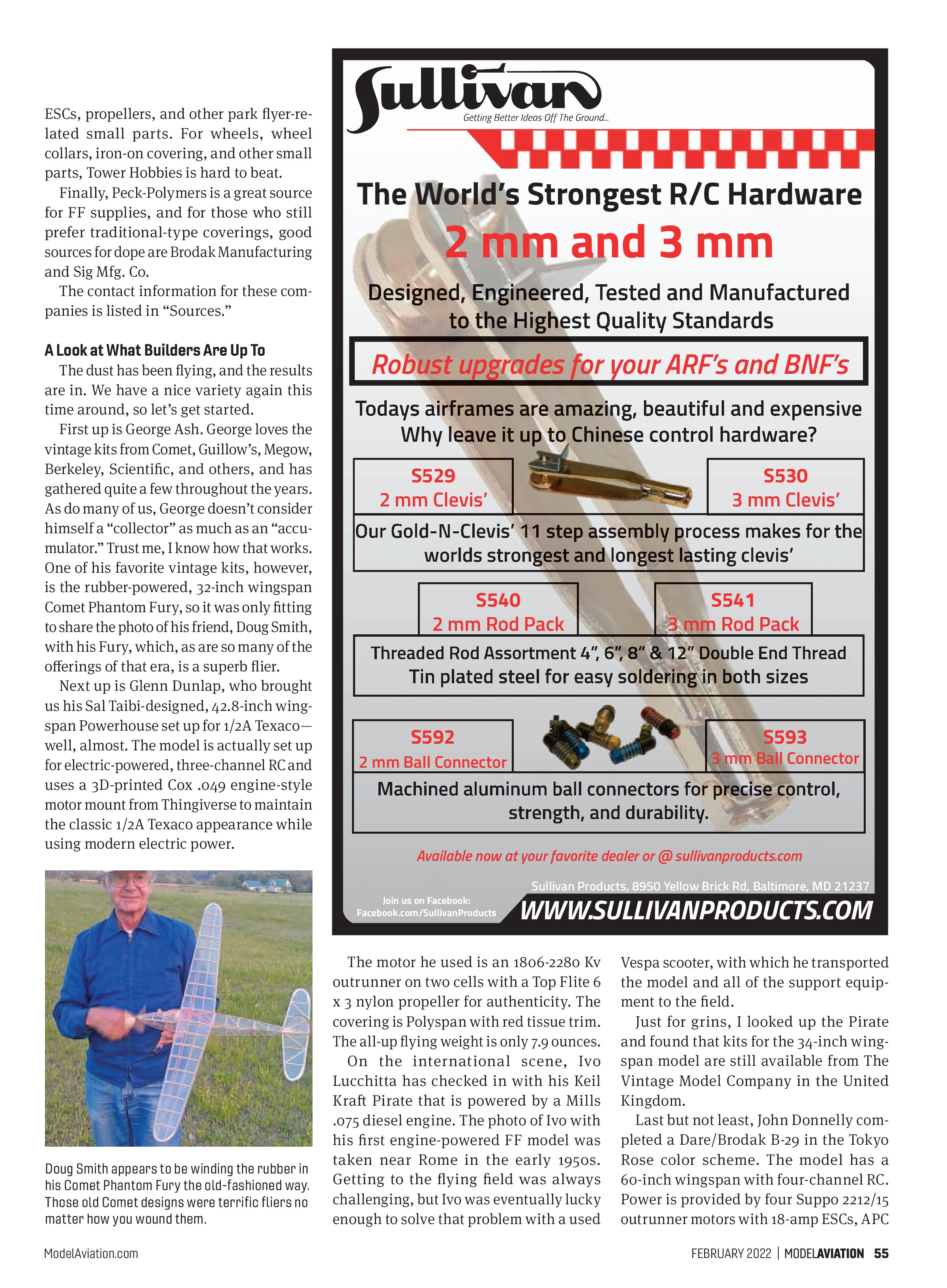
First up is George Ash. George loves the vintage kits from Comet, Guillows, Megow, Berkeley, Scientific, and others, and has gathered quite a few throughout the years. As do many of us, George doesn’t consider himself a “collector” as much as an “accumulator.” Trust me, I know how that works. One of his favorite vintage kits, however, is the rubber-powered, 32-inch wingspan Comet Phantom Fury, so it was only fitting to share the photo of his friend, Doug Smith, with his Fury, which, as are so many of the offerings of that era, is a superb flier.
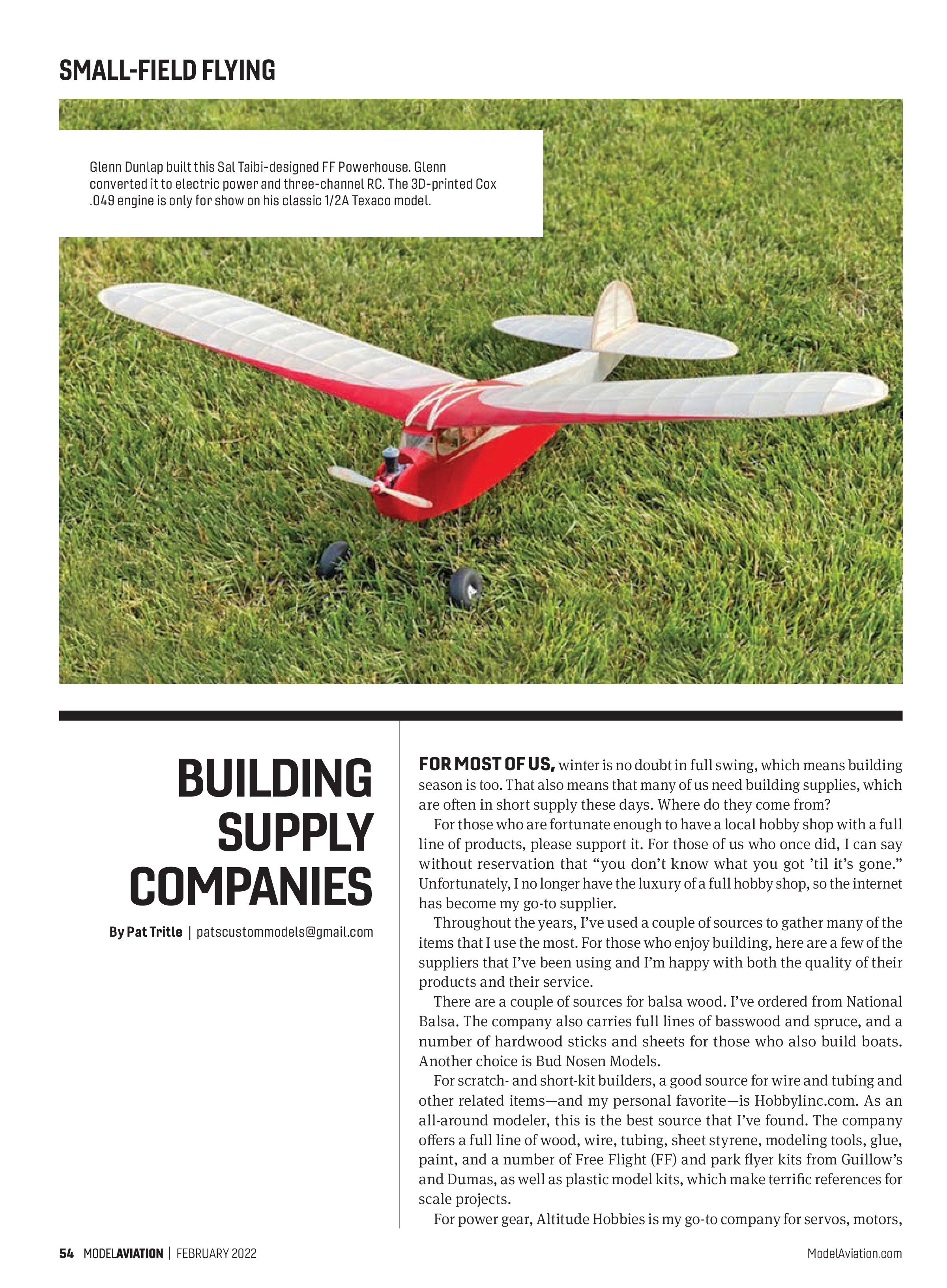
Next up is Glenn Dunlap, who brought us his Sal Taibi-designed, 42.8-inch wingspan Powerhouse set up for 1/2A Texaco—well, almost. The model is actually set up for electric-powered, three-channel RC and uses a 3D-printed Cox .049 engine-style motor mount from Thingiverse to maintain the classic 1/2A Texaco appearance while using modern electric power.

The motor he used is an 1806-2280 Kv outrunner on two cells with a Top Flite 6 x 3 nylon propeller for authenticity. The covering is Polyspan with red tissue trim. The all-up flying weight is only 7.9 ounces.
On the international scene, Ivo Lucchitta has checked in with his Keil Kraft Pirate that is powered by a Mills .075 diesel engine. The photo of Ivo with his first engine-powered FF model was taken near Rome in the early 1950s. Getting to the flying field was always challenging, but Ivo was eventually lucky enough to solve that problem with a used Vespa scooter, with which he transported the model and all of the support equipment to the field.
Just for grins, I looked up the Pirate and found that kits for the 34-inch wingspan model are still available from The Vintage Model Company in the United Kingdom.
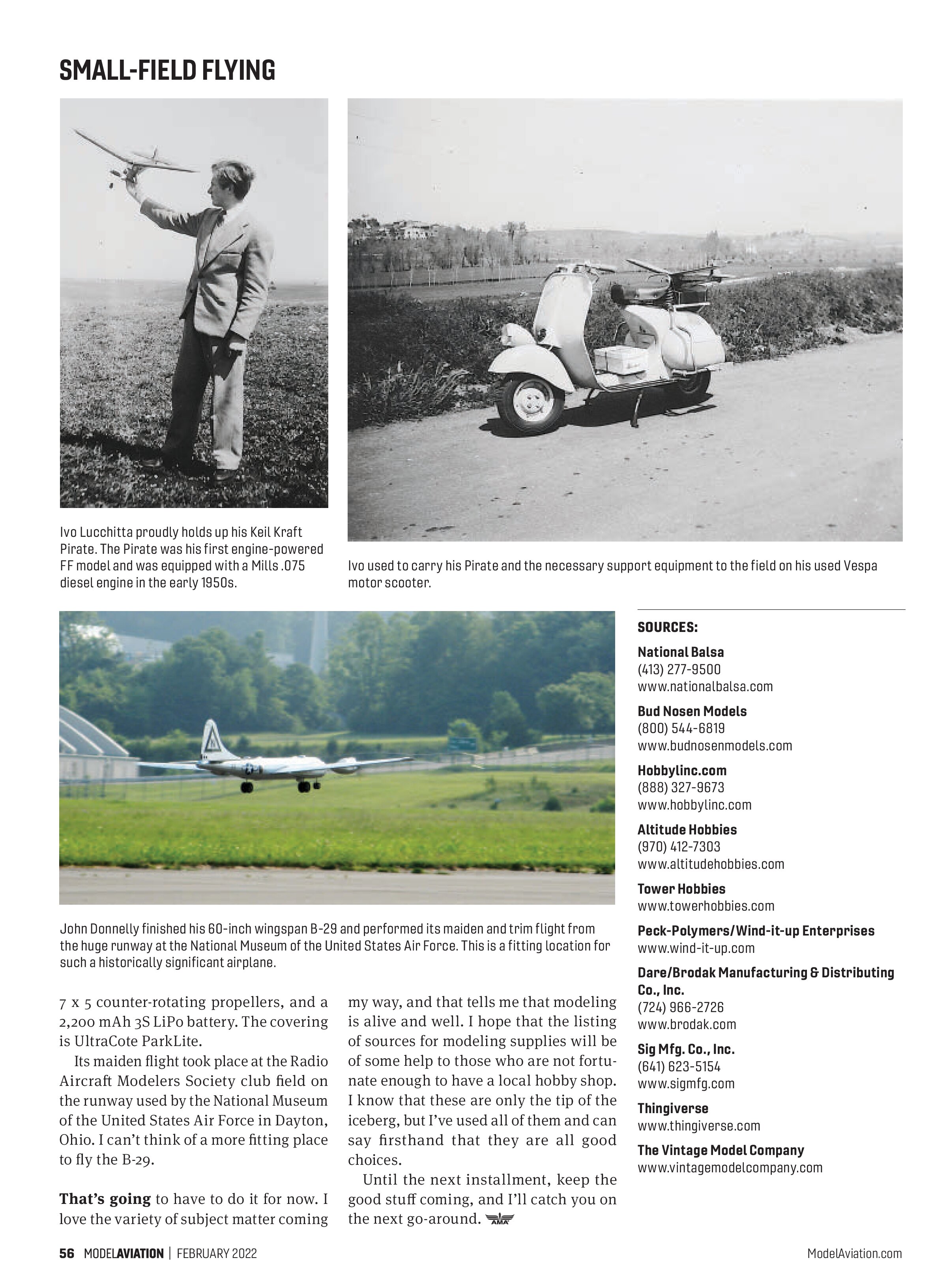
Last but not least, John Donnelly completed a Dare/Brodak B-29 in the Tokyo Rose color scheme. The model has a 60-inch wingspan with four-channel RC. Power is provided by four Suppo 2212/15 outrunner motors with 18-amp ESCs, APC


7 x 5 counter-rotating propellers, and a 2,200 mAh 3S LiPo battery. The covering is UltraCote ParkLite.
Its maiden flight took place at the Radio Aircraft Modelers Society club field on the runway used by the National Museum of the United States Air Force in Dayton, Ohio. I can’t think of a more fitting place to fly the B-29.
That’s going to have to do it for now. I love the variety of subject matter coming my way, and that tells me that modeling is alive and well. I hope that the listing of sources for modeling supplies will be of some help to those who are not fortunate enough to have a local hobby shop. I know that these are only the tip of the iceberg, but I’ve used all of them and can say firsthand that they are all good choices.
Until the next installment, keep the good stuff coming, and I’ll catch you on the next go-around.
SOURCES:
National Balsa
(413) 277-9500
www.nationalbalsa.com
Bud Nosen Models
(800) 544-6819
www.budnosenmodels.com
Hobbylinc.com
(888) 327-9673
www.hobbylinc.com
Altitude Hobbies
(970) 412-7303
www.altitudehobbies.com
Tower Hobbies
www.towerhobbies.com
Peck-Polymers/Wind-it-up Enterprises
www.wind-it-up.com
Dare/Brodak Manufacturing & Distributing Co., Inc.
(724) 966-2726
www.brodak.com
Sig Mfg. Co., Inc.
(641) 623-5154
www.sigmfg.com
Thingiverse
www.thingiverse.com
The Vintage Model Company
www.vintagemodelcompany.com