RC SLOPE SOARING

KING MOUNTAIN
By Greg Schutte | gshooty@yahoo.com
WITH NEARLY EVERY ARTICLE that I write, I receive emails inquiring about why I don’t share my flying locations. This month, I’m going to do a review of one place that is very special to me: King Mountain.
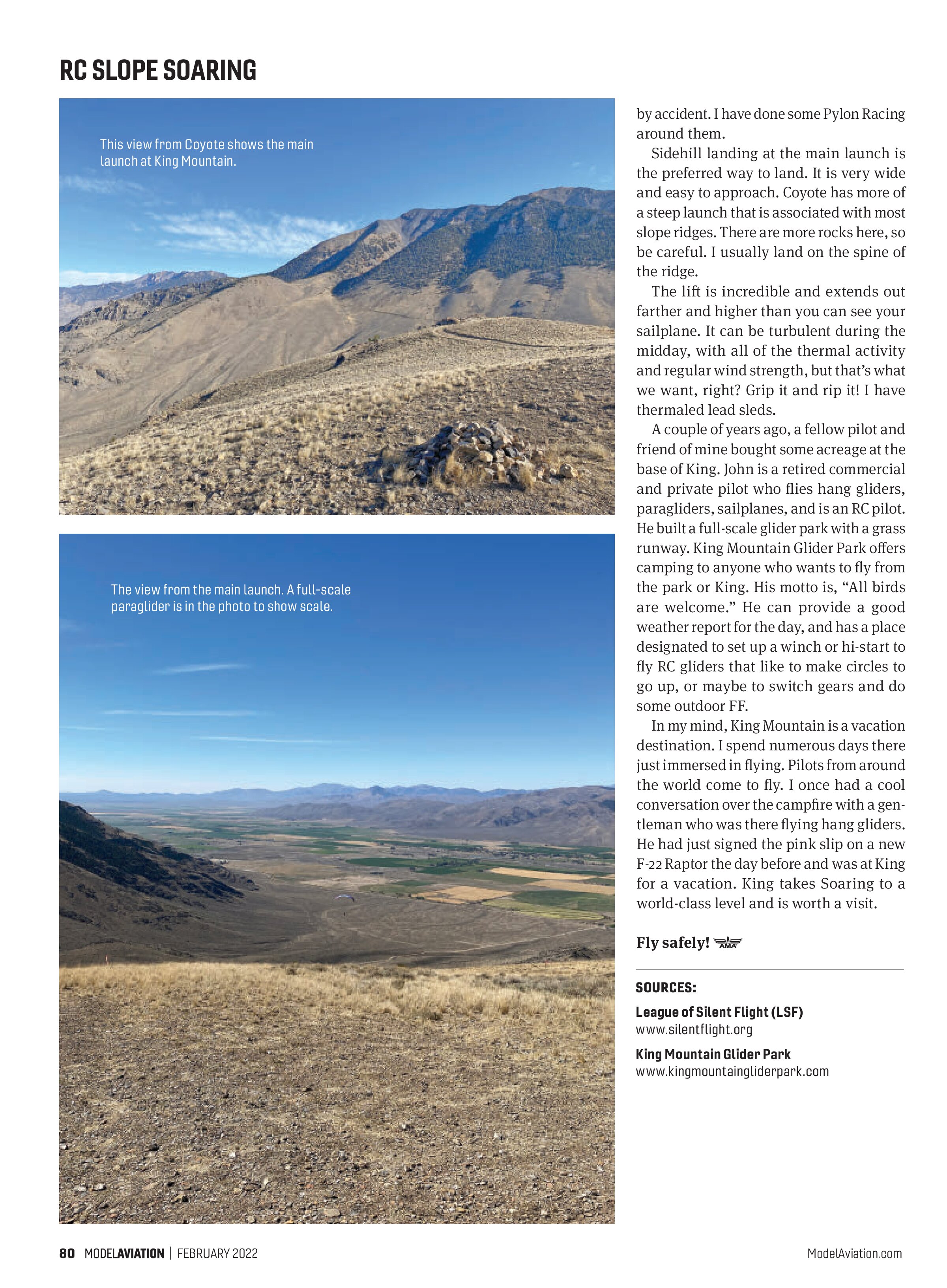
King, as it’s referred to, sits in the Lost River Mountain range near Moore, Idaho. The top of King is 10,612 feet high. The launch sites are in the 7,500-foot-altitude range, and the valley floor is approximately 5,500 feet in elevation. There is plenty of ridge to soar your flying machines.
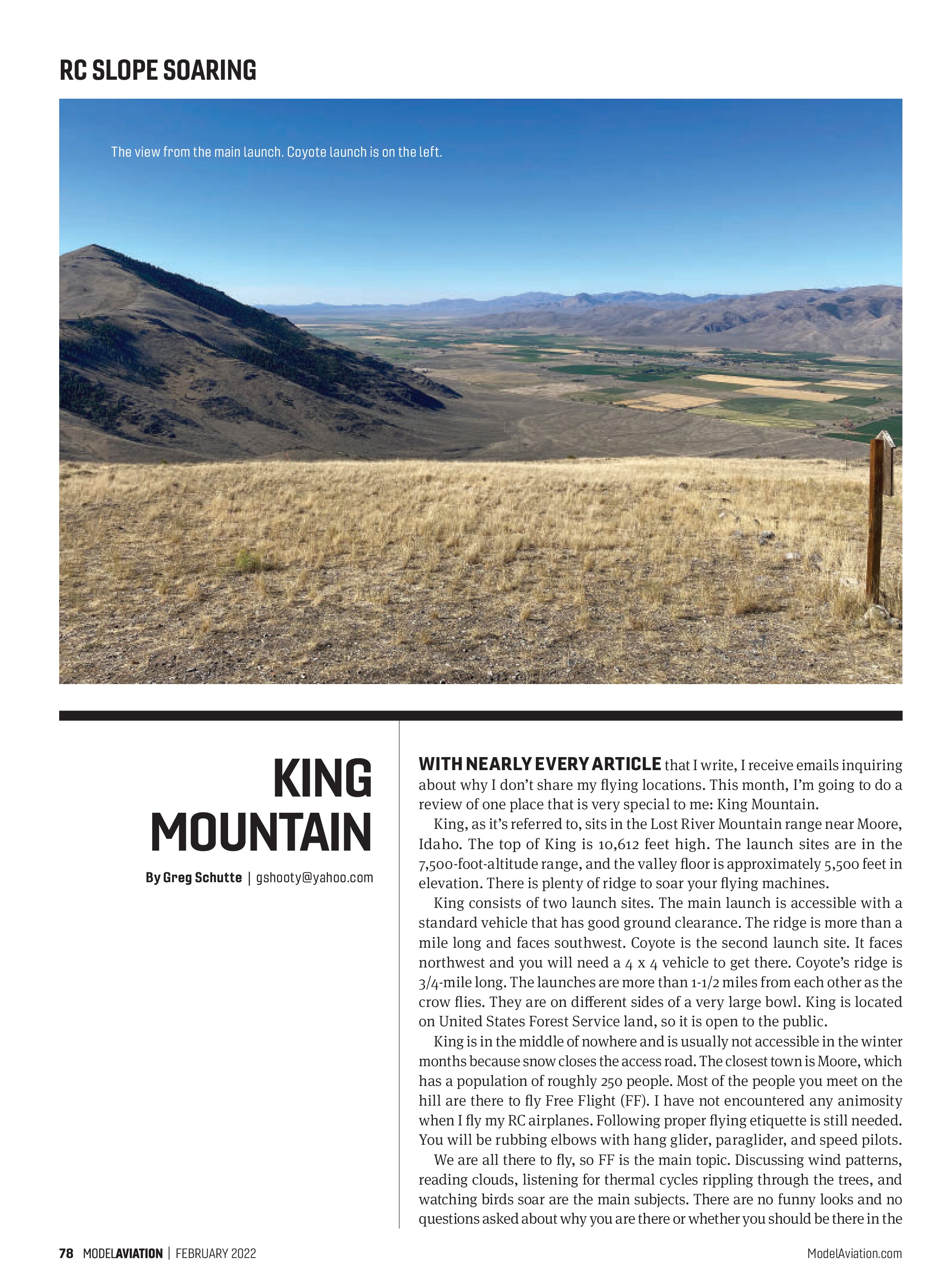
King consists of two launch sites. The main launch is accessible with a standard vehicle that has good ground clearance. The ridge is more than a mile long and faces southwest. Coyote is the second launch site. It faces northwest and you will need a 4 X 4 vehicle to get there. Coyote’s ridge is 3/4-mile long. The launches are more than 1-1/2 miles from each other as the crow flies. They are on different sides of a very large bowl. King is located on United States Forest Service land, so it is open to the public.
King is in the middle of nowhere and is usually not accessible in the winter months because snow closes the access road. The closest town is Moore, which has a population of roughly 250 people. Most of the people you meet on the hill are there to fly Free Flight (FF). I have not encountered any animosity when I fly my RC airplanes. Following proper flying etiquette is still needed. You will be rubbing elbows with hang glider, paraglider, and speed pilots.
We are all there to fly, so FF is the main topic. Discussing wind patterns, reading clouds, listening for thermal cycles rippling through the trees, and watching birds soar are the main subjects. There are no funny looks and no questions asked about why you are there or whether you should be there in the first place. The area is a designated FF area.
The weather patterns are conducive to FF. If you remember, I wrote about flying at Barclay Bay in a previous article and the weather phenomenon that happens there. I’m referring to the anabatic and katabatic wind flow cycles—“wonder wind” or “glass-off” are the common terms. At King, it happens on a grand scale. My first paraglider flight that I had there took me to more than 11,000 feet. This was in glass-off conditions—I wasn’t thermal flying. That is the highest I’ve ever been in a FF aircraft.
With the two ridges facing into the prevailing wind, it is flyable nearly every day. The Lost River Mountain range is basically a large, long slope. There is a road that follows the range at its base, and you could theoretically sit in the back of a vehicle and soar your 1/4-scale sailplane for miles. Think about that for a minute.
A typical summer day at King starts approximately 3 a.m. The katabatic flow starts blowing down the valley. As sunrise gets closer, the katabatic flow usually picks up. The wind blows right into the face of Coyote. Coyote is the place to be at sunrise. It usually blows 10 to 25 mph until around 10 a.m., then it calms down. At roughly noon, a light breeze will start blowing into the main launch at King.
As the day progresses, the thermals and breeze get stronger. You can measure their strength by how loud they are when they are rippling through the trees as they come from the valley floor and travel up the mountain to the top. At approximately 5 p.m., the anabatic flow begins to occur. When it happens, the thermals in the whole valley begin to go up. You must search for sink to get down. Many hang glider and paraglider pilots have been caught in the glass-off and stuck at 10,000 to 16,000 feet until after dark.
What I just described to you is a high-pressure day, when the surface wind forecast is 5 to 10 mph. You throw in any kind of weather and King starts to get scary strong. How scary? I have been on Coyote when the wind has been more than 55 mph on the lip. I was afraid to throw a rock off the hill. The rock would probably have come back and hit me.
I have been at the main launch when the wind has been blowing more than 40 mph sustained. That day was forecast to be 15 to 25 mph in the valley. There are storm days where the wind gets incredible to say the least. Dynamic Soaring could have some potential here.

Both launches are mountain terrain with a mixture of rocks and grass. The main launch is gentle, and the rocks are not as numerous. Two windsocks have been placed high in the trees on each side to show the prevailing wind direction, and there are a couple of smaller wind indicators at the main launch. They are closer to the ground and flexible in case you tag one


by accident. I have done some Pylon Racing around them.
Sidehill landing at the main launch is the preferred way to land. It is very wide and easy to approach. Coyote has more of a steep launch that is associated with most slope ridges. There are more rocks here, so be careful. I usually land on the spine of the ridge.
The lift is incredible and extends out farther and higher than you can see your sailplane. It can be turbulent during the midday, with all of the thermal activity and regular wind strength, but that’s what we want, right? Grip it and rip it! I have thermaled lead sleds.
A couple of years ago, a fellow pilot and friend of mine bought some acreage at the base of King. John is a retired commercial and private pilot who flies hang gliders, paragliders, sailplanes, and is an RC pilot. He built a full-scale glider park with a grass runway. King Mountain Glider Park offers camping to anyone who wants to fly from the park or King. His motto is, “All birds are welcome.” He can provide a good weather report for the day, and has a place designated to set up a winch or hi-start to fly RC gliders that like to make circles to go up, or maybe to switch gears and do some outdoor FF.
In my mind, King Mountain is a vacation destination. I spend numerous days there just immersed in flying. Pilots from around the world come to fly. I once had a cool conversation over the campfire with a gentleman who was there flying hang gliders. He had just signed the pink slip on a new F-22 Raptor the day before and was at King for a vacation. King takes Soaring to a world-class level and is worth a visit.
Fly safely!
SOURCES:
League of Silent Flight (LSF)
www.silentflight.org
King Mountain Glider Park
www.kingmountaingliderpark.com