BATTERY SELECTION
By John Glezellis | jglezellis@gmail.com
AS I WROTE THIS COLUMN, the 2021 flying season was nearing an end, especially for those of us who reside in the northeastern region of the US. However, the winter timeframe is ideal to work on a new competition International Miniature Aerobatic Club (IMAC) aircraft, perform routine maintenance, or even upgrade an existing aircraft with modern equipment.
In terms of all of the components found on the aircraft, you must make many decisions that will ultimately drive the manner in which the model performs. Regarding my personal aerobatic fleet, the models I construct or assemble for IMAC Known and Unknown sequences typically differ from those that are strictly built for a Freestyle or demonstration event in terms of the servo operating voltages.
Throughout the course of this column, I will discuss battery selection to cater to your flying needs and review a few product offerings in terms of supplying redundant power to the receiver for additional safety. Without further delay, let’s get started!
Battery Selection Basics
For a 35% or larger airframe, I prefer the use of two 4,000 mAh batteries and a separate 2,000 mAh battery for the ignition. Smaller-capacity batteries can be used, but it is mandatory to monitor the battery voltage between flights or throughout the flight and that the connectors used on the battery are appropriate. Generally, only 60% of the available capacity should be used in an effort to ensure sufficient reserve battery capacity before charging is required.
It is common to use approximately 400 mAh on an aerobatic model with high-performance servos, but ultimately, you should monitor battery voltages between flights. If consumption differs significantly, examine the aircraft because perhaps something is wrong with the linkage assembly, a servo, the batteries, etc.
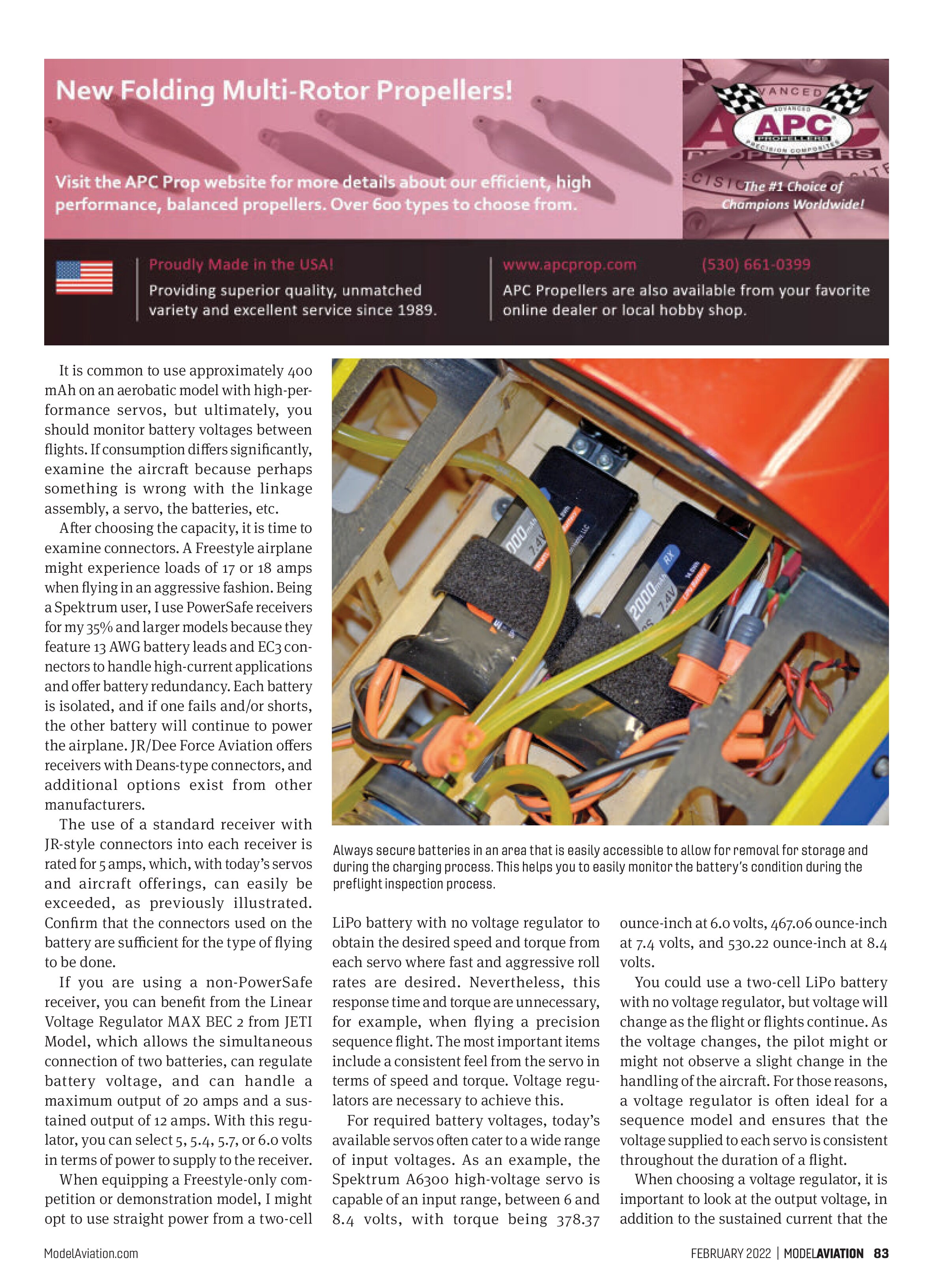
After choosing the capacity, it is time to examine connectors. A Freestyle airplane might experience loads of 17 or 18 amps when flying in an aggressive fashion. Being a Spektrum user, I use PowerSafe receivers for my 35% and larger models because they feature 13 AWG battery leads and EC3 connectors to handle high-current applications and offer battery redundancy. Each battery is isolated, and if one fails and/or shorts, the other battery will continue to power the airplane. JR/Dee Force Aviation offers receivers with Deans-type connectors, and additional options exist from other manufacturers.

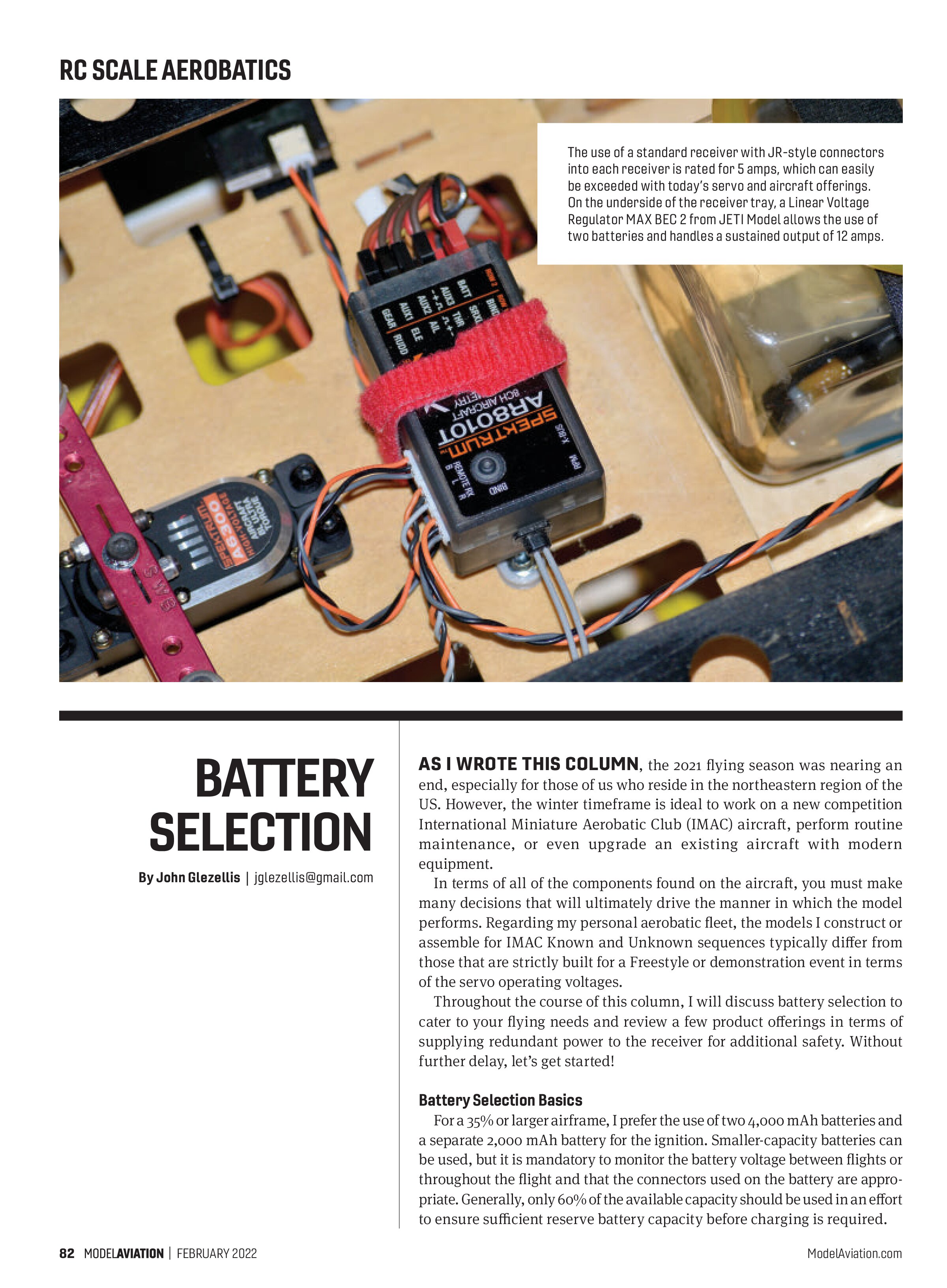
The use of a standard receiver with JR-style connectors into each receiver is rated for 5 amps, which, with today’s servos and aircraft offerings, can easily be exceeded, as previously illustrated. Confirm that the connectors used on the battery are sufficient for the type of flying to be done.
If you are using a non-PowerSafe receiver, you can benefit from the Linear Voltage Regulator MAX BEC 2 from JETI Model, which allows the simultaneous connection of two batteries, can regulate battery voltage, and can handle a maximum output of 20 amps and a sustained output of 12 amps. With this regulator, you can select 5, 5.4, 5.7, or 6.0 volts in terms of power to supply to the receiver.
When equipping a Freestyle-only competition or demonstration model, I might opt to use straight power from a two-cell LiPo battery with no voltage regulator to obtain the desired speed and torque from each servo where fast and aggressive roll rates are desired. Nevertheless, this response time and torque are unnecessary, for example, when flying a precision sequence flight. The most important items include a consistent feel from the servo in terms of speed and torque. Voltage regulators are necessary to achieve this.
For required battery voltages, today’s available servos often cater to a wide range of input voltages. As an example, the Spektrum A6300 high-voltage servo is capable of an input range, between 6 and 8.4 volts, with torque being 378.37 ounce-inch at 6.0 volts, 467.06 ounce-inch at 7.4 volts, and 530.22 ounce-inch at 8.4 volts.
You could use a two-cell LiPo battery with no voltage regulator, but voltage will change as the flight or flights continue. As the voltage changes, the pilot might or might not observe a slight change in the handling of the aircraft. For those reasons, a voltage regulator is often ideal for a sequence model and ensures that the voltage supplied to each servo is consistent throughout the duration of a flight.
When choosing a voltage regulator, it is important to look at the output voltage, in addition to the sustained current that the
RC SCALE AEROBATICS
voltage regulator can handle. Additionally, for some voltage regulators, you can change the output voltage either with a mechanical switch or by shorting various pins found on the voltage regulator. When doing so, verify the output voltage with a voltmeter before connecting anything to the receiver or the servos. Some servos are able to operate at 8.4 volts and others at 12.6 volts. Regardless of the voltage, regulating the voltage down is essential to allow a pilot to have consistency in speed and torque, no matter what stage of the flight he or she is in.
PowerBox-Systems offers a unit called the PowerBox Competition SR2, which supports PowerBox, Futaba, JETI, and Spektrum receivers, to name a few. A lot of capability exists, such as servo-matching for 22 outputs, output voltage selection of 6.0, 7.4, or 7.8 volts, as well as unregulated, and a lot of features that Scale enthusiasts can utilize, such as door sequencers and iGyro technology.
For an IMAC competitor, however, the number of servo outputs, output voltages, and even the maximum load of 2 x 20 amps, are extremely impressive. PowerBox offers quite a few different products for power distribution. In short, these are just a few advantages to using a system such as this. Remember, though—gyro use is not allowed in IMAC competition.
Mounting and Connections
Batteries should be installed in an easily accessible area where they can be removed with ease and taken out during the charging process so that if an error is encountered, the aircraft will not be at risk. Because we are looking at safety, LiPo cells should never be stored while fully charged because sitting fully charged for an extended period of time can damage the cells.
Spektrum Smart technology-equipped batteries are unique. When programmed with a Spektrum Smart charger, Smart batteries will automatically discharge to your predetermined storage voltage when they are left to rest for a time period of your choice.
There are few choices for switch options. For example, Spektrum offers the Deluxe 3-Wire Switch Harness, which allows you to connect the switch to both the receiver and receiver battery. If space

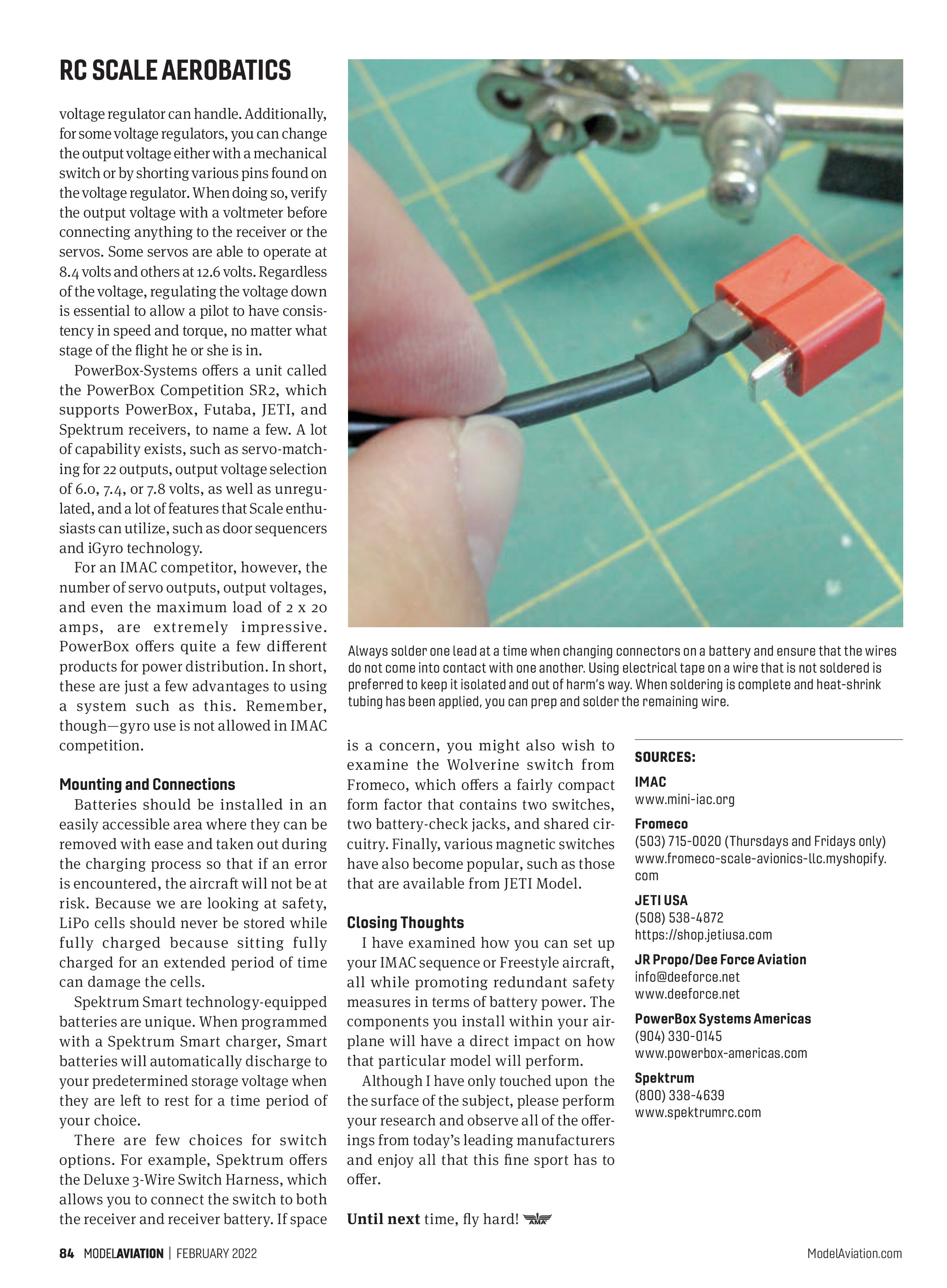
Always solder one lead at a time when changing connectors on a battery and ensure that the wires do not come into contact with one another. Using electrical tape on a wire that is not soldered is preferred to keep it isolated and out of harm’s way. When soldering is complete and heat-shrink tubing has been applied, you can prep and solder the remaining wire.
is a concern, you might also wish to examine the Wolverine switch from Fromeco, which offers a fairly compact form factor that contains two switches, two battery-check jacks, and shared circuitry. Finally, various magnetic switches have also become popular, such as those that are available from JETI Model.
Closing Thoughts
I have examined how you can set up your IMAC sequence or Freestyle aircraft, all while promoting redundant safety measures in terms of battery power. The components you install within your airplane will have a direct impact on how that particular model will perform.
Although I have only touched upon the surface of the subject, please perform your research and observe all of the offerings from today’s leading manufacturers and enjoy all that this fine sport has to offer.
Until next time, fly hard!
SOURCES:
IMAC
www.mini-iac.org
Fromeco
(503) 715-0020 (Thursdays and Fridays only)
www.fromeco-scale-avionics-llc.myshopify.com
JETI USA
(508) 538-4872
https://shop.jetiusa.com
JR Propo/Dee Force Aviation
info@deeforce.net
www.deeforce.net
PowerBox Systems Americas
(904) 330-0145
www.powerbox-americas.com
Spektrum
(800) 338-4639
www.spektrumrc.com