INSIDE ELECTRIC MOTORS AND TIPS TO PREVENT MOTORS/ESCS FROM SHUTTING DOWN
By James Wang | heloeditor@gmail.com

AFTER FLYING ELECTRIC RC helicopters for a long time, you might experience the worst nightmare: a motor shutting down during flight. The shutdown could be because the ESC overheated, the motor burned up, a receiver brownout triggered failsafe, a battery connector came unplugged, or because of a poor soldering joint, etc. It is even more frustrating after a crash when you do not know the cause and the shutdown repeats.
Motor Magnet and Temperature
Checking the motor and ESC temperatures immediately after a flight is a good habit because their temperatures communicate their health. The motor casing could reach 60° to 80° C, the ESC could also reach 80°C, and the LiPo battery could reach 45° C after an aggressive flight. What is the maximum threshold temperature for these devices?
For brushless motors, I recommend never exceeding 80° C. A good target is 60°, and 70° is borderline too hot. Every brand of motor has a different threshold. Scorpion motors tend to run hotter, but they seem to thrive and do fine. I check the temperature with a remote-sensing temperature gun, which sells for approximately $50. If, after a flight, you cannot keep a fingertip on the motor casing for 2 seconds, the motor is too hot.
There are many solutions for taking care of a motor that overheats. Go into the ESC program and reduce the timing to a lower degree (I usually use 5°). In a Castle Creations ESC, you can change the frame rate from 8Hz to 12Hz. You can change the helicopter’s gear ratio to optimally match the rotor speed at which you like to fly, add ventilation holes in a canopy to improve cooling, or change to a bigger motor.
Model helicopter motors are rated by their maximum continuous power in watts and maximum continuous current in amps. The motors on most 700-size electric helicopters that run on 12S LiPo batteries draw 80 amps continuously during aerobatics and surge to 150 amps for short bursts when the rotor is loaded during extreme collectives.
Assume that a 12S LiPo battery is 44.4 volts; 44.4 volts x 80 amps is 3,552 watts. Therefore, a motor capable of producing 4,000 watts continuously is required for 3D flying. If a 3,000-watt motor is used for 3D flying, the motor will overheat. However, that 3,000-watt motor could be fine for gentle flying because it cannot handle the aerodynamic loading.
Most 700-size helicopters that are in a steady hover at 1,500 rpm consume approximately 20 amps continuously (44.4 volts x 20 amps = 888 watts). I measured these values using the data-logging feature of a Castle Creations Phoenix Edge 160-amp ESC.
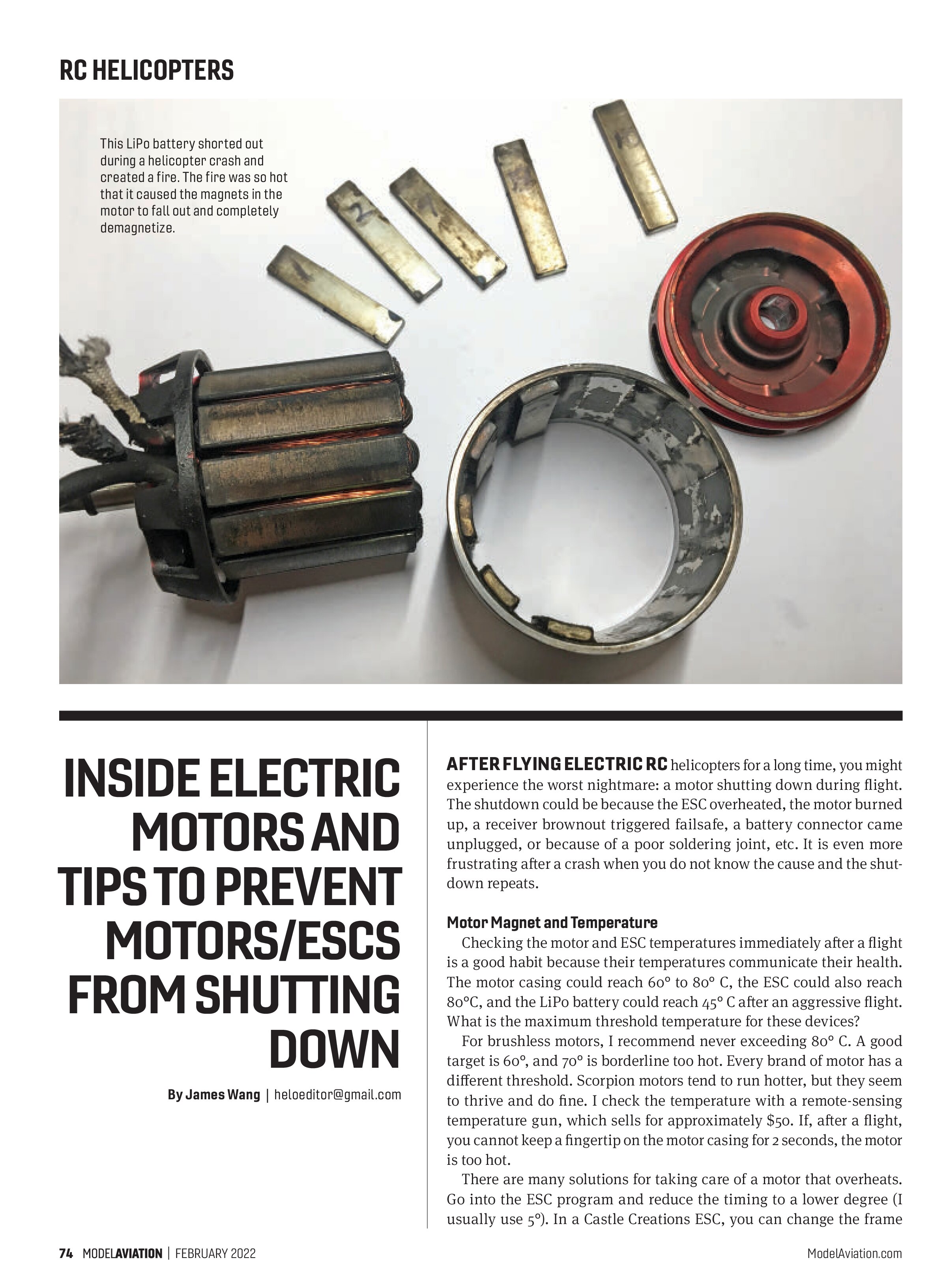
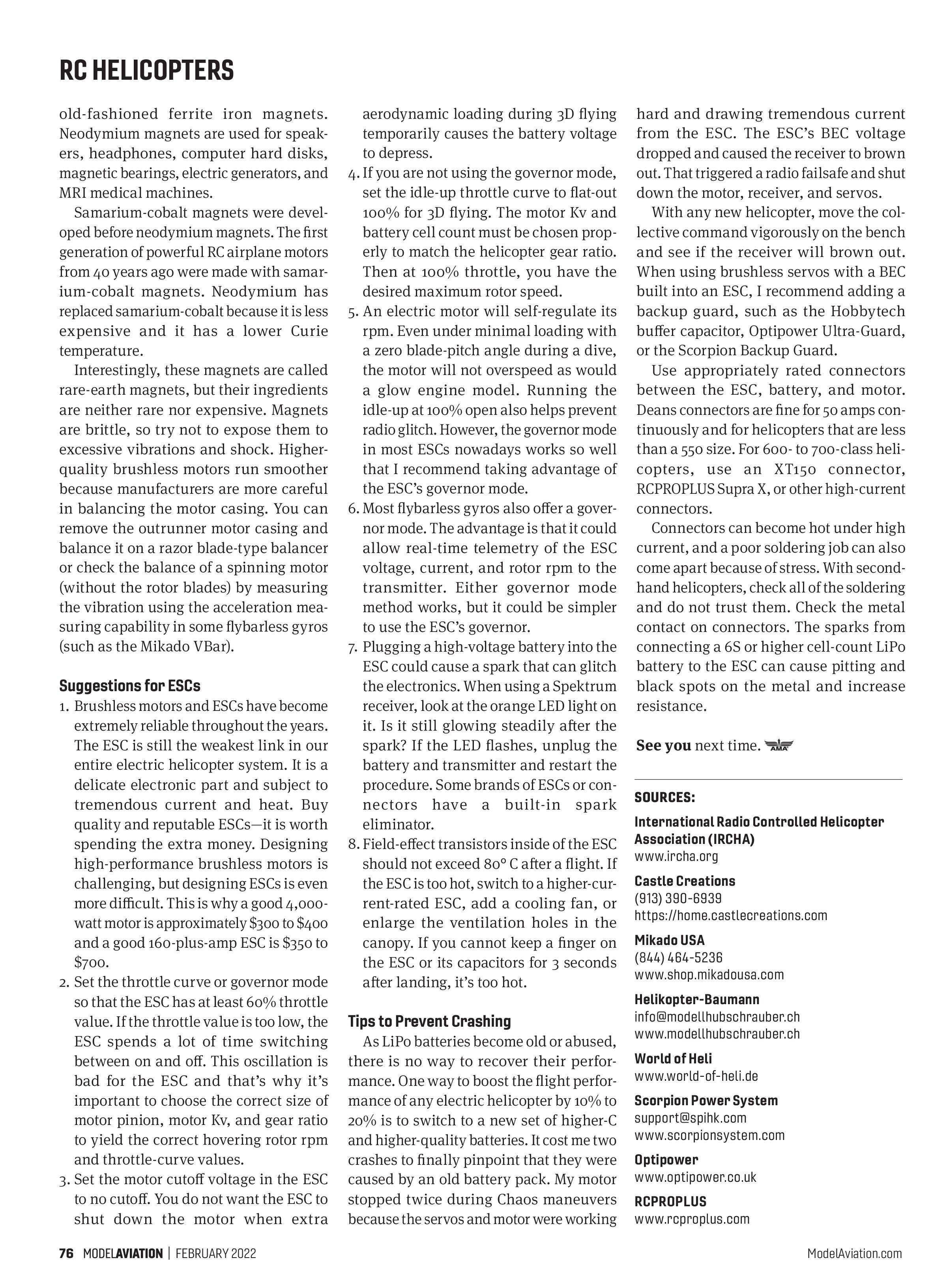
If a motor becomes exceedingly hot, the insulation coating on the copper wire winding can melt and create a short, and the magnets will start losing their magnetic characteristic. The temperature at which a permanent magnet completely loses its magnetism is called the Curie temperature. This temperature varies from 200° to 300° C, depending upon the type and quality of the magnet.
Most brushless motors for RC aircraft use neodymium magnets. Neodymium is popular because it has superb performance versus cost, excellent magnetic-field strength, and good resistance to demagnetization.
Neodymium magnets were developed in approximately 1982 by General Motors in the US and by Sumitomo Special Metals of Japan for use in small, electric motors. They are an alloy of neodymium, iron, and boron. Neodymium magnets (NdFeB) have 10 times more magnetic strength than

old-fashioned ferrite iron magnets. Neodymium magnets are used for speakers, headphones, computer hard disks, magnetic bearings, electric generators, and MRI medical machines.
Samarium-cobalt magnets were developed before neodymium magnets. The first generation of powerful RC airplane motors from 40 years ago were made with samarium-cobalt magnets. Neodymium has replaced samarium-cobalt because it is less expensive and it has a lower Curie temperature.
Interestingly, these magnets are called rare-earth magnets, but their ingredients are neither rare nor expensive. Magnets are brittle, so try not to expose them to excessive vibrations and shock. Higher-quality brushless motors run smoother because manufacturers are more careful in balancing the motor casing. You can remove the outrunner motor casing and balance it on a razor blade-type balancer or check the balance of a spinning motor (without the rotor blades) by measuring the vibration using the acceleration measuring capability in some flybarless gyros (such as the Mikado VBar).
Suggestions for ESCs
- Brushless motors and ESCs have become extremely reliable throughout the years. The ESC is still the weakest link in our entire electric helicopter system. It is a delicate electronic part and subject to tremendous current and heat. Buy quality and reputable ESCs—it is worth spending the extra money. Designing high-performance brushless motors is challenging, but designing ESCs is even more difficult. This is why a good 4,000-watt motor is approximately $300 to $400 and a good 160-plus-amp ESC is $350 to $700.
- Set the throttle curve or governor mode so that the ESC has at least 60% throttle value. If the throttle value is too low, the ESC spends a lot of time switching between on and off. This oscillation is bad for the ESC and that’s why it’s important to choose the correct size of motor pinion, motor Kv, and gear ratio to yield the correct hovering rotor rpm and throttle-curve values.
- Set the motor cutoff voltage in the ESC to no cutoff. You do not want the ESC to shut down the motor when extra aerodynamic loading during 3D flying temporarily causes the battery voltage to depress.
- If you are not using the governor mode, set the idle-up throttle curve to flat-out 100% for 3D flying. The motor Kv and battery cell count must be chosen properly to match the helicopter gear ratio. Then at 100% throttle, you have the desired maximum rotor speed.
- An electric motor will self-regulate its rpm. Even under minimal loading with a zero blade-pitch angle during a dive, the motor will not overspeed as would a glow engine model. Running the idle-up at 100% open also helps prevent radio glitch. However, the governor mode in most ESCs nowadays works so well that I recommend taking advantage of the ESC’s governor mode.
- Most flybarless gyros also offer a governor mode. The advantage is that it could allow real-time telemetry of the ESC voltage, current, and rotor rpm to the transmitter. Either governor mode method works, but it could be simpler to use the ESC’s governor.
- Plugging a high-voltage battery into the ESC could cause a spark that can glitch the electronics. When using a Spektrum receiver, look at the orange LED light on it. Is it still glowing steadily after the spark? If the LED flashes, unplug the battery and transmitter and restart the procedure. Some brands of ESCs or connectors have a built-in spark eliminator.
- Field-effect transistors inside the ESC should not exceed 80°C after a flight. If the ESC is too hot, switch to a higher-current-rated ESC, add a cooling fan, or enlarge the ventilation holes in the canopy. If you cannot keep a finger on the ESC or its capacitors for 3 seconds after landing, it’s too hot.
Tips to Prevent Crashing
As LiPo batteries become old or abused, there is no way to recover their performance. One way to boost the flight performance of any electric helicopter by 10% to 20% is to switch to a new set of higher-C and higher-quality batteries. It cost me two crashes to finally pinpoint that they were caused by an old battery pack. My motor stopped twice during Chaos maneuvers because the servos and motor were working
hard and drawing tremendous current from the ESC. The ESC’s BEC voltage dropped and caused the receiver to brown out. That triggered a radio failsafe and shut down the motor, receiver, and servos.
With any new helicopter, move the collective command vigorously on the bench and see if the receiver will brown out. When using brushless servos with a BEC built into an ESC, I recommend adding a backup guard, such as the Hobbytech buffer capacitor, Optipower Ultra-Guard, or the Scorpion Backup Guard.
Use appropriately rated connectors between the ESC, battery, and motor. Deans connectors are fine for 50 amps continuously and for helicopters that are less than a 550 size. For 600- to 700-class helicopters, use an XT150 connector, RCPROPLUS Supra X, or other high-current connectors.
Connectors can become hot under high current, and a poor soldering job can also come apart because of stress. With second-hand helicopters, check all of the soldering and do not trust them. Check the metal contact on connectors. The sparks from connecting a 6S or higher cell-count LiPo battery to the ESC can cause pitting and black spots on the metal and increase resistance.
See you next time.
SOURCES:
International Radio Controlled Helicopter Association (IRCHA)
www.ircha.org
Castle Creations
(913) 390-6939
https://home.castlecreations.com
Mikado USA
(844) 464-5236
www.shop.mikadousa.com
Helikopter-Baumann
info@modellhubschrauber.ch
www.modellhubschrauber.ch
World of Heli
www.world-of-heli.de
Scorpion Power System
support@spihk.com
www.scorpionsystem.com
Optipower
www.optipower.co.uk
RCPROPLUS
www.rcproplus.com