RC GIANT SCALE

PHÖNIX D.I AT RHINEBECK JAMBOREE
By Sal Calvagna | rcgiants@optonline.net
WELCOME BACK and happy 2022 to all. I hope my readers and your family and friends are all healthy. Many flying events returned and were held across the country in 2021. I was able to attend a few. In this column, you’ll see a couple of unique models that I spied at the Rhinebeck Jamboree, held in September 2021 at the Old Rhinebeck Aerodrome in Rhinebeck, New York.
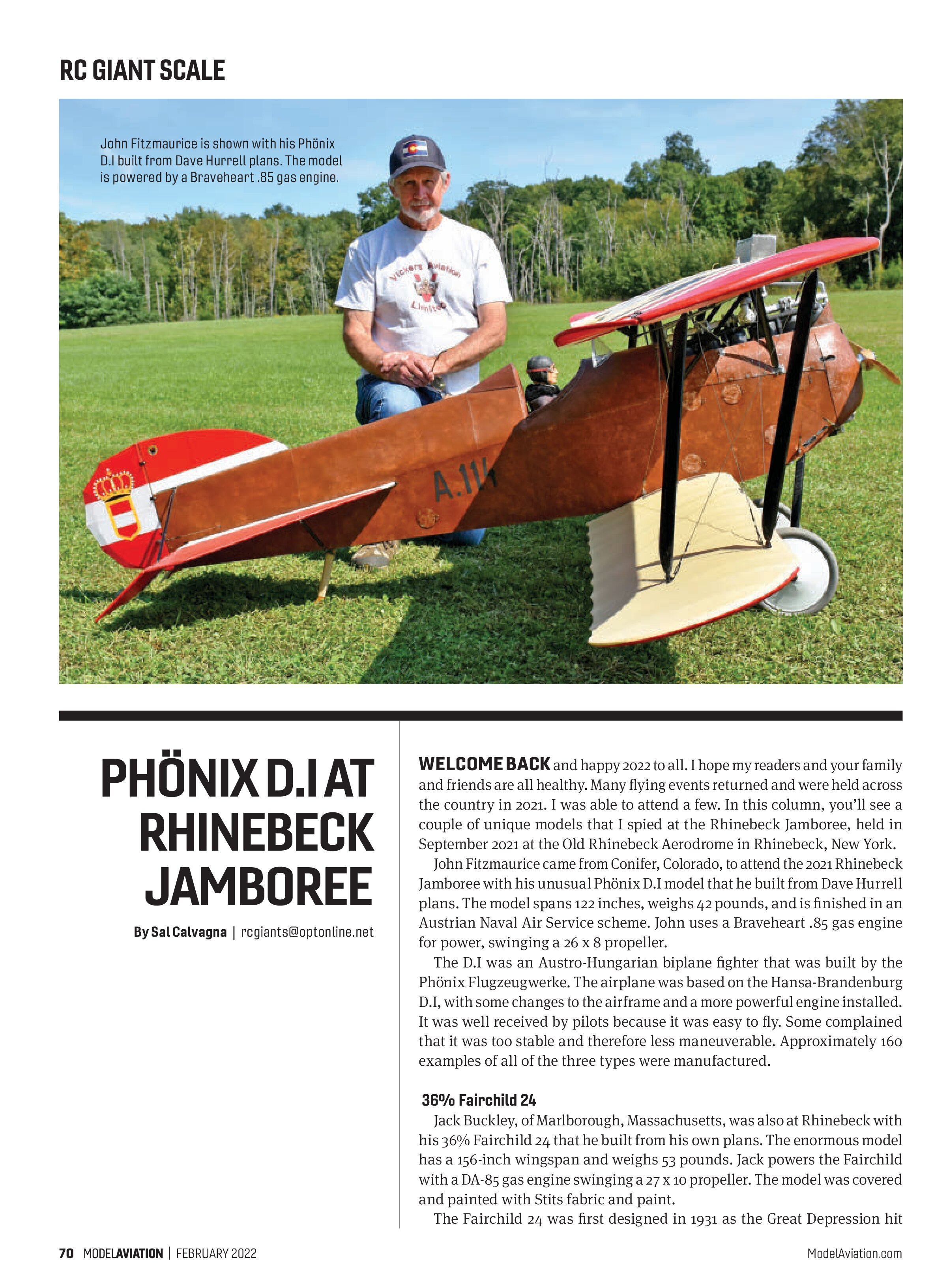
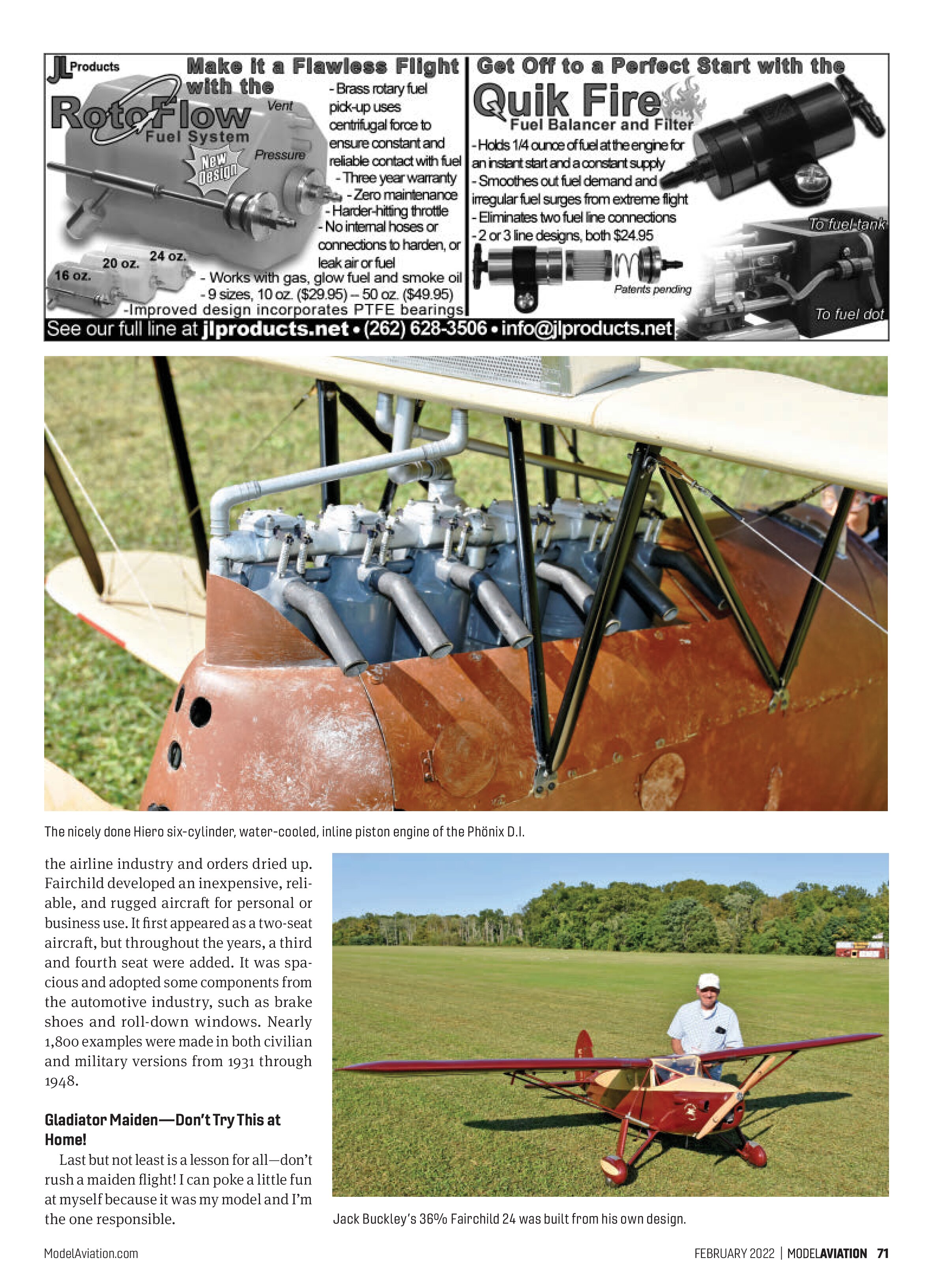
John Fitzmaurice came from Conifer, Colorado, to attend the 2021 Rhinebeck Jamboree with his unusual Phönix D.I model that he built from Dave Hurrell plans. The model spans 122 inches, weighs 42 pounds, and is finished in an Austrian Naval Air Service scheme. John uses a Braveheart .85 gas engine for power, swinging a 26 x 8 propeller.
The D.I was an Austro-Hungarian biplane fighter that was built by the Phönix Flugzeugwerke. The airplane was based on the Hansa-Brandenburg D.I, with some changes to the airframe and a more powerful engine installed. It was well received by pilots because it was easy to fly. Some complained that it was too stable and therefore less maneuverable. Approximately 160 examples of all of the three types were manufactured.
36% Fairchild 24
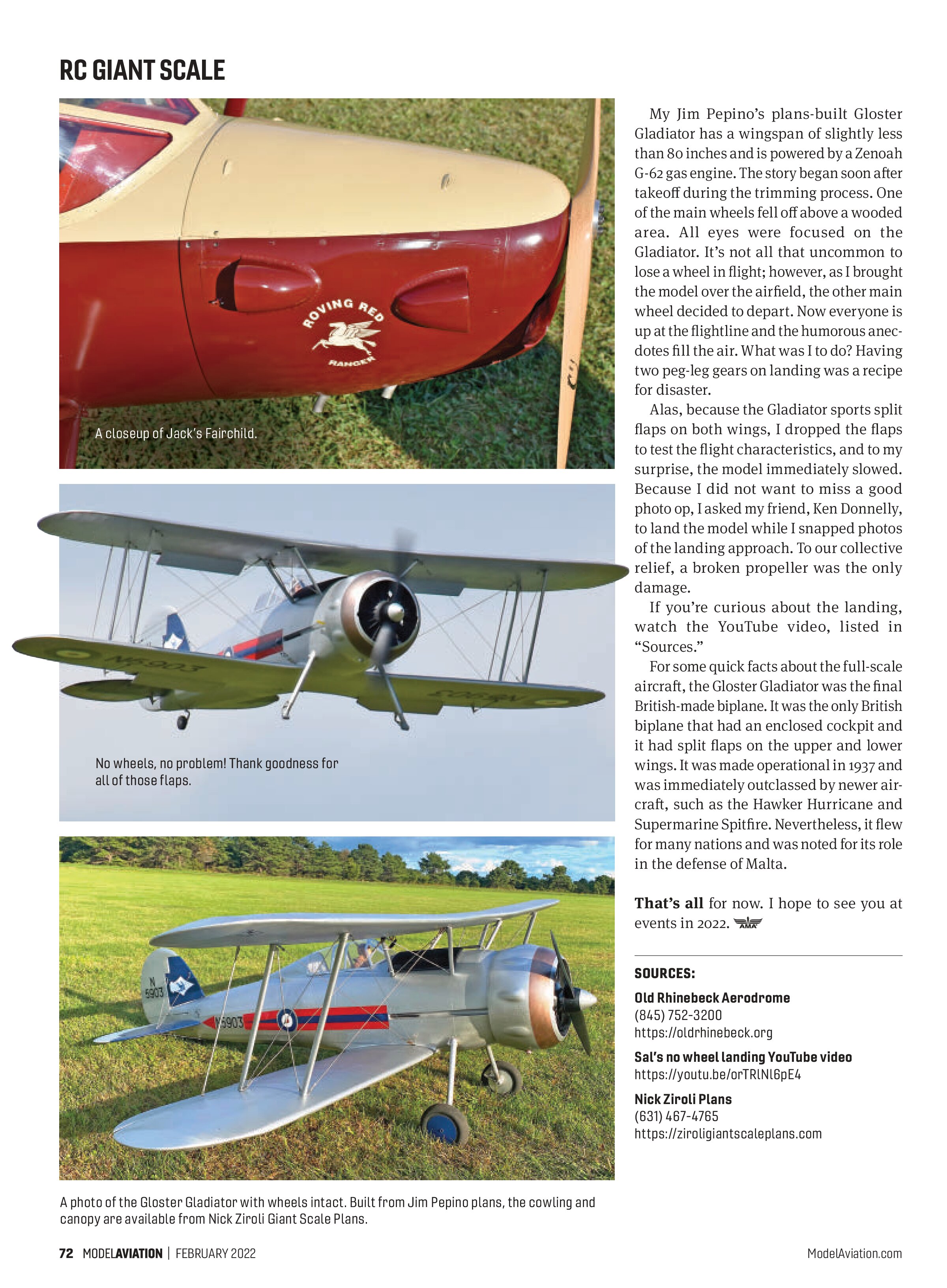
Jack Buckley, of Marlborough, Massachusetts, was also at Rhinebeck with his 36% Fairchild 24 that he built from his own plans. The enormous model has a 156-inch wingspan and weighs 53 pounds. Jack powers the Fairchild with a DA-85 gas engine swinging a 27 x 10 propeller. The model was covered and painted with Stits fabric and paint.
The Fairchild 24 was first designed in 1931 as the Great Depression hit the airline industry and orders dried up. Fairchild developed an inexpensive, reliable, and rugged aircraft for personal or business use. It first appeared as a two-seat aircraft, but throughout the years, a third and fourth seat were added. It was spacious and adopted some components from the automotive industry, such as brake shoes and roll-down windows. Nearly 1,800 examples were made in both civilian and military versions from 1931 through 1948.
Gladiator Maiden—Don’t Try This at Home!
Last but not least is a lesson for all—don’t rush a maiden flight! I can poke a little fun at myself because it was my model and I’m the one responsible.


My Jim Pepino’s plans-built Gloster Gladiator has a wingspan of slightly less than 80 inches and is powered by a Zenoah G-62 gas engine. The story began soon after takeoff during the trimming process. One of the main wheels fell off above a wooded area. All eyes were focused on the Gladiator. It’s not all that uncommon to lose a wheel in flight; however, as I brought the model over the airfield, the other main wheel decided to depart. Now everyone is up at the flightline and the humorous anecdotes fill the air. What was I to do? Having two peg-leg gears on landing was a recipe for disaster.
Alas, because the Gladiator sports split flaps on both wings, I dropped the flaps to test the flight characteristics, and to my surprise, the model immediately slowed. Because I did not want to miss a good photo op, I asked my friend, Ken Donnelly, to land the model while I snapped photos of the landing approach. To our collective relief, a broken propeller was the only damage.
If you’re curious about the landing, watch the YouTube video, listed in “Sources.”
For some quick facts about the full-scale aircraft, the Gloster Gladiator was the final British-made biplane. It was the only British biplane that had an enclosed cockpit and it had split flaps on the upper and lower wings. It was made operational in 1937 and was immediately outclassed by newer aircraft, such as the Hawker Hurricane and Supermarine Spitfire. Nevertheless, it flew for many nations and was noted for its role in the defense of Malta.
That’s all for now. I hope to see you at events in 2022.
SOURCES:
Old Rhinebeck Aerodrome
(845) 752-3200
https://oldrhinebeck.org
Sal’s no wheel landing YouTube video
https://youtu.be/orTRNl6pE4
Nick Ziroli Plans
(631) 467-4765
https://ziroli giantscaleplans.com