RC COMBAT

E1000 AIRPLANE ROUNDUP
By Heath Bartel | heath.bartel@gmail.com
AN IDEAL RC COMBAT airplane has great flight performance, is extremely durable, is quick and easy to build or repair, and is inexpensive. It is impossible, however, for a single design to embody all of these competing goals because tradeoffs must be made between them.
For example, an airplane can be made more durable by adding extra spars and reinforcement at the expense of added weight, which reduces flight performance. Wooden parts could be replaced with carbon fiber to increase strength without increasing weight. The cost and difficulty of the build would, however, increase.
Careful attention to drag reduction will improve performance but could result in increased build time and increased weight. It is more accurate to state that a good Combat aircraft design strikes a balance between these competing goals by maximizing performance while limiting build time and cost.
Although durability, the time required to build, and cost are straightforward, flight performance requires a more detailed review. The flight performance of an RC Combat airplane can be divided into four main areas: launching, turning ability, top speed, and vertical stability.
An airplane that is hard to launch will fly fewer rounds because of failed launches or even damage that is the result of a bad launch attempt. The three general launch techniques, in order from easiest to hardest, are the overhand dart throw, the underhand throw, and the wingtip discus launch. The motor and wing position will dictate what type of launch can be used.
Wingtip launching requires some practice because new pilots tend to overthrow the airplane, resulting in an unintended roll close to the ground. Wingtip launching is a skill worth learning because a bad launch, while holding a pusher wing in the center, can easily send a finger into a propeller.
A Combat airplane that can turn tightly while maintaining speed in the turns is desirable. The primary factors in turning ability are the airfoil shape, wing loading, and wing aspect ratio. A large, long wing will result in a lighter wing loading. If the wing is made too large, the result is a powered sailplane. It would be great at making tight inside loops but would be too slow to chase streamers.
Flat-bottom wings can make good inside loops but will have poor or nonexistent outside loop ability. The goal is to have a balance of speed and turning ability. Because the top speed is also limited by drag, reasonable steps should be taken to reduce drag whenever possible.
Vertical stability is the ability of an airplane to resist yaw caused by an asymmetric drag on the wing. An aircraft with a streamer attached to one wingtip will yaw in the direction of the added drag. An airplane with higher vertical stability will better resist this yaw force. One with lower vertical stability might fly great right up to the point where a streamer is caught on a wingtip, and then it becomes nearly impossible to fly.
Let’s look at three real-world examples of Combat airplanes that I have built and flown. All of these aircraft use the same E1000-class power package, allowing me to compare the airframes.
Flite Test Mighty Mini Arrow
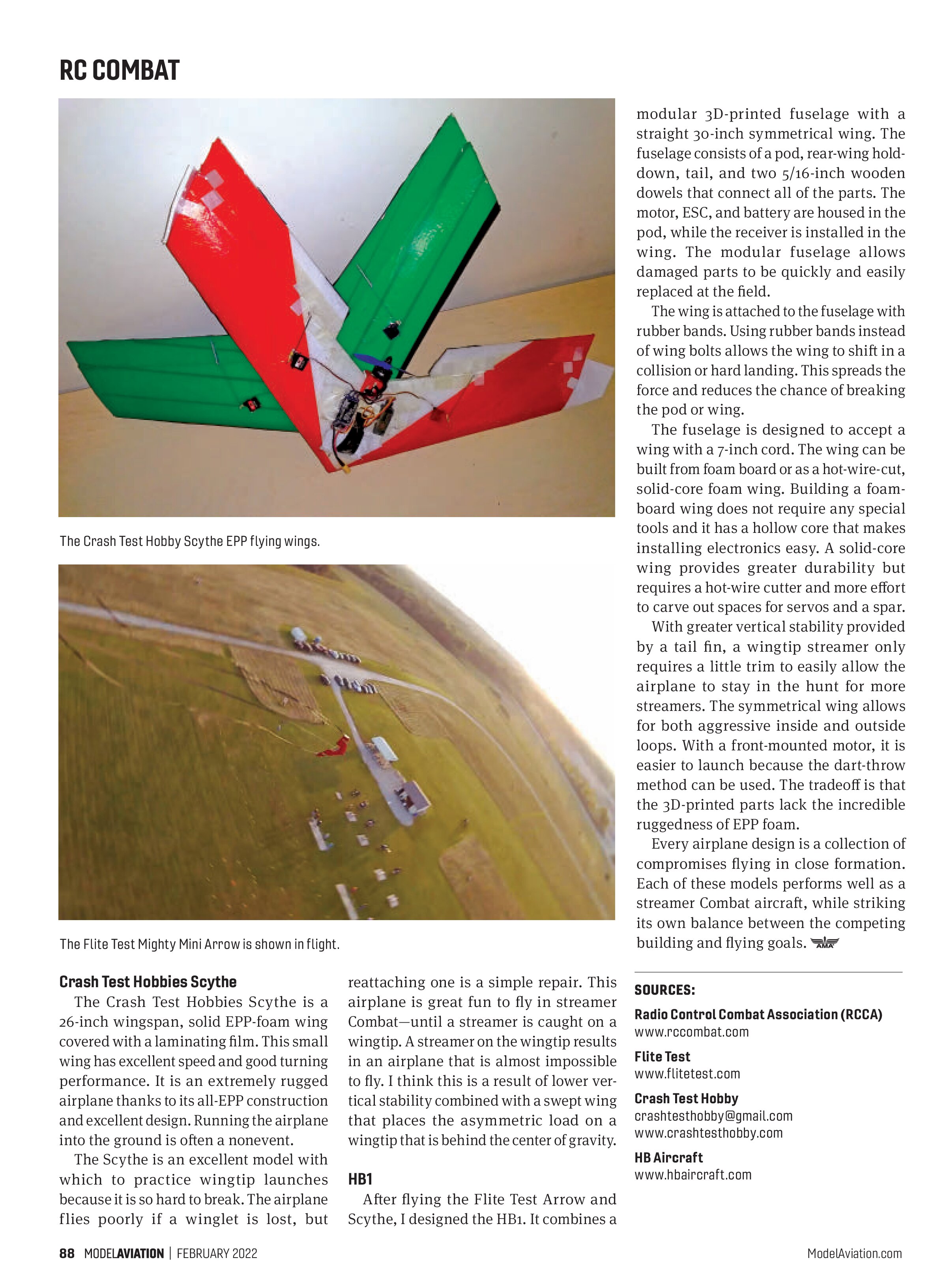
The Flite Test Mighty Mini Arrow is a 29-inch wingspan flying wing in a pusher configuration. It is constructed from foam board and is available as a laser-cut kit or can be scratch-built from plans. The aptly named “speed build” kit reduces the build time by approximately 50% versus scratch-building from plans.
The airplane is easy to build, with excellent build videos and plans available. No special tools are required to complete the scratch or kit build. A hollow wing and a center pod provide ample room for electronics. The motor position, which is forward of the trailing edge, provides an easy streamer attachment point.
The Flite Test Arrow is a fun airplane to fly, with good speed and tight inside loops. The outside loop performance is limited by the flat-bottom wing. In a crash, the motor and propeller are well protected. The center seam and pod section can be a weak point in a crash or midair collision. Dents and dings are easy to repair with tape and hot glue.
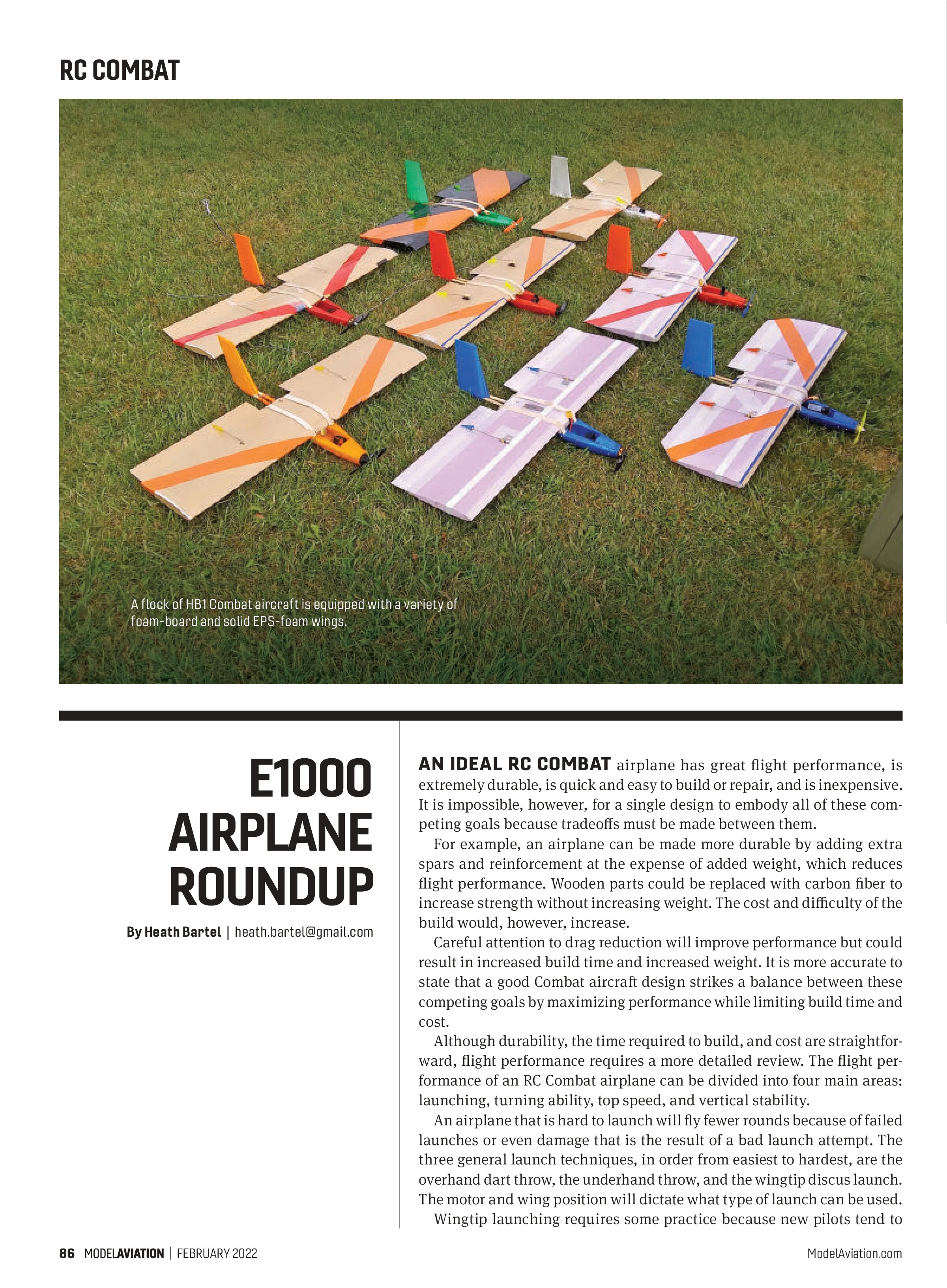
modular 3D-printed fuselage with a straight 30-inch symmetrical wing. The fuselage consists of a pod, rear-wing hold-down, tail, and two 5/16-inch wooden dowels that connect all of the parts. The motor, ESC, and battery are housed in the pod, while the receiver is installed in the wing. The modular fuselage allows damaged parts to be quickly and easily replaced at the field.
The wing is attached to the fuselage with rubber bands. Using rubber bands instead of wing bolts allows the wing to shift in a collision or hard landing. This spreads the force and reduces the chance of breaking the pod or wing.
The fuselage is designed to accept a wing with a 7-inch cord. The wing can be built from foam board or as a hot-wire-cut, solid-core foam wing. Building a foam-board wing does not require any special tools and it has a hollow core that makes installing electronics easy. A solid-core wing provides greater durability but requires a hot-wire cutter and more effort to carve out spaces for servos and a spar.
With greater vertical stability provided by a tail fin, a wingtip streamer only requires a little trim to easily allow the airplane to stay in the hunt for more streamers. The symmetrical wing allows for both aggressive inside and outside loops. With a front-mounted motor, it is easier to launch because the dart-throw method can be used. The tradeoff is that the 3D-printed parts lack the incredible ruggedness of EPP foam.
Every airplane design is a collection of compromises flying in close formation. Each of these models performs well as a streamer Combat aircraft, while striking its own balance between the competing building and flying goals.


Crash Test Hobbies Scythe
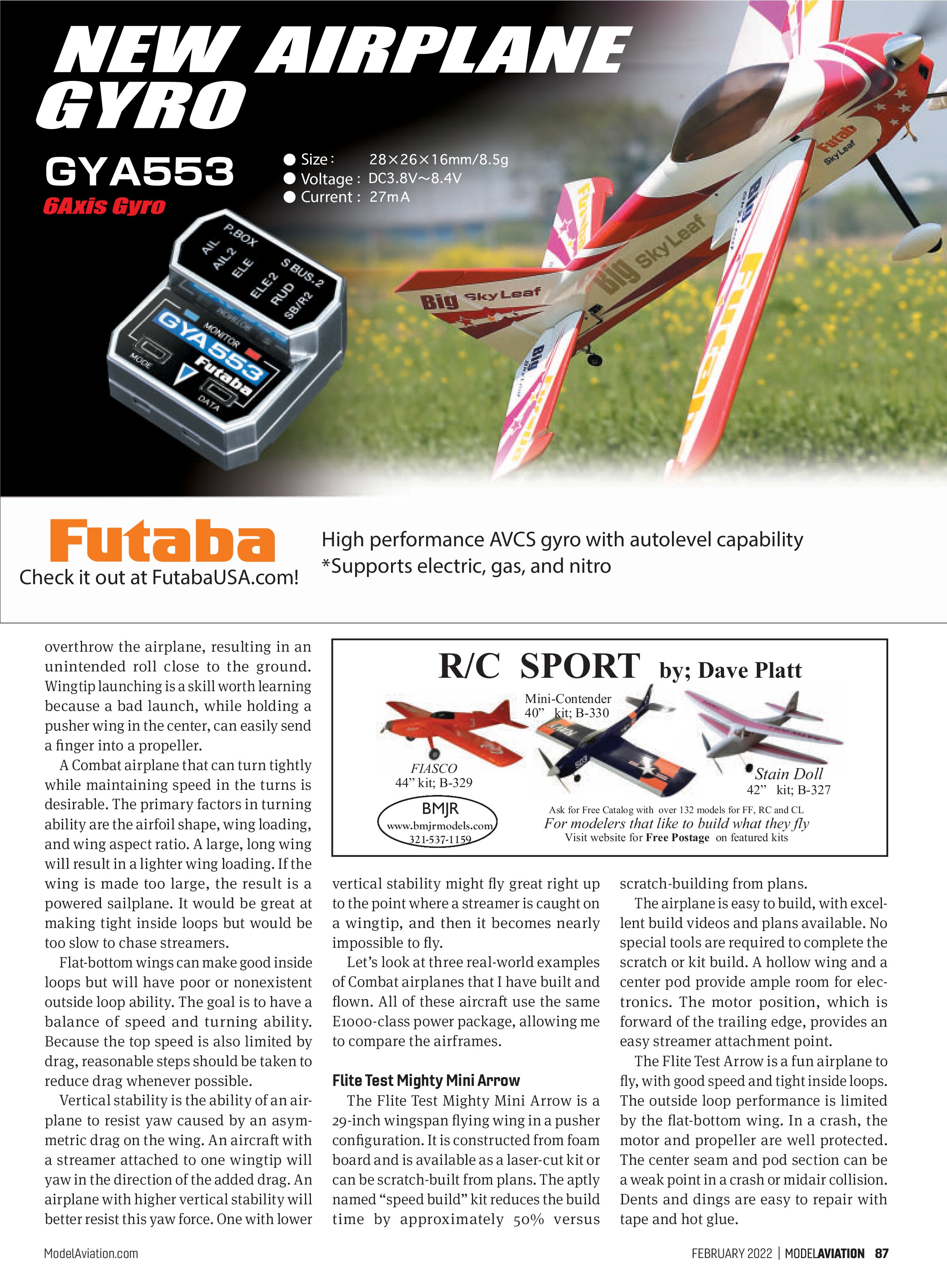
The Crash Test Hobbies Scythe is a 26-inch wingspan, solid EPP-foam wing covered with a laminating film. This small wing has excellent speed and good turning performance. It is an extremely rugged airplane thanks to its all-EPP construction and excellent design. Running the airplane into the ground is often a nonevent.
The Scythe is an excellent model with which to practice wingtip launches because it is so hard to break. The airplane flies poorly if a winglet is lost, but reattaching one is a simple repair. This airplane is great fun to fly in streamer Combat—until a streamer is caught on a wingtip. A streamer on the wingtip results in an airplane that is almost impossible to fly. I think this is a result of lower vertical stability combined with a swept wing that places the asymmetric load on a wingtip that is behind the center of gravity.
HB1
After flying the Flite Test Arrow and Scythe, I designed the HB1. It combines a
SOURCES:
Radio Control Combat Association (RCCA)
www.rccombat.com
Flite Test
www.flitetest.com
Crash Test Hobby
crashtesthobby@gmail.com
www.crashtesthobby.com
HB Aircraft
www.hbaircraft.com