HOBBYZONE AEROSCOUT S 2 1.1M RTF WITH SAFE
New Products That Are Worth a Closer Look

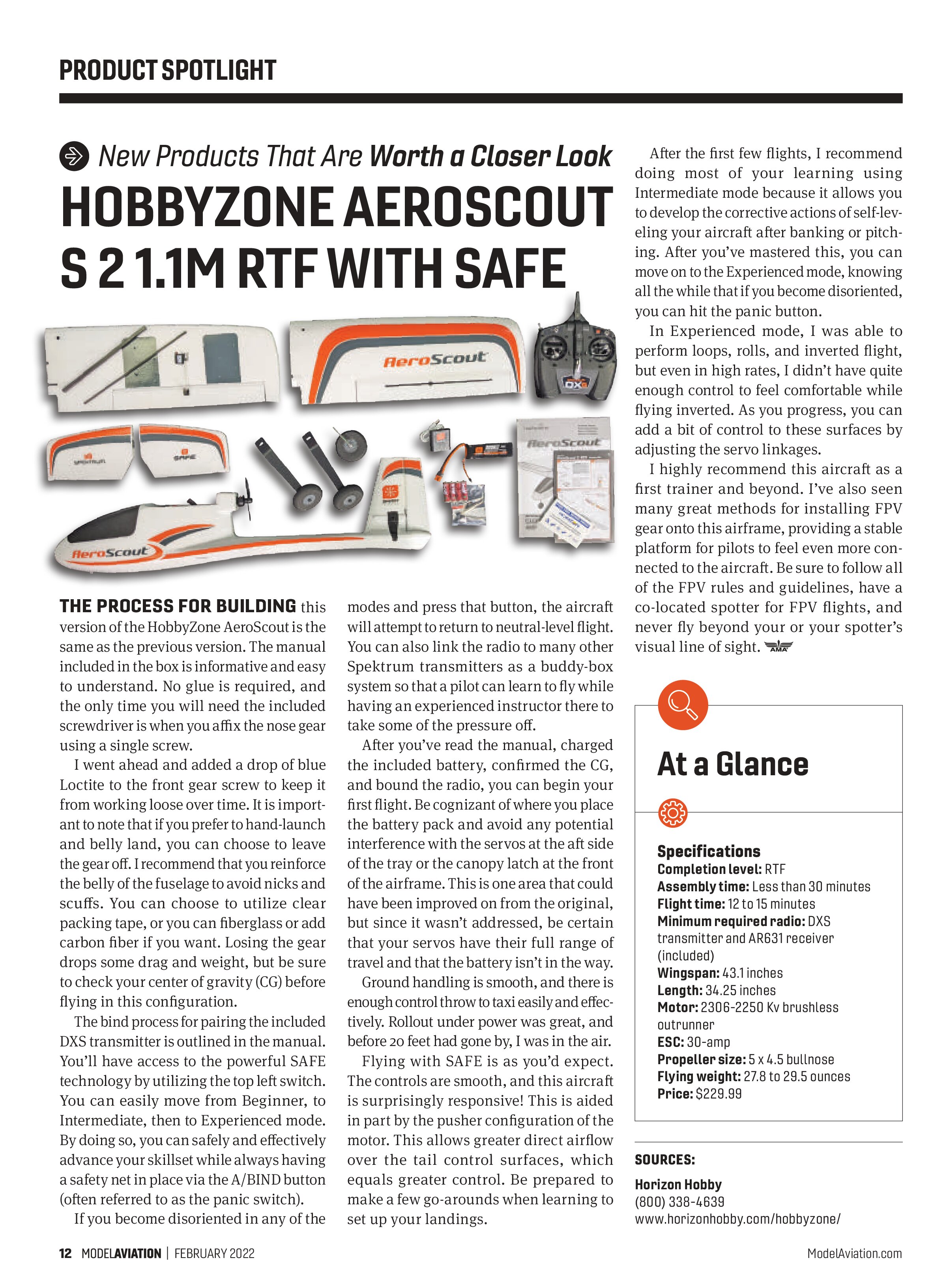
THE PROCESS FOR BUILDING this version of the HobbyZone AeroScout is the same as the previous version. The manual included in the box is informative and easy to understand. No glue is required, and the only time you will need the included screwdriver is when you affix the nose gear using a single screw.
I went ahead and added a drop of blue Loctite to the front gear screw to keep it from working loose over time. It is important to note that if you prefer to hand-launch and belly land, you can choose to leave the gear off. I recommend that you reinforce the belly of the fuselage to avoid nicks and scuffs. You can choose to utilize clear packing tape, or you can fiberglass or add carbon fiber if you want. Losing the gear drops some drag and weight, but be sure to check your center of gravity (CG) before flying in this configuration.
The bind process for pairing the included DXS transmitter is outlined in the manual. You’ll have access to the powerful SAFE technology by utilizing the top left switch. You can easily move from Beginner, to Intermediate, then to Experienced mode. By doing so, you can safely and effectively advance your skillset while always having a safety net in place via the A/BIND button (often referred to as the panic switch).
If you become disoriented in any of the modes and press that button, the aircraft will attempt to return to neutral-level flight. You can also link the radio to many other Spektrum transmitters as a buddy-box system so that a pilot can learn to fly while having an experienced instructor there to take some of the pressure off.
After you’ve read the manual, charged the included battery, confirmed the CG, and bound the radio, you can begin your first flight. Be cognizant of where you place the battery pack and avoid any potential interference with the servos at the aft side of the tray or the canopy latch at the front of the airframe. This is one area that could have been improved on from the original, but since it wasn’t addressed, be certain that your servos have their full range of travel and that the battery isn’t in the way.
Ground handling is smooth, and there is enough control throw to taxi easily and effectively. Rollout under power was great, and before 20 feet had gone by, I was in the air.
Flying with SAFE is as you’d expect. The controls are smooth, and this aircraft is surprisingly responsive! This is aided in part by the pusher configuration of the motor. This allows greater direct airflow over the tail control surfaces, which equals greater control. Be prepared to make a few go-arounds when learning to set up your landings.
After the first few flights, I recommend doing most of your learning using Intermediate mode because it allows you to develop the corrective actions of self-leveling your aircraft after banking or pitching. After you’ve mastered this, you can move on to the Experienced mode, knowing all the while that if you become disoriented, you can hit the panic button.
In Experienced mode, I was able to perform loops, rolls, and inverted flight, but even in high rates, I didn’t have quite enough control to feel comfortable while flying inverted. As you progress, you can add a bit of control to these surfaces by adjusting the servo linkages.
I highly recommend this aircraft as a first trainer and beyond. I’ve also seen many great methods for installing FPV gear onto this airframe, providing a stable platform for pilots to feel even more connected to the aircraft. Be sure to follow all of the FPV rules and guidelines, have a co-located spotter for FPV flights, and never fly beyond your or your spotter’s visual line of sight.
At a Glance
Specifications
Completion level: RTF
Assembly time: Less than 30 minutes
Flight time: 12 to 15 minutes
Minimum required radio: DXS transmitter and AR631 receiver (included)
Wingspan: 43.1 inches
Length: 34.25 inches
Motor: 2306-2250 Kv brushless outrunner
ESC: 30-amp
Propeller size: 5 x 4.5 bullnose
Flying weight: 27.8 to 29.5 ounces
Price: $229.99
SOURCES:
Horizon Hobby
(800) 338-4639
www.horizonhobby.com/hobbyzone/
New Products from the Modeler’s Mall

BMJR BRFF Park Flyer @ $75 + S&H from BMJR Models
Box 1210, Sharpes FL 32959; Tel.: (321) 537-1159; website: www.bjmrmodels.com
The BRFF Park Flyer is based on Bud Romak’s 1959 1/2A Free Flight (FF) model, which originally had a 68-1/2-inch wingspan with 275 sq. in. of wing area and was powered by a Thermal Hopper .049 engine. Bud sent a copy of the plans that were drawn by Bill Dean to BMJR. The plans were used to scale the model to a 36-inch wingspan with 118 sq. in. of wing area. This size is perfect for 1/4A or E-36 FF model.
After trimming and flying the model at the 2021 AMA Nats, BMJR went the next step with making it an electric RC park flyer. The timer was replaced with an RC receiver, a couple of micro servos for rudder and elevator were added, and the BRFF Park Flyer flew right off the board!
Recommended power is a 22mm brushless motor.

Horizon Hobby Acquires RealFlight Simulator from Knife Edge Software
4105 Fieldstone Rd., Champaign IL 61822; Tel.: (800) 338-4639; website: www.horizonhobby.com/realflight/
Horizon Hobby has acquired RealFlight, the leading RC flight simulator software, from Knife Edge Software. Knife Edge was founded by Scott Kemp in 1996 to establish a new standard in RC simulation software. Jim Bourke joined Knife Edge in 2003 to manage operations then purchased the company in 2012. Knife Edge actively developed and improved RealFlight for 25 years.
RealFlight includes more than 170 aircraft to fly, including aircraft from Horizon Hobby’s E-flite, HobbyZone, Hangar 9, and Blade brands. Pilots can fly at more than 40 flying sites, including AMA’s International Aeromodeling Center in Muncie, Indiana, and Horizon’s own Eli Field in Monticello, Illinois. The software comes packed with amazing features, such as true-to-life physics, VR compatibility, multiplayer, gamelike challenges, and the ability to edit aircraft and flying fields.
Chris Dickerson, CEO of Horizon Hobby, said, “Knife Edge Software has built an amazing platform with RealFlight. The Horizon team is excited to continue to enhance the software with next-generation features and align our RC offerings so pilots can further explore their passion for flying.”

Extreme RRS Servo Distribution System @ $273.95 + S&H from Advanced Radio
Email: sales@boomarc.com; website: www.boomarc.com
Extreme RRS from Advanced Radio is a high-powered servo distribution system that is designed for extreme 3D and International Miniature Aerobatics Club (IMAC) flying. It boasts dual or single receiver inputs for receiver redundancy, 16 freely assignable channels with servo matching, servo reversing, 15-point servo matching, and high-power delivery to match today’s high-powered digital servos.
Multiprotocol support is available for S.Bus2, Spektrum SRXL and high-speed SRXL2, JR/Dee Force Aviation XBus, Graupner HoTT, JETI EXbus, FrSky, and Sport, and all S.Bus-compatible transmitters, including CORE. The Extreme RRS works with LiFe, LiPo, and Li-Ion battery chemistries (high-powered batteries are required) and has full dual-battery redundancy—if one battery fails, the other will take full control.
Use the 64k color, 2.4-inch diagonal smart display for live feedback and simple programming, in a single touch-screen display. With intuitive buttons and a single setup design, your model will be in the air before you know it.
For more information about the Extreme RRS, visit any Advanced Radio retailer or the Booma RC website.