FOCAL POINT
Interested in sharing your handiwork? Visit www.ModelAviation.com for submission guidelines.
Bridi UFO
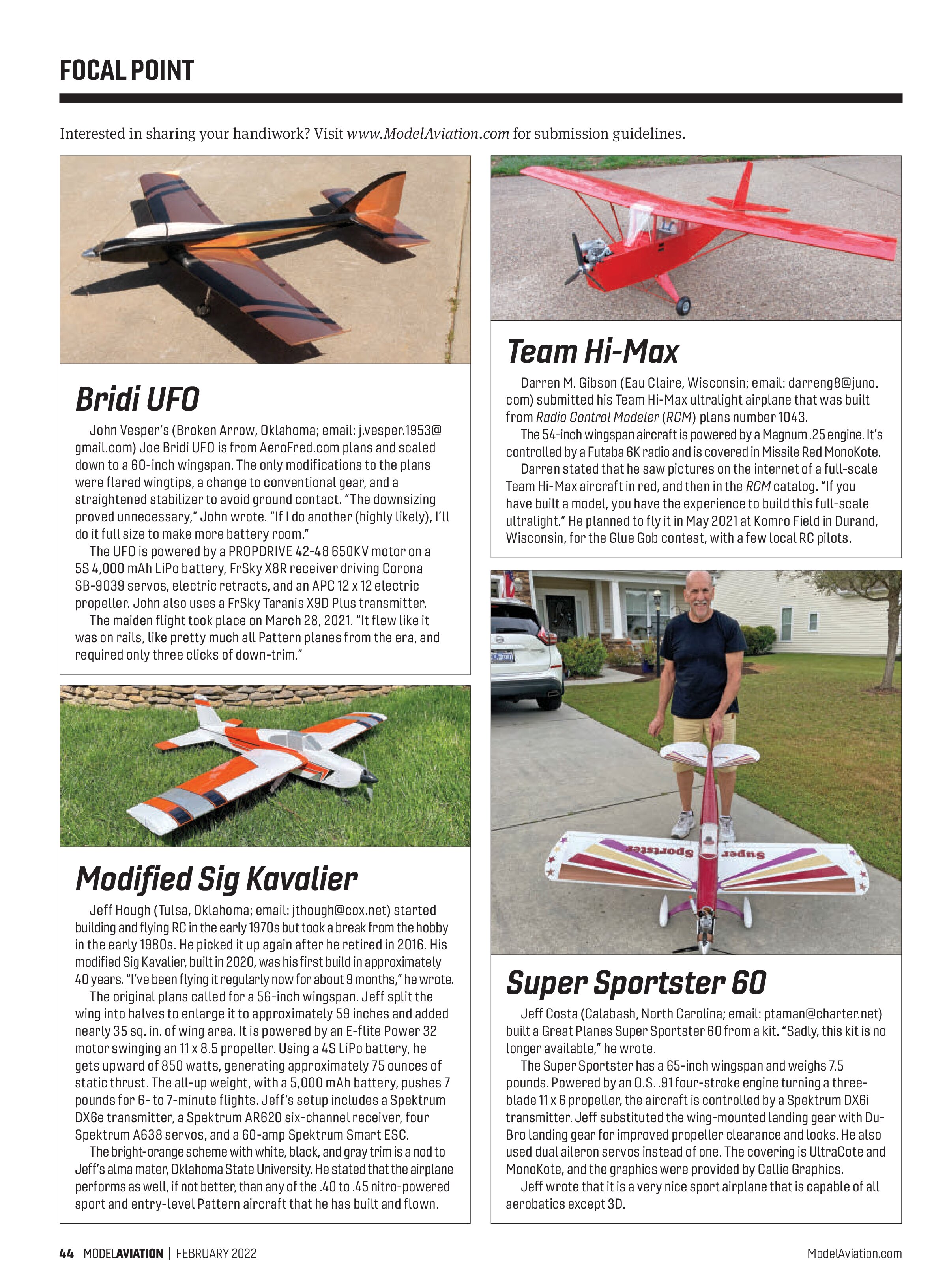
John Vesper’s (Broken Arrow, Oklahoma; email: j.vesper.1953@gmail.com) Joe Bridi UFO is from AeroFred.com plans and scaled down to a 60-inch wingspan. The only modifications to the plans were flared wingtips, a change to conventional gear, and a straightened stabilizer to avoid ground contact. “The downsizing proved unnecessary,” John wrote. “If I do another (highly likely), I’ll do it full size to make more battery room.”
The UFO is powered by a PROPDRIVE 42-48 650KV motor on a 5S 4,000 mAh LiPo battery, FrSky X8R receiver driving Corona SB-9039 servos, electric retracts, and an APC 12 x 12 electric propeller. John also uses a FrSky Taranis X9D Plus transmitter.
The maiden flight took place on March 28, 2021. “It flew like it was on rails, like pretty much all Pattern planes from the era, and required only three clicks of down-trim.”

Modified Sig Kavalier
Jeff Hough (Tulsa, Oklahoma; email: jthough@cox.net) started building and flying RC in the early 1970s but took a break from the hobby in the early 1980s. He picked it up again after he retired in 2016. His modified Sig Kavalier, built in 2020, was his first build in approximately 40 years. “I’ve been flying it regularly now for about 9 months,” he wrote.
The original plans called for a 56-inch wingspan. Jeff split the wing into halves to enlarge it to approximately 59 inches and added nearly 35 sq. in. of wing area. It is powered by an E-flite Power 32 motor swinging an 11 x 8.5 propeller. Using a 4S LiPo battery, he gets upward of 850 watts, generating approximately 75 ounces of static thrust. The all-up weight, with a 5,000 mAh battery, pushes 7 pounds for 6- to 7-minute flights. Jeff’s setup includes a Spektrum DX6e transmitter, a Spektrum AR620 six-channel receiver, four Spektrum A638 servos, and a 60-amp Spektrum Smart ESC.
The bright-orange scheme with white, black, and gray trim is a nod to Jeff’s alma mater, Oklahoma State University. He stated that the airplane performs as well, if not better, than any of the .40 to .45 nitro-powered sport and entry-level Pattern aircraft that he has built and flown.

Team Hi-Max
Darren M. Gibson (Eau Claire, Wisconsin; email: darreng@juno.com) submitted his Team Hi-Max ultralight airplane that was built from Radio Control Modeler (RCM) plans number 1043.
The 54-inch wingspan aircraft is powered by a Magnum .25 engine. It’s controlled by a Futaba 6K radio and is covered in Missile Red MonoKote.
Darren stated that he saw pictures on the internet of a full-scale Team Hi-Max aircraft in red, and then in the RCM catalog. “If you have built a model, you have the experience to build this full-scale ultralight.” He planned to fly it in May 2021 at Komro Field in Durand, Wisconsin, for the Glue Gob contest, with a few local RC pilots.

Super Sportster 60
Jeff Costa (Calabash, North Carolina; email: ptaman@charter.net) built a Great Planes Super Sportster 60 from a kit. “Sadly, this kit is no longer available,” he wrote.
The Super Sportster has a 65-inch wingspan and weighs 7.5 pounds. Powered by an O.S. .91 four-stroke engine turning a three-blade 11 x 6 propeller, the aircraft is controlled by a Spektrum DX6i transmitter. Jeff substituted the wing-mounted landing gear with Du-Bro landing gear for improved propeller clearance and looks. He also used dual aileron servos instead of one. The covering is UltraCote and MonoKote, and the graphics were provided by Callie Graphics.
Jeff wrote that it is a very nice sport airplane that is capable of all aerobatics except 3D.

Piper Tri-Pacer
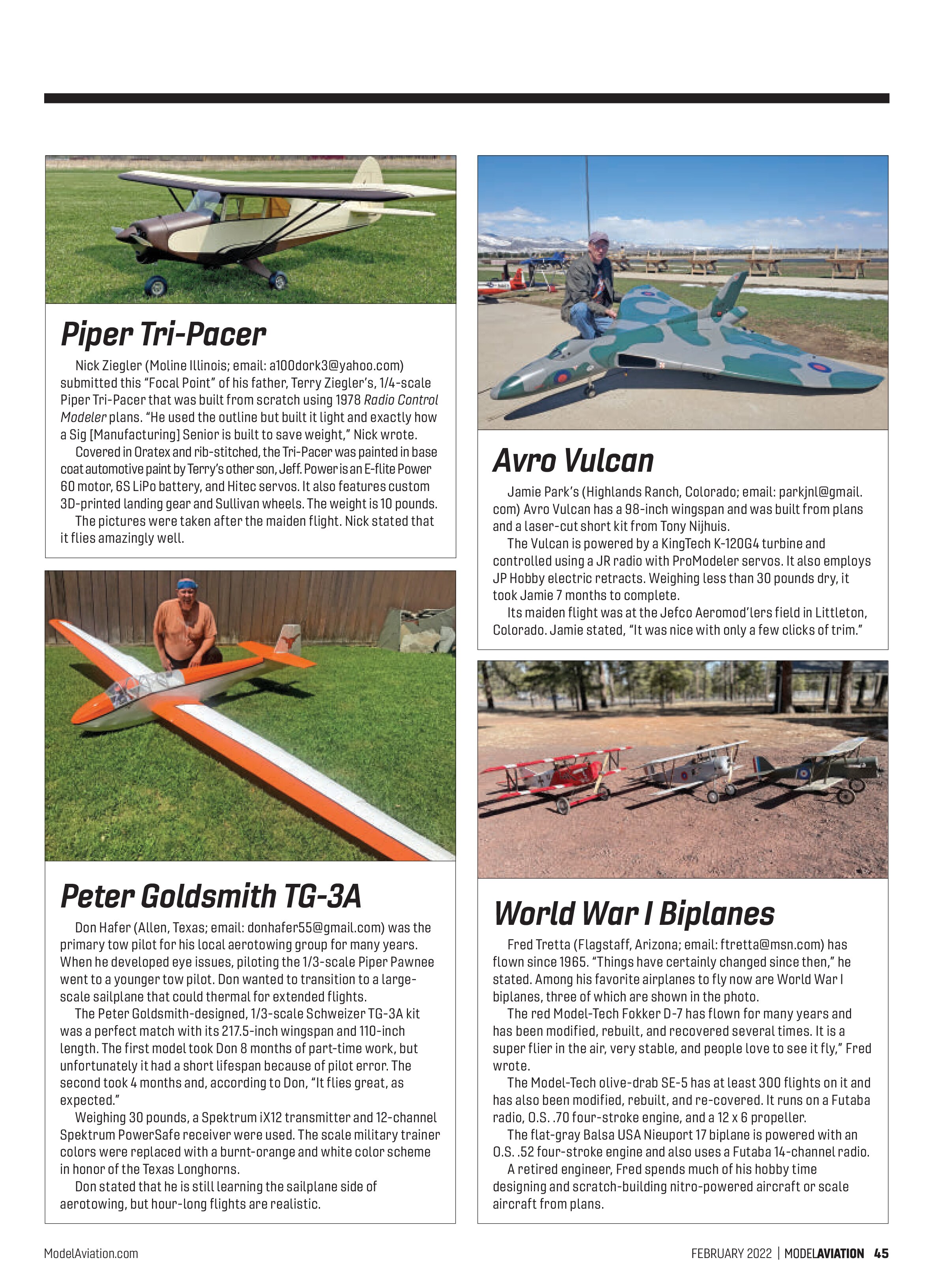
Nick Ziegler (Moline Illinois; email: a1000dork3@yahoo.com) submitted this “Focal Point” of his father, Terry Ziegler’s, 1/4-scale Piper Tri-Pacer that was built from scratch using 1978 Radio Control Modeler plans. “He used the outline but built it light and exactly how a Sig [Manufacturing] Senior is built to save weight,” Nick wrote.
Covered in Oratex and rib-stitched, the Tri-Pacer was painted in base coat automotive paint by Terry’s other son, Jeff. Power is an E-flite Power 60 motor, 6S LiPo battery, and Hitec servos. It also features custom 3D-printed landing gear and Sullivan wheels. The weight is 10 pounds.
The pictures were taken after the maiden flight. Nick stated that it flies amazingly well.

Avro Vulcan
Jamie Park’s (Highlands Ranch, Colorado; email: parkjn1@gmail.com) Avro Vulcan has a 98-inch wingspan and was built from plans and a laser-cut short kit from Tony Nijhuis.
The Vulcan is powered by a KingTech K-120G4 turbine and controlled using a JR radio with ProModeler servos. It also employs JP Hobby electric retracts. Weighing less than 30 pounds dry, it took Jamie 7 months to complete.
Its maiden flight was at the Jefco Aeromod’lers field in Littleton, Colorado. Jamie stated, “It was nice with only a few clicks of trim.”

Peter Goldsmith TG-3A
Don Hafer (Allen, Texas; email: donhafer55@gmail.com) was the primary tow pilot for his local aerotowing group for many years. When he developed eye issues, piloting the 1/3-scale Piper Pawnee went to a younger tow pilot. Don wanted to transition to a large-scale sailplane that could thermal for extended flights.
The Peter Goldsmith-designed, 1/3-scale Schweizer TG-3A kit was a perfect match with its 217.5-inch wingspan and 110-inch length. The first model took Don 8 months of part-time work, but unfortunately it had a short lifespan because of pilot error. The second took 4 months and, according to Don, “It flies great, as expected.”
Weighing 30 pounds, a Spektrum iX12 transmitter and 12-channel Spektrum PowerSafe receiver were used. The scale military trainer colors were replaced with a burnt-orange and white color scheme in honor of the Texas Longhorns.
Don stated that he is still learning the sailplane side of aerotowing, but hour-long flights are realistic.

World War I Biplanes
Fred Tretta (Flagstaff, Arizona; email: ftretta@msn.com) has flown since 1965. “Things have certainly changed since then,” he stated. Among his favorite airplanes to fly now are World War I biplanes, three of which are shown in the photo.
The red Model-Tech Fokker D-7 has flown for many years and has been modified, rebuilt, and recovered several times. It is a super flier in the air, very stable, and people love to see it fly,” Fred wrote.
The Model-Tech olive-drab SE-5 has at least 300 flights on it and has also been modified, rebuilt, and re-covered. It runs on a Futaba radio, O.S. .70 four-stroke engine, and a 12 x 6 propeller.
The flat-gray Balsa USA Nieuport 17 biplane is powered with an O.S. .52 four-stroke engine and also uses a Futaba 14-channel radio.
A retired engineer, Fred spends much of his hobby time designing and scratch-building nitro-powered aircraft or scale aircraft from plans.

Interested in sharing your handiwork? Visit www.ModelAviation.com for submission guidelines.
Das Ugly Stik
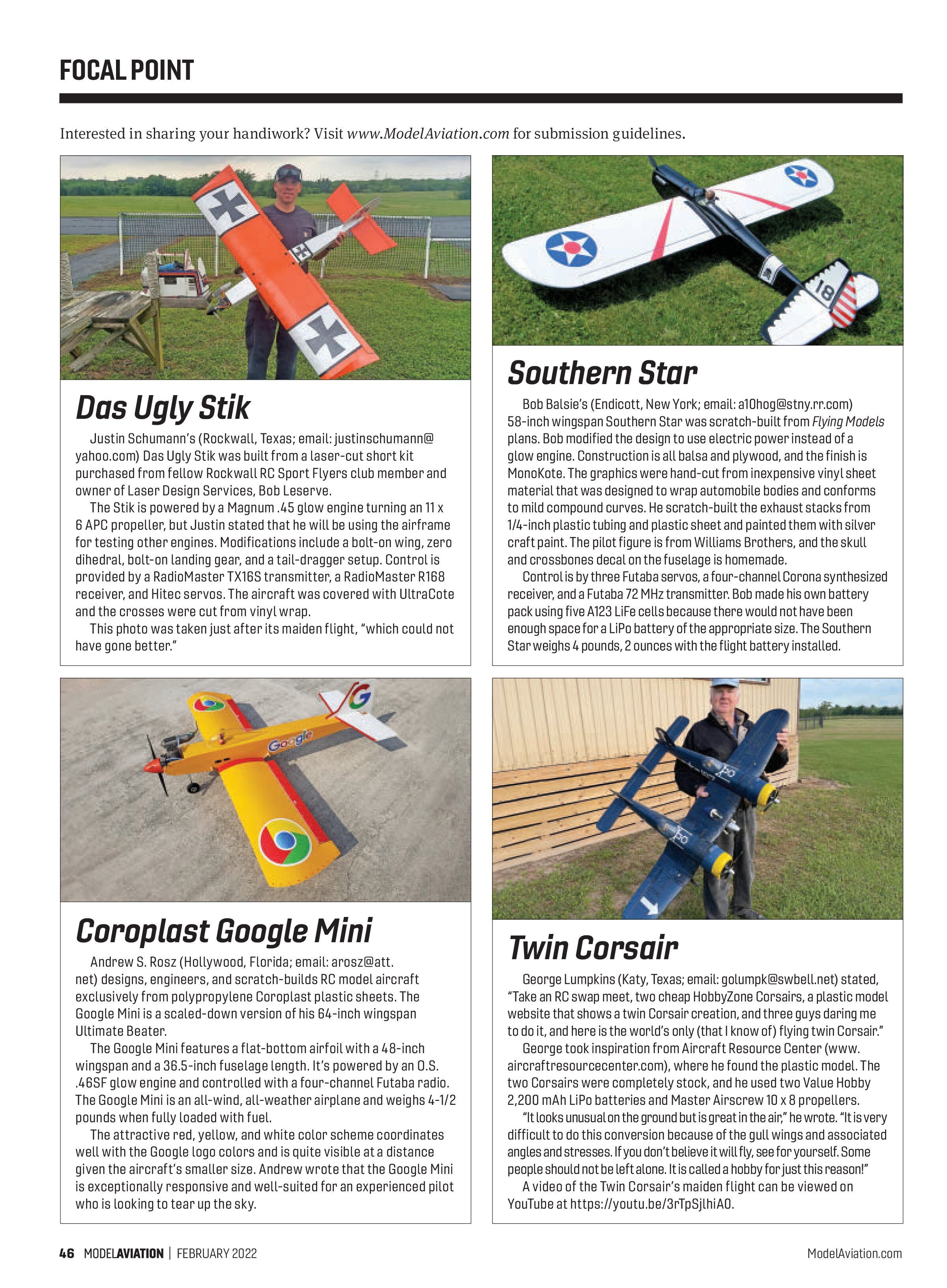
Justin Schumann’s (Rockwall, Texas; email: justinschumann@yahoo.com) Das Ugly Stik was built from a laser-cut short kit purchased from fellow Rockwall RC Sport Flyers club member and owner of Laser Design Services, Bob Leserve.
The Stik is powered by a Magnum .45 glow engine turning an 11 x 6 APC propeller, but Justin stated that he will be using the airframe for testing other engines. Modifications include a bolt-on wing, zero dihedral, bolt-on landing gear, and a tail-dragger setup. Control is provided by a RadioMaster TX16S transmitter, a RadioMaster R168 receiver, and Hitec servos. The aircraft was covered with UltraCote and the crosses were cut from vinyl wrap.
This photo was taken just after its maiden flight, “which could not have gone better.”

Southern Star
Bob Balsie’s (Endicott, New York; email: al0hbg@stny.rr.com) 58-inch wingspan Southern Star was scratch-built from Flying Models plans. Bob modified the design to use electric power instead of a glow engine. Construction is all balsa and plywood, and the finish is MonoKote. The graphics were hand-cut from inexpensive vinyl sheet material that was designed to wrap automobile bodies and conforms to mild compound curves. He scratch-built the exhaust stacks from 1/4-inch plastic tubing and plastic sheet and painted them with silver craft paint. The pilot figure is from Williams Brothers, and the skull and crossbones decal on the fuselage is homemade.
Control is by three Futaba servos, a four-channel Corona synthesized receiver, and a Futaba 72 MHz transmitter. Bob made his own battery pack using five A123 LiFe cells because there would not have been enough space for a LiPo battery of the appropriate size. The Southern Star weighs 4 pounds, 2 ounces with the flight battery installed.

Coroplast Google Mini
Andrew S. Rosz (Hollywood, Florida; email: arosz@att.net) designs, engineers, and scratch-builds RC model aircraft exclusively from polypropylene Coroplast plastic sheets. The Google Mini is a scaled-down version of his 64-inch wingspan Ultimate Beater.
The Google Mini features a flat-bottom airfoil with a 48-inch wingspan and a 36.5-inch fuselage length. It’s powered by an O.S. .46SF glow engine and controlled with a four-channel Futaba radio. The Google Mini is an all-wind, all-weather airplane and weighs 4-1/2 pounds when fully loaded with fuel.
The attractive red, yellow, and white color scheme coordinates well with the Google logo colors and is quite visible at a distance given the aircraft’s smaller size. Andrew wrote that the Google Mini is exceptionally responsive and well-suited for an experienced pilot who is looking to tear up the sky.

Twin Corsair
George Lumpkins (Katy, Texas; email: golumpk@swbell.net) stated, “Take an RC swap meet, two cheap HobbyZone Corsairs, a plastic model website that shows a twin Corsair creation, and three guys daring me to do it, and here is the world’s only (that I know of) flying twin Corsair.”
George took inspiration from Aircraft Resource Center (www.aircraftresourcecenter.com), where he found the plastic model. The two Corsairs were completely stock, and he used two Value Hobby 2,200 mAh LiPo batteries and Master Airscrew 10 x 8 propellers.
“It looks unusual on the ground but is great in the air,” he wrote. “It is very difficult to do this conversion because of the gull wings and associated angles and stresses. If you don’t believe it will fly, see for yourself. Some people should not be left alone. It is called a hobby for just this reason!”
A video of the Twin Corsair’s maiden flight can be viewed on YouTube at https://youtu.be/3rTnSjIhiA0.

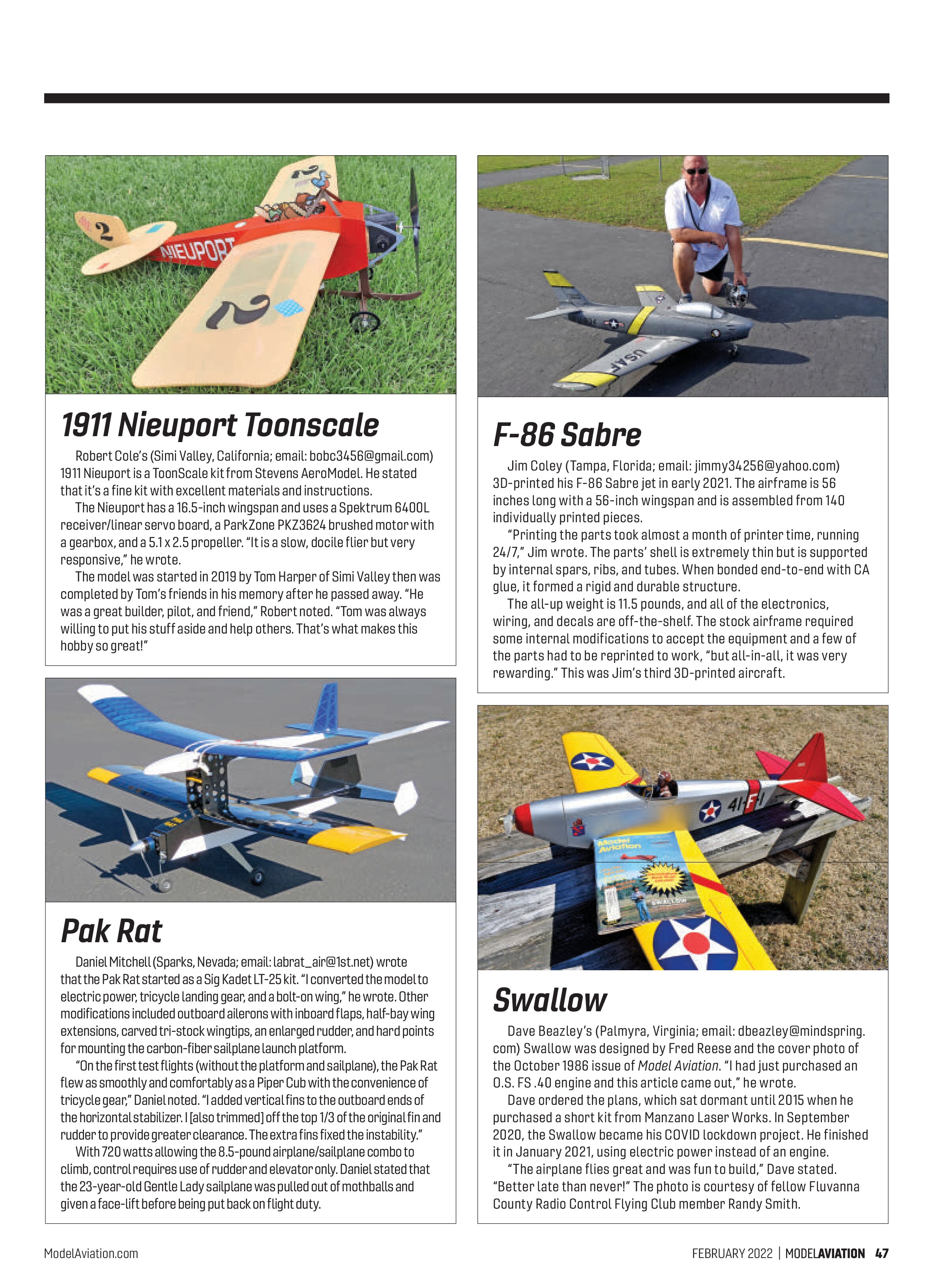
1911 Nieuport Toonscale
Robert Cole’s (Simi Valley, California; email: bobc3456@gmail.com) 1911 Nieuport is a ToonScale kit from Stevens AeroModel. He stated that it’s a fine kit with excellent materials and instructions.
The Nieuport has a 16.5-inch wingspan and uses a Spektrum 6400L receiver/linear servo board, a ParkZone PKZ3624 brushed motor with a gearbox, and a 5.1 x 2.5 propeller. “It is a slow, docile flier but very responsive,” he wrote.
The model was started in 2019 by Tom Harper of Simi Valley then was completed by Tom’s friends in his memory after he passed away. “He was a great builder, pilot, and friend,” Robert noted. “Tom was always willing to put his stuff aside and help others. That’s what makes this hobby so great!”

F-86 Sabre
Jim Coley (Tampa, Florida; email: jimmy34256@yahoo.com) 3D-printed his F-86 Sabre jet in early 2021. The airframe is 56 inches long with a 56-inch wingspan and is assembled from 140 individually printed pieces.
“Printing the parts took almost a month of printer time, running 24/7,” Jim wrote. The parts’ shell is extremely thin but is supported by internal spars, ribs, and tubes. When bonded end-to-end with CA glue, it formed a rigid and durable structure.
The all-up weight is 11.5 pounds, and all of the electronics, wiring, and decals are off-the-shelf. The stock airframe required some internal modifications to accept the equipment and a few of the parts had to be reprinted to work, “but all-in-all, it was very rewarding.” This was Jim’s third 3D-printed aircraft.

Pak Rat
Daniel Mitchell (Sparks, Nevada; email: labrat_air@1st.net) wrote that the Pak Rat started as a Sig Kadet LT-25 kit. “I converted the model to electric power, tricycle landing gear, and a bolt-on wing,” he wrote. Other modifications included outboard ailerons with inboard flaps, half-bay wing extensions, carved tri-stock wingtips, an enlarged rudder, and hard points for mounting the carbon-fiber sailplane launch platform.
“On the first test flights (without the platform and sailplane), the Pak Rat flew as smoothly and comfortably as a Piper Cub with the convenience of tricycle gear,” Daniel noted. “I added vertical fins to the outboard ends of the horizontal stabilizer. I [also trimmed] off the top 1/3 of the original fin and rudder to provide greater clearance. The extra fins fixed the instability.”
With 720 watts allowing the 8.5-pound airplane/sailplane combo to climb, control requires use of rudder and elevator only. Daniel stated that the 23-year-old Gentle Lady sailplane was pulled out of mothballs and given a face-lift before being put back on flight duty.

Swallow
Dave Beazley’s (Palmyra, Virginia; email: dbeazley@mindspring.com) Swallow was designed by Fred Reese and the cover photo of the October 1986 issue of Model Aviation. “I had just purchased an O.S. FS .40 engine and this article came out,” he wrote.
Dave ordered the plans, which sat dormant until 2015 when he purchased a short kit from Manzano Laser Works. In September 2020, the Swallow became his COVID lockdown project. He finished it in January 2021, using electric power instead of an engine.
“The airplane flies great and was fun to build,” Dave stated. “Better late than never!” The photo is courtesy of fellow Fluvanna County Radio Control Flying Club member Randy Smith.