OLDIES BUT GOODIES: BRUSHED MOTORS IN THE MODERN ERA
By Terry Dunn | terrydunn74@gmail.com


BRUSHLESS MOTORS BECAME WIDELY accepted by the RC airplane community approximately 20 years ago. In most cases, brushless motors are lighter, more efficient, and require less maintenance than the brushed motors that preceded them. Along with LiPo batteries, brushless motors helped elevate electric-powered models from a nerdy cult fringe of the hobby to its current mainstream status, but this does not mean that we should abandon brushed motors completely.
Much like today’s brushless offerings, there was once a large selection of brushed motors in a wide range of quality and performance levels. Some of the higher-end brushed motors could compete with brushless power today. I am not suggesting that we should reopen the production lines for those once-beloved brushed motors, but there is no reason not to use the ones that we still have.
I recently obtained two antique, electric-powered models that had brushed power systems installed when I got them. The models are now restored to flying condition and both still use brushed motors! Keep reading to learn about these airplanes and my reasons for keeping the old-school motors in them.
Vintage Valencia
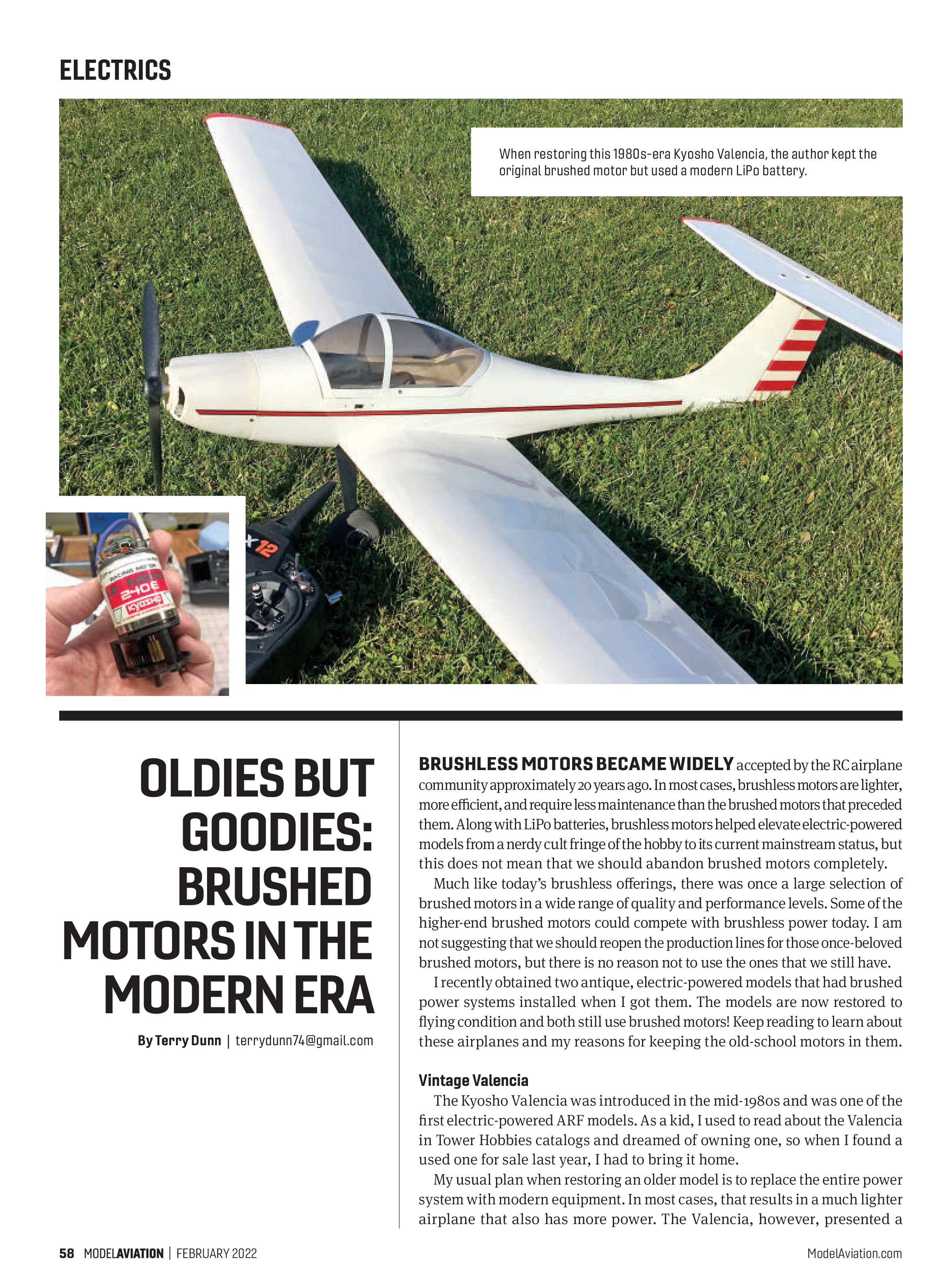
The Kyosho Valencia was introduced in the mid-1980s and was one of the first electric-powered ARF models. As a kid, I used to read about the Valencia in Tower Hobbies catalogs and dreamed of owning one, so when I found a used one for sale last year, I had to bring it home.
My usual plan when restoring an older model is to replace the entire power system with modern equipment. In most cases, that results in a much lighter airplane that also has more power. The Valencia, however, presented a challenge. The heaviest components (a Le Mans 240e brushed motor and a six-cell NiCd battery) were located at the front of the airplane. Although I could replace the motor and battery with lighter, contemporary gear, I would have to forfeit most of that weight savings by adding nose weight in order to achieve the correct center of gravity (CG).
The stock motor, gearbox, and propeller appeared to be in excellent condition. I certainly could have boosted the Valencia’s power with a brushless motor, but it seemed like a waste. The Valencia is meant to be a gentle, three-channel, Sunday flier. Why overpower it with a brushless motor when I already had a perfectly good brushed motor on hand? I decided to keep the stock motor and add a modern battery.
A two-cell LiPo battery has approximately the same nominal voltage as the six-cell NiCd battery that was originally suggested for the Valencia (7.4 volts and 7.2 volts, respectively). The specific LiPo that I chose for the Valencia has about the same footprint as the NiCd, so it easily fits in the nose of the model. Its 2,250 mAh capacity is nearly double that of the 1,200 mAh NiCd (resulting in longer flight times) and it is less than half the weight (5 ounces compared with 11 ounces).
Because of the lighter battery, I knew that I would have to add nose weight to balance the airplane. That’s where advancements in radio equipment helped me quite a bit. The original design called for three standard-size servos (approximately 1.5 ounces each) that were located in a tray behind the airplane’s CG. Two of those servos operated the rudder and elevator. The third servo was used to flip a mechanical switch that turned the motor on and off! I replaced the rudder and elevator servos with modern 9-gram (.3-ounce)


mini servos, which have plenty of torque for this application. I traded the throttle servo and switch for a brushed ESC that is located forward of the CG.
In the end, I only had to add 2.5 ounces of ballast to the firewall for balance. The advertised flying weight of the Valencia is 51 ounces. My revamped antique weighs 44 ounces. The stock brushed motor delivers 180 watts of power, which is plenty for quick grass takeoffs and aggressive climbs. My flight times are well over 10 minutes. That old, brushed motor is definitely a good match for this airplane.
Just Because
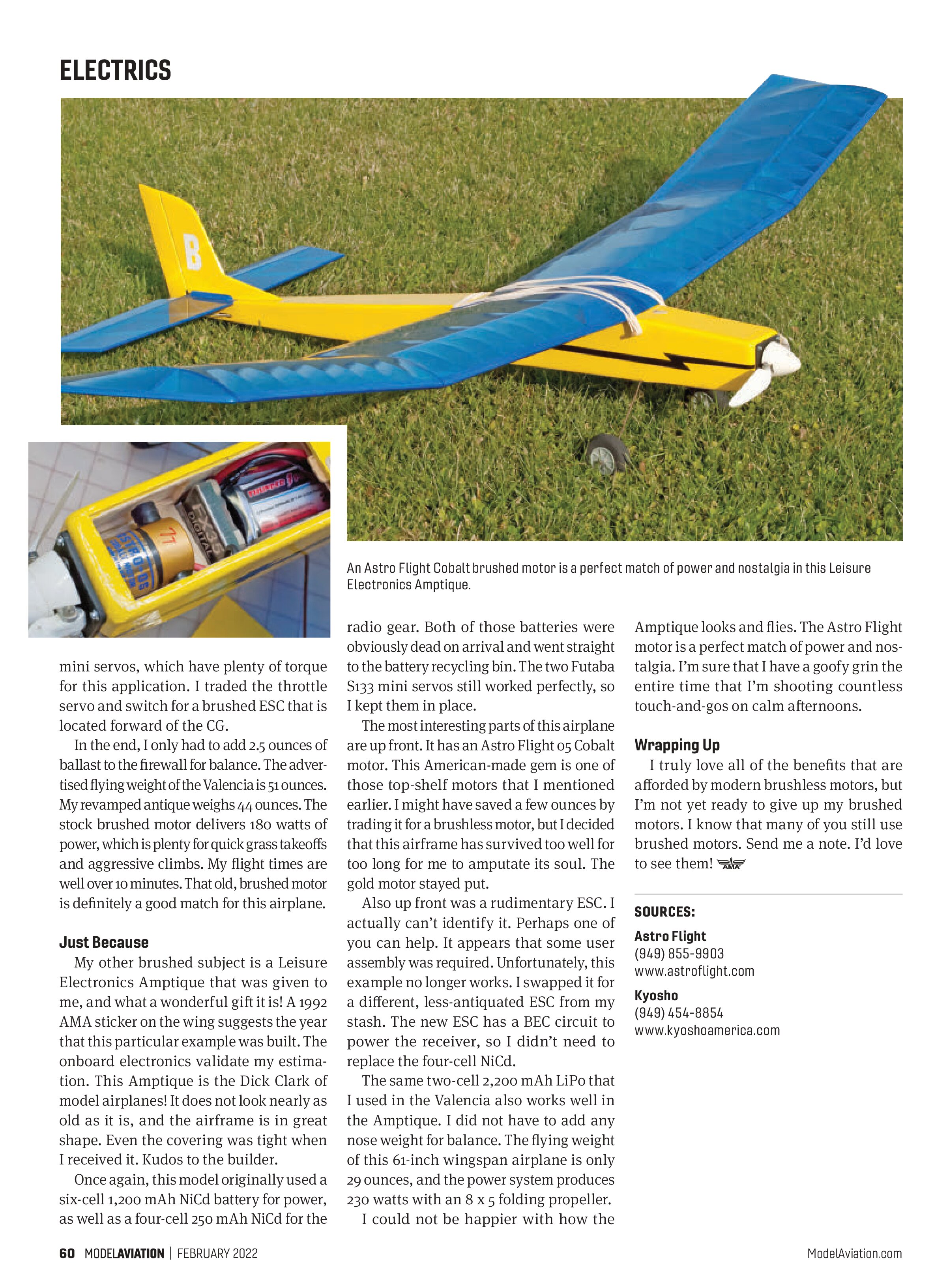
My other brushed subject is a Leisure Electronics Amptique that was given to me, and what a wonderful gift it is! A 1992 AMA sticker on the wing suggests the year that this particular example was built. The onboard electronics validate my estimation. This Amptique is the Dick Clark of model airplanes! It does not look nearly as old as it is, and the airframe is in great shape. Even the covering was tight when I received it. Kudos to the builder.
Once again, this model originally used a six-cell 1,200 mAh NiCd battery for power, as well as a four-cell 250 mAh NiCd for the radio gear. Both of those batteries were obviously dead on arrival and went straight to the battery recycling bin. The two Futaba S133 mini servos still worked perfectly, so I kept them in place.
The most interesting parts of this airplane are up front. It has an Astro Flight 05 Cobalt motor. This American-made gem is one of those top-shelf motors that I mentioned earlier. I might have saved a few ounces by trading it for a brushless motor, but I decided that this airframe has survived too well for too long for me to amputate its soul. The gold motor stayed put.
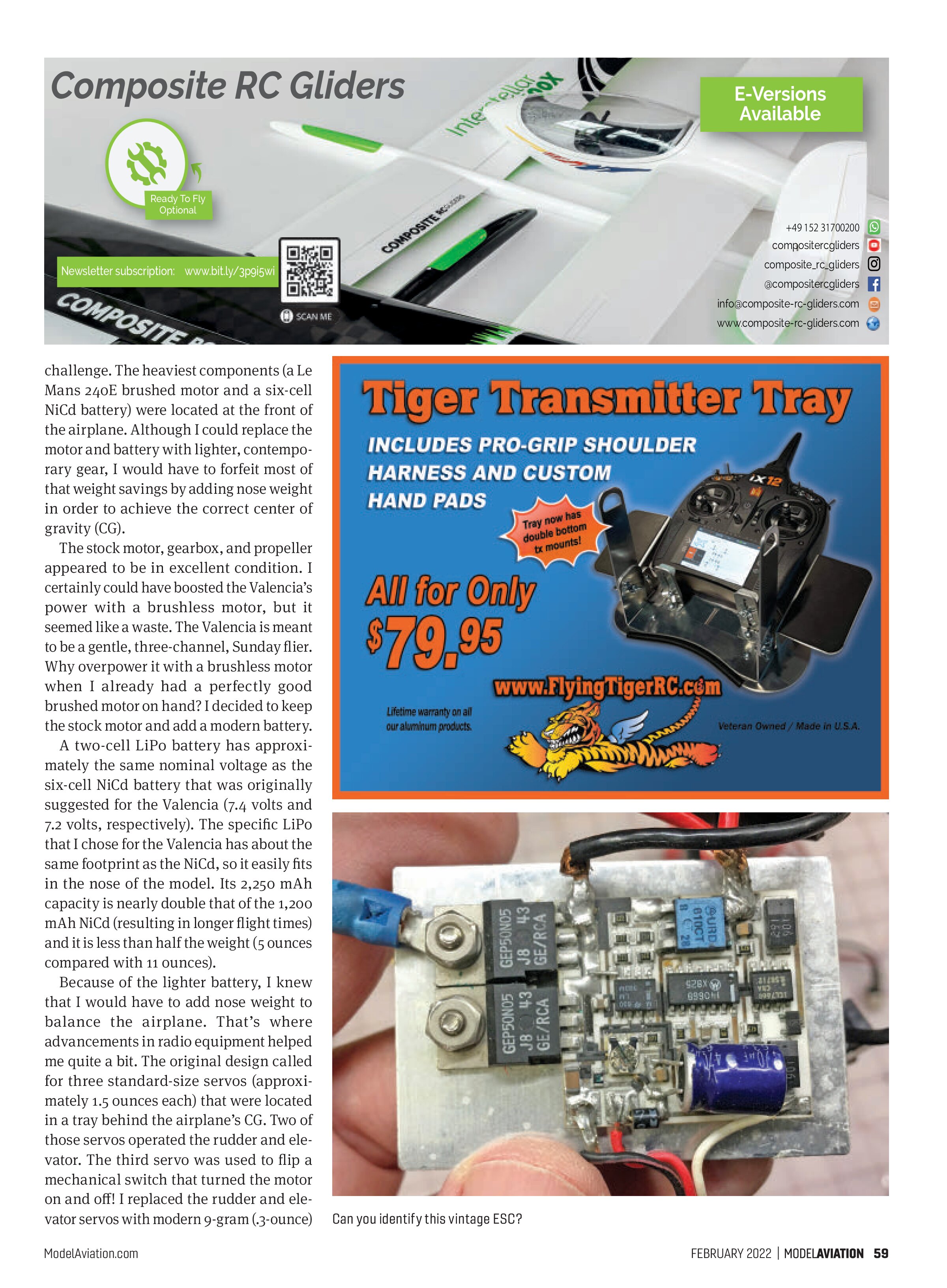
Also up front was a rudimentary ESC. I actually can’t identify it. Perhaps one of you can help. It appears that some user assembly was required. Unfortunately, this example no longer works. I swapped it for a different, less-antiquated ESC from my stash. The new ESC has a BEC circuit to power the receiver, so I didn’t need to replace the four-cell NiCd.
The same two-cell 2,200 mAh LiPo that I used in the Valencia also works well in the Amptique. I did not have to add any nose weight for balance. The flying weight of this 61-inch wingspan airplane is only 29 ounces, and the power system produces 230 watts with an 8 x 5 folding propeller.
I could not be happier with how the Amptique looks and flies. The Astro Flight motor is a perfect match of power and nostalgia. I’m sure that I have a goofy grin the entire time that I’m shooting countless touch-and-go’s on calm afternoons.
Wrapping Up
I truly love all of the benefits that are afforded by modern brushless motors, but I’m not yet ready to give up my brushed motors. I know that many of you still use brushed motors. Send me a note. I’d love to see them!
SOURCES:
Astro Flight
(949) 855-9903
www.astroflight.com
Kyosho
(949) 454-8854
www.kyoshoamerica.com