The Deal with Drones

THE HD REVOLUTION HAS FINALLY COME FOR FPV DRONE RACING
By Joshua Bardwell
joshuabardwell@fpvknowitall.com
NO, THIS ARTICLE ISN’T about the DJI FPV system. When FPV drones were first created, digital high-definition (HD) video barely existed. The first FPV cameras were repurposed analog security cameras. The first FPV video transmitters (vTX) were basically tiny, little analog television stations. Broadcast television switched to digital video in 2013, but in 2021, many FPV pilots were still flying the same analog video as before.
In 2019, DJI released the first commercially successful digital HD FPV system. Many freestyle and casual pilots have switched over, but racers still hold out, in large part because of the DJI FPV system’s cost, weight, and, most importantly, latency. The DJI FPV system has inconsistent latency, which throws off the precision that top racing pilots need. Until recently, systems to allow race officials to record, replay, and monitor pilots’ video feeds were extremely expensive, and the way the DJI system transmits its signals throws off the radio frequency-based timing systems used at races.
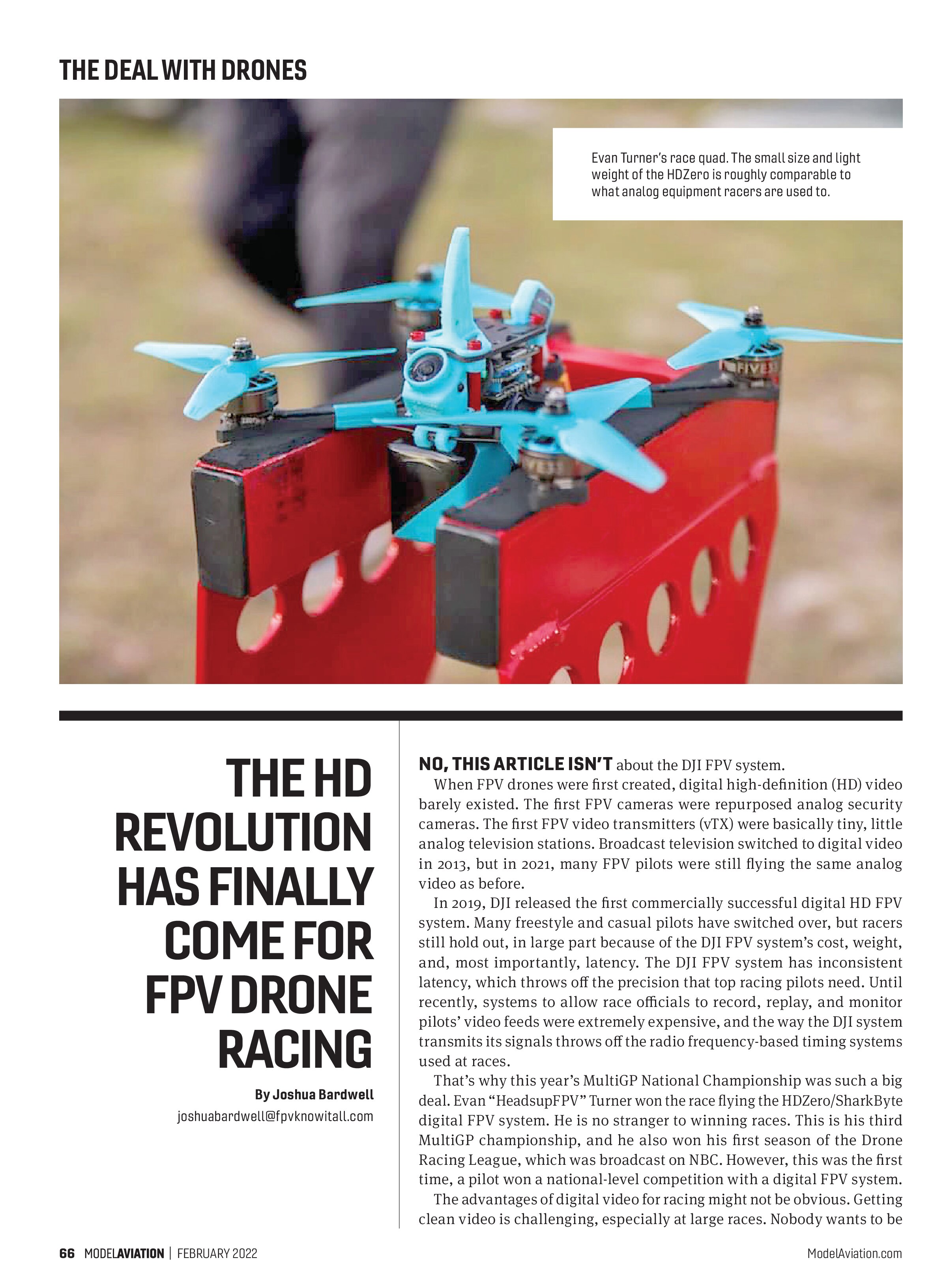
That’s why this year’s MultiGP National Championship was such a big deal. Evan “HeadsupFPV” Turner won the race flying the HDZero/SharkByte digital FPV system. He is no stranger to winning races. This is his third MultiGP championship, and he also won his first season of the Drone Racing League, which was broadcast on NBC. However, this was the first time, a pilot won a national-level competition with a digital FPV system.
The advantages of digital video for racing might not be obvious. Getting clean video is challenging, especially at large races. Nobody wants to be knocked out of a race because of interference. Organizers and pilots do their best, but there are often issues. Digital systems, such as HDZero/SharkByte, are more resistant to interference, and when the signal degrades, the way it does so is more predictable and less disruptive than are analog signals. Of course, having a clear, high-resolution image lets you go faster without crashing.
It must be acknowledged that Evan is the owner of Five33, a drone parts store in which he primarily sells his own brand of racing equipment, but he also sells HDZero/SharkByte. Is his enthusiasm about HDZero simply a business decision? I don’t know, but with a national-level title at stake, it’s hard to believe he’d take chances on anything he didn’t truly believe in.
The results speak for themselves. No, HDZero didn’t make Evan win the race. He’d be a favorite no matter what he was flying. But the fact that HDZero carried him through the race without a single technical glitch is a major accomplishment.
Evan said, “As someone who is very passionate about the FPV industry, I felt that drone racing needed to adapt to digital video sooner rather than later. It was a large risk for me to swap over my entire fleet to HDZero mere days before the event; however, I felt it was a risk worth taking to prove to the world that digital video was viable for the highest level of competition, and that it was a very organic next step for this community to grow.
“The system outperformed everyone’s

solution, the Fat Shark Scout HD goggles are box-style goggles with a built-in HDZero receiver. The main disadvantage of these goggles is that they lack HDMI output, so you won’t be able to display the signal on an external screen.
For video transmitters, the best one today is the HDZero Race V2. This vTX will fit on most frames with a 20mm mounting location. The TX5R.1 has equal specifications to the Race V2, but the 5R.1 extends outside of its 20mm mounting holes and won’t fit in some tighter racing frames.
What about people who don’t race? Is HDZero for them? In my opinion, not quite yet. The main limitation of today’s HDZero vTX is its output power: only 200 mW for the 5R.1 and the Race V2. This is more than enough for racing, but most park flyers and freestyle pilots will feel constrained by the range, especially if they’re used to an analog vTX pumping out 800 mW or more.
Yes, the HDZero system uses digital wizardry to make the most of every mW, but in the end, there’s no substitute for more power. Fortunately, HDZero is developing a 1-watt vTX, which is reported to be in production at the time of this writing and might even be released by the time you read this.

expectations. My video link was crystal clear, [had] little to no breakup, and my drone did not interfere with anyone else’s signal. It simply performed when it needed to, and that is the indication of a system ready for the mass markets. HDZero and digital systems alike are the future of all things FPV. And I cannot wait to see where it takes us. I don’t plan on flying analog ever again.”
What makes the HDZero/SharkByte system so appropriate for racing? Latency is low—not as low as the fastest analog cameras—and consistent. The channels overlap perfectly with the race band frequencies that are used by analog systems, meaning timing systems simply work. The HDZero system allows pilots to cluster in a line, similar to analog. (The DJI system requires pilots to be spaced at least 10 to 15 feet apart to avoid interference.) The HDZero system is simple to broadcast and record, making it easy to officiate and spectate the race.
Why do I keep saying HDZero/SharkByte? Because the system is designed by HDZero and (mostly) manufactured by Fat Shark under the SharkByte name. HDZero has stated, however, that its goal is to have as many manufacturers as possible building HDZero systems to avoid the proprietary lock-in that occurs with the DJI system. Keep an eye out for HDZero video transmitters from other major brands in the future.
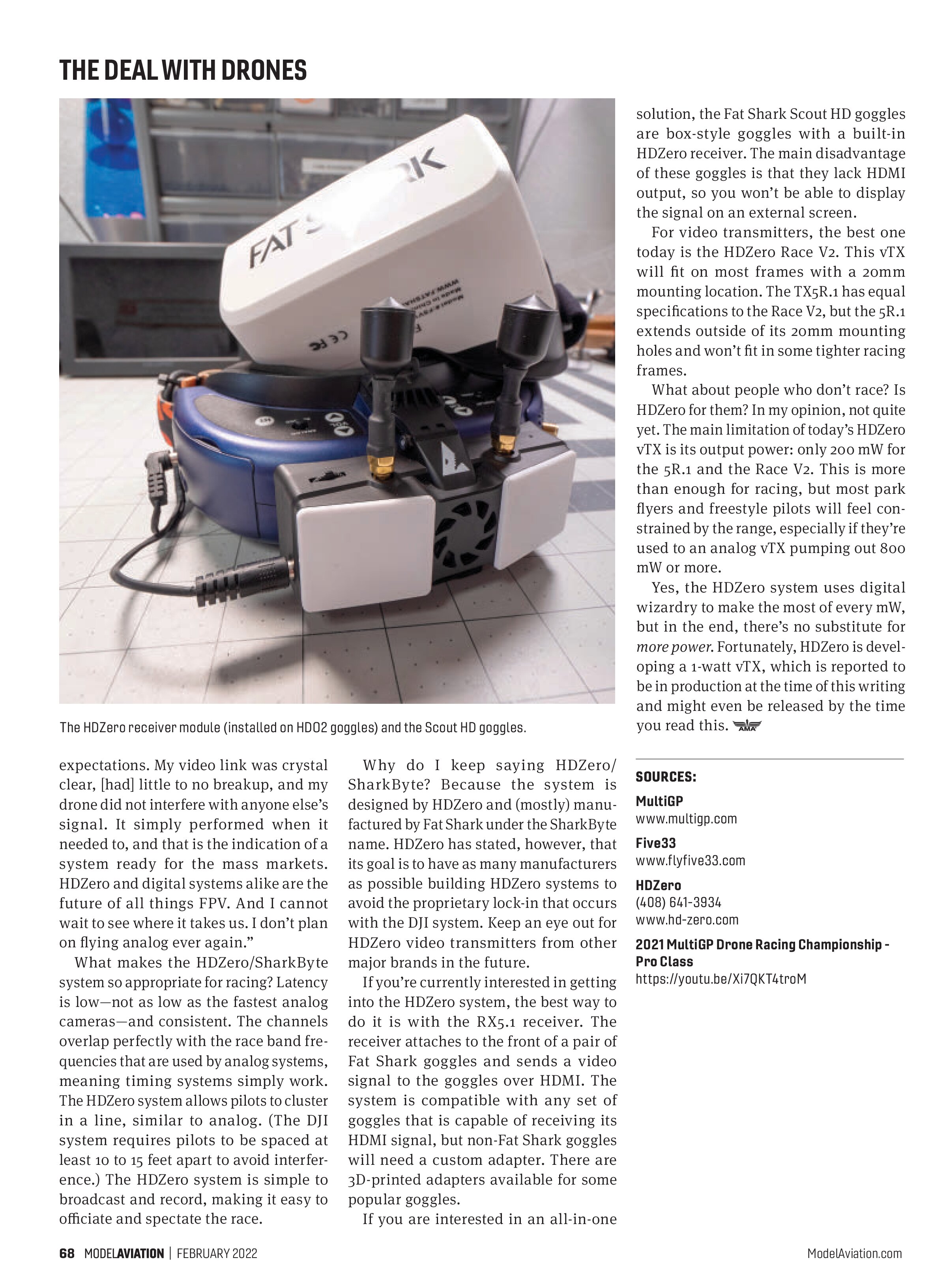
If you’re currently interested in getting into the HDZero system, the best way to do it is with the RX5.1 receiver. The receiver attaches to the front of a pair of Fat Shark goggles and sends a video signal to the goggles over HDMI. The system is compatible with any set of goggles that is capable of receiving its HDMI signal, but non-Fat Shark goggles will need a custom adapter. There are 3D-printed adapters available for some popular goggles.
If you are interested in an all-in-one solution, the Fat Shark Scout HD goggles are box-style goggles with a built-in HDZero receiver.
SOURCES:
MultiGP
www.multigp.com
Five33
www.flyfive33.com
HDZero
(408) 641-3934
www.hd-zero.com
2021 MultiGP Drone Racing Championship - Pro Class
https://youtu.be/Xi7QKT4troM