GOLDBERG VITAL PEOPLE ANNOUNCED

THE AMA EXECUTIVE COUNCIL
selected three people as recipients of the 2021 Carl & Beth Goldberg Vital People Award.
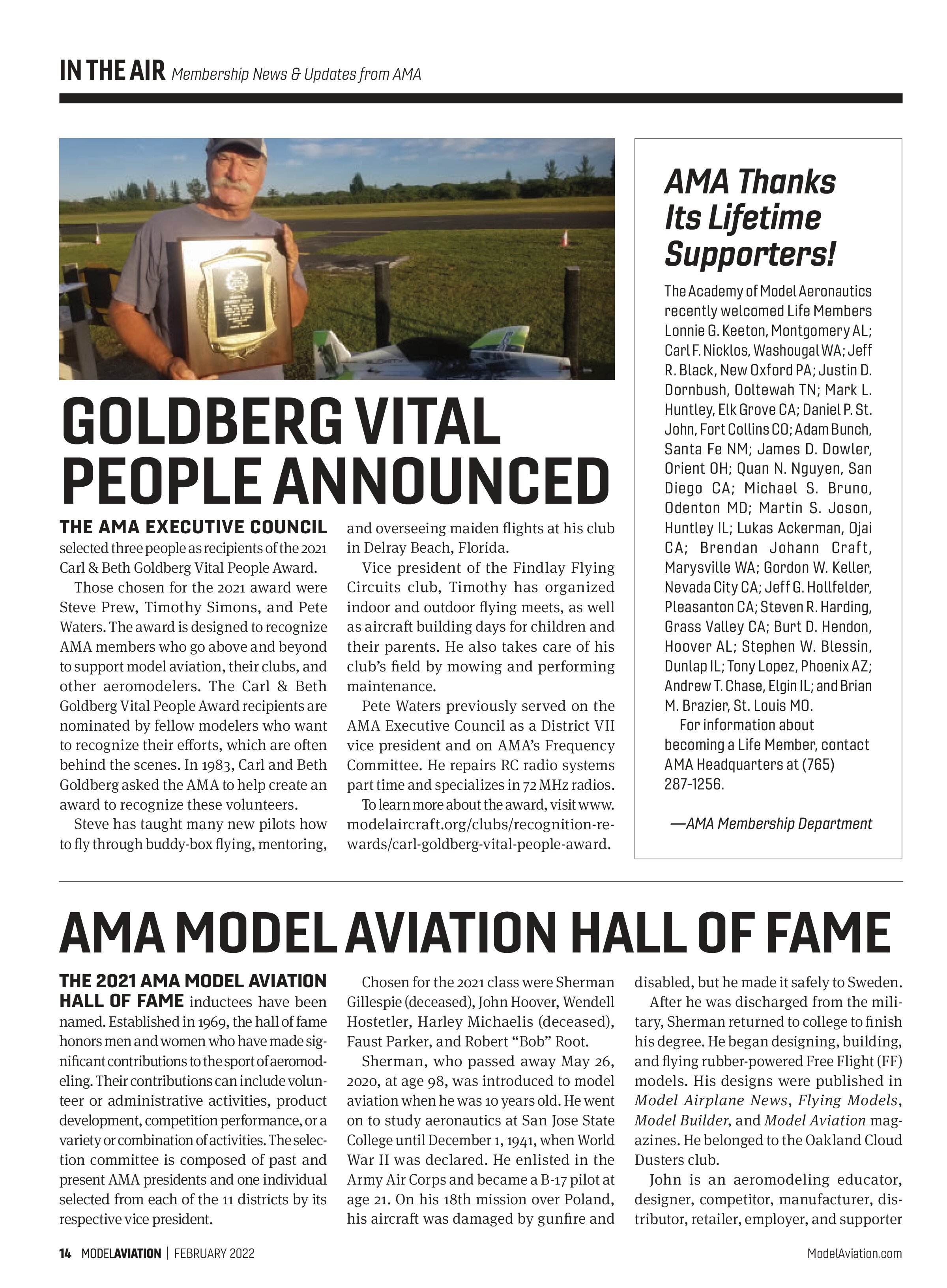
Those chosen for the 2021 award were Steve Prew, Timothy Simons, and Pete Waters. The award is designed to recognize AMA members who go above and beyond to support model aviation, their clubs, and other aeromodelers. The Carl & Beth Goldberg Vital People Award recipients are nominated by fellow modelers who want to recognize their efforts, which are often behind the scenes. In 1983, Carl and Beth Goldberg asked the AMA to help create an award to recognize these volunteers.
Steve has taught many new pilots how to fly through buddy-box flying, mentoring, and overseeing maiden flights at his club in Delray Beach, Florida.
Vice president of the Findlay Flying Circuits club, Timothy has organized indoor and outdoor flying meets, as well as aircraft building days for children and their parents. He also takes care of his club’s field by mowing and performing maintenance.
Pete Waters previously served on the AMA Executive Council as a District VII vice president and on AMA’s Frequency Committee. He repairs RC radio systems part time and specializes in 72 MHz radios.
To learn more about the award, visit www.modelaircraft.org/clubs/recognition-rewards/carl-goldberg-vital-peop....
AMA MODEL AVIATION HALL OF FAME
THE 2021 AMA MODEL AVIATION HALL OF FAME
inductees have been named. Established in 1969, the hall of fame honors men and women who have made significant contributions to the sport of aeromodeling. Their contributions can include volunteer or administrative activities, product development, competition performance, or a variety or combination of activities. The selection committee is composed of past and present AMA presidents and one individual selected from each of the 11 districts by its respective vice president.
Chosen for the 2021 class were Sherman Gillespie (deceased), John Hoover, Wendell Hostetler, Harley Michaelis (deceased), Faust Parker, and Robert “Bob” Root.
Sherman, who passed away May 26, 2020, at age 98, was introduced to model aviation when he was 10 years old. He went on to study aeronautics at San Jose State College until December 1, 1941, when World War II was declared. He enlisted in the Army Air Corps and became a B-17 pilot at age 21. On his 18th mission over Poland, his aircraft was damaged by gunfire and disabled, but he made it safely to Sweden. After he was discharged from the military, Sherman returned to college to finish his degree. He began designing, building, and flying rubber-powered Free Flight (FF) models. His designs were published in Model Airplane News, Flying Models, Model Builder, and Model Aviation magazines. He belonged to the Oakland Cloud Dusters club.
John is an aeromodeling educator, designer, competitor, manufacturer, distributor, retailer, employer, and supporter of model aircraft. He has demonstrated excellence in competition, designing, publishing, manufacturing, and teaching model aviation. He earned awards from NASA and the U.S. Army and is a past recipient of the Carl & Beth Goldberg Vital People Award.
Ten of his designs have been published and kitted and appeared in Model Aviation and Park Pilot. He is a prolific builder, having built or assembled more than 400 aircraft. John has successfully competed in RC Soaring and RC Pylon Racing and created a line of aeromodeling parts, hardware, and accessories. He also has sponsored multidisciplinary aeromodeling seminars.
Wendell encountered his first model aircraft at age 6. It was a rubber-powered Peanut Scale aircraft. He began building and flying models, including early escapement RC airplanes. He continued the craft, which led him in 1974 to start drawing Giant Scale model plans, including plans for a Skybolt.
In 1979, Wendell created Hostetler’s Plans, which is still in business today. He has drawn at least one new set of plans each year for the last 41 years. As of January 2021, he had created 52 total designs, with his largest being a 55% Giles 202. He is always helpful to builders and his loyal customers.
As a kid growing up in the Great Depression era, it was a big deal to young Harley when an airplane flew into Walla Walla, Washington. Living to be 99 years old, the RC sailplane pilot passed away in October 2020, after 90-plus years of designing and flying model aircraft.
Harley scratch-built his first FF airplane. By age 17, he was a member of a local airplane club and built a model in shop class. The self-taught modeler became involved with RC sailplanes in the mid-1960s. He was the oldest modeler in the Northwest Soaring Society and competed until 2008, when vision changes required him to participate in less-demanding sport flying.
He began creating original sailplane designs in 1969, and 17 of his construction articles were published in various aeromodeling magazines.
A competitive FF pilot, designer, club leader, and contest director, Faust has competed internationally on multiple FAI World Championship teams. At the AMA Nats, he clinched several titles in the 1990s. He is a lifetime member of the National Free Flight Society (NFFS) and was inducted into the NFFS Hall of Fame in 2010. He has designed four aircraft.
Faust received his bachelor’s and master’s degrees from the University of Texas at Arlington. He earned his Ph.D. from the University of Texas at Austin. His career has included working for seven years as a contract chemist at the School of Aerospace Medicine, Brooks Air Force Base in San Antonio, and 25 years as the director of an environmental toxicology laboratory in Houston.
An AMA member since 1949, Bob began modeling at an early age by scratch-building and kit-building FF, Control Line, and RC aircraft. As a young modeler, he joined virtually all of the model airplane clubs in his community and participated in numerous club activities. In 2020, he competed in the U.S. Scale Masters. His passion for building and flying has been a major part of his life.
Bob earned a bachelor’s degree in mechanical engineering with an aeronautical option from Oregon State University in 1960. Throughout his professional life, he has been employed by major aircraft corporations, working on the designs of commercial and defense aircraft. In the late 1970s and early 1980s, he worked for Northrop Grumman Aircraft Corporation as a member of its concept/design team, leading to the development of the B-2 Spirit stealth bomber. In 1983, Bob obtained his general aviation pilot’s license.
To see a list of past AMA Model Aviation Hall of Fame inductees, visit www.modelaircraft.org/museum/history-recognition/ama-model-aviation-hall....
Build the Lockheed Vega
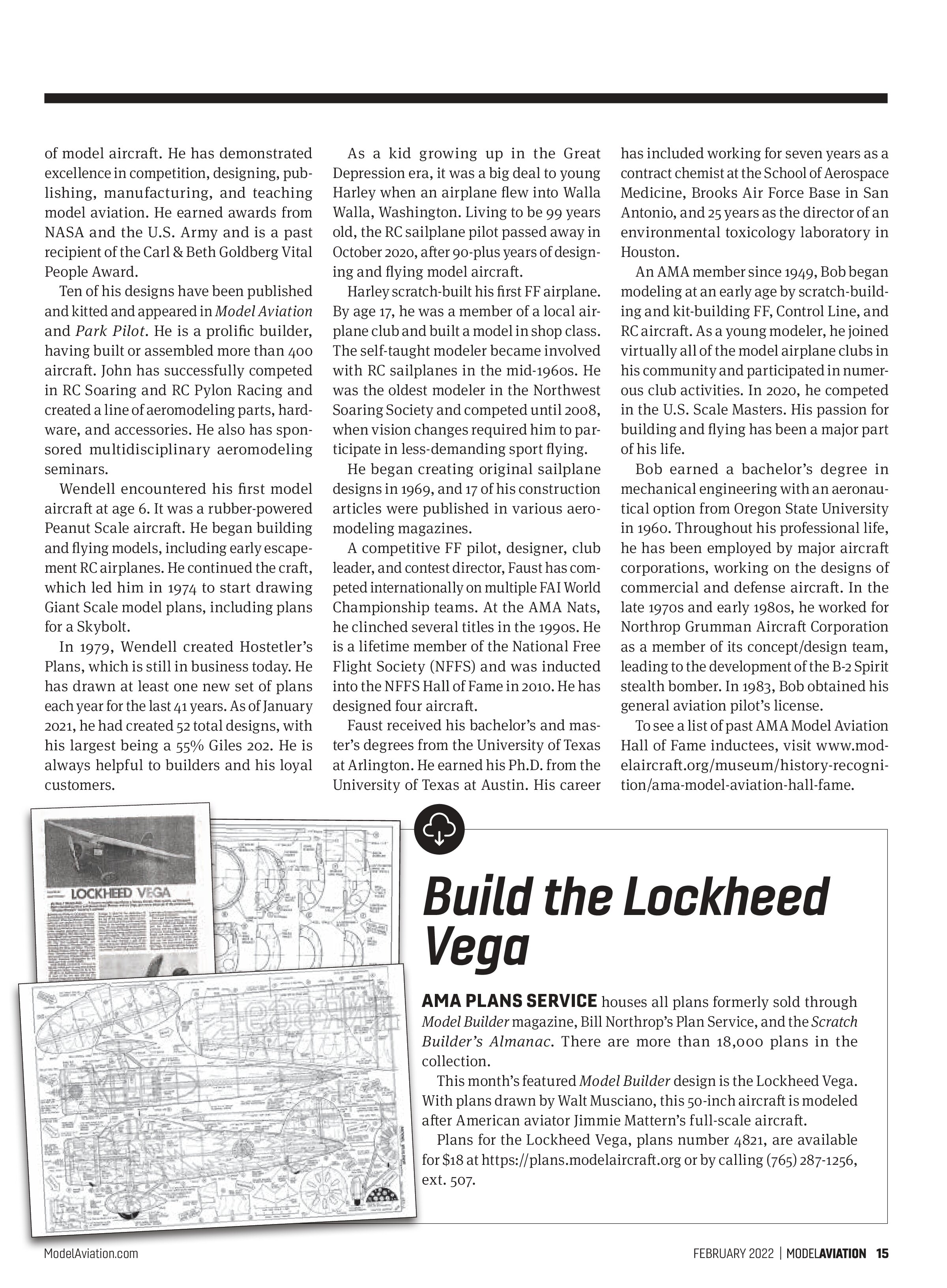
AMA PLANS SERVICE houses all plans formerly sold through Model Builder magazine, Bill Northrop’s Plan Service, and the Scratch Builder’s Almanac. There are more than 18,000 plans in the collection.
This month’s featured Model Builder design is the Lockheed Vega. With plans drawn by Walt Musciano, this 50-inch aircraft is modeled after American aviator Jimmie Mattern’s full-scale aircraft.
Plans for the Lockheed Vega, plans number 4821, are available for $18 at https://plans.modelaircraft.org or by calling (765) 287-1256, ext. 507.

THE WRIGHT BROTHERS’ successful flight sparked the imagination of millions. Flight was a reality and both full-scale and model aircraft quickly took to the air. Orville Wright’s influence on model aviation would not simply be one of inspiration. He also briefly helped design model aircraft.
This story begins in 1923, with Harold Miller attending a Wright family Christmas party. Harold’s wife, Ivonette Wright, was Orville and Wilbur’s niece. During the party, Orville brought out a toy that he had played with as a boy. Intrigued, Harold asked if he could take the design to the toy company he worked for, the Miami Wood Specialty Company.
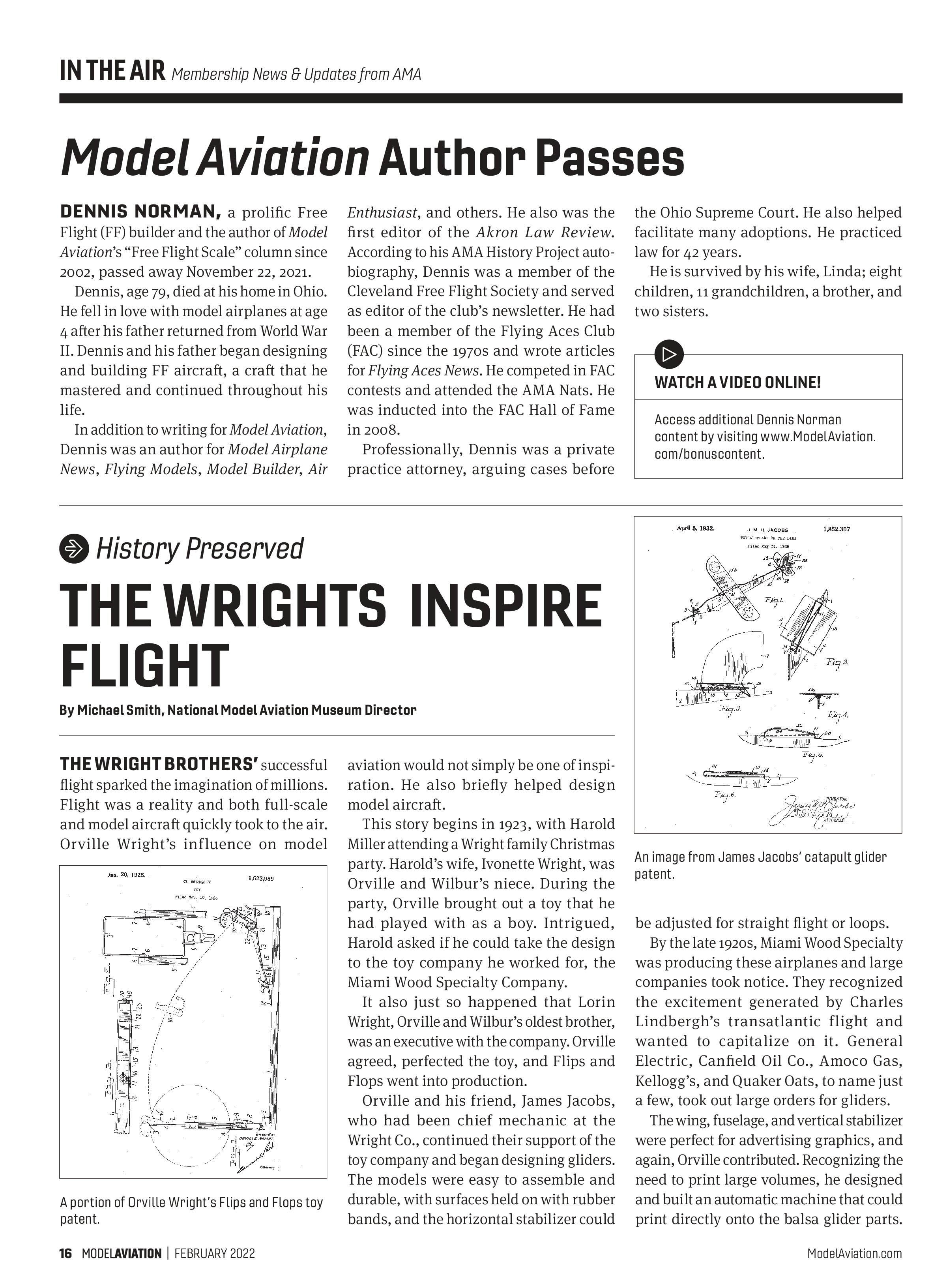
It also just so happened that Lorin Wright, Orville and Wilbur’s oldest brother, was an executive with the company. Orville agreed, perfected the toy, and Flips and Flops went into production.
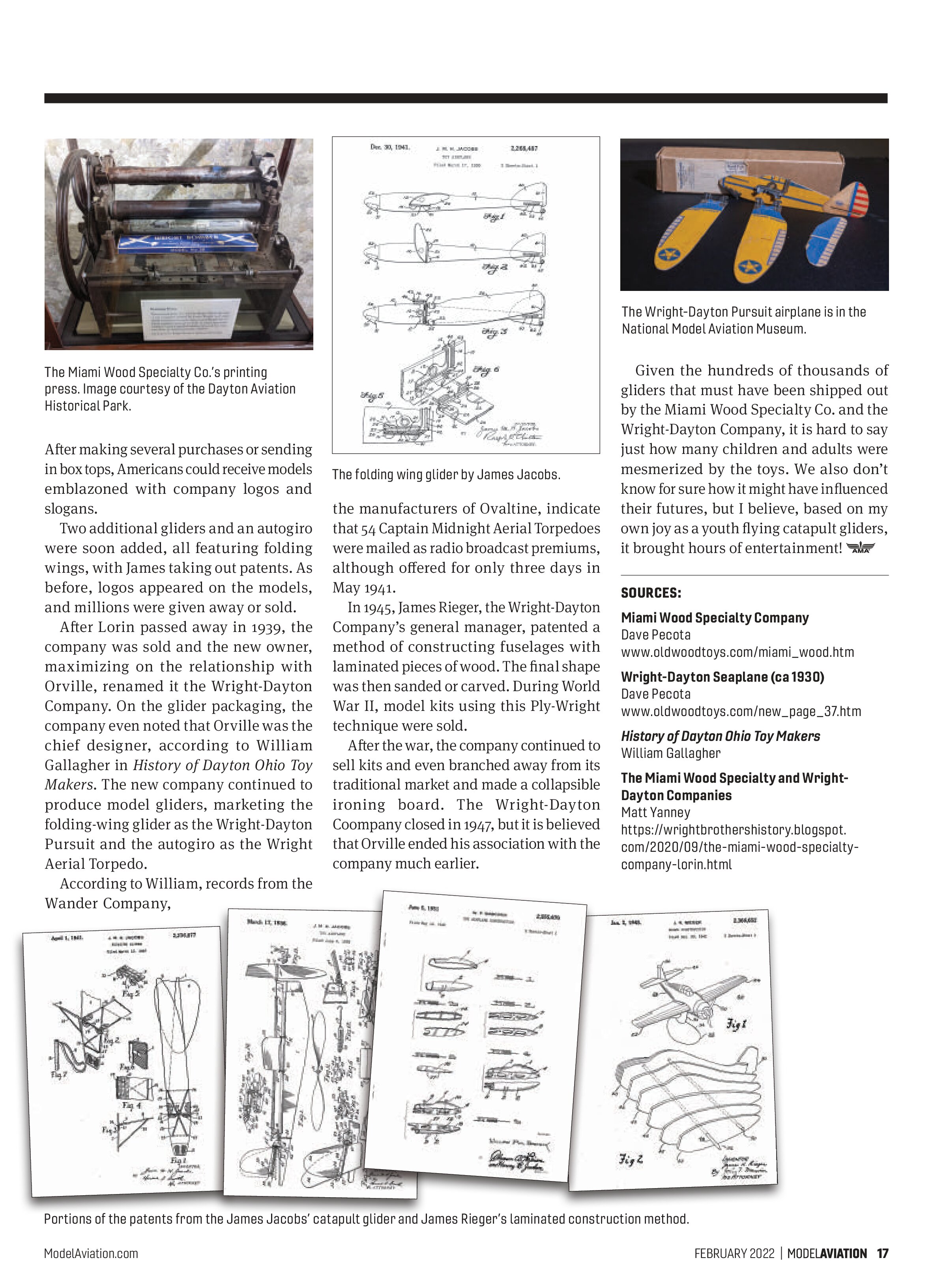
Orville and his friend, James Jacobs, who had been chief mechanic at the Wright Co., continued their support of the toy company and began designing gliders. The models were easy to assemble and durable, with surfaces held on with rubber bands, and the horizontal stabilizer could be adjusted for straight flight or loops.

By the late 1920s, Miami Wood Specialty was producing these airplanes and large companies took notice. They recognized the excitement generated by Charles Lindbergh’s transatlantic flight and wanted to capitalize on it. General Electric, Canfield Oil Co., Amoco Gas, Kellogg’s, and Quaker Oats, to name just a few, took out large orders for gliders.
The wing, fuselage, and vertical stabilizer were perfect for advertising graphics, and again, Orville contributed. Recognizing the need to print large volumes, he designed and built an automatic machine that could print directly onto the balsa glider parts.

The Miami Wood Specialty Co.’s printing press. Image courtesy of the Dayton Aviation Historical Park.
After making several purchases or sending in box tops, Americans could receive models emblazoned with company logos and slogans.
Two additional gliders and an autogiro were soon added, all featuring folding wings, with James taking out patents. As before, logos appeared on the models, and millions were given away or sold.
After Lorin passed away in 1939, the company was sold and the new owner, maximizing on the relationship with Orville, renamed it the Wright-Dayton Company. On the glider packaging, the company even noted that Orville was the chief designer, according to William Gallagher in History of Dayton Ohio Toy Makers. The new company continued to produce model gliders, marketing the folding-wing glider as the Wright-Dayton Pursuit and the autogiro as the Wright Aerial Torpedo.
According to William, records from the Wander Company, the manufacturers of Ovaltine, indicate that 54 Captain Midnight Aerial Torpedoes were mailed as radio broadcast premiums, although offered for only three days in May 1941.
In 1945, James Rieger, the Wright-Dayton Company’s general manager, patented a method of constructing fuselages with laminated pieces of wood. The final shape was then sanded or carved. During World War II, model kits using this Ply-Wright technique were sold.
After the war, the company continued to sell kits and even branched away from its traditional market and made a collapsible ironing board. The Wright-Dayton Company closed in 1947, but it is believed that Orville ended his association with the company much earlier.

The folding wing glider by James Jacobs.

The Wright-Dayton Pursuit airplane is in the National Model Aviation Museum.
Given the hundreds of thousands of gliders that must have been shipped out by the Miami Wood Specialty Co. and the Wright-Dayton Company, it is hard to say just how many children and adults were mesmerized by the toys. We also don’t know for sure how it might have influenced their futures, but I believe, based on my own joy as a youth flying catapult gliders, it brought hours of entertainment!

SOURCES:
Miami Wood Specialty Company
Dave Pecota
www.oldwoodtoys.com/miami_wood.htm
Wright-Dayton Seaplane (ca 1930)
Dave Pecota
www.oldwoodtoys.com/new_page_37.htm
History of Dayton Ohio Toy Makers
William Gallagher
The Miami Wood Specialty and Wright-Dayton Companies
Matt Yanney
https://wrightbrothershistory.blogspot.com/2020/09/the-miami-wood-specialty-company-lorin.html