AIRPLANE
DESIGNS
FROM 50
YEARS AGO
By Bob Noll | bobrcl@aol.com

I HOPE THAT ALL of my Vintage RC airplane friends had a fun-filled flying season by either attending a Vintage Radio Control Society (VRCS) event or by simply flying an airplane that was built by hand. Let’s take a look at the airplane designs that were published 50 years ago in our model magazines.
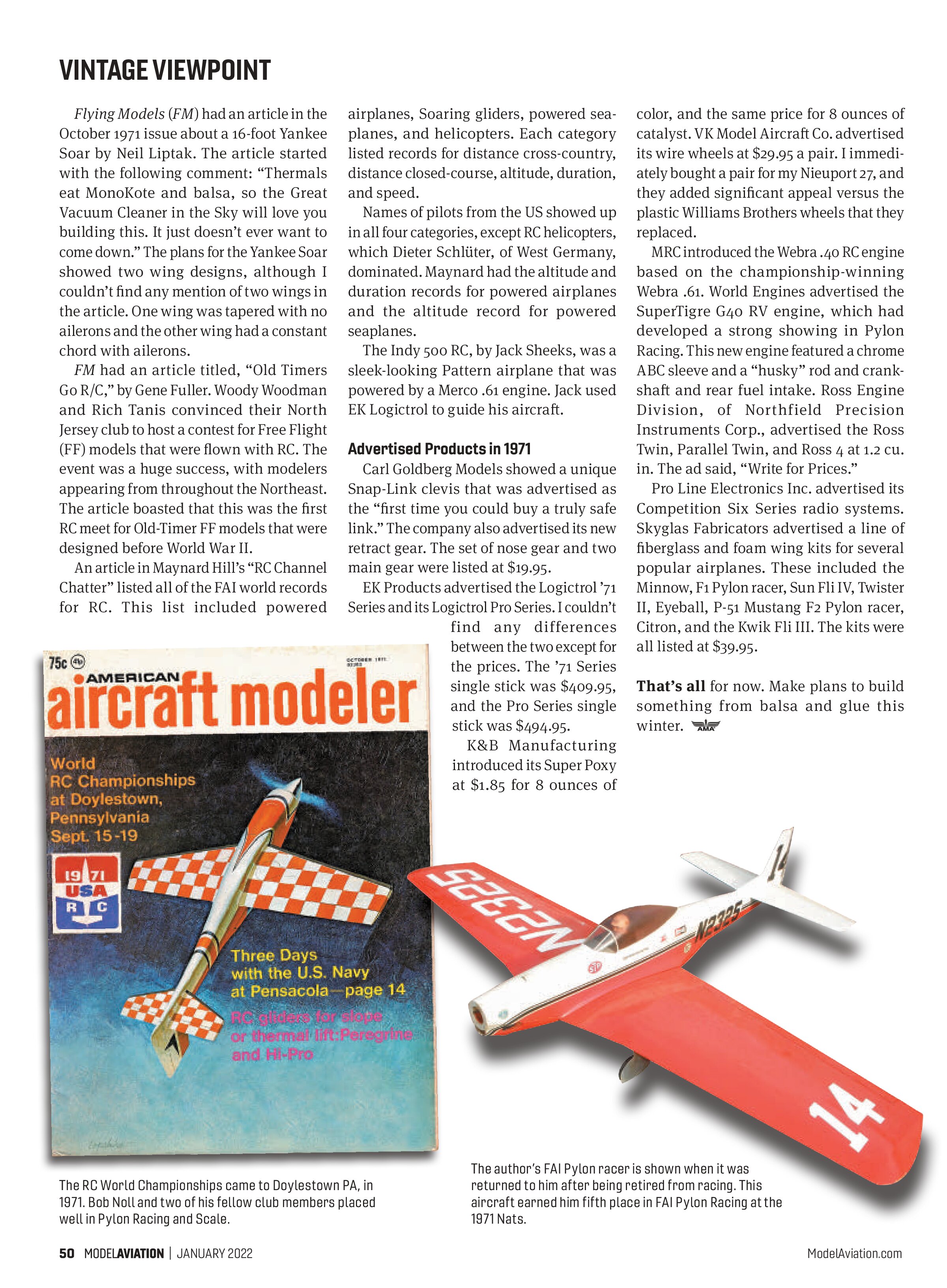
I’ll start this month with a magazine that no longer exists, American Aircraft Modeler (AAM). The October 1971 issue had a cover that advertised the World RC Championships in Doylestown, Pennsylvania. More about this event later.
AAM featured two Slope Soaring aircraft that were becoming popular for modelers who lived in places that could support that form of our hobby. The Peregrine, by Bob Andris, was a special-purpose racing and aerobatic Slope Soaring sailplane. The V-tail design used only aileron and elevator control. Transmitters with the ability to mix both pitch and yaw with a V-tail aircraft were not available at the time.
The Hi-Pro, by Harley Michaelis, was an all-purpose Thermal Duration or Slope Soaring sailplane. It used a commercially available fiberglass fuselage. The article showed several wing and tail configurations.
Model Airplane News (MAN) contained a special section titled, “Radio Control Speed & Sport.” The Shark, a Formula 1 (F1) Pylon racer by Robert Morse and Joe Foster, was a pretty aircraft that really moved. It was fashioned after a racer flown at the famous Reno Air Races.
The “Pylon Pit Patter” column, by Clif Weirick, contained the results of a contest in Syracuse, New York. When I saw my name after placing fourth in F1 and first in Formula 2 (F2), it brought back fond memories of my Pylon Racing days.
Allow me to tell you about how two of my Pylon Racing aircraft came back to me. I had two F1 Stiegel Minnows in identical paint schemes that I campaigned for several years. I was approached at a Westchester Radio Aero Modelers (WRAM) trade show by someone who wanted to buy the pair. At that time, I had decided to retire from competitive Pylon Racing and sold them.
Approximately two years ago, I was contacted through AMA about buying back one of the racers, which showed up at an estate sale. I had both my name and my caller’s name, Art Riegal, on the wing, so that is how I was found. There was only one airplane for sale, and I assumed that the other had crashed. I contacted the estate and bought back the remaining racer for a small donation to it.
Many years ago, I was approached again at the WRAM Show by a friend about my FAI Pylon Racing airplane. He bought the racer simply because he thought it was a great-looking airplane. His intention was to only fly it for sport. Well, it happened again. The friend who bought the FAI racer gave it back to me after he had flown it many times and thought I should have it because he was planning to retire it.
Back to the magazines.
An article in MAN about “Padre’s Parachute,” by Rev. Wayne Kobes, caught my eye. The author showed how he licked the problem of small-field landing in a unique way. Wayne attached a 9-foot diameter chute that he made from nylon to the bottom of his Falcon 56 fuselage and designed a unique release mechanism—just fly over the runway and release!
Radio Control Modeler contained articles about all phases of RC at the 1971 AMA Nats. The 40th annual AMA Nats was held at Naval Air Station Glenview in Glenview, Illinois. Several members of the AeroGuidance Society (AGS) were entered in that Nats, which was sponsored by the U.S. Navy. The Navy also provided all of the judges that were required for Scale, Pattern, F1 and F2 Pylon Racing, and Soaring.
AGS member Ralph Jackson was in fifth place in Scale, and Hale Wallace was in 10th place with his Lumley Chipmunk.
Both Ralph and Hale were members of the 1970 US Scale team. Hale’s Chipmunk earned top Scale points, and Ralph was awarded Best Flight Achievement for his Handley Page O/400.
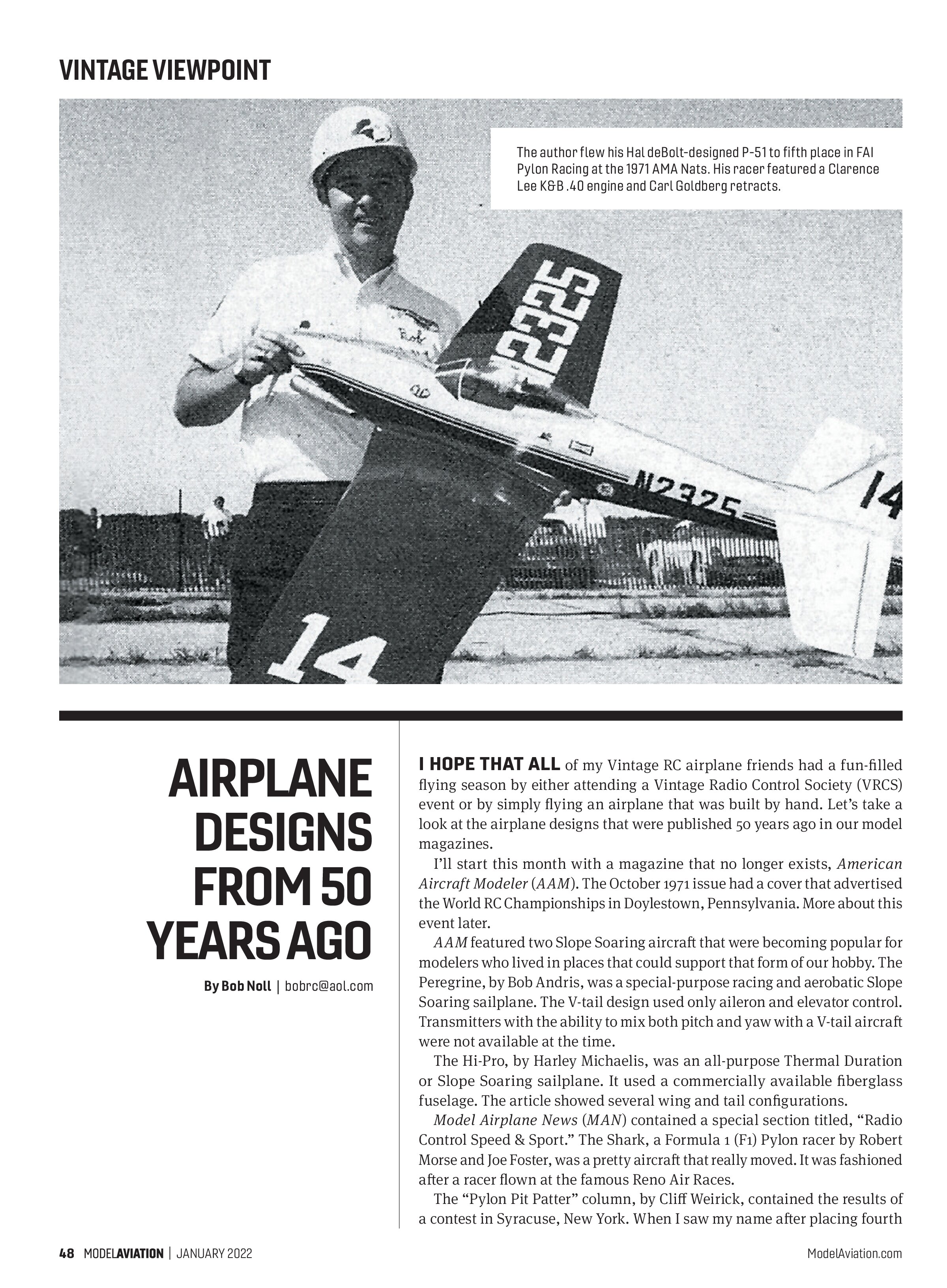
I placed fifth in FAI Pylon Racing with my Hal deBolt-designed P-51. At that time, FAI Pylon Racing rules required a semiscale airplane with .40 cu. in. power using a muffler and fuel with no nitro. Fifth place wasn’t bad because there were 49 entries. My P-51 used Carl Goldberg retracts. Retracts were not allowed in AMA Pylon Racing categories.
airplanes, Soaring gliders, powered seaplanes, and helicopters. Each category listed records for distance cross-country, distance closed-course, altitude, duration, and speed.
Names of pilots from the US showed up in all four categories, except RC helicopters, which Dieter Schlüter, of West Germany, dominated. Maynard had the altitude and duration records for powered airplanes and the altitude record for powered seaplanes.
The Indy 500 RC, by Jack Sheeks, was a sleek-looking Pattern airplane that was powered by a Merco .61 engine. Jack used EK Logictrol to guide his aircraft.
Advertised Products in 1971
Carl Goldberg Models showed a unique Snap-Link clevis that was advertised as the “first time you could buy a truly safe link.” The company also advertised its new retract gear. The set of nose gear and two main gear were listed at $19.95.
EK Products advertised the Logictrol ’71 Series and its Logictrol Pro Series. I couldn’t find any differences between the two except for the prices. The ’71 Series single stick was $409.95, and the Pro Series single stick was $494.95.
K&B Manufacturing introduced its Super Poxy at $1.85 for 8 ounces of

color, and the same price for 8 ounces of catalyst. VK Model Aircraft Co. advertised its wire wheels at $29.95 a pair. I immediately bought a pair for my Nieuport 27, and they added significant appeal versus the plastic Williams Brothers wheels that they replaced.
MRC introduced the Webra .40 RC engine based on the championship-winning Webra .61. World Engines advertised the SuperTigre G40 RV engine, which had developed a strong showing in Pylon Racing. This new engine featured a chrome ABC sleeve and a “husky” rod and crankshaft and rear fuel intake. Ross Engine Division, of Northfield Precision Instruments Corp., advertised the Ross Twin, Parallel Twin, and Ross 4 at 1.2 cu. in. The ad said, “Write for Prices.”
Pro Line Electronics Inc. advertised its Competition Six Series radio systems. Skyglas Fabricators advertised a line of fiberglass and foam wing kits for several popular airplanes. These included the Minnow, F1 Pylon racer, Sun Fli IV, Twister II, Eyeball, P-51 Mustang F2 Pylon racer, Citron, and the Kwik Fli III. The kits were all listed at $39.95.
That’s all for now. Make plans to build something from balsa and glue this winter.