SAFETY COMES FIRST
By Dave Gee

I SMELL TROUBLE…
“BRAIN FART” IS A COLORFUL slang phrase to describe a moment when we just aren’t paying proper attention. There usually isn’t even a distraction or other excuse. Experienced modeler Rod Sage brought the subject up and gave a classic example:
“I had just refurbished a small, four-stroke engine and had it running on a test stand in my backyard. I noticed a screw vibrate out of the intake pipe and fall, so I quickly reached for it … brain-fart moment. The prop chewed up my thumb and first finger pretty good, and I needed 18 little stitches.”
Rod has been around propellers and engines long enough to know perfectly well not to do that, but a brain fart occurred, and he paid the price. He figured that the only positive angle was to share the story here so that we can all be more aware of the danger. A momentary lapse of judgment can have consequences!
Nobody can concentrate all of the time. A good way to avoid brain farts is to develop and use a standard routine when working with our aircraft. Make good habits and develop your mental “muscle memory” so that even if your mind wanders, your fingers stay safe. We are in this hobby for fun and relaxation, so we tend to be in a relaxed state of mind, but getting hurt is no fun at all.
A Corker of a Suggestion!
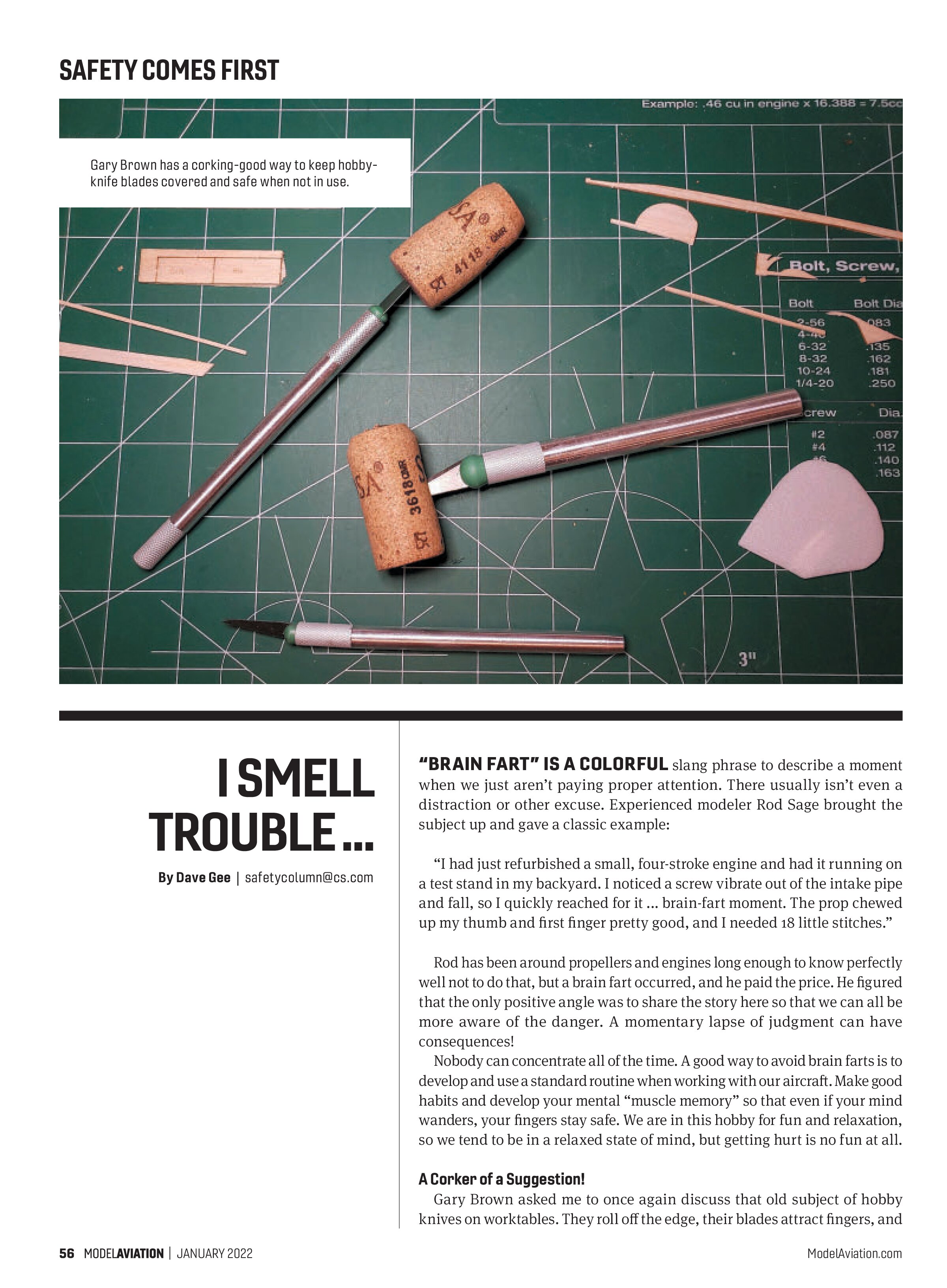
Gary Brown asked me to once again discuss that old subject of hobby knives on worktables. They roll off the edge, their blades attract fingers, and they generally lie in wait to cause trouble. Many builders use a clever system of some sort to keep the blades safe between uses, but Gary described an old classic:
“Maybe you’ve already seen enough of this type of suggestion previously, but I’ll offer it anyway, just in case there are still readers out there in model aviation land with unprotected blades lying about and a surplus of wine corks!
“Instead of throwing out that rubbery, plastic cork when the wine bottle is empty, cut out pieces to use on the blades of your hobby knives or any other sharp tool to protect the blade and your fingers.”
If you take Gary’s good advice, remember to stick the blades into the side of the cork and not the end, so that it can’t roll around (or off) the table. Many corks are not actually made of cork these days, but either type will work well as a hobby-knife blade scabbard. Teetotalers such as I can obtain a couple of corks by asking nicely at a restaurant. Tip your server well—they work hard.
TRUST Is Vital
I urge all AMA members to visit The Recreational UAS Safety Test (TRUST) program website and get your FAA drone qualification documented, even if you don’t actually fly them. We all want to promote safely flying unmanned aircraft, and your involvement helps. Let’s show them how many modelers are out there supporting the AMA’s lobbying effort! Besides, if I can qualify for the license, it can’t be that difficult. Even an old-timer such as I can find a few new things to learn in the process. You might become a safer pilot just by participating in this easy and informative program.
How Not to Run an Event
I have a warm feeling about our AMA insurance because it makes it possible for us to fly at all sorts of great flying sites. Being financially covered in the unlikely event of a mishap has allowed our hobby to keep growing. Is there a downside to aviation insurance? Here’s the sad tale of an aviation group that seems to have used its insurance policy as a weapon.
Small air museums are my favorite kind, and I have memberships all across the country. On a recent trip to Iowa, I had a rental car and a whole day to myself. There’s an antique light airplane field and museum several hours away, and it was having a fly-in that week. Nothing like the friendly feeling of a local aviation event, right?
Mind you, this rural field is not close to anything, so I spent most of the day driving just to enjoy an hour of airplanes and buy some souvenirs. I downloaded an event information sheet and directions from the museum’s website and headed out. With luck, I’d come away with a new mystery airplane photo!
There was a Beechcraft Staggerwing in the pattern as I drove up. Great! But that glimpse was the highlight of my trip, and things went downhill fast.
At the gate, I ask how much it was to park and was told, “We don’t allow visitors.” At an air museum? I was told that to attend this event, there was a $90 insurance fee, plus a $35 membership charge, and maybe a $90 camping fee!
I mentioned my long drive, and that the advertising flyer didn’t say “No spectators.” Nope. The leadership confirmed that “this is a members-only event” and

outsiders are not welcome. I could shell out $125 for membership and insurance, “but even so, we’re not sure if we can allow you on the premises.” I thought about just paying up (considering my investment of time and gas), but that attitude was a bit much. How disappointing.
This group used its aviation insurance policy not as a tool for safe flying and recruitment, but as a barricade against newcomers. Hey, they can run their club however they like, but I bet their insurance agent is embarrassed.
Compare this with any modeling event! A stranger such as I might be grabbed and taken to the flightline and handed a buddy-box transmitter to see what fun it is to safely fly an RC trainer. Don’t worry; flight instruction is covered by AMA insurance. Of course, when someone finds out who I really am, they shout, “Everyone take cover and get that radio away from him!”
Most of a Mystery Airplane
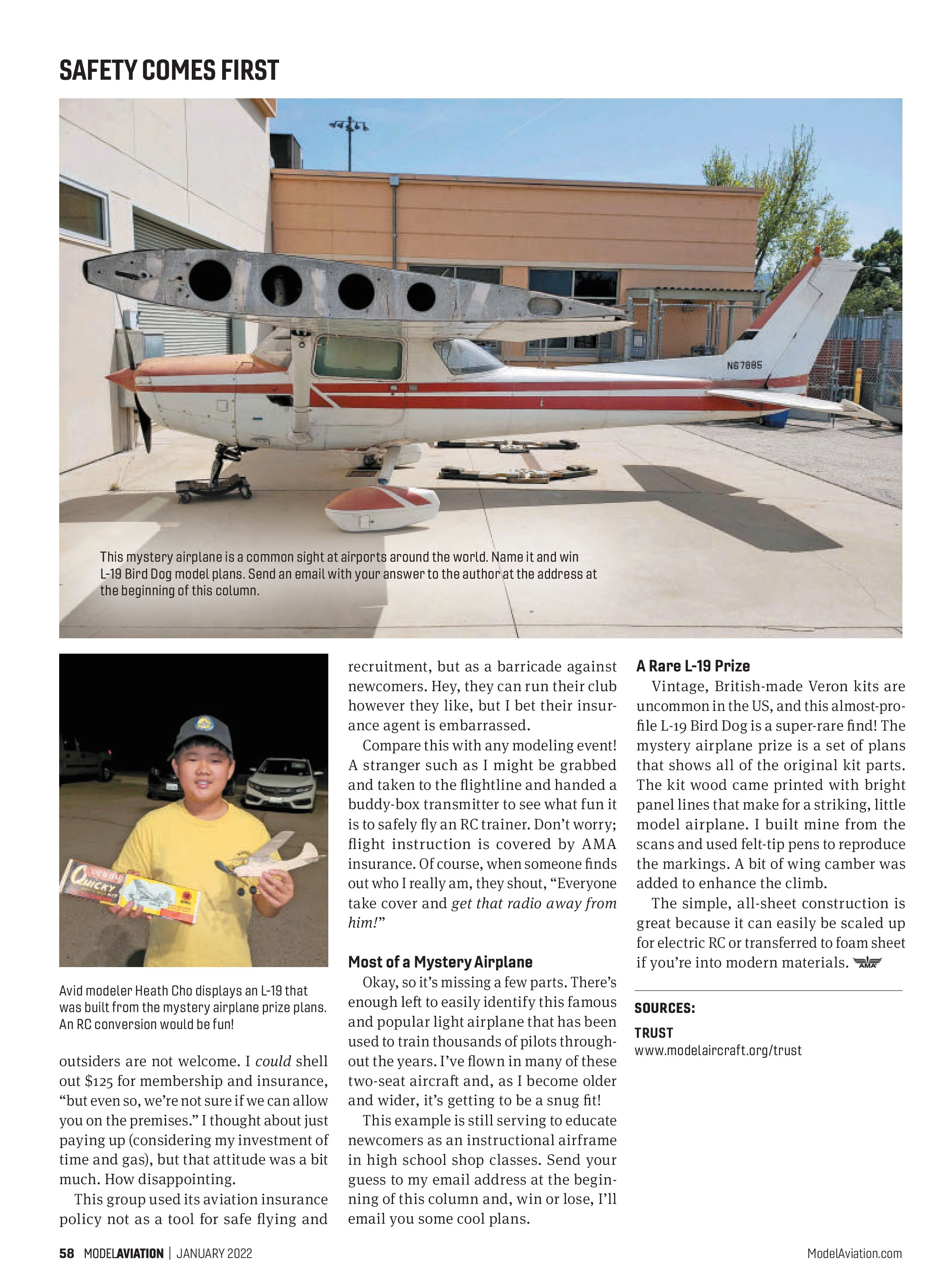
Okay, so it’s missing a few parts. There’s enough left to easily identify this famous and popular light airplane that has been used to train thousands of pilots throughout the years. I’ve flown in many of these two-seat aircraft and, as I become older and wider, it’s getting to be a snug fit!
This example is still serving to educate newcomers as an instructional airframe in high school shop classes. Send your guess to my email address at the beginning of this column and, win or lose, I’ll email you some cool plans.
A Rare L-19 Prize
Vintage, British-made Veron kits are uncommon in the US, and this almost-profile L-19 Bird Dog is a super-rare find! The mystery airplane prize is a set of plans that shows all of the original kit parts. The kit wood came printed with bright panel lines that make for a striking, little model airplane. I built mine from the scans and used felt-tip pens to reproduce the markings. A bit of wing camber was added to enhance the climb.
The simple, all-sheet construction is great because it can easily be scaled up for electric RC or transferred to foam sheet if you’re into modern materials.
SOURCES:
TRUST
www.modelaircraft.org/trust