INDOOR FREE FLIGHT
HARLAN WOOD STRIPPER MODIFICATION
By Don Slusarczyk | don@slusarczyk.com

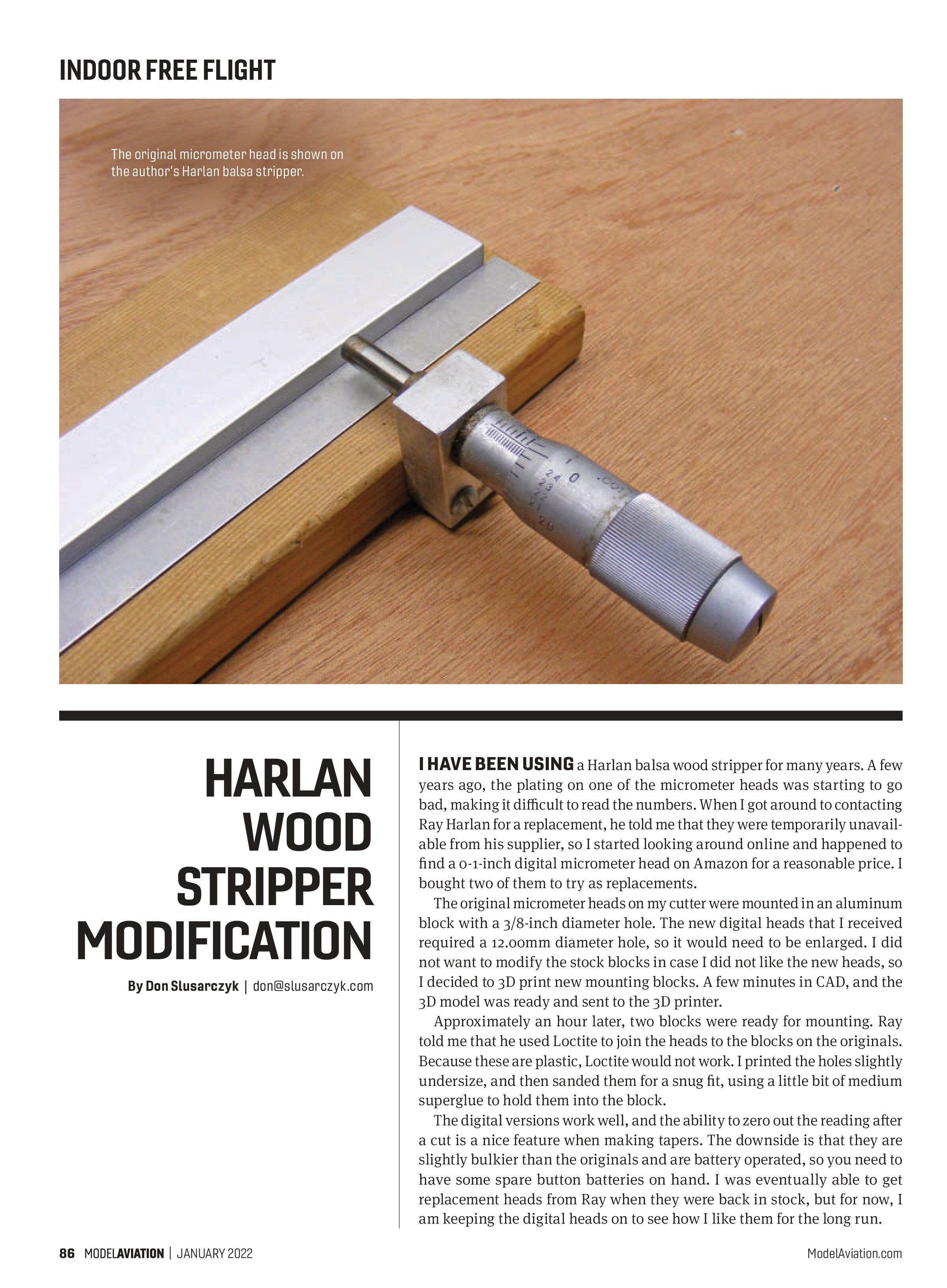
I HAVE BEEN USING a Harlan balsa wood stripper for many years. A few years ago, the plating on one of the micrometer heads was starting to go bad, making it difficult to read the numbers. When I got around to contacting Ray Harlan for a replacement, he told me that they were temporarily unavailable from his supplier, so I started looking around online and happened to find a 0-1-inch digital micrometer head on Amazon for a reasonable price. I bought two of them to try as replacements.
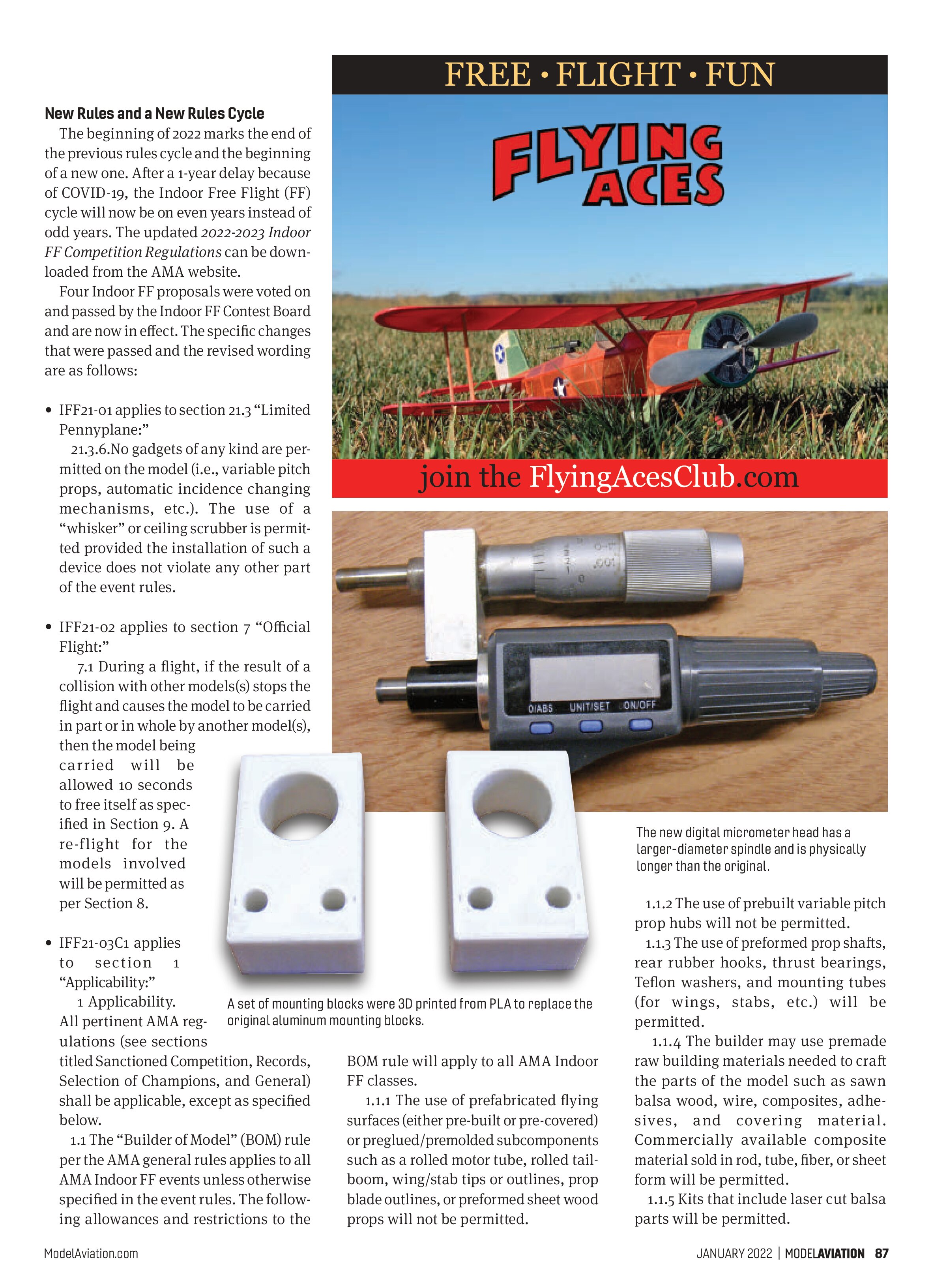
The original micrometer heads on my cutter were mounted in an aluminum block with a 3/8-inch diameter hole. The new digital heads that I received required a 12.00mm diameter hole, so it would need to be enlarged. I did not want to modify the stock blocks in case I did not like the new heads, so I decided to 3D print new mounting blocks. A few minutes in CAD, and the 3D model was ready and sent to the 3D printer.
Approximately an hour later, two blocks were ready for mounting. Ray told me that he used Loctite to join the heads to the blocks on the originals. Because these are plastic, Loctite would not work. I printed the holes slightly undersize, and then sanded them for a snug fit, using a little bit of medium superglue to hold them into the block.
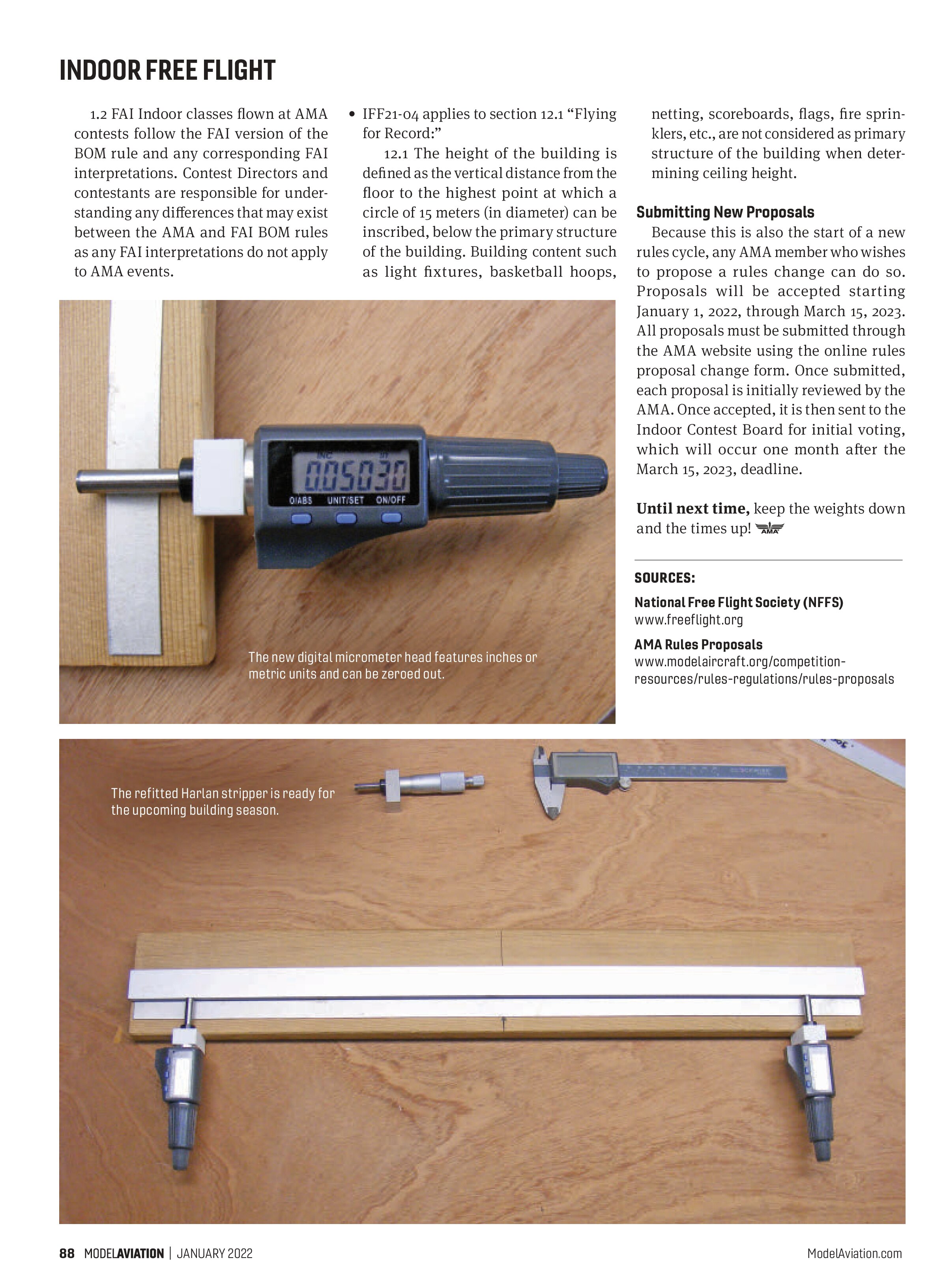
The digital versions work well, and the ability to zero out the reading after a cut is a nice feature when making tapers. The downside is that they are slightly bulkier than the originals and are battery operated, so you need to have some spare button batteries on hand. I was eventually able to get replacement heads from Ray when they were back in stock, but for now, I am keeping the digital heads on to see how I like them for the long run.
New Rules and a New Rules Cycle
The beginning of 2022 marks the end of the previous rules cycle and the beginning of a new one. After a 1-year delay because of COVID-19, the Indoor Free Flight (FF) cycle will now be on even years instead of odd years. The updated 2022-2023 Indoor FF Competition Regulations can be downloaded from the AMA website.
Four Indoor FF proposals were voted on and passed by the Indoor FF Contest Board and are now in effect. The specific changes that were passed and the revised wording are as follows:
- IFF21-01 applies to section 21.3 “Limited Pennyplane:”
21.3.6. No gadgets of any kind are permitted on the model (i.e., variable pitch props, automatic incidence changing mechanisms, etc.). The use of a “whisker” or ceiling scrubber is permitted provided the installation of such a device does not violate any other part of the event rules. - IFF21-02 applies to section 7 “Official Flight:”
7.1 During a flight, if the result of a collision with other model(s) stops the flight and causes the model to be carried in part or in whole by another model(s), then the model being carried will be allowed 10 seconds to free itself as specified in Section 9. A re-flight for the models involved will be permitted as per Section 8. - IFF21-03C1 applies to section 1 “Applicability:”
1 Applicability. All pertinent AMA regulations (see sections titled Sanctioned Competition, Records, Selection of Champions, and General) shall be applicable, except as specified below.
1.1 The “Builder of Model” (BOM) rule per the AMA general rules applies to all AMA Indoor FF events unless otherwise specified in the event rules. The following allowances and restrictions to the BOM rule will apply to all AMA Indoor FF classes.
1.1.1 The use of prefabricated flying surfaces (either pre-built or pre-covered) or preglued/premolded subcomponents such as a rolled motor tube, rolled tail-boom, wing/stab tips or outlines, prop blade outlines, or preformed sheet wood props will not be permitted.
1.1.2 The use of prebuilt variable pitch prop hubs will not be permitted.
1.1.3 The use of preformed prop shafts, rear rubber hooks, thrust bearings, Teflon washers, and mounting tubes (for wings, stabs, etc.) will be permitted.
1.1.4 The builder may use premade raw building materials needed to craft the parts of the model such as sawn balsa wood, wire, composites, adhesives, and covering material. Commercially available composite material sold in rod, tube, fiber, or sheet form will be permitted.
1.1.5 Kits that include laser cut balsa parts will be permitted.


1.2 FAI Indoor classes flown at AMA contests follow the FAI version of the BOM rule and any corresponding FAI interpretations. Contest Directors and contestants are responsible for understanding any differences that may exist between the AMA and FAI BOM rules as any FAI interpretations do not apply to AMA events.

• IFF21-04 applies to section 12.1 “Flying for Record:”
12.1 The height of the building is defined as the vertical distance from the floor to the highest point at which a circle of 15 meters (in diameter) can be inscribed, below the primary structure of the building. Building content such as light fixtures, basketball hoops, netting, scoreboards, flags, fire sprinklers, etc., are not considered as primary structure of the building when determining ceiling height.
Submitting New Proposals
Because this is also the start of a new rules cycle, any AMA member who wishes to propose a rules change can do so. Proposals will be accepted starting January 1, 2022, through March 15, 2023. All proposals must be submitted through the AMA website using the online rules proposal change form. Once submitted, each proposal is initially reviewed by the AMA. Once accepted, it is then sent to the Indoor Contest Board for initial voting, which will occur one month after the March 15, 2023, deadline.
Until next time, keep the weights down and the times up!
SOURCES:
National Free Flight Society (NFFS)
www.freeflight.org
AMA Rules Proposals
www.modelaircraft.org/competition-resources/rules-regulations/rules-proposals