SMALL-FIELD FLYING

BUILDING SEASON IS HERE
By Pat Tritle | patscustommodels@gmail.com
IT’S HARD TO BELIEVE that another year has slipped by and we’re already heading back into building season. This has been a terrific year for modeling, although the summer flying season sailed by at warp speed. As builders, however, we have those winter months to keep us busy working on maintenance and repairs, plus new projects in anticipation of next year’s flying season. Isn’t it great to have two hobbies?
Now it’s time to give some serious thought to your next project. There’s a ton of good stuff out there, so choosing just one or two new projects can be a real challenge.
How do you go about it? It depends on your skill level, the available building time, and what types of airplanes you like to fly. If your building time is limited because of work or family commitments, it’s best to choose something less complex. For those with lots of time on their hands, more complicated projects can be a good choice. After all, the goal is to finish the model and fly it in the spring.
Another consideration, of course, is what to build. My personal preference is civilian subjects in general, leaning toward private airplanes. Others’ preferences might fall into the World War I era or the Golden Age, while some might prefer World War II-era warbirds. Whatever your preference, there are plenty of great kits or plans out there from which to choose.
Dave Diels Scale FF Kits
I am a firm believer in giving credit where credit is due. In this case, I’ve known about Dave Diels’ scale Free Flight (FF) kits for years, and I have a couple of Dave’s older printwood kits in my stash. I visited his website a couple of weeks ago and found a laser-cut kit for a 24.88-inch wingspan Rubber FF SB2C Helldiver and thought it might be fun to give it a try, so I ordered one. By reputation, I figured that the kit would be nice, but I had no idea it would be that nice.
The kit is very complete. The decal sheets, wood quality, and laser-cutting are superb, and the six pages of plans and assembly/detail drawings are nothing short of spectacular. To say I was impressed would be a gross understatement. The best part is that for those who like to convert FF kits to RC, this and several other Diels kits are great starting points for such a conversion.
Building
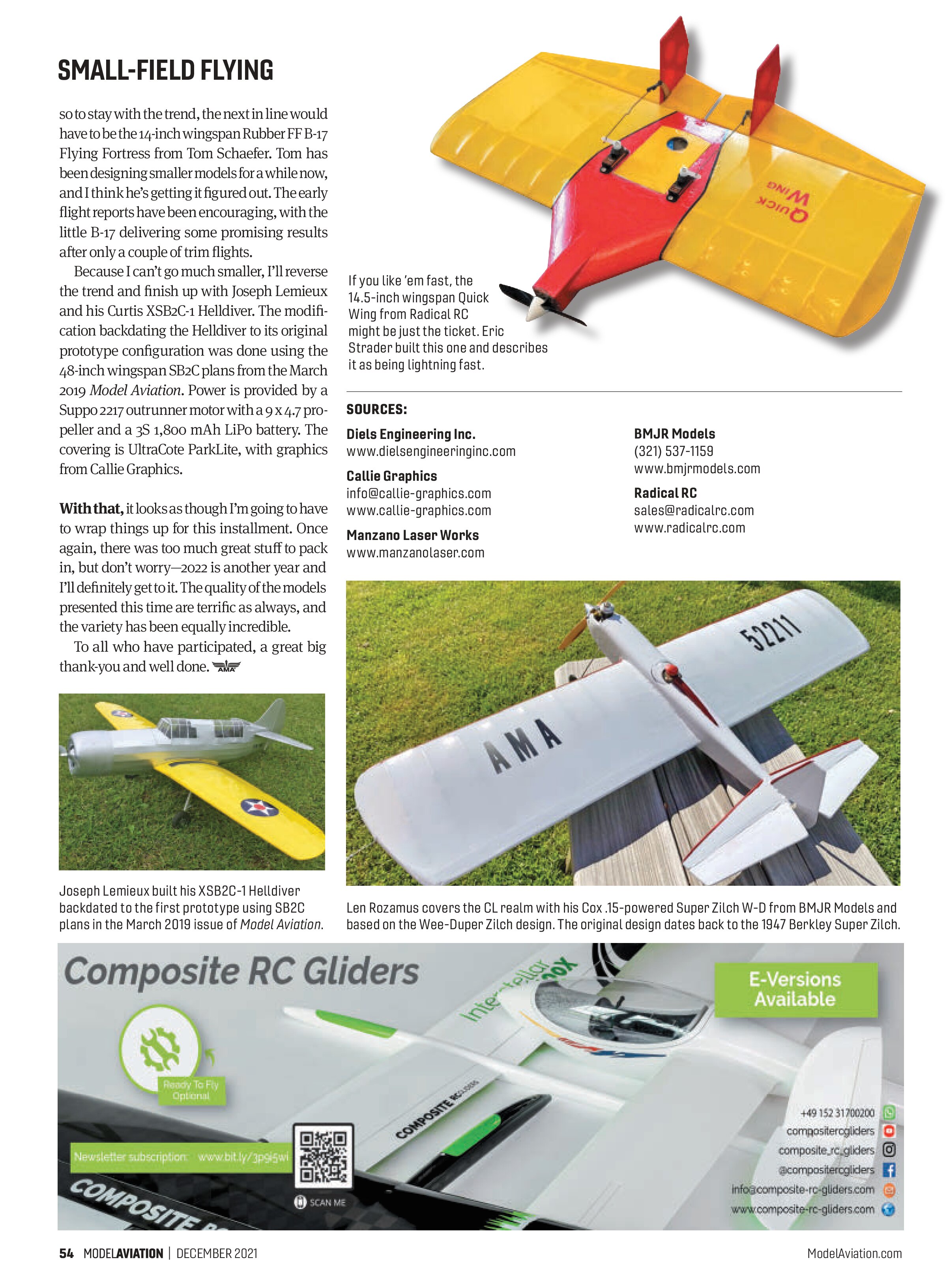
Readers have been keeping busy finishing up some beautiful models. I’ll begin with George Rutledge’s 44-inch wingspan P-6E Hawk. The model was built from a Manzano Laser Works short kit. A few minor modifications were made. The cockpit opening and radiator were reshaped, and the cowling and wheel spats were carved from balsa rather than blue foam. The model was covered with UltraCote ParkLite, with decals from Callie Graphics.
Stepping into the Control Line (CL) realm, my old modeling friend, Len Rozamus, has recently completed the Super Zilch W-D from BMJRModels. The design is based on the Wee-Duper Zilch. The model has a 34-inch wingspan and is set up for .09 to .15 glow power. Len’s is fitted with a vintage Cox Tee Dee .15 engine.
The original Zilch was designed by Jim Saftig and published in the April 1951 Model Airplane News and again in Model Aviation in February 1979. The model was covered with silkspan and painted with

epoxy paint for fuelproofing. Great job in keeping with a classic, old design.
Eric Strader stepped up to the plate with his 14.5-inch wingspan Quick Wing from Radical RC. The model is powered by a Medusa Research 12 X 30mm 4,000 Kv afterburner inrunner motor with a Castle Creations 9-amp ESC and a 350 mAh 2S LiPo battery. Guidance is by way of 5-gram digital servos and a Berg Micro Stamp receiver. The model tips the scales at 3.1 ounces. It is nothing short of lightning fast and is a blast to fly.
It wasn’t intentional, but the models I’ve shared seem to be getting smaller as I progress,
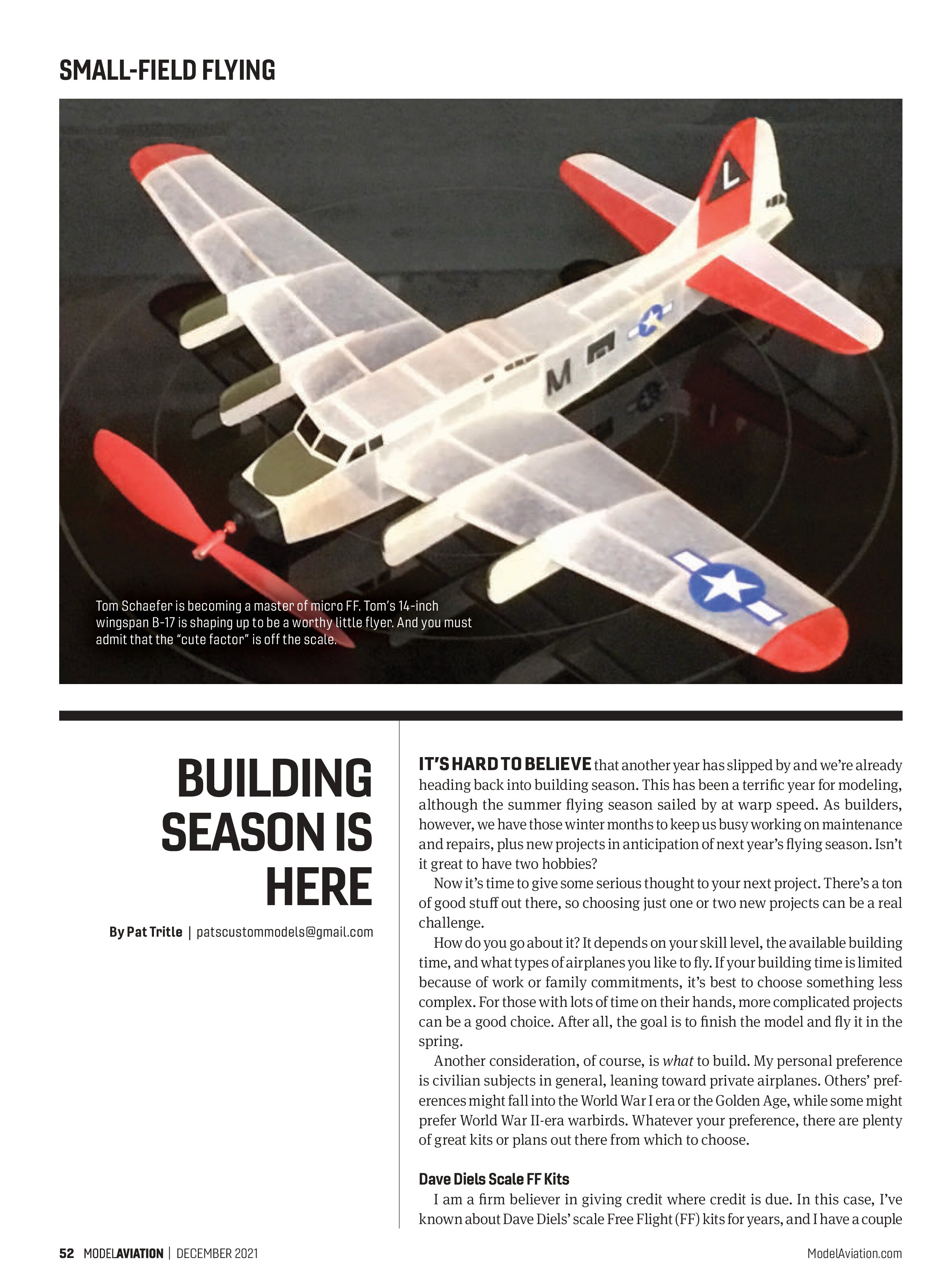
so to stay with the trend, the next in line would have to be the 14-inch wingspan Rubber FF B-17 Flying Fortress from Tom Schaefer. Tom has been designing smaller models for a while now, and I think he’s getting it figured out. The early flight reports have been encouraging, with the little B-17 delivering some promising results after only a couple of trim flights.
Because I can’t go much smaller, I’ll reverse the trend and finish up with Joseph Lemieux and his Curtis XSB2C-1 Helldiver. The modification backdating the Helldiver to its original prototype configuration was done using the 48-inch wingspan SB2C plans from the March 2019 Model Aviation. Power is provided by a Suppo 2217 outrunner motor with a 9 X 4.7 propeller and a 3S 1,800 mAh LiPo battery. The covering is UltraCote ParkLite, with graphics from Callie Graphics.
With that, it looks as though I’m going to have to wrap things up for this installment. Once again, there was too much great stuff to pack in, but don’t worry—2022 is another year and I’ll definitely get to it. The quality of the models presented this time are terrific as always, and the variety has been equally incredible.
To all who have participated, a great big thank-you and well done.

SOURCES:
Diels Engineering Inc.
www.dielsengineeringinc.com
Callie Graphics
info@callie-graphics.com
www.callie-graphics.com
Manzano Laser Works
www.manzanolaser.com
BMJR Models
(321) 537-1159
www.bmjrmodels.com
Radical RC
sales@radicalrc.com
www.radicalrc.com