RC SLOPE SOARING

SUPER CORSAIR
By Greg Schutte | gshooty@yahoo.com
THROUGHOUT MY AVIATION JOURNEY, I have always had one airplane that I absolutely love. Even before I could fly RC, I would buy plastic models and toys of it. That airplane is the F4U Corsair. With its bent wing, huge propeller, and monster radial engine, it always looked and sounded like “mean poetry” carving through the air. It was the third airplane that I designed and built when I started Slope Soaring. It has been in my stable of RC flying machines since then, and I’ve had it as a Slope, electric, and a Free Flight model.
Another attribute to being an RC aeromodeler seems to be that for every flying model I have, there are multiple kits waiting to be built. They sit in the garage or storage, longing to have their potential reached.
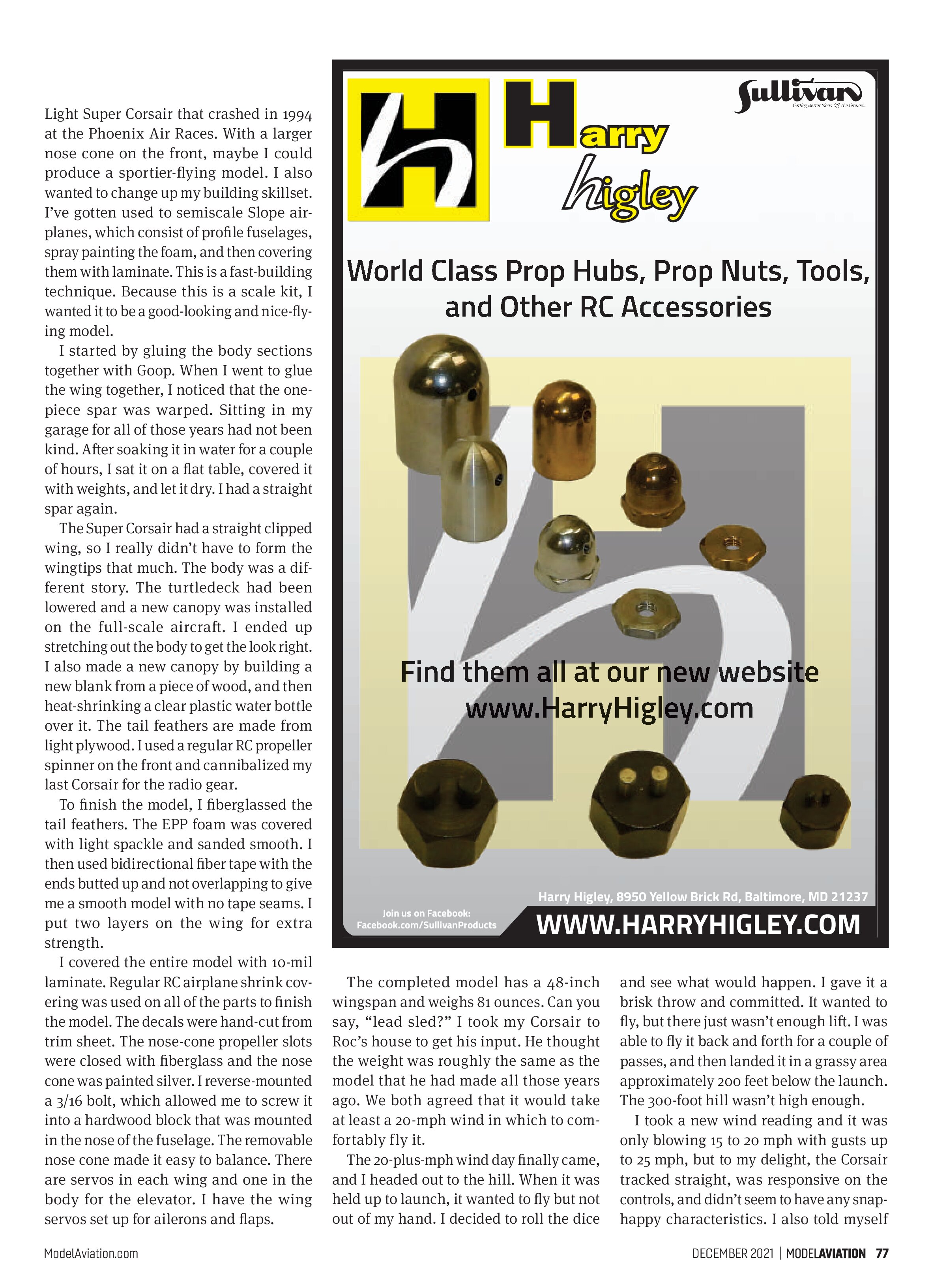
One such kit that I have is a scratch-built EPP Corsair. I received it from my buddy, Roc Cox. Roc and a fellow aeromodeler designed and cut out this kit years before I received it. It is one of three kits that were made. The Corsair has been in my garage in a plastic garbage bag, patiently waiting its turn, for more than 10 years. With my flying fleet thinned out, I was looking for something to build.
One day, as I was working in the garage, the spar for the Corsair fell off of the shelf and onto my workbench. This had to be a sign. It took a little bit of digging in the garage to find the actual kit. I took stock and realized that all of the pieces were still there. This kit had survived moves to three different houses. It was time to finish the dream.
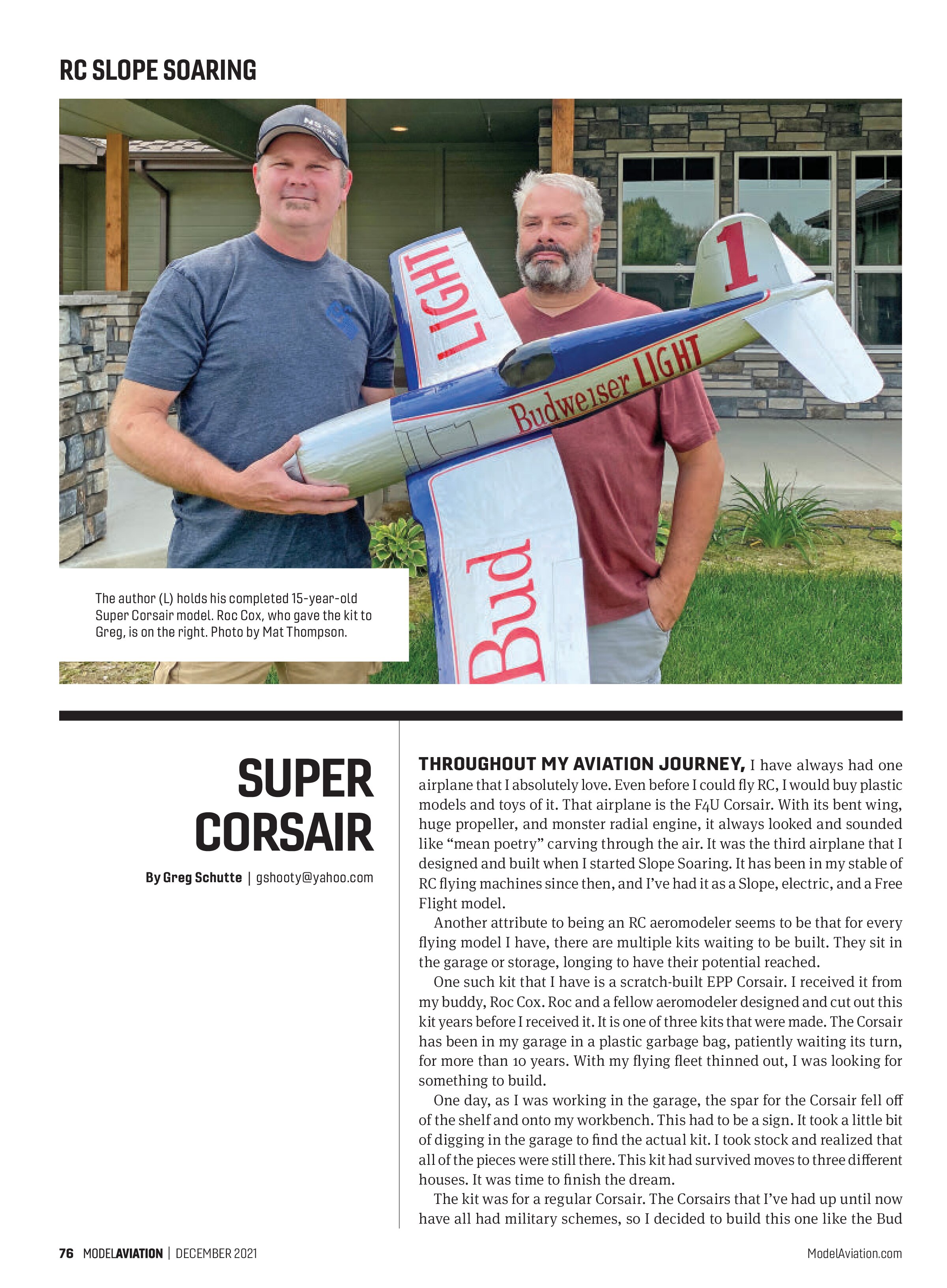
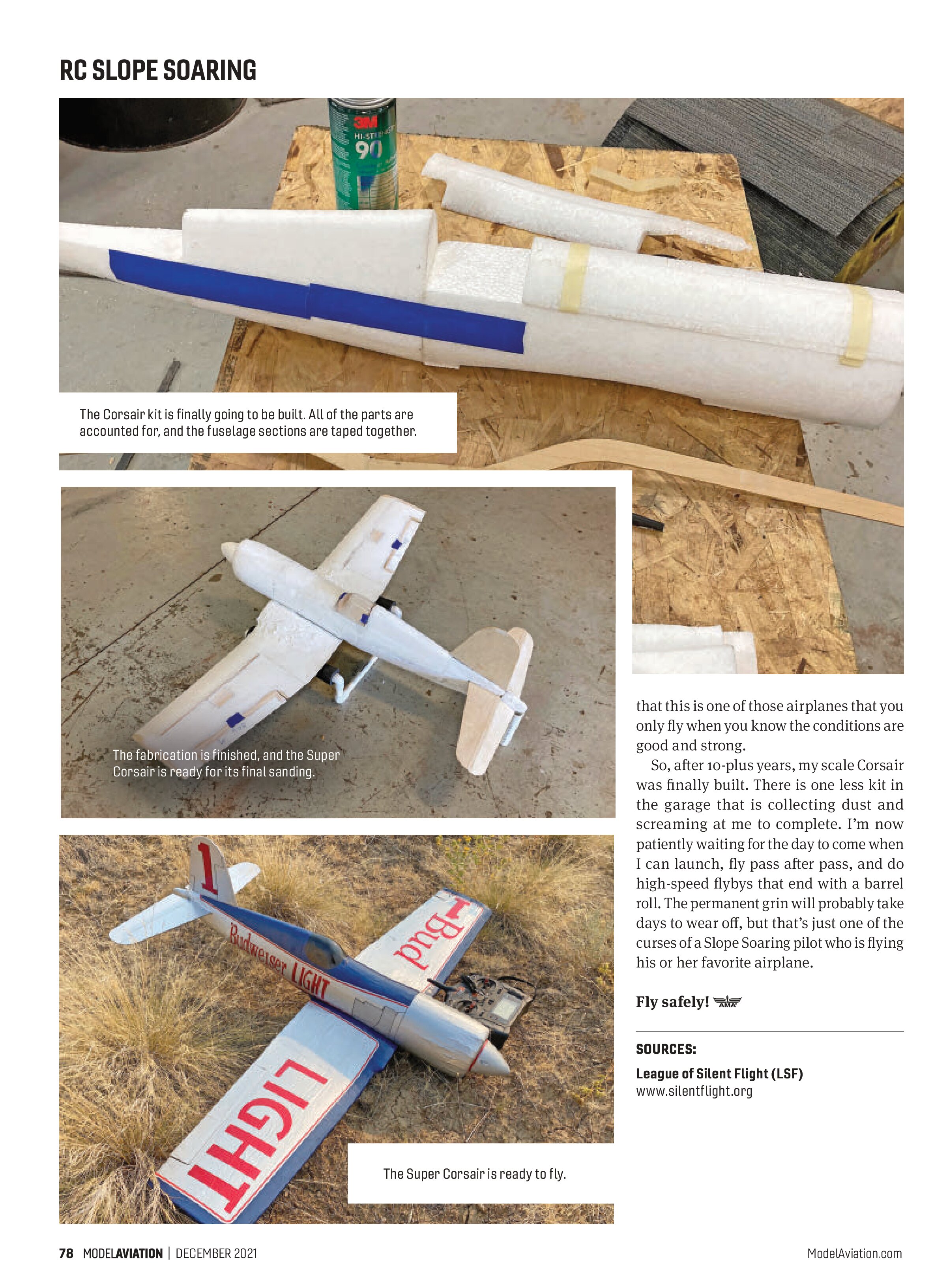
The kit was for a regular Corsair. The Corsairs that I’ve had up until now have all had military schemes, so I decided to build this one like the Bud Light Super Corsair that crashed in 1994 at the Phoenix Air Races. With a larger nose cone on the front, maybe I could produce a sportier-flying model. I also wanted to change up my building skillset.
I’ve gotten used to semiscale Slope airplanes, which consist of profile fuselages, spray painting the foam, and then covering them with laminate. This is a fast-building technique. Because this is a scale kit, I wanted it to be a good-looking and nice-flying model.
I started by gluing the body sections together with Goop. When I went to glue the wing together, I noticed that the one-piece spar was warped. Sitting in my garage for all of those years had not been kind. After soaking it in water for a couple of hours, I sat it on a flat table, covered it with weights, and let it dry. I had a straight spar again.
The Super Corsair had a straight clipped wing, so I really didn’t have to form the wingtips that much. The body was a different story. The turtledeck had been lowered and a new canopy was installed on the full-scale aircraft. I ended up stretching out the body to get the look right. I also made a new canopy by building a new blank from a piece of wood, and then heat-shrinking a clear plastic water bottle over it. The tail feathers are made from light plywood. I used a regular RC propeller spinner on the front and cannibalized my last Corsair for the radio gear.
To finish the model, I fiberglassed the tail feathers. The EPP foam was covered with light spackle and sanded smooth. I then used bidirectional fiber tape with the ends butted up and not overlapping to give me a smooth model with no tape seams. I put two layers on the wing for extra strength.
I covered the entire model with 10-mil laminate. Regular RC airplane shrink covering was used on all of the parts to finish the model. The decals were hand-cut from trim sheet. The nose-cone propeller slots were closed with fiberglass and the nose cone was painted silver. I reverse-mounted a 3/16 bolt, which allowed me to screw it into a hardwood block that was mounted in the nose of the fuselage. The removable nose cone made it easy to balance. There are servos in each wing and one in the body for the elevator. I have the wing servos set up for ailerons and flaps.
The completed model has a 48-inch wingspan and weighs 81 ounces. Can you say, “lead sled?” I took my Corsair to Roc’s house to get his input. He thought the weight was roughly the same as the model that he had made all those years ago. We both agreed that it would take at least a 20-mph wind in which to comfortably fly it.
The 20-plus-mph wind day finally came, and I headed out to the hill. When it was held up to launch, it wanted to fly but not out of my hand. I decided to roll the dice and see what would happen. I gave it a brisk throw and committed. It wanted to fly, but there just wasn’t enough lift. I was able to fly it back and forth for a couple of passes, and then landed it in a grassy area approximately 200 feet below the launch. The 300-foot hill wasn’t high enough.
I took a new wind reading and it was only blowing 15 to 20 mph with gusts up to 25 mph, but to my delight, the Corsair tracked straight, was responsive on the controls, and didn’t seem to have any snap-happy characteristics. I also told myself


that this is one of those airplanes that you only fly when you know the conditions are good and strong.
So, after 10-plus years, my scale Corsair was finally built. There is one less kit in the garage that is collecting dust and screaming at me to complete. I’m now patiently waiting for the day to come when I can launch, fly pass after pass, and do high-speed flybys that end with a barrel roll. The permanent grin will probably take days to wear off, but that’s just one of the curses of a Slope Soaring pilot who is flying his or her favorite airplane.
Fly safely!
SOURCES:
League of Silent Flight (LSF)
www.silentflight.org