RC SCALE AEROBATICS

CONSISTENT FUNDAMENTAL ELEMENTS
By John Glezellis | jglezellis@gmail.com
THROUGHOUT THE PAST several months, I have witnessed some pilots struggle with a few items as they become familiar with a given International Miniature Aerobatic Club (IMAC) sequence that includes, but is not limited to, maneuver positioning, as well as showing a clear start and exit to a figure. Although the 2021 season is about to come to an end, there is no better time than the present to discuss fundamental elements that are consistent, no matter what the flying season is or what schedule is being flown.
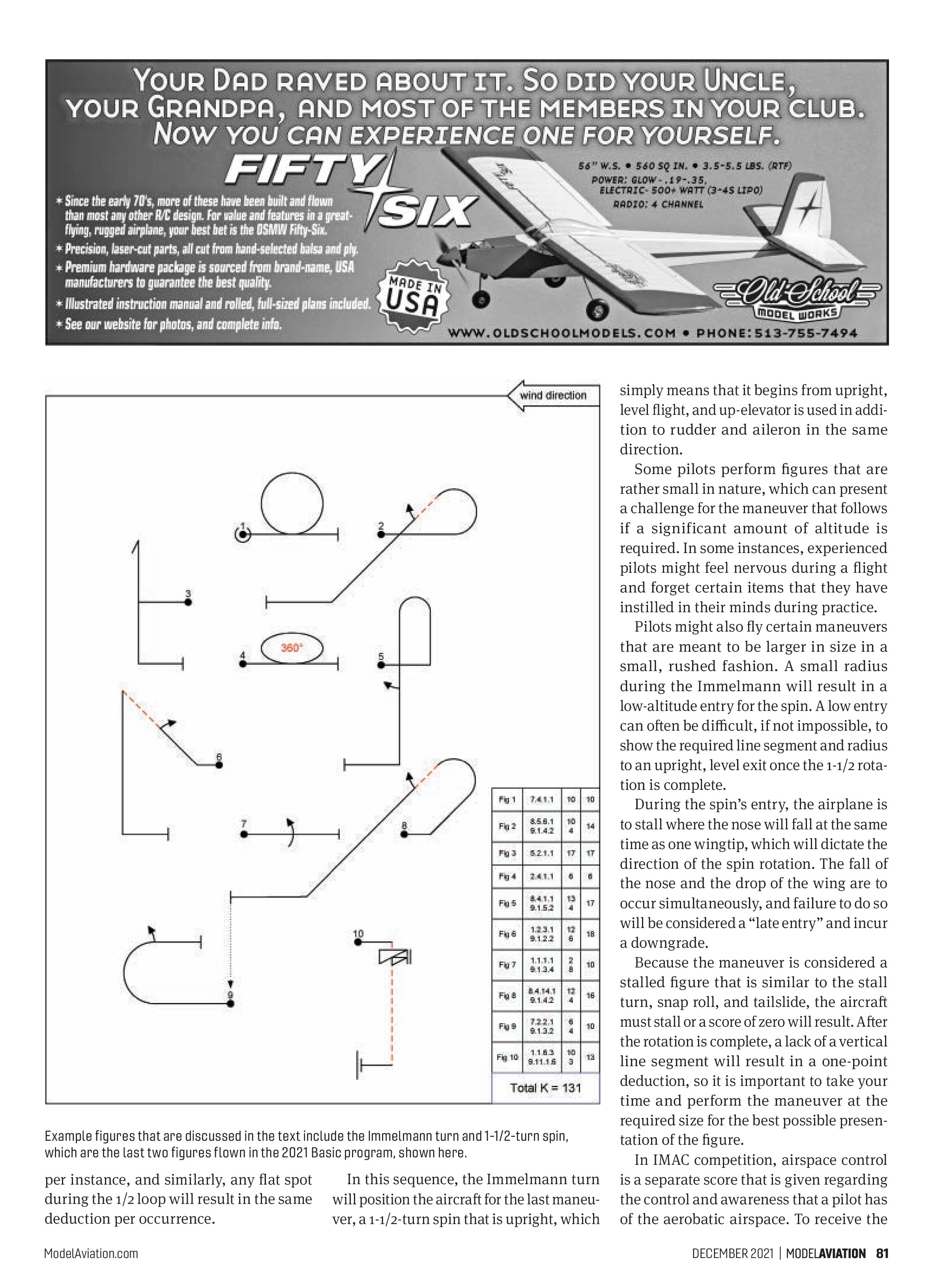
Because examples are always helpful to visualize and highlight certain critical items, I will examine the last two maneuvers found in the 2021 Basic schedule, including the Immelmann turn that leads into a 1-1/2-turn spin. Not only will I explore the basic forms of each figure, the proper execution, and what is meant by the defined start and exit of a maneuver, I will also cover a few techniques that both the pilot and caller can follow to ensure success during that competition flight.
Without further delay, let’s begin!
Let’s Discuss Maneuvers!
The Immelmann turn in the 2021 Basic schedule is one where the pilot must perform a 1/2 loop followed by a 1/2 roll immediately after the 1/2 inside loop is flown. It is meant as a turnaround maneuver and should be placed toward the end of the aerobatic airspace. Should the 1/2 roll occur early, a 1/2-point deduction for every 5° of remaining loop segment will be applied, and a 1/2-point deduction per 5° from level will be applied in terms of roll angle. If any variation in the radius is shown, one point will be deducted

per instance, and similarly, any flat spot during the 1/2 loop will result in the same deduction per occurrence.
In this sequence, the Immelmann turn will position the aircraft for the last maneuver, a 1-1/2-turn spin that is upright, which
simply means that it begins from upright, level flight, and up-elevator is used in addition to rudder and aileron in the same direction.
Some pilots perform figures that are rather small in nature, which can present a challenge for the maneuver that follows if a significant amount of altitude is required. In some instances, experienced pilots might feel nervous during a flight and forget certain items that they have instilled in their minds during practice.
Pilots might also fly certain maneuvers that are meant to be larger in size in a small, rushed fashion. A small radius during the Immelmann will result in a low-altitude entry for the spin. A low entry can often be difficult, if not impossible, to show the required line segment and radius to an upright, level exit once the 1-1/2 rotation is complete.
During the spin’s entry, the airplane is to stall where the nose will fall at the same time as one wingtip, which will dictate the direction of the spin rotation. The fall of the nose and the drop of the wing are to occur simultaneously, and failure to do so will be considered a “late entry” and incur a downgrade.
Because the maneuver is considered a stalled figure that is similar to the stall turn, snap roll, and tailslide, the aircraft must stall or a score of zero will result. After the rotation is complete, a lack of a vertical line segment will result in a one-point deduction, so it is important to take your time and perform the maneuver at the required size for the best possible presentation of the figure.
In IMAC competition, airspace control is a separate score that is given regarding the control and awareness that a pilot has of the aerobatic airspace. To receive the

best score, the aircraft should be flown at a distance that will result in the best presentation (e.g., not far away from the pilot) and proper balance of the airspace, and the location of the airplane within that airspace must be shown.
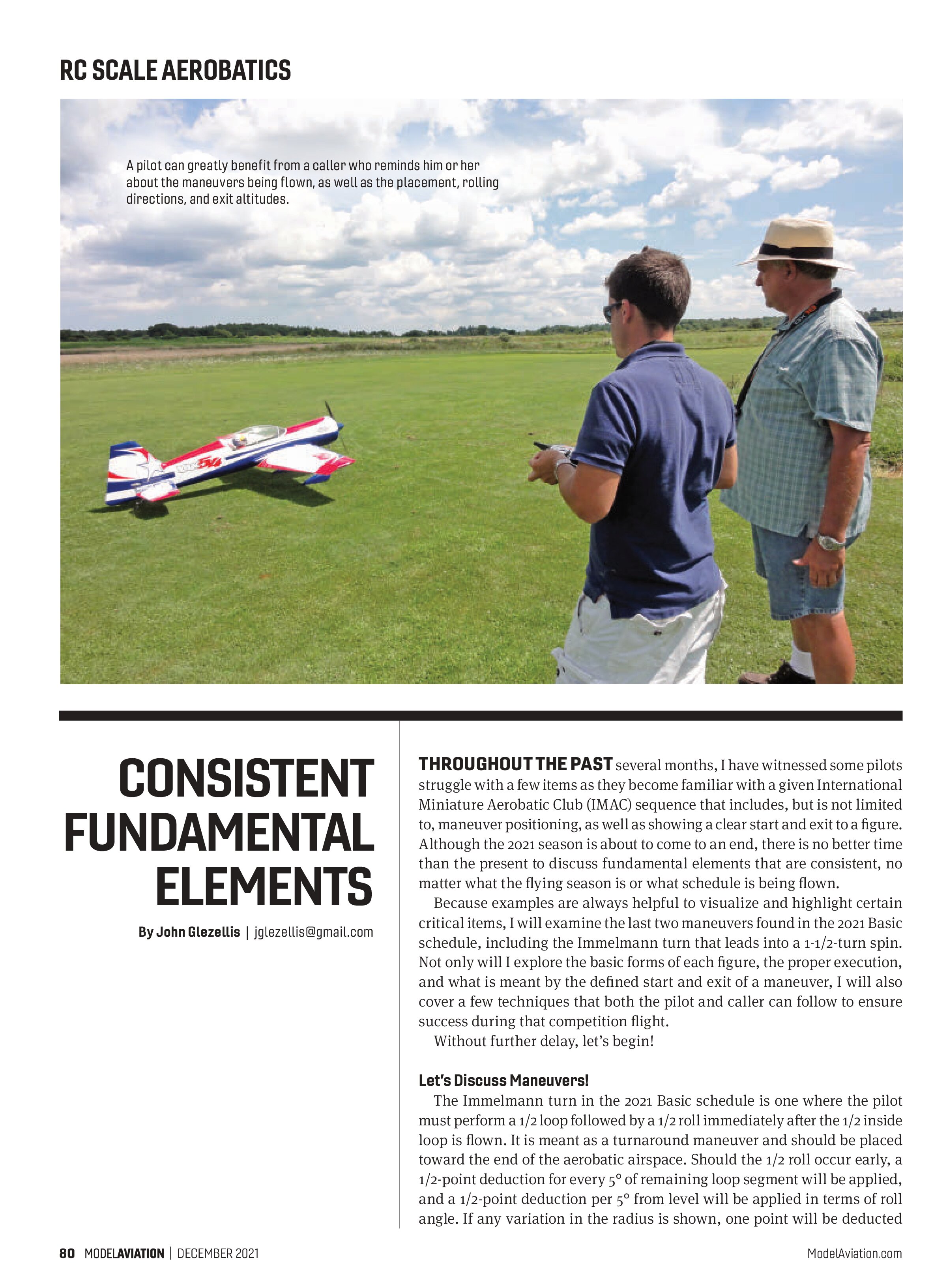
Whether you are flying a Known or Unknown program, you must note the required entry and exit altitudes to best prepare for the maneuver that follows. During a contest, a pilot will have a caller stand behind him or her and read each maneuver that is to be flown to serve as a reminder to the pilot; however, the pilot must know and be quite familiar with the program to be flown.
When writing out a call sheet for your caller to utilize, make a note on the required altitude for the following maneuver by stating “exit high” for the Immelmann. After all, in the heat of a competition flight, you might become anxious, and although you once had the Basic schedule memorized, you might forget certain items as you are concentrating on the execution of the flight.
Entry and Exit Basics
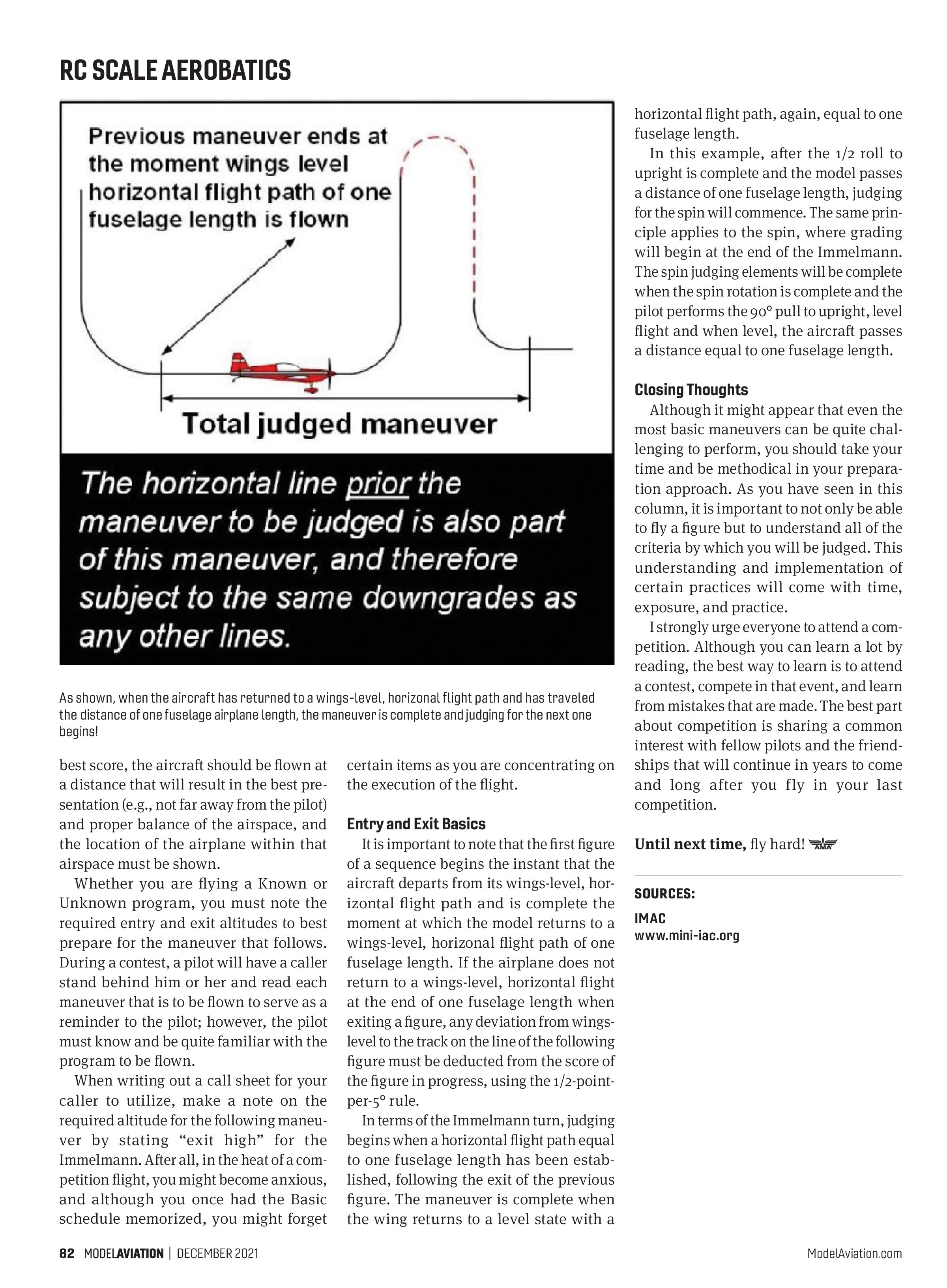
It is important to note that the first figure of a sequence begins the instant that the aircraft departs from its wings-level, horizontal flight path and is complete the moment at which the model returns to a wings-level, horizontal flight path of one fuselage length. If the airplane does not return to a wings-level, horizontal flight at the end of one fuselage length when exiting a figure, any deviation from wings-level to the track on the line of the following figure must be deducted from the score of the figure in progress, using the 1/2-point-per-5° rule.
In terms of the Immelmann turn, judging begins when a horizontal flight path equal to one fuselage length has been established, following the exit of the previous figure. The maneuver is complete when the wing returns to a level state with a horizontal flight path, again, equal to one fuselage length.
In this example, after the 1/2 roll to upright is complete and the model passes a distance of one fuselage length, judging for the spin will commence. The same principle applies to the spin, where grading will begin at the end of the Immelmann. The spin judging elements will be complete when the spin rotation is complete and the pilot performs the 90° pull to upright, level flight and when level, the aircraft passes a distance equal to one fuselage length.
Closing Thoughts
Although it might appear that even the most basic maneuvers can be quite challenging to perform, you should take your time and be methodical in your preparation approach. As you have seen in this column, it is important to not only be able to fly a figure but to understand all of the criteria by which you will be judged. This understanding and implementation of certain practices will come with time, exposure, and practice.
I strongly urge everyone to attend a competition. Although you can learn a lot by reading, the best way to learn is to attend a contest, compete in that event, and learn from mistakes that are made. The best part about competition is sharing a common interest with fellow pilots and the friendships that will continue in years to come and long after you fly in your last competition.
Until next time, fly hard!
SOURCES:
IMAC
www.mini-iac.org