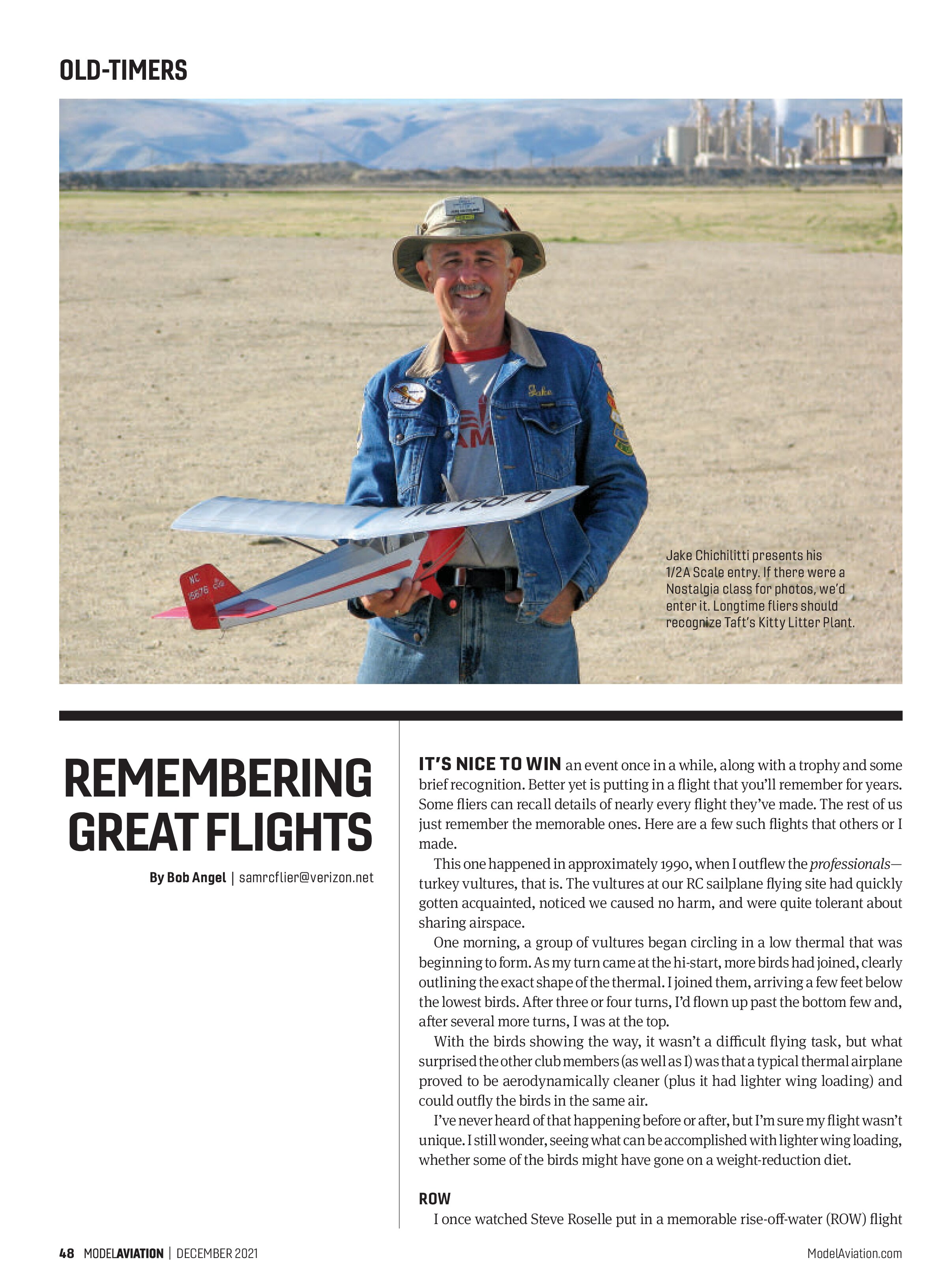
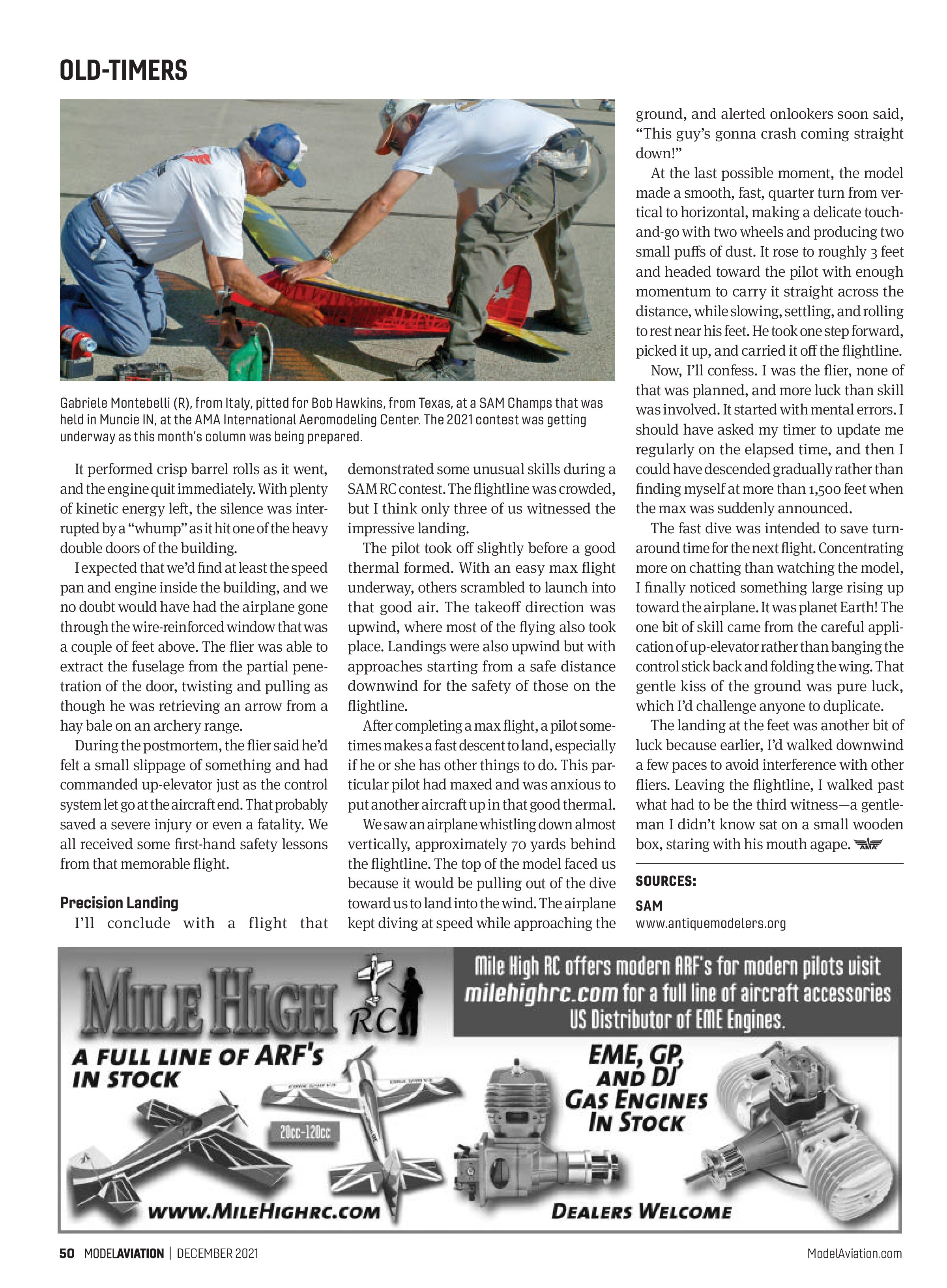
OLD-TIMERS

REMEMBERING
GREAT FLIGHTS
By Bob Angel | samrcflier@verizon.net
IT’S NICE TO WIN
an event once in a while, along with a trophy and some brief recognition. Better yet is putting in a flight that you’ll remember for years. Some fliers can recall details of nearly every flight they’ve made. The rest of us just remember the memorable ones. Here are a few such flights that others or I made.
This one happened in approximately 1990, when I outflew the professionals—turkey vultures, that is. The vultures at our RC sailplane flying site had quickly gotten acquainted, noticed we caused no harm, and were quite tolerant about sharing airspace.
One morning, a group of vultures began circling in a low thermal that was beginning to form. As my turn came at the hi-start, more birds had joined, clearly outlining the exact shape of the thermal. I joined them, arriving a few feet below the lowest birds. After three or four turns, I’d flown up past the bottom few and, after several more turns, I was at the top.
With the birds showing the way, it wasn’t a difficult flying task, but what surprised the other club members (as well as I) was that a typical thermal airplane proved to be aerodynamically cleaner (plus it had lighter wing loading) and could outfly the birds in the same air.
I’ve never heard of that happening before or after, but I’m sure my flight wasn’t unique. I still wonder, seeing what can be accomplished with lighter wing loading, whether some of the birds might have gone on a weight-reduction diet.
ROW
I once watched Steve Roselle put in a memorable rise-off-water (ROW) flight

It performed crisp barrel rolls as it went, and the engine quit immediately. With plenty of kinetic energy left, the silence was interrupted by a “whump” as it hit one of the heavy double doors of the building.
I expected that we’d find at least the speed pan and engine inside the building, and we no doubt would have had the airplane gone through the wire-reinforced window that was a couple of feet above. The flier was able to extract the fuselage from the partial penetration of the door, twisting and pulling as though he was retrieving an arrow from a hay bale on an archery range.
During the postmortem, the flier said he’d felt a small slippage of something and had commanded up-elevator just as the control system let go at the aircraft end. That probably saved a severe injury or even a fatality. We all received some first-hand safety lessons from that memorable flight.
Precision Landing
I’ll conclude with a flight that demonstrated some unusual skills during a SAMRC contest. The flightline was crowded, but I think only three of us witnessed the impressive landing.
The pilot took off slightly before a good thermal formed. With an easy max flight underway, others scrambled to launch into that good air. The takeoff direction was upwind, where most of the flying also took place. Landings were also upwind but with approaches starting from a safe distance downwind for the safety of those on the flightline.
After completing a max flight, a pilot sometimes makes a fast descent to land, especially if he or she has other things to do. This particular pilot had maxed and was anxious to put another aircraft up in that good thermal.
We saw an airplane whistling down almost vertically, approximately 70 yards behind the flightline. The top of the model faced us because it would be pulling out of the dive toward us to land into the wind. The airplane kept diving at speed while approaching the ground, and alerted onlookers soon said, “This guy’s gonna crash coming straight down!”
At the last possible moment, the model made a smooth, fast, quarter turn from vertical to horizontal, making a delicate touch-and-go with two wheels and producing two small puffs of dust. It rose to roughly 3 feet and headed toward the pilot with enough momentum to carry it straight across the distance, while slowing, settling, and rolling to rest near his feet. He took one step forward, picked it up, and carried it off the flightline.
Now, I’ll confess. I was the flier, none of that was planned, and more luck than skill was involved. It started with mental errors. I should have asked my timer to update me regularly on the elapsed time, and then I could have descended gradually rather than finding myself at more than 1,500 feet when the max was suddenly announced.
The fast dive was intended to save turnaround time for the next flight. Concentrating more on chatting than watching the model, I finally noticed something large rising up toward the airplane. It was planet Earth! The one bit of skill came from the careful application of up-elevator rather than banging the control stick back and folding the wing. That gentle kiss of the ground was pure luck, which I’d challenge anyone to duplicate.
The landing at the feet was another bit of luck because earlier, I’d walked downwind a few paces to avoid interference with other fliers. Leaving the flightline, I walked past what had to be the third witness—a gentleman I didn’t know sat on a small wooden box, staring with his mouth agape.