FOCAL POINT
Interested in sharing your handiwork? Visit www.ModelAviation.com for submission guidelines.
Canadair CL-415
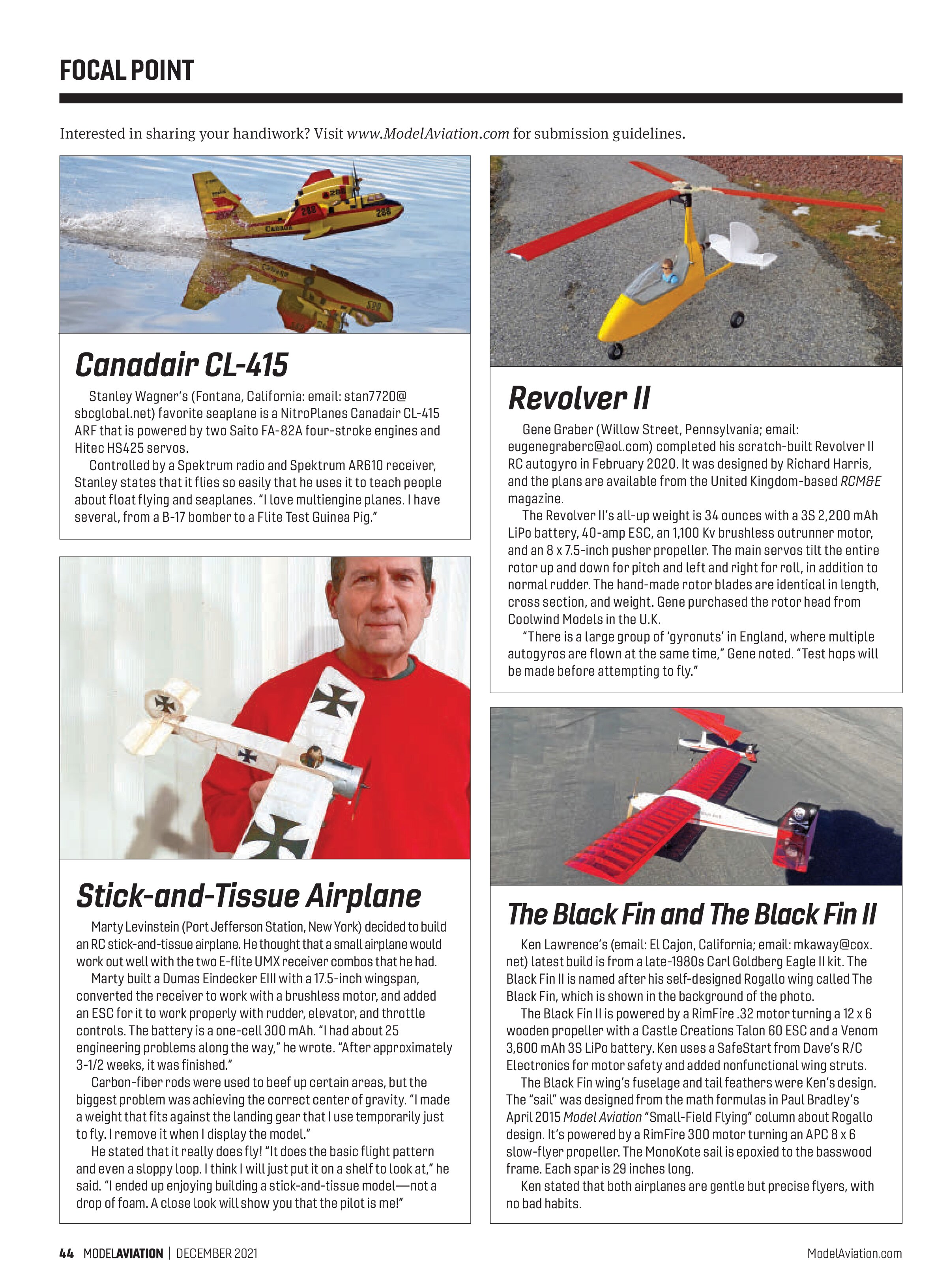
Stanley Wagner’s (Fontana, California; email: stan7720@sbcglobal.net) favorite seaplane is a NitroPlanes Canadair CL-415 ARF that is powered by two Saito FA-82A four-stroke engines and Hitec HS425 servos.
Controlled by a Spektrum radio and Spektrum AR610 receiver, Stanley states that it flies so easily that he uses it to teach people about float flying and seaplanes. “I love multiengine planes. I have several, from a B-17 bomber to a Flite Test Guinea Pig.”

Stick-and-Tissue Airplane
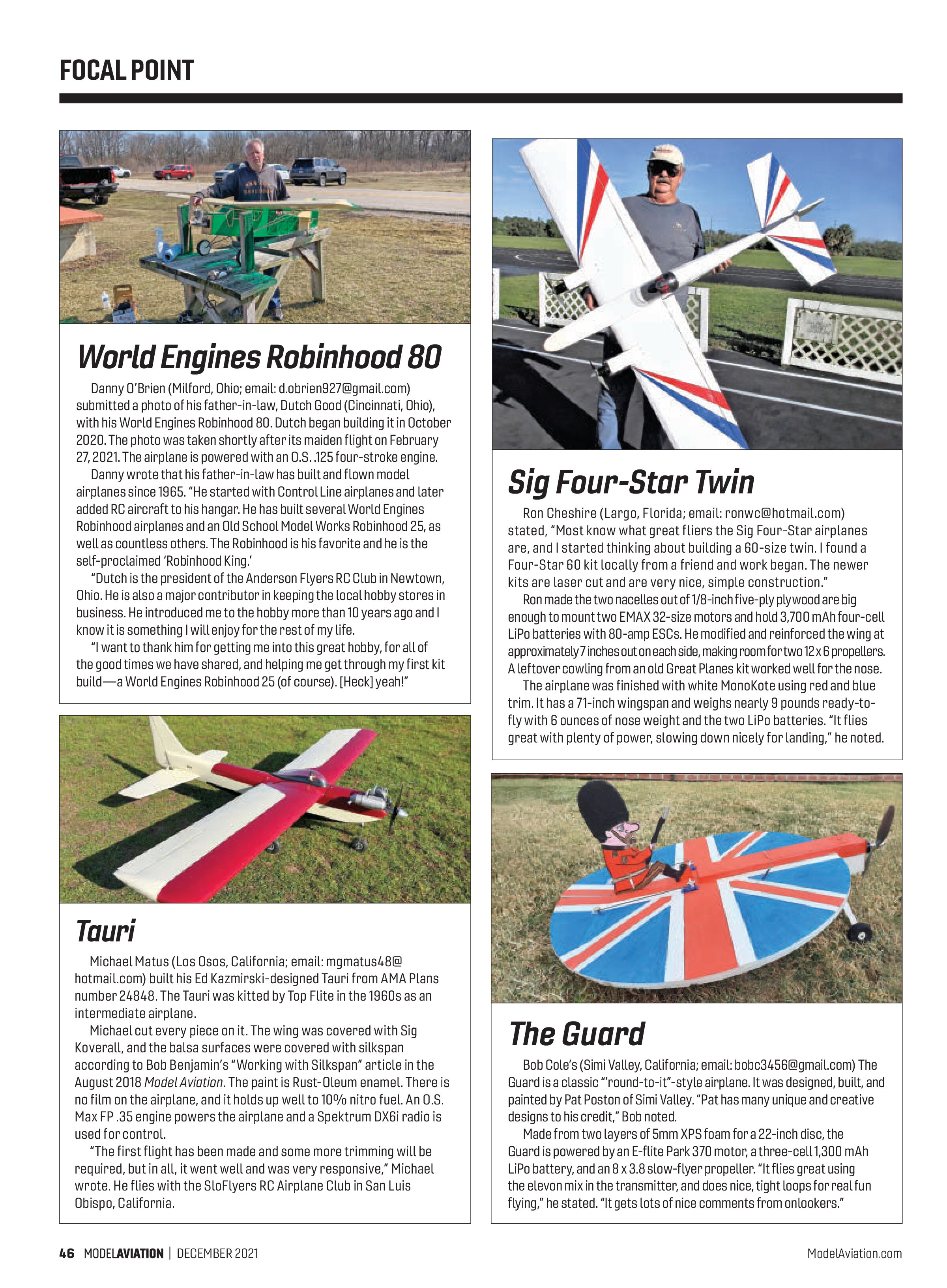
Marty Levinstein (Port Jefferson Station, New York) decided to build an RC stick-and-tissue airplane. He thought that a small airplane would work out well with the two E-flite UMX receiver combos that he had.
Marty built a Dumas Eindecker EIII with a 17.5-inch wingspan, converted the receiver to work with a brushless motor, and added an ESC for it to work properly with rudder, elevator, and throttle controls. The battery is a one-cell 300 mAh. “I had about 25 engineering problems along the way,” he wrote. “After approximately 3-1/2 weeks, it was finished.”
Carbon-fiber rods were used to beef up certain areas, but the biggest problem was achieving the correct center of gravity. “I made a weight that fits against the landing gear that I use temporarily just to fly. I remove it when I display the model.”
He stated that it really does fly! “It does the basic flight pattern and even a sloppy loop. I think I will just put it on a shelf to look at,” he said. “I ended up enjoying building a stick-and-tissue model—not a drop of foam. A close look will show you that the pilot is me!”

Revolver II
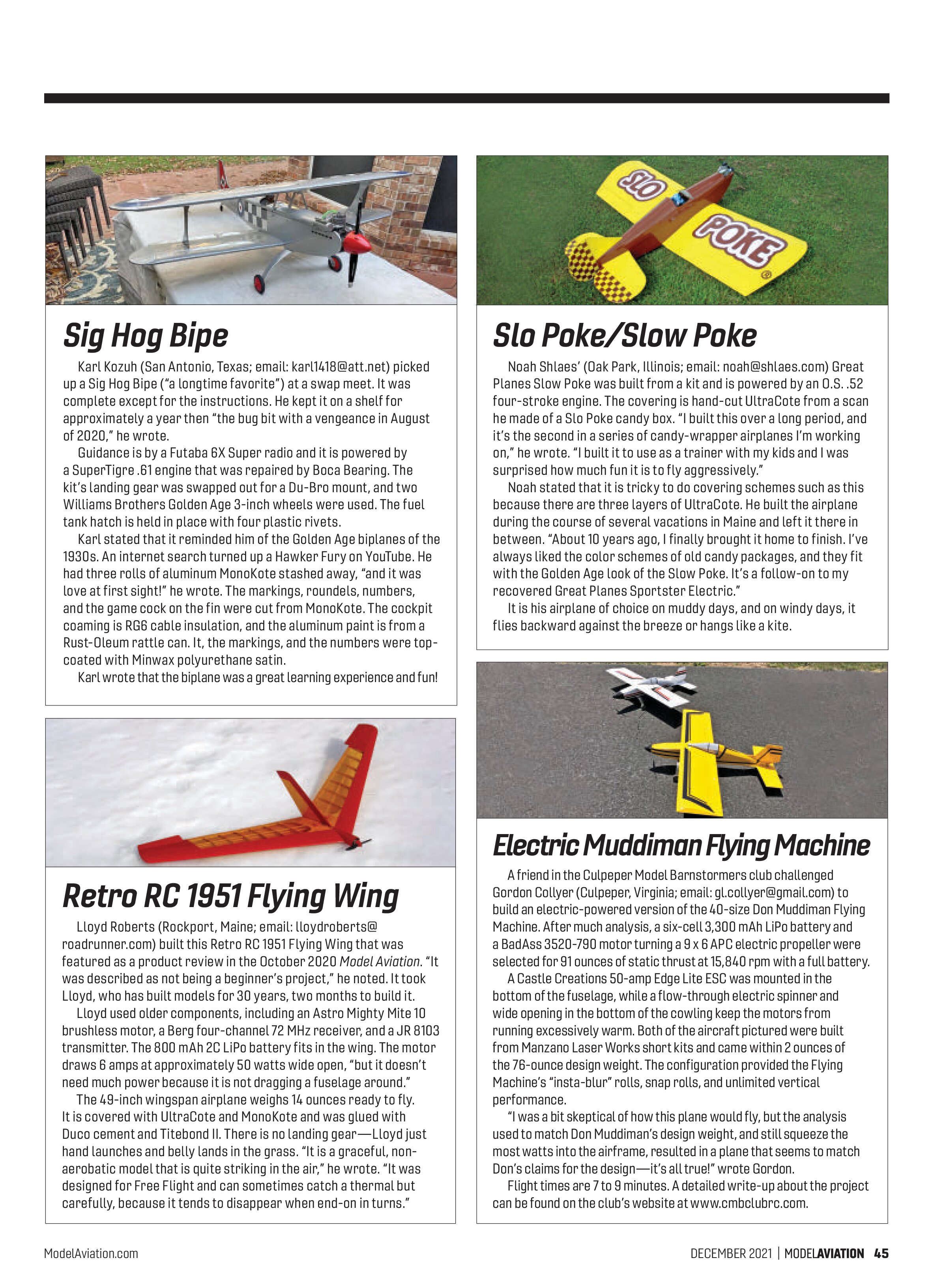
Gene Graber (Willow Street, Pennsylvania; email: eugenegraber@aol.com) completed his scratch-built Revolver II RC autogyro in February 2020. It was designed by Richard Harris, and the plans are available from the United Kingdom-based RCM&E magazine.
The Revolver II’s all-up weight is 34 ounces with a 3S 2,200 mAh LiPo battery, 40-amp ESC, an 1,100 Kv brushless outrunner motor, and an 8 x 7.5-inch pusher propeller. The main servos tilt the entire rotor up and down for pitch and left and right for roll, in addition to normal rudder. The hand-made rotor blades are identical in length, cross section, and weight. Gene purchased the rotor head from Coolwind Models in the U.K.
“There is a large group of ‘gyronuts’ in England, where multiple autogyros are flown at the same time,” Gene noted. “Test hops will be made before attempting to fly.”

The Black Fin and The Black Fin II
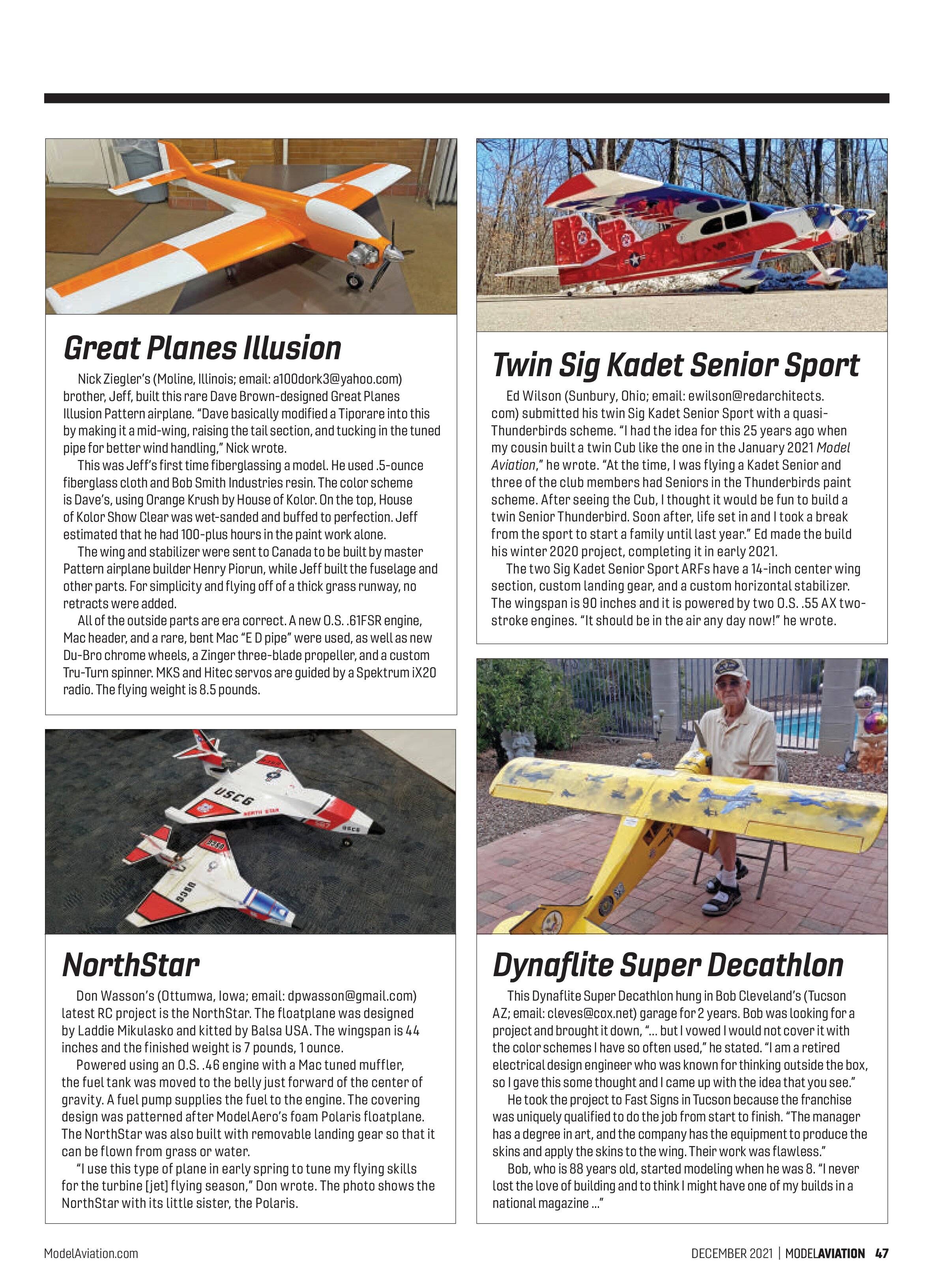
Ken Lawrence’s (email: El Cajon, California; email: mkaway@cox.net) latest build is from a late-1980s Carl Goldberg Eagle II kit. The Black Fin II is named after his self-designed Rogallo wing called The Black Fin, which is shown in the background of the photo.
The Black Fin II is powered by a RimFire .32 motor turning a 12 x 6 wooden propeller with a Castle Creations Talon 60 ESC and a Venom 3,600 mAh 3S LiPo battery. Ken uses a SafeStart from Dave’s R/C Electronics for motor safety and added nonfunctional wing struts.
The Black Fin wing’s fuselage and tail feathers were Ken’s design. The “sail” was designed from the math formulas in Paul Bradley’s April 2015 Model Aviation “Small-Field Flying” column about Rogallo design. It’s powered by a RimFire 300 motor turning an APC 8 x 6 slow-flyer propeller. The MonoKote sail is epoxied to the basswood frame. Each spar is 29 inches long.
Ken stated that both airplanes are gentle but precise flyers, with no bad habits.

Sig Hog Bipe
Karl Kozuh (San Antonio, Texas; email: karl1418@att.net) picked up a Sig Hog Bipe (“a longtime favorite”) at a swap meet. It was complete except for the instructions. He kept it on a shelf for approximately a year then “the bug bit with a vengeance in August of 2020,” he wrote.
Guidance is by a Futaba 6X Super radio and it is powered by a SuperTigre .61 engine that was repaired by Boca Bearing. The kit’s landing gear was swapped out for a Du-Bro mount, and two Williams Brothers Golden Age 3-inch wheels were used. The fuel tank hatch is held in place with four plastic rivets.
Karl stated that it reminded him of the Golden Age biplanes of the 1930s. An internet search turned up a Hawker Fury on YouTube. He had three rolls of aluminum MonoKote stashed away, “and it was love at first sight!” he wrote. The markings, roundels, numbers, and the game cock on the fin were cut from MonoKote. The cockpit coaming is RG6 cable insulation, and the aluminum paint is from a Rust-Oleum rattle can. It, the markings, and the numbers were top-coated with Minwax polyurethane satin.
Karl wrote that the biplane was a great learning experience and fun!

Retro RC 1951 Flying Wing
Lloyd Roberts (Rockport, Maine; email: lloydrroberts@roadrunner.com) built this Retro RC 1951 Flying Wing that was featured as a product review in the October 2020 Model Aviation. “It was described as not being a beginner’s project,” he noted. It took Lloyd, who has built models for 30 years, two months to build it.
Lloyd used older components, including an Astro Mighty Mite 10 brushless motor, a Berg four-channel 72 MHz receiver, and a JR 8103 transmitter. The 800 mAh 2C LiPo battery fits in the wing. The motor draws 6 amps at approximately 50 watts wide open, “but it doesn’t need much power because it is not dragging a fuselage around.”
The 49-inch wingspan airplane weighs 14 ounces ready to fly. It is covered with UltraCote and MonoKote and was glued with Duco cement and Titebond II. There is no landing gear—Lloyd just hand launches and belly lands in the grass. “It is a graceful, non-aerobatic model that is quite striking in the air,” he wrote. “It was designed for Free Flight and can sometimes catch a thermal but carefully, because it tends to disappear when end-on in turns.”

Slo Poke/Slow Poke
Noah Shlaes’ (Oak Park, Illinois; email: noah@shlaes.com) Great Planes Slow Poke was built from a kit and is powered by an O.S. .52 four-stroke engine. The covering is hand-cut UltraCote from a scan he made of a Slo Poke candy box. “I built this over a long period, and it’s the second in a series of candy-wrapper airplanes I’m working on,” he wrote. “I built it to use as a trainer with my kids and I was surprised how much fun it is to fly aggressively.”
Noah stated that it is tricky to do covering schemes such as this because there are three layers of UltraCote. He built the airplane during the course of several vacations in Maine and left it there in between. “About 10 years ago, I finally brought it home to finish. I’ve always liked the color schemes of old candy packages, and they fit with the Golden Age look of the Slow Poke. It’s a follow-on to my recovered Great Planes Sportster Electric.”
It is his airplane of choice on muddy days, and on windy days, it flies backward against the breeze or hangs like a kite.

Electric Muddiman Flying Machine
A friend in the Culpeper Model Barnstormers club challenged Gordon Collyer (Culpeper, Virginia; email: gl.collyer@gmail.com) to build an electric-powered version of the 40-size Don Muddiman Flying Machine. After much analysis, a six-cell 3,300 mAh LiPo battery and a BadAss 3520-790 motor turning a 9 x 6 APC electric propeller were selected for 91 ounces of static thrust at 15,840 rpm with a full battery.
A Castle Creations 50-amp Edge Lite ESC was mounted in the bottom of the fuselage, while a flow-through electric spinner and wide opening in the bottom of the cowling keep the motors from running excessively warm. Both of the aircraft pictured were built from Manzano Laser Works’s short kits and came within 2 ounces of the 76-ounce design weight. The configuration provided the Flying Machine’s “insta-blur” rolls, snap rolls, and unlimited vertical performance.
“I was a bit skeptical of how this plane would fly, but the analysis used to match Don Muddiman’s design weight, and still squeeze the most watts into the airframe, resulted in a plane that seems to match Don’s claims for the design—it’s all true!” wrote Gordon.
Flight times are 7 to 9 minutes. A detailed write-up about the project can be found on the club’s website at www.cmbclubrc.com.

World Engines Robinhood 80
Danny O’Brien (Milford, Ohio; email: d.obrien927@gmail.com) submitted a photo of his father-in-law, Dutch Good (Cincinnati, Ohio), with his World Engines Robinhood 80. Dutch began building it in October 2020. The photo was taken shortly after its maiden flight on February 27, 2021. The airplane is powered with an O.S. .125 four-stroke engine.
Danny wrote that his father-in-law has built and flown model airplanes since 1965. “He started with Control Line airplanes and later added RC aircraft to his hangar. He has built several World Engines Robinhood airplanes and an Old School Model Works Robinhood 25, as well as countless others. The Robinhood is his favorite and he is the self-proclaimed ‘Robinhood King.’
“Dutch is the president of the Anderson Flyers RC Club in Newtown, Ohio. He is also a major contributor in keeping the local hobby stores in business. He introduced me to the hobby more than 10 years ago and I know it is something I will enjoy for the rest of my life.
“I want to thank him for getting me into this great hobby, for all of the good times we have shared, and helping me get through my first kit build—a World Engines Robinhood 25 (of course). [Heck] yeah!”

Sig Four-Star Twin
Ron Cheshire (Largo, Florida; email: ronwc@hotmail.com) stated, “Most know what great fliers the Sig Four-Star airplanes are, and I started thinking about building a 60-size twin. I found a Four-Star 60 kit locally from a friend and work began. The newer kits are laser cut and are very nice, simple construction.”
Ron made the nacelles out of 1/8-inch five-ply plywood and big enough to mount two EMAX 32-size motors and hold 3,700 mAh four-cell LiPo batteries with 80-amp ESCs. He modified and reinforced the wing at approximately 7 inches out on each side, making room for two 12 x 6 propellers. A leftover cowling from an old Great Planes kit worked well for the nose.
The airplane was finished with white MonoKote using red and blue trim. It has a 71-inch wingspan and weighs nearly 9 pounds ready-to-fly with 6 ounces of nose weight and the two LiPo batteries. “It flies great with plenty of power, slowing down nicely for landing,” he noted.

Tauri
Michael Matus (Los Osos, California; email: mgmatus48@hotmail.com) built his Ed Kazmirski-designed Tauri from AMA Plans number 24848. The Tauri was kitted by Top Flite in the 1960s as an intermediate airplane.
Michael cut every piece on it. The wing was covered with Sig Koverall, and the balsa surfaces were covered with silkspan according to Bob Benjamin’s “Working with Silkspan” article in the August 2018 Model Aviation. The paint is Rust-Oleum enamel. There is no film on the airplane, and it holds up well to 10% nitro fuel. An O.S. Max FP .35 engine powers the airplane and a Spektrum DX6i radio is used for control.
“The first flight has been made and some more trimming will be required, but in all, it went well and was very responsive,” Michael wrote. He flies with the SloFlyers RC Airplane Club in San Luis Obispo, California.

The Guard
Bob Cole’s (Simi Valley, California; email: bobc3456@gmail.com) The Guard is a classic “round-to-it”-style airplane. It was designed, built, and painted by Pat Poston of Simi Valley. “Pat has many unique and creative designs to his credit,” Bob noted.
Made from two layers of 5mm XPS foam for a 22-inch disc, the Guard is powered by an E-flite Park 370 motor, a three-cell 1,300 mAh LiPo battery, and an 8 x 3.8 slow-flyer propeller. “It flies great using the elevon mix in the transmitter, and does nice, tight loops for real fun flying,” he stated. “It gets lots of nice comments from onlookers.”

Great Planes Illusion
Nick Ziegler’s (Moline, Illinois; email: a1000dork3@yahoo.com) brother, Jeff, built this rare Dave Brown-designed Great Planes Illusion Pattern airplane. “Dave basically modified a Tiporare into this by making it a mid-wing, raising the tail section, and tucking in the tuned pipe for better wind handling,” Nick wrote.
This was Jeff’s first time fiberg lassing a model. He used .5-ounce fiberglass cloth and Bob Smith Industries resin. The color scheme is Dave’s, using Orange Krush by House of Kolor. On the top, House of Kolor Show Clear was wet-sanded and buffed to perfection. Jeff estimated that he had 100-plus hours in the paint work alone.
The wing and stabilizer were sent to Canada to be built by master Pattern airplane builder Henry Piorun, while Jeff built the fuselage and other parts. For simplicity and flying off of a thick grass runway, no retracts were added.
All of the outside parts are era correct. A new O.S. .61FSR engine, Mac header, and a rare, bent Mac “E D pipe” were used, as well as new Du-Bro chrome wheels, a Zinger three-blade propeller, and a custom Tru-Turn spinner. MKS and Hitec servos are guided by a Spektrum iX20 radio. The flying weight is 8.5 pounds.

Twin Sig Kadet Senior Sport
Ed Wilson (Sunbury, Ohio; email: ewilson@redarchitects.com) submitted his twin Sig Kadet Senior Sport with a quasi-Thunderbirds scheme. “I had the idea for this 25 years ago when my cousin built a twin Cub like the one in the January 2021 Model Aviation,” he wrote. “At the time, I was flying a Kadet Senior and three of the club members had Seniors in the Thunderbirds paint scheme. After seeing the Cub, I thought it would be fun to build a twin Senior Thunderbird. Soon after, life set in and I took a break from the sport to start a family until last year.” Ed made the build his winter 2020 project, completing it in early 2021.
The two Sig Kadet Senior Sport ARFs have a 14-inch center wing section, custom landing gear, and a custom horizontal stabilizer. The wingspan is 90 inches and it is powered by two O.S. .55 AX two-stroke engines. “It should be in the air any day now!” he wrote.

NorthStar
Don Wasson’s (Ottumwa, Iowa; email: dpwasson@gmail.com) latest RC project is the NorthStar. The floatplane was designed by Laddie Mikulasko and kitted by Balsa USA. The wingspan is 44 inches and the finished weight is 7 pounds, 1 ounce.
Powered using an O.S. .46 engine with a Mac tuned muffler, the fuel tank was moved to the belly just forward of the center of gravity. A fuel pump supplies the fuel to the engine. The covering design was patterned after ModelAero’s foam Polaris floatplane. The NorthStar was also built with removable landing gear so that it can be flown from grass or water.
“I use this type of plane in early spring to tune my flying skills for the turbine [jet] flying season,” Don wrote. The photo shows the NorthStar with its little sister, the Polaris.

Dynaflite Super Decathlon
This Dynaflite Super Decathlon hung in Bob Cleveland’s (Tucson AZ; email: cleves@cox.net) garage for 2 years. Bob was looking for a project and brought it down, “… but I vowed I would not cover it with the color schemes I have so often used,” he stated. “I am a retired electrical design engineer who was known for thinking outside the box, so I gave this some thought and I came up with the idea that you see.”
He took the project to Fast Signs in Tucson because the franchise was uniquely qualified to do the job from start to finish. “The manager has a degree in art, and the company has the equipment to produce the skins and apply the skins to the wing. Their work was flawless.”
Bob, who is 88 years old, started modeling when he was 8. “I never lost the love of building and to think I might have one of my builds in a national magazine …”