The Deal with Drones
FIRST SHOTS FIRED IN THE FIGHT AGAINST REMOTE ID
By Joshua Bardwell
joshuabardwell@fpvknowitall.com

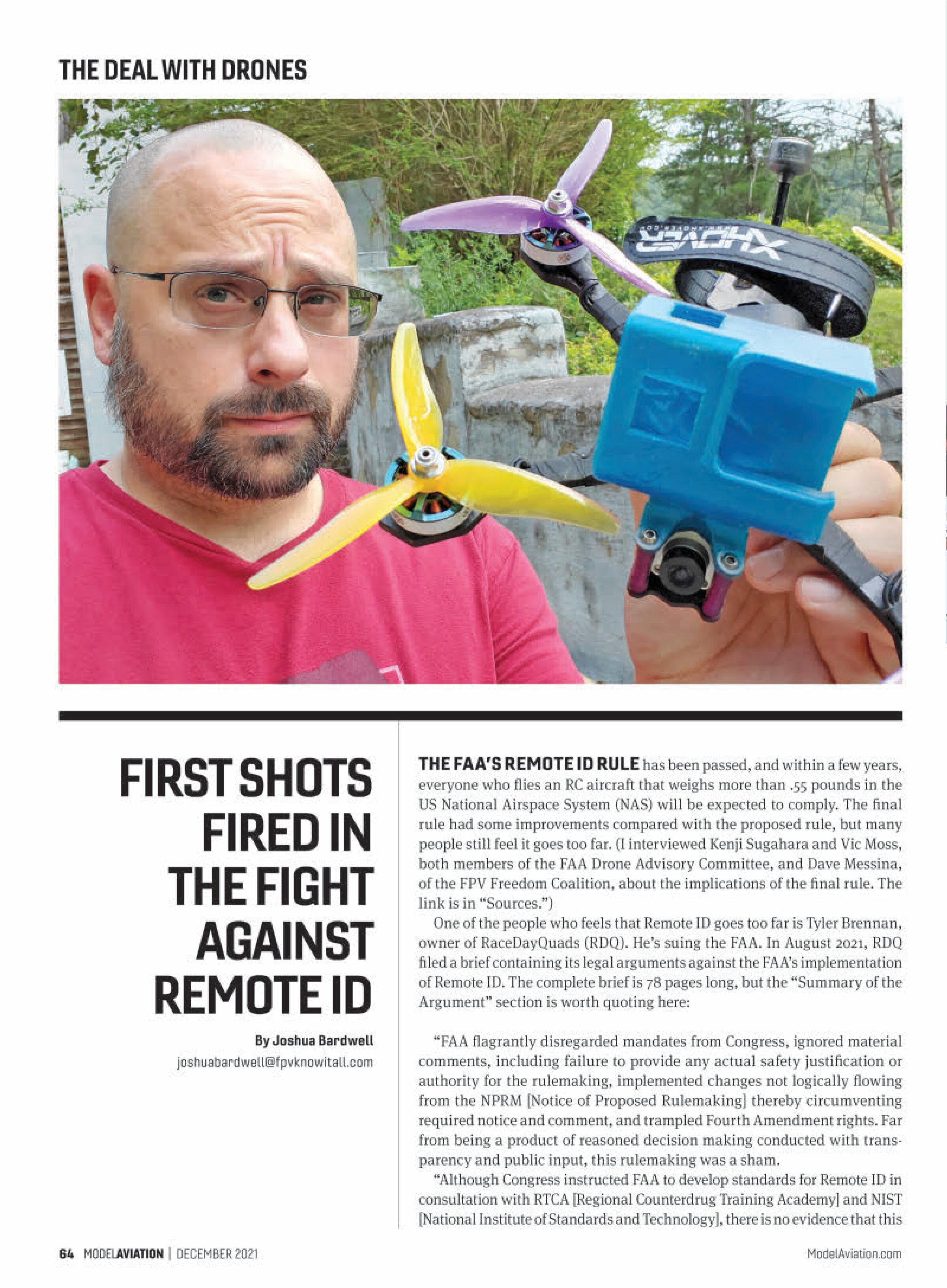
THE FAA’S REMOTE ID RULE has been passed, and within a few years, everyone who flies an RC aircraft that weighs more than .55 pounds in the US National Airspace System (NAS) will be expected to comply. The final rule had some improvements compared with the proposed rule, but many people still feel it goes too far. (I interviewed Kenji Sugahara and Vic Moss, both members of the FAA Drone Advisory Committee, and Dave Messina, of the FPV Freedom Coalition, about the implications of the final rule. The link is in “Sources.”)
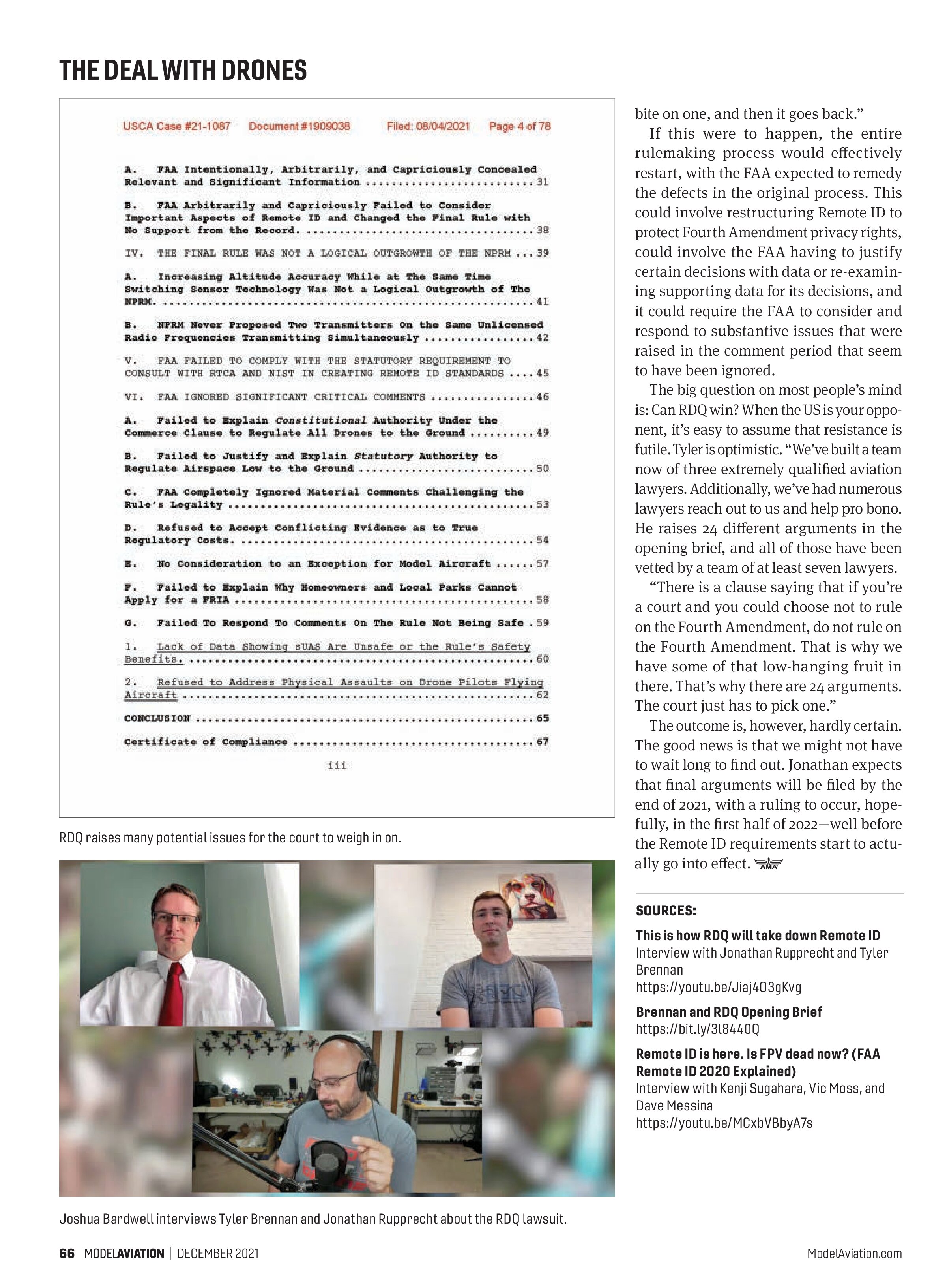
One of the people who feels that Remote ID goes too far is Tyler Brennan, owner of RaceDayQuads (RDQ). He’s suing the FAA. In August 2021, RDQ filed a brief containing its legal arguments against the FAA’s implementation of Remote ID. The complete brief is 78 pages long, but the “Summary of the Argument” section is worth quoting here:
“FAA flagrantly disregarded mandates from Congress, ignored material comments, including failure to provide any actual safety justification or authority for the rulemaking, implemented changes not logically flowing from the NPRM [Notice of Proposed Rulemaking] thereby circumventing required notice and comment, and trampled Fourth Amendment rights. Far from being a product of reasoned decision making conducted with transparency and public input, this rulemaking was a sham.
“Although Congress instructed FAA to develop standards for Remote ID in consultation with RTCA [Regional Counterdrug Training Academy] and NIST [National Institute of Standards and Technology], there is no evidence that this was done. FAA has maintained that the Remote ID Cohort, a group of companies formed during the NPRM’s comment period to assist FAA with developing technology requirements for Remote ID, was unrelated to the Remote ID rulemaking. Accordingly, all documents exchanged, meetings held, and information shared between FAA and the [Remote ID] Cohort remained secret and the public’s attempts to comment or ask questions were denied, a flagrant violation of the notice and comment requirements of the APA [Administrative Procedure Act] and DOT [Department of Transportation] rulemaking regulations, or an arbitrary and capricious failure to consider extremely relevant USCA [U.S. Court of Appeals] Case #21-1087 Document #1909038 Filed: 08/04/2021 Page 24 of 78 15 information. It also renders justification for changes in the final rule implausible.
“FAA has presented this rule as necessary to ensure safety and efficiency in the national airspace, claiming that Remote ID would be used for things such as detect-and-avoid and traffic management. A full consideration of all the relevant information, however, shows otherwise. FAA plainly states the purpose of Remote ID is supplying necessary data to security partners, not air traffic, and indicates most everything will go to law enforcement if requested. FAA needs to call this rule what it is—a GPS tracking and identification rulemaking—properly disclose all of the off-record communications evidencing the full nature and intent of the rule, allow public comment and participation in light of this knowledge, and adequately respond to material public comments and concerns as required for a proper notice and comment rulemaking under the Administrative Procedure Act.
“As written, the rule blatantly violates Fourth Amendment guarantees and flies in the face of Supreme Court precedent. In addition to ignoring Constitutional protections, FAA disregarded significant public comments and concerns. Among other things, commenters challenged FAA’s statutory and constitutional authority to regulate non-commercial drones and non-navigable airspace; pointed out inaccurate data relied upon in the USCA Case #21-1087 Document #1909038 Filed: 08/04/2021 Page 25 of 78 16 regulatory analysis; presented reasonable alternatives to the excessively broad and burdensome requirements; and questioned the alleged safety justifications of the rule. FAA did not respond adequately or at all. FAA also implemented multiple changes that were not presented for public comment and review because they were not a logical outgrowth of the NPRM.
“The plethora of procedural errors, Constitutional violation, inexcusable subversive maneuvers to conceal the true security focus of the alleged safety rulemakings, thus preventing meaningful public participation, and the failure to respond to or address the material comments received, render the rule as promulgated void.”
If the court sides with RDQ, what might the outcome look like for RC hobbyists? Jonathan Rupprecht, counsel for RDQ, says the exact outcome depends on how the law is struck down. He sees the most likely outcome as a complete vacatur with remand to the FAA. “There are too many substantive issues that were completely ignored. If we have 10 arguments that we’re launching at the FAA, they’re going to have to survive all 10. The court only needs to

bite on one, and then it goes back.”
If this were to happen, the entire rulemaking process would effectively restart, with the FAA expected to remedy the defects in the original process. This could involve restructuring Remote ID to protect Fourth Amendment privacy rights, could involve the FAA having to justify certain decisions with data or re-examining supporting data for its decisions, and it could require the FAA to consider and respond to substantive issues that were raised in the comment period that seem to have been ignored.
The big question on most people’s mind is: Can RDQ win? When the US is your opponent, it’s easy to assume that resistance is futile. Tyler is optimistic. “We’ve built a team now of three extremely qualified aviation lawyers. Additionally, we’ve had numerous lawyers reach out to us and help pro bono. He raises 24 different arguments in the opening brief, and all of those have been vetted by a team of at least seven lawyers.
“There is a clause saying that if you’re a court and you could choose not to rule on the Fourth Amendment, do not rule on the Fourth Amendment. That is why we have some of that low-hanging fruit in there. That’s why there are 24 arguments. The court just has to pick one.”
The outcome is, however, hardly certain. The good news is that we might not have to wait long to find out. Jonathan expects that final arguments will be filed by the end of 2021, with a ruling to occur, hopefully, in the first half of 2022—well before the Remote ID requirements start to actually go into effect.
SOURCES:
This is how RDQ will take down Remote ID
Interview with Jonathan Rupprecht and Tyler Brennan
https://youtu.be/Jiaj403gKvg
Brennan and RDQ Opening Brief
https://bit.ly/3l844UQ
Remote ID is here. Is FPV dead now? (FAA Remote ID 2020 Explained)
Interview with Kenji Sugahara, Vic Moss, and Dave Messina
https://youtu.be/MCx bV BbyA7s