CONTROL LINE NAVY CARRIER

BRODAK MEMORIAL FLY-IN
By John Vlna | flycarrier@yahoo.com
PLANS ARE UNDERWAY for the 2022 Brodak Memorial Fly-In. The final dates are June 13-18, 2022, the week before Father’s Day. The events will be the same as the last fly-in. The status for the 2022 Brodak Memorial Fly-In will be announced on the Brodak website; see the “Sources” at the end of this column.
Kawasaki Experimental Test-Flights
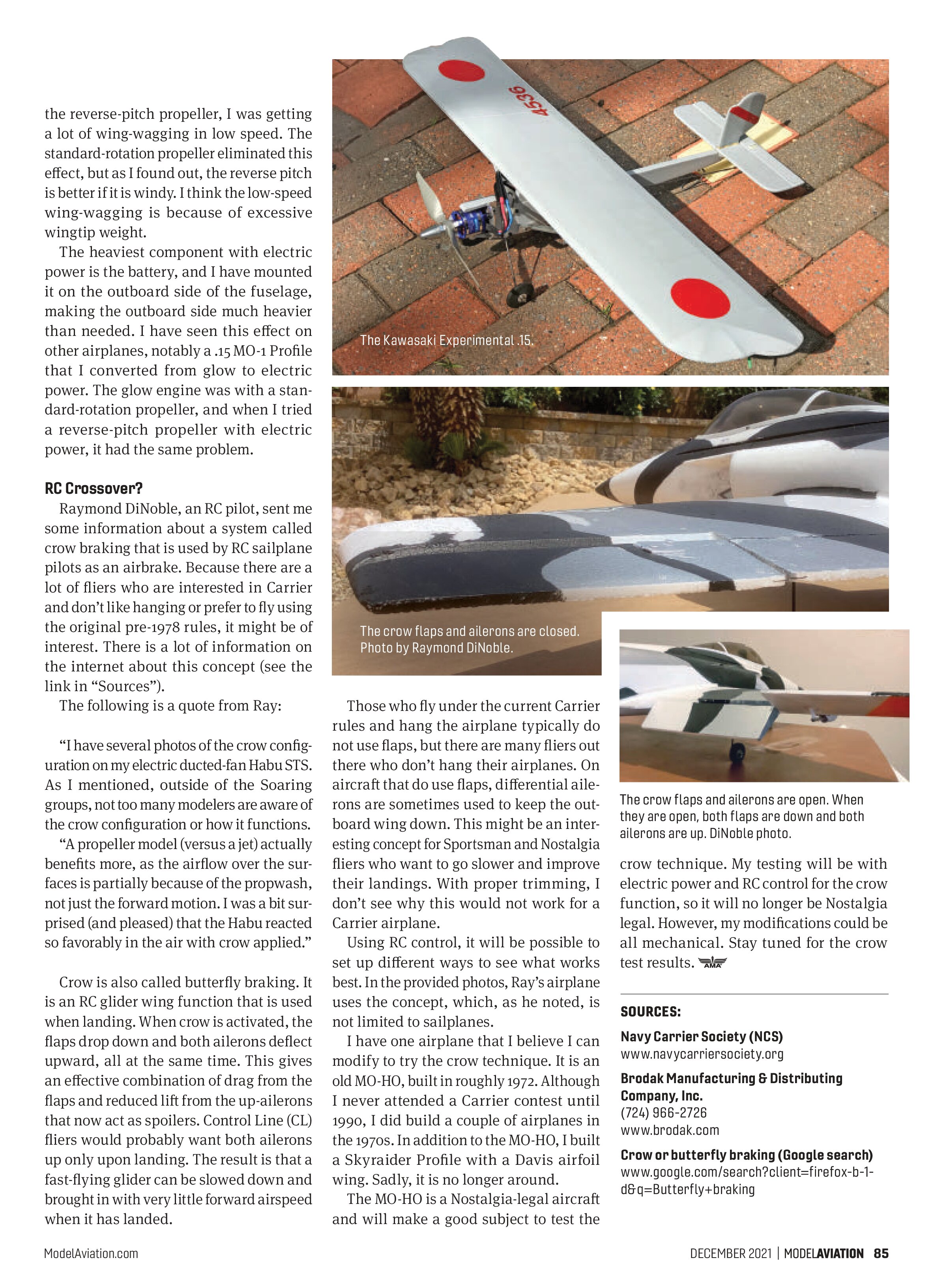
Unfortunately, because of some medical problems, I have not been able to fly as much this year as I would have liked. However, in May, I was able to test-fly the Kawasaki. The results were just as I had hoped.
The design goal was to have a lightweight, .15 Profile model with a power combination that used a three-cell battery. My previous electric-powered .15 Profiles all used four-cell batteries. Using a three-cell versus a four-cell typically saves 3.5 ounces. The Kawasaki’s flying weight ended up at 1 pound, 12 ounces. By way of comparison, my Airedale 15 is 2 pounds, 5 ounces. The 9-ounce difference is a combination of the battery and model construction. The 9 ounces might not sound like much, but it makes a big difference in performance.
I started test-flying with an APC 8 x 6 electric reverse-pitch propeller, and I also tried a standard-rotation propeller. I found that the reverse-pitch propeller gives better line tension in windy conditions. High speed was not affected with either choice. With this combination, I was able to get approximately 68 mph for high speed. My best low speed to date is approximately 8 mph, but there is room for more trimming.
It is clear to me that the potential is there for good low-speed times. With the reverse-pitch propeller, I was getting a lot of wing-wagging in low speed. The standard-rotation propeller eliminated this effect, but as I found out, the reverse pitch is better if it is windy. I think the low-speed wing-wagging is because of excessive wingtip weight.
The heaviest component with electric power is the battery, and I have mounted it on the outboard side of the fuselage, making the outboard side much heavier than needed. I have seen this effect on other airplanes, notably a .15 MO-1 Profile that I converted from glow to electric power. The glow engine was with a standard-rotation propeller, and when I tried a reverse-pitch propeller with electric power, it had the same problem.
RC Crossover?
Raymond DiNoble, an RC pilot, sent me some information about a system called crow braking that is used by RC sailplane pilots as an airbrake. Because there are a lot of fliers who are interested in Carrier and don’t like hanging or prefer to fly using the original pre-1978 rules, it might be of interest. There is a lot of information on the internet about this concept (see the link in “Sources”).
The following is a quote from Ray:
“I have several photos of the crow configuration on my electric ducted-fan Habu STS. As I mentioned, outside of the Soaring groups, not too many modelers are aware of the crow configuration or how it functions.
“A propeller model (versus a jet) actually benefits more, as the airflow over the surfaces is partially because of the propwash, not just the forward motion. I was a bit surprised (and pleased) that the Habu reacted so favorably in the air with crow applied.”
Crow is also called butterfly braking. It is an RC glider wing function that is used when landing. When crow is activated, the flaps drop down and both ailerons deflect upward, all at the same time. This gives an effective combination of drag from the flaps and reduced lift from the up-ailerons that now act as spoilers. Control Line (CL) fliers would probably want both ailerons up only upon landing. The result is that a fast-flying glider can be slowed down and brought in with very little forward airspeed when it has landed.


Those who fly under the current Carrier rules and hang the airplane typically do not use flaps, but there are many fliers out there who don’t hang their airplanes. On aircraft that do use flaps, differential ailerons are sometimes used to keep the outboard wing down. This might be an interesting concept for Sportsman and Nostalgia fliers who want to go slower and improve their landings. With proper trimming, I don’t see why this would not work for a Carrier airplane.
Using RC control, it will be possible to set up different ways to see what works best. In the provided photos, Ray’s airplane uses the concept, which, as he noted, is not limited to sailplanes.
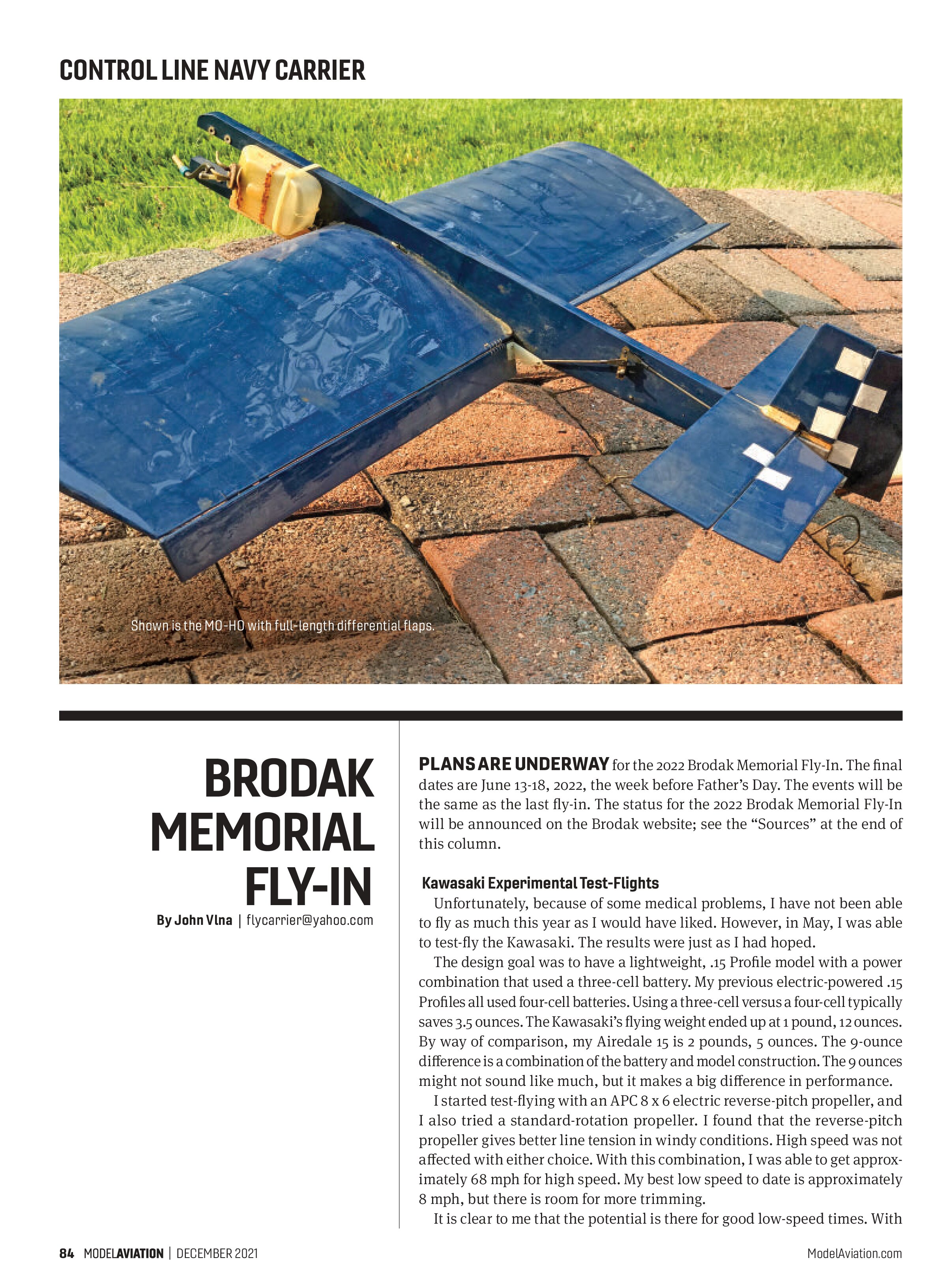
I have one airplane that I believe I can modify to try the crow technique. It is an old MO-HO, built in roughly 1972. Although I never attended a Carrier contest until 1990, I did build a couple of airplanes in the 1970s. In addition to the MO-HO, I built a Skyraider Profile with a Davis airfoil wing. Sadly, it is no longer around.
The MO-HO is a Nostalgia-legal aircraft and will make a good subject to test the crow technique. My testing will be with electric power and RC control for the crow function, so it will no longer be Nostalgia legal. However, my modifications could be all mechanical. Stay tuned for the crow test results.
SOURCES:
Navy Carrier Society (NCS)
www.navycarriersociety.org
Brodak Manufacturing & Distributing Company, Inc.
(724) 966-2726
www.brodak.com
Crow or butterfly braking (Google search)
www.google.com/search?client=firefox-b-1-d&q=Butterfly+braking