THIS COLLECTIVE-PITCH HELI CAN HANDLE DIFFICULT MANEUVERS
Blade Nano S3 RTF with AS3X and SAFE
By Fitz Walker | flying_fitz@yahoo.com
Photos by Jeff Dunehew and the author

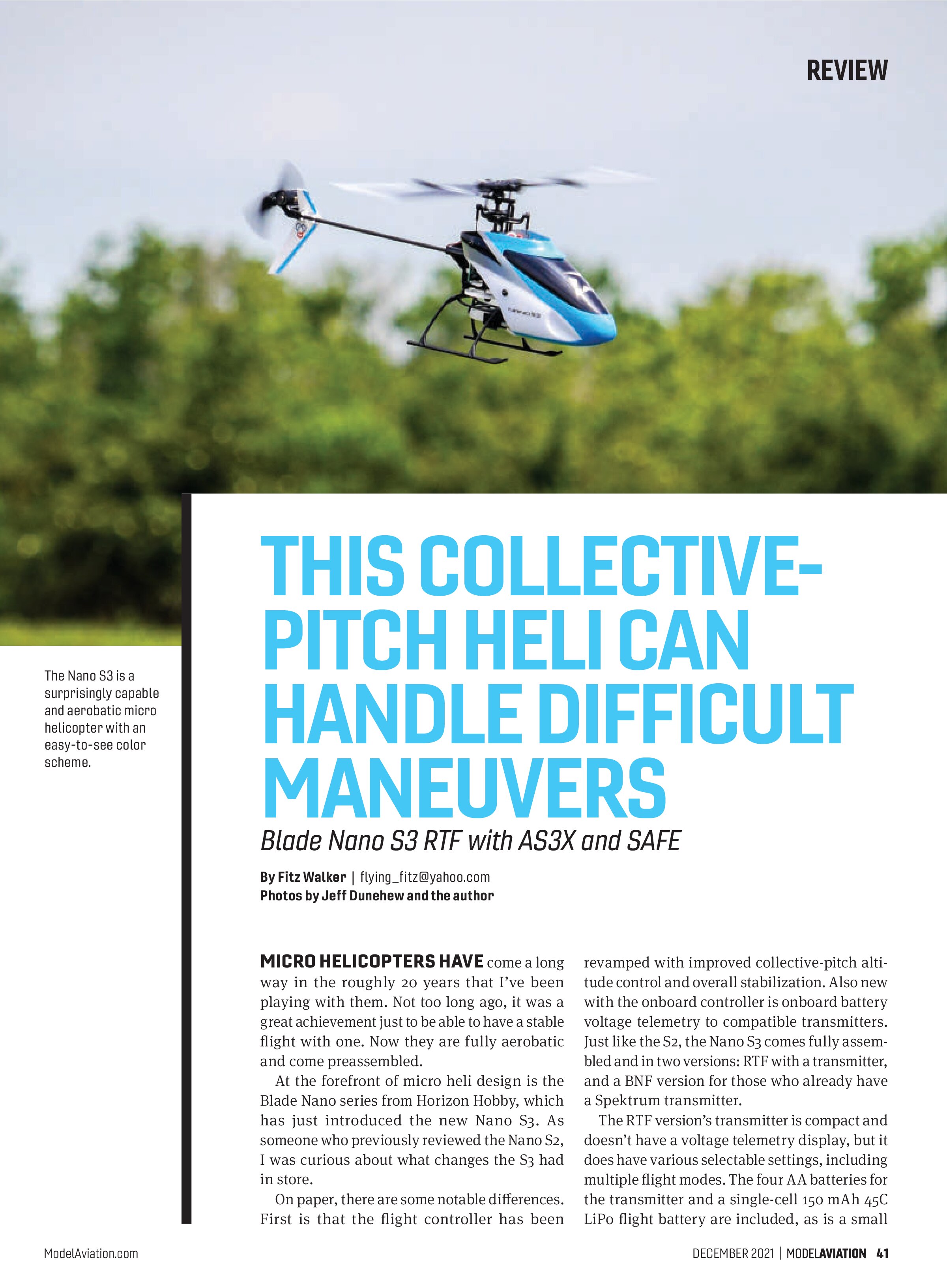
MICRO HELICOPTERS HAVE come a long way in the roughly 20 years that I’ve been playing with them. Not too long ago, it was a great achievement just to be able to have a stable flight with one. Now they are fully aerobatic and come preassembled.
At the forefront of micro heli design is the Blade Nano series from Horizon Hobby, which has just introduced the new Nano S3. As someone who previously reviewed the Nano S2, I was curious about what changes the S3 had in store.
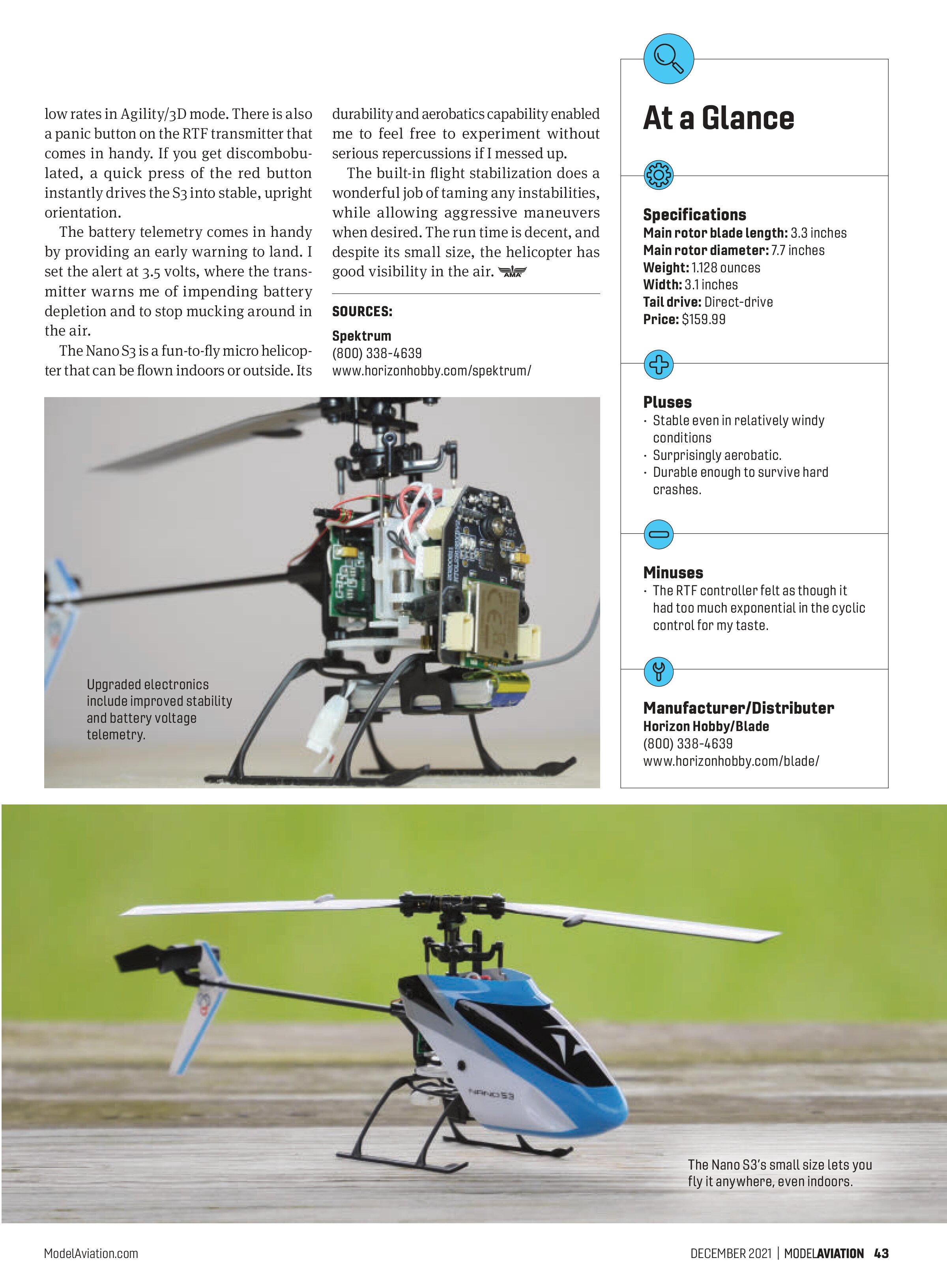
On paper, there are some notable differences. First is that the flight controller has been revamped with improved collective-pitch altitude control and overall stabilization. Also new with the onboard controller is onboard battery voltage telemetry to compatible transmitters.
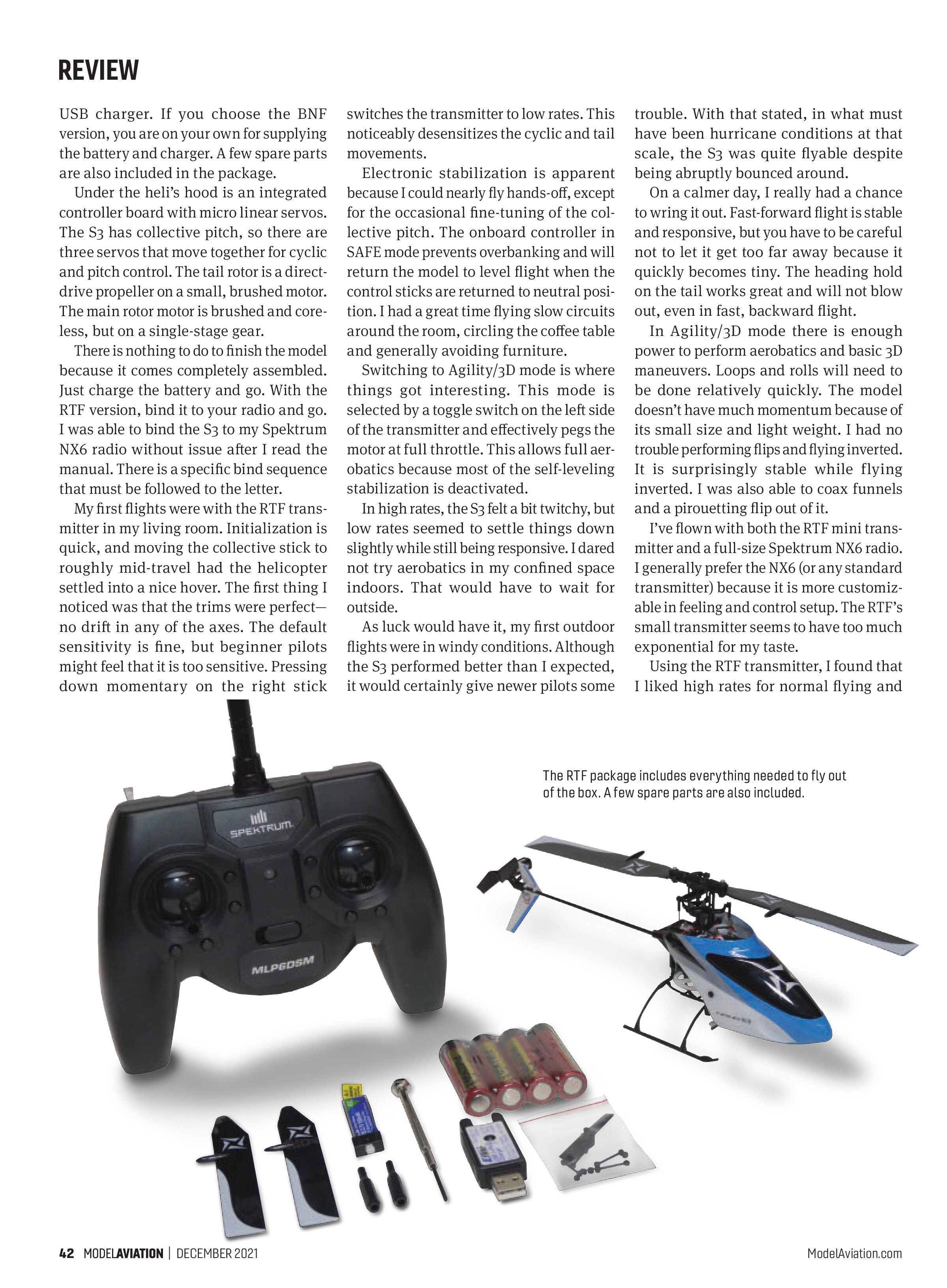
Just like the S2, the Nano S3 comes fully assembled and in two versions: RTF with a transmitter, and a BNF version for those who already have a Spektrum transmitter.
The RTF version’s transmitter is compact and doesn’t have a voltage telemetry display, but it does have various selectable settings, including multiple flight modes. The four AA batteries for the transmitter and a single-cell 150 mAh 45C LiPo flight battery are included, as is a small
REVIEW
USB charger. If you choose the BNF version, you are on your own for supplying the battery and charger. A few spare parts are also included in the package.
Under the heli’s hood is an integrated controller board with micro linear servos. The S3 has collective pitch, so there are three servos that move together for cyclic and pitch control. The tail rotor is a direct-drive propeller on a small, brushed motor. The main rotor motor is brushed and coreless, but on a single-stage gear.
There is nothing to do to finish the model because it comes completely assembled. Just charge the battery and go. With the RTF version, bind it to your radio and go. I was able to bind the S3 to my Spektrum NX6 radio without issue after I read the manual. There is a specific bind sequence that must be followed to the letter.
My first flights were with the RTF transmitter in my living room. Initialization is quick, and moving the collective stick to roughly mid-travel had the helicopter settled into a nice hover. The first thing I noticed was that the trims were perfect—no drift in any of the axes. The default sensitivity is fine, but beginner pilots might feel that it is too sensitive. Pressing down momentary on the right stick switches the transmitter to low rates. This noticeably desensitizes the cyclic and tail movements.
Electronic stabilization is apparent because I could nearly fly hands-off, except for the occasional fine-tuning of the collective pitch. The onboard controller in SAFE mode prevents overbanking and will return the model to level flight when the control sticks are returned to neutral position. I had a great time flying slow circuits around the room, circling the coffee table and generally avoiding furniture.
Switching to Agility/3D mode is where things got interesting. This mode is selected by a toggle switch on the left side of the transmitter and effectively pegs the motor at full throttle. This allows full aerobatics because most of the self-leveling stabilization is deactivated.
In high rates, the S3 felt a bit twitchy, but low rates seemed to settle things down slightly while still being responsive. I dared not try aerobatics in my confined space indoors. That would have to wait for outside.
As luck would have it, my first outdoor flights were in windy conditions. Although the S3 performed better than I expected, it would certainly give newer pilots some trouble. With that stated, in what must have been hurricane conditions at that scale, the S3 was quite flyable despite being abruptly bounced around.
On a calmer day, I really had a chance to wring it out. Fast-forward flight is stable and responsive, but you have to be careful not to let it get too far away because it quickly becomes tiny. The heading hold on the tail works great and will not blow out, even in fast, backward flight.
In Agility/3D mode there is enough power to perform aerobatics and basic 3D maneuvers. Loops and rolls will need to be done relatively quickly. The model doesn’t have much momentum because of its small size and light weight. I had no trouble performing flips and flying inverted. It is surprisingly stable while flying inverted. I was also able to coax funnels and a pirouetting flip out of it.
I’ve flown with both the RTF mini transmitter and a full-size Spektrum NX6 radio. I generally prefer the NX6 (or any standard transmitter) because it is more customizable in feeling and control setup. The RTF’s small transmitter seems to have too much exponential for my taste.
Using the RTF transmitter, I found that I liked high rates for normal flying and

low rates in Agility/3D mode. There is also a panic button on the RTF transmitter that comes in handy. If you get discombobulated, a quick press of the red button instantly drives the S3 into stable, upright orientation.
The battery telemetry comes in handy by providing an early warning to land. I set the alert at 3.5 volts, where the transmitter warns me of impending battery depletion and to stop mucking around in the air.
The Nano S3 is a fun-to-fly micro helicopter that can be flown indoors or outside. Its durability and aerobatics capability enabled me to feel free to experiment without serious repercussions if I messed up.
The built-in flight stabilization does a wonderful job of taming any instabilities, while allowing aggressive maneuvers when desired. The run time is decent, and despite its small size, the helicopter has good visibility in the air.
SOURCES:
Spektrum
(800) 338-4639
www.horizonhobby.com/spektrum/

At a Glance
Specifications
Main rotor blade length: 3.3 inches
Main rotor diameter: 7.7 inches
Weight: 1.128 ounces
Width: 3.1 inches
Tail drive: Direct-drive
Price: $159.99
Pluses
- Stable even in relatively windy conditions
- Surprisingly aerobatic.
- Durable enough to survive hard crashes.
Minuses
- The RTF controller felt as though it had too much exponential in the cyclic control for my taste.
Manufacturer/Distributor
Horizon Hobby/Blade
(800) 338-4639
www.horizonhobby.com/blade/