LOOKING BACK ON 2021
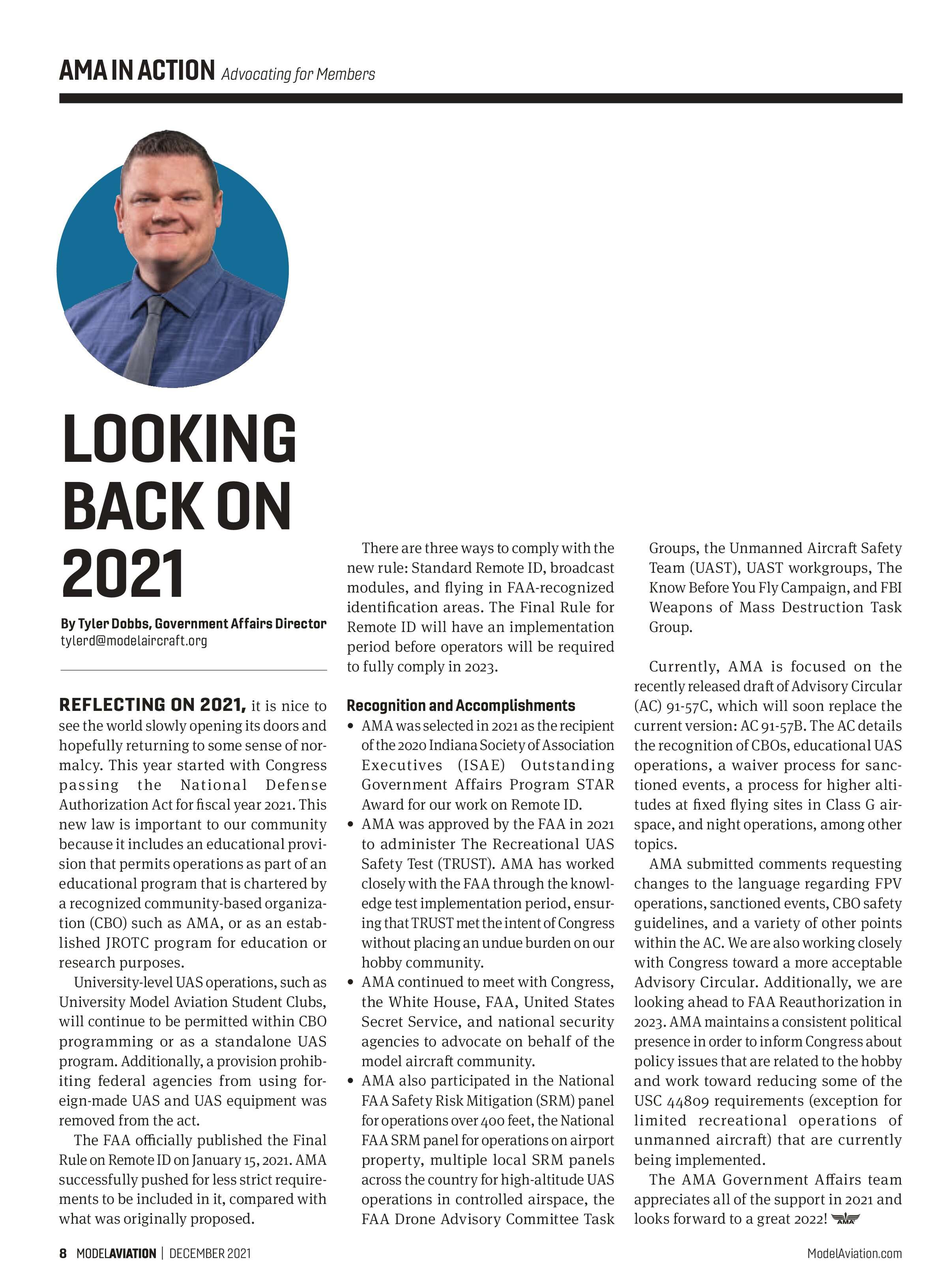
By Tyler Dobbs, Government Affairs Director
tylerd@modelaircraft.org

REFLECTING ON 2021, it is nice to see the world slowly opening its doors and hopefully returning to some sense of normalcy. This year started with Congress passing the National Defense Authorization Act for fiscal year 2021. This new law is important to our community because it includes an educational provision that permits operations as part of an educational program that is chartered by a recognized community-based organization (CBO) such as AMA, or as an established JROTC program for education or research purposes.
University-level UAS operations, such as University Model Aviation Student Clubs, will continue to be permitted within CBO programming or as a standalone UAS program. Additionally, a provision prohibiting federal agencies from using foreign-made UAS and UAS equipment was removed from the act.
The FAA officially published the Final Rule on Remote ID on January 15, 2021. AMA successfully pushed for less strict requirements to be included in it, compared with what was originally proposed.
There are three ways to comply with the new rule: Standard Remote ID, broadcast modules, and flying in FAA-recognized identification areas. The Final Rule for Remote ID will have an implementation period before operators will be required to fully comply in 2023.
Recognition and Accomplishments
- AMA was selected in 2021 as the recipient of the 2020 Indiana Society of Association Executives (ISAE) Outstanding Government Affairs Program STAR Award for our work on Remote ID.
- AMA was approved by the FAA in 2021 to administer The Recreational UAS Safety Test (TRUST). AMA has worked closely with the FAA through the knowledge test implementation period, ensuring that TRUST met the intent of Congress without placing an undue burden on our hobby community.
- AMA continued to meet with Congress, the White House, FAA, United States Secret Service, and national security agencies to advocate on behalf of the model aircraft community.
- AMA also participated in the National FAA Safety Risk Mitigation (SRM) panel for operations over 400 feet, the National FAA SRM panel for operations on airport property, multiple local SRM panels across the country for high-altitude UAS operations in controlled airspace, the FAA Drone Advisory Committee Task Groups, the Unmanned Aircraft Safety Team (UAST), UAST workgroups, The Know Before You Fly Campaign, and FBI Weapons of Mass Destruction Task Group.
Currently, AMA is focused on the recently released draft of Advisory Circular (AC) 91-57C, which will soon replace the current version: AC 91-57B. The AC details the recognition of CBOs, educational UAS operations, a waiver process for sanctioned events, a process for higher altitudes at fixed flying sites in Class G airspace, and night operations, among other topics.
AMA submitted comments requesting changes to the language regarding FPV operations, sanctioned events, CBO safety guidelines, and a variety of other points within the AC. We are also working closely with Congress toward a more acceptable Advisory Circular. Additionally, we are looking ahead to FAA Reauthorization in 2023. AMA maintains a consistent political presence in order to inform Congress about policy issues that are related to the hobby and work toward reducing some of the USC 44809 requirements (exception for limited recreational operations of unmanned aircraft) that are currently being implemented.
The AMA Government Affairs team appreciates all of the support in 2021 and looks forward to a great 2022!