VINTAGE VIEWPOINT

SNOOPY’S DOGHOUSE
By Bob Noll | bobrc@aol.com
THE FIRST THING I would like to do this month is share something that I received from Bill Risko after he read my article about Snoopy’s Doghouse. I think you will find it an interesting read.
“Hi Bob. Having been an RCer since the late 1950s and early ’60s, cutting my teeth on single-channel rudder only, I enjoy your rendition of days gone by, as well as current events. Your column is my first stop in each issue in which you are included. I opened to page 52 in this month’s issue [July 2021] and found a picture of Snoopy’s Doghouse. The memories came flooding back.
“Years ago, my good friend, Bob Lopshire, created the AMA show team concept and asked me to be the announcer. The team consisted of well-organized, accomplished RC pilots who functioned well as a team. One of the outstanding hits of our flight demonstrations was Snoopy and his flying doghouse that, during our show, would be ‘attacked’ by the Red Baron in his red triplane. I would then explain to the crowd that Snoopy was doing his very best to outsmart the Red Baron during their several-minute show.
“The reason I bring this up is because after several shows, AMA received a cease-and-desist order from Schulz Syndicate, stating that we could no longer use the word Snoopy unless we paid royalties. We had no choice but to eliminate the word Snoopy from any of my narrations.
“I did go to great pains to let the crowd know that we could no longer use the term that generally referred to the dog that is flying the doghouse because of the previous mentioned cease-and-desist order. I would say things such as, ‘Now you know who the dog is that is flying the doghouse,’ or ‘The cartoon character flying the doghouse is a well-known character,’ etc.
“I thought you might find it interesting as to the history regarding Snoopy and his flying doghouse. I always thought it was quite small of the syndicate to take us to task for such a minor item. The show team concept caught on, and more clubs tried to get involved because the manufacturers of RC equipment and materials offered to supply, at no charge, whatever was required to keep the show teams going. That’s exactly what killed the show team concept.
“Oh well, it was fun for the years that it lasted, and I enjoyed the friendship of my fellow team members and being able to bring the model aviation world to the uninitiated. Best wishes.”
Fifty Years Ago
Now for a look back 50 years into my magazine library. My thanks to those of you who have told me that you enjoy reading about RC in the past and that it brings back good memories.
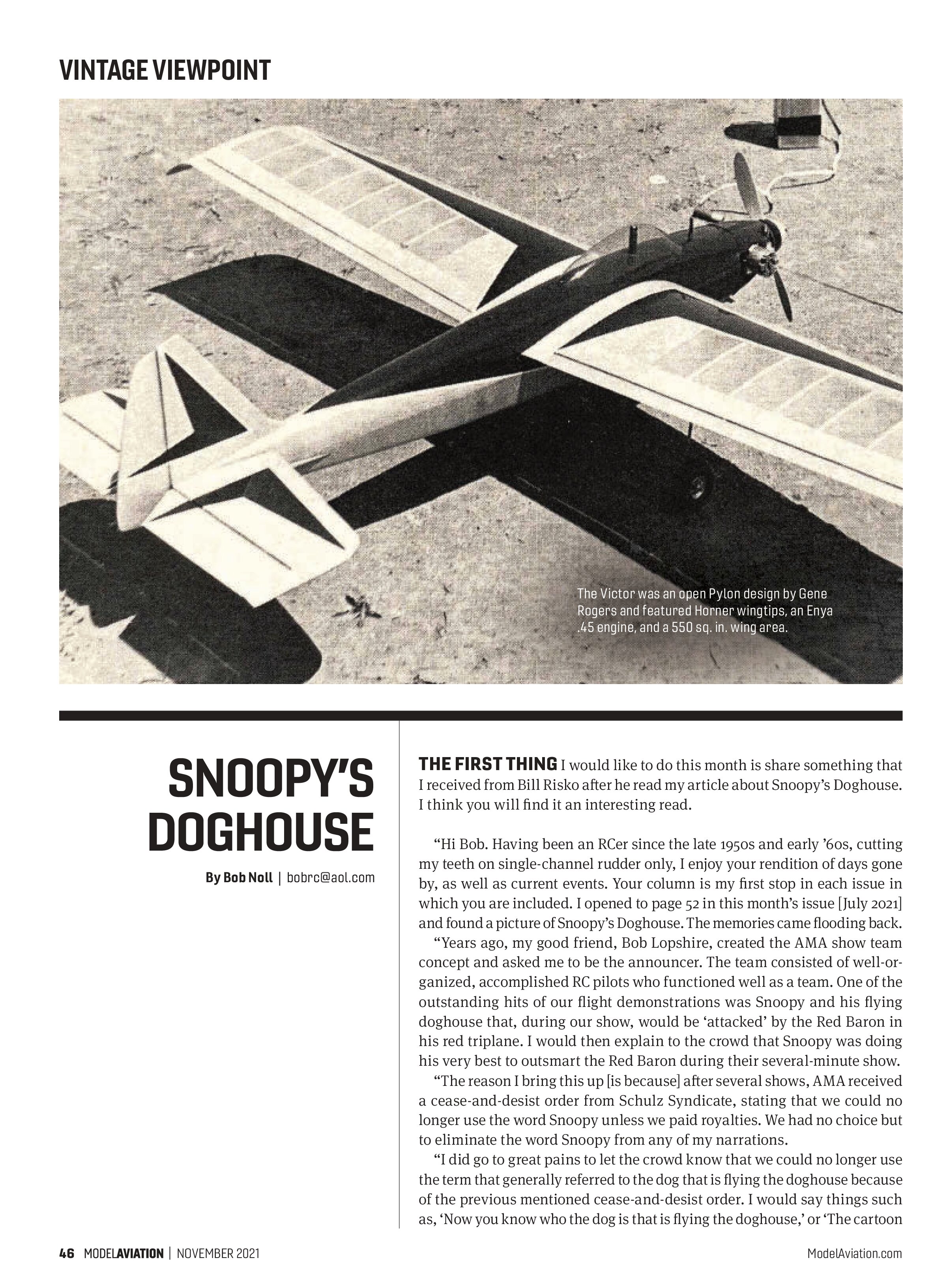
Flying Models published an article by Gene Rogers about his Victor for sport Pylon Racing. The Victor had a 550 sq. in. wing, an Enya .45 engine for thrust, and Pro-Line brains. Many racers were published in the early 1970s because racing had become very popular as the reliability of RC systems improved considerably.
An article by Vern Zundel featured a Stand-Off Scale Schweizer 1-30 sailplane. The 1-30 was a little-known Schweizer type that blended powered flight with thermal soaring. This 2-inch-to-the-foot airplane had an 80-inch wingspan and used a Fox .29 engine.
An interesting article by Maynard Hill reported an attempt by Gus Geissinger and Vern Smith at the world speed record. Their “No Discount” speed machine couldn’t quite cut the mustard and reached a speed of 196 mph. The record, held by a German, remained at 200 mph. The No Discount used a NACA 63-015 airfoil on its 405 sq. in. wing and weighed 5 pounds—1 ounce more with fuel. The power came from a SuperTigre .60 engine fitted with a mini-pipe and reached more than 19,000 rpm in the air. I should point out that nitro is not allowed for FAI records.
Gene Fuller and Fred Allan wrote an article about the Graupner Wankel. The test bed for the Wankel was an ARF Starlighter made by G Products Co. of Gleasondale Industrial Park in Stow, Massachusetts. The article described the Starlighter as the “ARFiest ARF” that was available at a cost of $39.95.
Radio Control Modeler (RCM) had an article about a 1/2A racer that could be built as either a Cassutt or a Bonzo, with the only differences being the outline of the horizontal and vertical stabilizers. Both designs used the same fuselage and the ACE R/C foam wing.
RCM had an article about the upcoming


1971 RC Aerobatic Championship that would be hosted by the US. It was to be held at Doylestown, Pennsylvania, and the US team consisted of Jim Whitley, Phil Kraft, and Ron Chidgey. I was there!
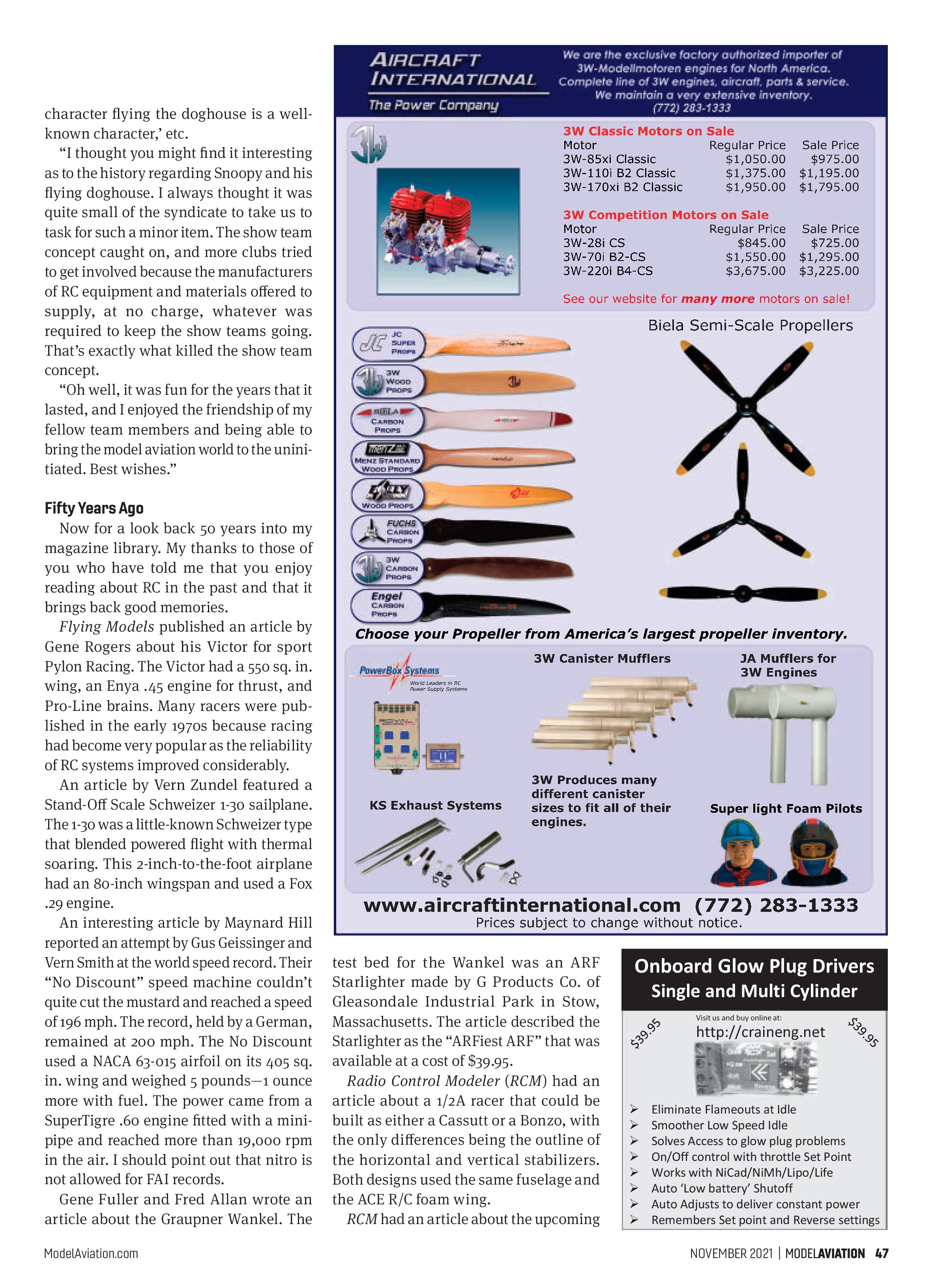
Roy Scott published an article with plans for a B.E.2e. Roy wrote that the B.E.2e tempted him for many reasons. One reason was that if ever an airplane looked “out of the past,” this one did. It brought home the pioneer spirit of aviation during World War I with wood, fabric, rigging wire, high cabanes, and big wings.
With the interest in RC sailplanes growing, there was an article by Lee Renaud about his Esprit. This 7-foot, 20-ounce high-performance sailplane was designed around the modern two-channel miniature proportional equipment. With a wingspan of 84 inches, it offered competitive performance with a convenient size.
RCM also had an article that started off with, “The green flag for 1971 Formula I racing season came down in Southern California for two of the largest pylon meets ever held.” The first, hosted by the Valley Fliers, saw a turnout of 75 aircraft among 55 entrants. The second meet, held two weeks later near the end of May, must be classified as the greatest Formula 1 (F1) race ever to take place. Hosted by the BARKS Club at an old World War II airstrip north of Bakersfield, California, 71 pilots entered the race, with approximately 90 airplanes, to see Bob Smith set a new F1 record of 1:30.3!
In a Soaring article by Don Dewey, he reported that the League of Silent Flight (LSF) membership had topped the 100 mark. LSF was one of the first AMA Special Interest Groups.
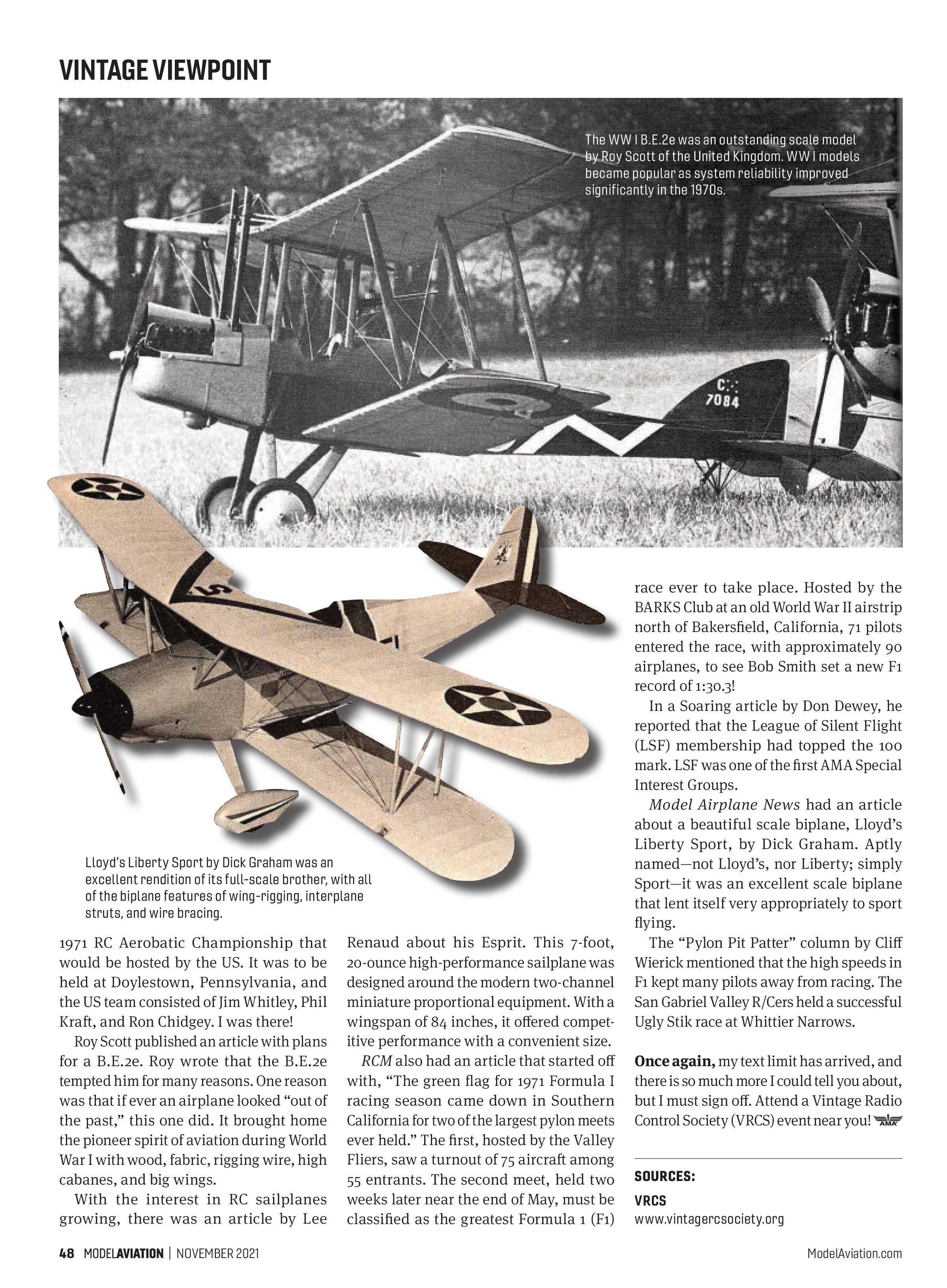
Model Airplane News had an article about a beautiful scale biplane, Lloyd’s Liberty Sport, by Dick Graham. Aptly named—not Lloyd’s, nor Liberty; simply Sport—it was an excellent scale biplane that lent itself very appropriately to sport flying.
The “Pylon Pit Patter” column by Cliff Wierick mentioned that the high speeds in F1 kept many pilots away from racing. The San Gabriel Valley R/Cers held a successful Ugly Stik race at Whittier Narrows.
Once again, my text limit has arrived, and there is so much more I could tell you about, but I must sign off. Attend a Vintage Radio Control Society (VRCS) event near you!