PARACHUTE-DROPPING VTOL CONVERGENCE
Photos by Robert Carter | email: f35pilot@att.net
ROBERT CARTER (Long Beach, California) stated that he is probably the only person in the world doing this. He wrote:


“My son does drone ocean fishing. I use two of his 3D-printed servo drop mechanisms on my plane. On Saturdays, I introduce new people to our RC hobby. Our club field is in a city park. We get a lot of people driving and walking by. I have a sign by the road: ‘Free—Try to drop parachutes in the orange cones. Be our copilot.’
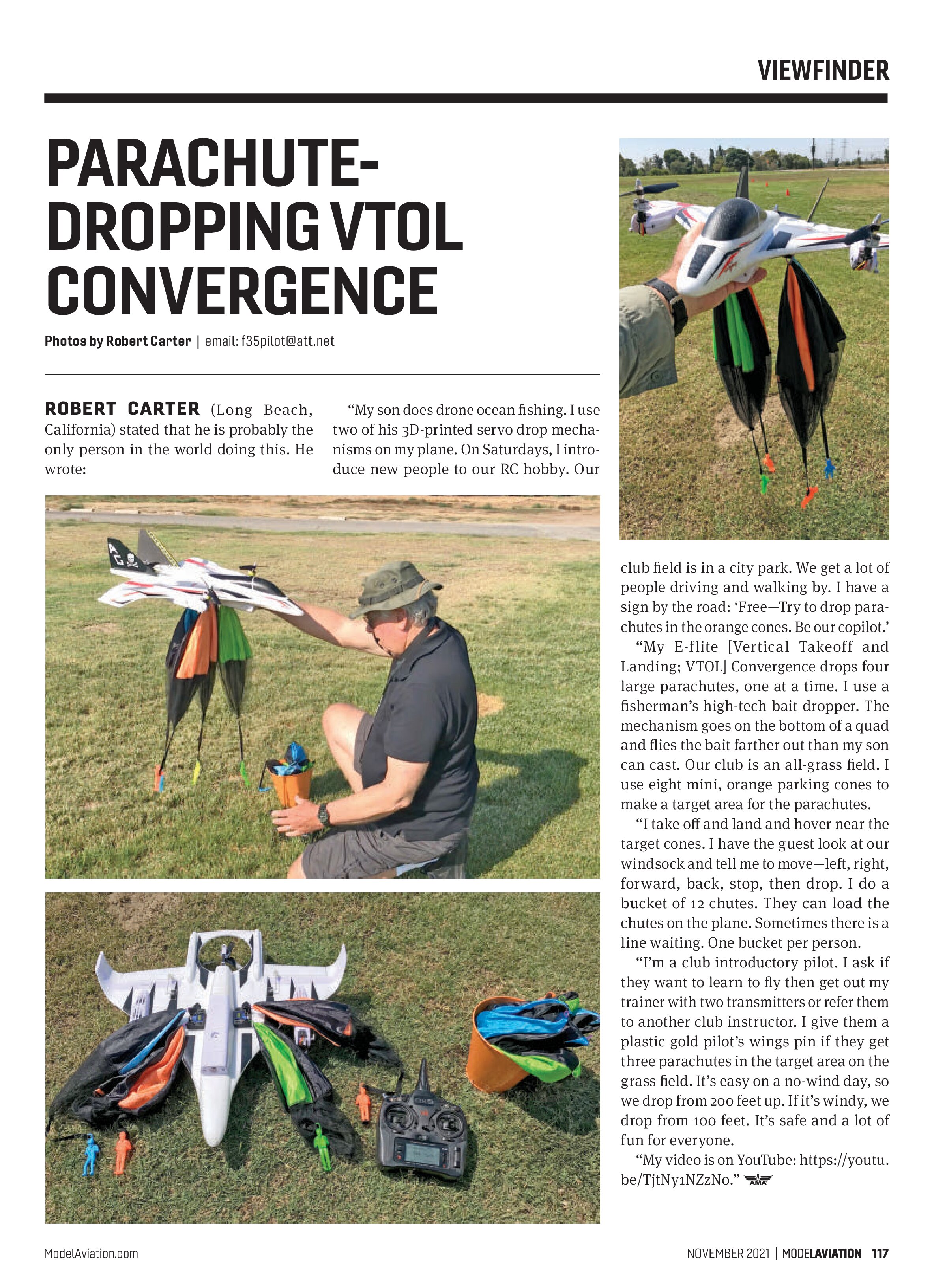
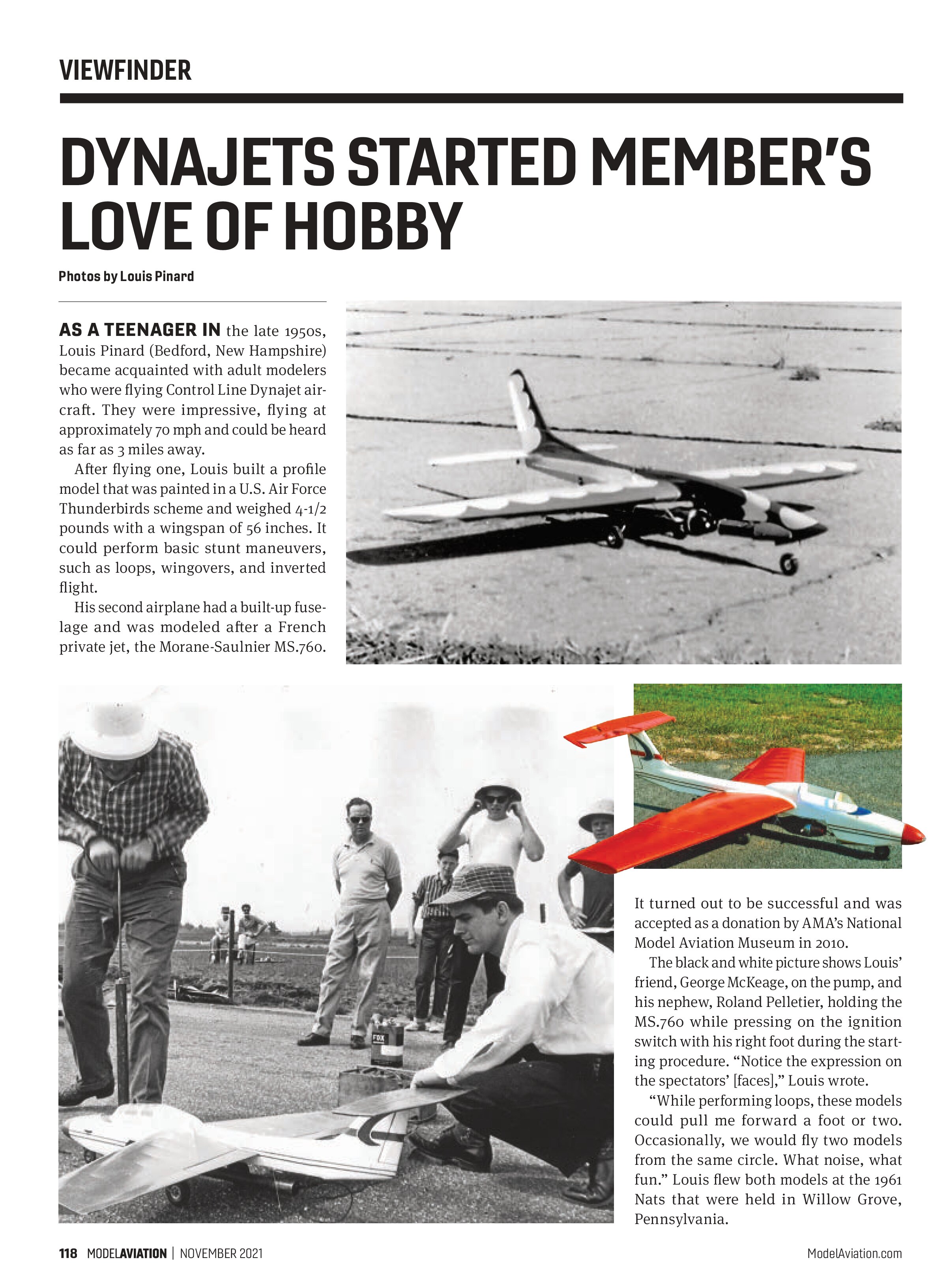
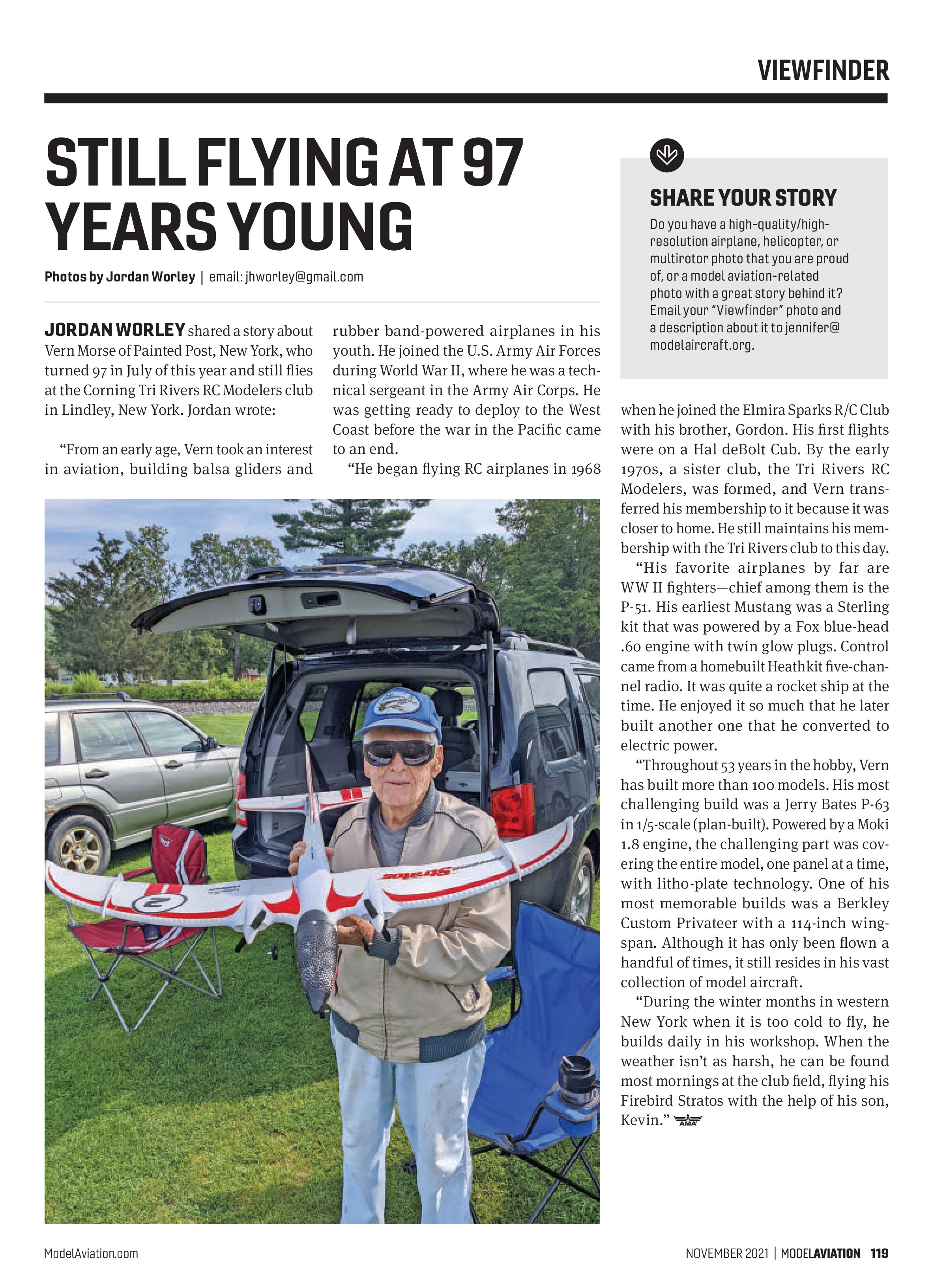
“My E-flite [Vertical Takeoff and Landing; VTOL] Convergence drops four large parachutes, one at a time. I use a fisherman’s high-tech bait dropper. The mechanism goes on the bottom of a quad and flies the bait farther out than my son can cast. Our club is an all-grass field. I use eight mini, orange parking cones to make a target area for the parachutes.
“I take off and land and hover near the target cones. I have the guest look at our windsock and tell me to move—left, right, forward, back, stop, then drop. I do a bucket of 12 chutes. They can load the chutes on the plane. Sometimes there is a line waiting. One bucket per person.
“I’m a club introductory pilot. I ask if they want to learn to fly then get out my trainer with two transmitters or refer them to another club instructor. I give them a plastic gold pilot’s wings pin if they get three parachutes in the target area on the grass field. It’s easy on a no-wind day, so we drop from 200 feet up. If it’s windy, we drop from 100 feet. It’s safe and a lot of fun for everyone.
“My video is on YouTube: https://youtu.be/TjtNy1NZzNo.”
DYNAJETS STARTED MEMBER’S LOVE OF HOBBY
Photos by Louis Pinard
AS A TEENAGER IN the late 1950s, Louis Pinard (Bedford, New Hampshire) became acquainted with adult modelers who were flying Control Line Dynajet aircraft. They were impressive, flying at approximately 70 mph and could be heard as far as 3 miles away.
After flying one, Louis built a profile model that was painted in a U.S. Air Force Thunderbirds scheme and weighed 4-1/2 pounds with a wingspan of 56 inches. It could perform basic stunt maneuvers, such as loops, wingovers, and inverted flight.
His second airplane had a built-up fuselage and was modeled after a French private jet, the Morane-Saulnier MS.760.


It turned out to be successful and was accepted as a donation by AMA’s National Model Aviation Museum in 2010.
The black and white picture shows Louis’ friend, George McKeage, on the pump, and his nephew, Roland Pelletier, holding the MS.760 while pressing on the ignition switch with his right foot during the starting procedure. “Notice the expression on the spectators’ faces,” Louis wrote.
“While performing loops, these models could pull me forward a foot or two. Occasionally, we would fly two models from the same circle. What noise, what fun.” Louis flew both models at the 1961 Nats that were held in Willow Grove, Pennsylvania.
STILL FLYING AT 97 YEARS YOUNG
Photos by Jordan Worley | email: jhworley@gmail.com
JORDAN WORLEY shared a story about Vern Morse of Painted Post, New York, who turned 97 in July of this year and still flies at the Corning Tri Rivers RC Modelers club in Lindley, New York. Jordan wrote:
“From an early age, Vern took an interest in aviation, building balsa gliders and rubber band-powered airplanes in his youth. He joined the U.S. Army Air Forces during World War II, where he was a technical sergeant in the Army Air Corps. He was getting ready to deploy to the West Coast before the war in the Pacific came to an end.
“He began flying RC airplanes in 1968 when he joined the Elmira Sparks R/C Club with his brother, Gordon. His first flights were on a Hal deBolt Cub. By the early 1970s, a sister club, the Tri Rivers RC Modelers, was formed, and Vern transferred his membership to it because it was closer to home. He still maintains his membership with the Tri Rivers club to this day.

“His favorite airplanes by far are WW II fighters—chief among them is the P-51. His earliest Mustang was a Sterling kit that was powered by a Fox blue-head .60 engine with twin glow plugs. Control came from a homebuilt Heathkit five-channel radio. It was quite a rocket ship at the time. He enjoyed it so much that he later built another one that he converted to electric power.
“Throughout 53 years in the hobby, Vern has built more than 100 models. His most challenging build was a Jerry Bates P-63 in 1/5-scale (plan-built). Powered by a Moki 1.8 engine, the challenging part was covering the entire model, one panel at a time, with litho-plate technology. One of his most memorable builds was a Berkley Custom Privateer with a 114-inch wingspan. Although it has only been flown a handful of times, it still resides in his vast collection of model aircraft.
“During the winter months in western New York when it is too cold to fly, he builds daily in his workshop. When the weather isn’t as harsh, he can be found most mornings at the club field, flying his Firebird Stratos with the help of his son, Kevin.”