Safety Comes First

YOUR CLUB'S
SAFETY
CULTURE
By Dave Gee | safetycolumn@cs.com
INDUSTRIAL SAFETY PROFESSIONALS sometimes talk about the “safety culture” of a given organization or workplace. It’s shorthand for “how we do things around here.” The employees might feel strongly about making sure everyone uses eye protection, or perhaps they all tend to ignore certain rules. A good safety culture makes workers feel comfortable with reminding a comrade about a dangerous oversight.
This is relevant to our flying sites. A given field’s safety culture might include friendly pilots who look out for each other, or maybe the mood is more tense and people are reluctant to say something if they see a hazardous situation. You’ll find safety cultures in many areas of life—not just aeromodeling.
Balcony Baby
I recently found myself in a safety culture dilemma at a wedding dinner, of all places.
A happy group of new in-laws was in a banquet room that overlooked a lower floor. A young woman with a baby walked over to the balcony, and then, to my horror, she stood right against the railing with the child over the edge. She was holding the infant close to her body, but it was a foolish and dangerous act.
What was I to do? Shouting at her and rushing over to prevent a disaster seemed appropriate, but I realized that direct confrontation might make things worse. The mother might react in unexpected ways, possibly having enjoyed too much champagne. Doing nothing was not an option.
I decided to act in a subtly casual manner. I tried to sound disappointed as I very loudly said, “Oh, please don’t do that.” The woman responded with, “It’s okay, I’ve got her.” Then I said, “That’s what Michael Jackson said, but remember how bad the magazine photos made him look?” By this time, many other guests had chimed in, and the woman stepped back from the railing, still protesting that there was nothing to worry about because she had a firm grip on the baby. Whew!
This sort of dilemma pops up at RC flying fields sometimes, but usually with model aircraft instead of babies. You might see a pilot skipping an important step or making a worrisome mistake. You’ll need to decide whether it’s worth saying something, and if so, what approach to use. The situation might call for a light, witty comment, quiet diplomatic advice, or a shouted warning. These choices are not always easy, but I think that hurt feelings are better than hurt people.
Knuckle Dragging
Tom Nied is a savvy pilot. He caught himself in a close call before things got serious, and then decided to share the information with everyone else so that they could learn from his incident. He wrote:
“I recently had a safety issue while adjusting a needle valve from behind the spinning propeller of a Magnum .46 [engine]. I was trying to get just one more click and heard/felt a buzzing sound. Too close! The middle joint of my forefinger was actually touching the backside of the spinning propeller. Fortunately, there were no cuts or abrasions, but don’t let your guard down, even though you’ve started engines a million times.”
No Preflight but Lots of Distractions
Bill Kuhl posted this story online. It is edited for brevity, losing some of the colorful characters, but keeping the safety lessons intact:
“Spring finally brought a chance to fly my floatplane from water again instead of an ice runway. After a good flight and some loops and rolls, I put it back onto the water but rather far away.
“I tried to taxi in and could not control it. The airplane just swam in circles. It went into some lily pads, so perhaps weeds were attached to the water rudder and that was the problem. I got the kayak off of my truck but then noticed that ‘Mike the Pike Hunter’ was already in his boat retrieving the model for me. There are some good people in the world!
“We had a great time talking, but that distracted me from attaching my kayak properly to the roof rack. After driving a short distance, the kayak slid over to the other side. The front strap was completely missing! I went back and found it in the street.
“Back in the shop, I discovered that the problem with the airplane was that last


winter, I had replaced the rudder servo with a different one after stripping out the gears. In the winter, the water rudder is removed, so I had not noticed that it had moved opposite the airplane rudder. No wonder I could not control it. A preflight inspection of the airplane and of my vehicle would have saved lots of trouble!”
I think that “Mike the Pike Hunter,” retriever of stranded seaplanes, is my kind of guy.
RTP for Me and Thee
Round-the-Pole (RTP) tethered flying has been around forever, but it really became popular during World War II in places where outdoor flying was restricted. Rubber or electric power works great in small spaces,
and the tether string keeps the airplanes safely on course.
RTP flying is easy and forgiving. This makes it perfect for newcomers with beginner-style models and can provide practical safety training for larger, more powerful types. RTP teaches propeller safety and flightline/pit procedures. Just learning how to handle a model without breaking it or hurting yourself puts a pilot on the right path to bigger airplanes and helicopters.
Will’s TetherHawk RTP
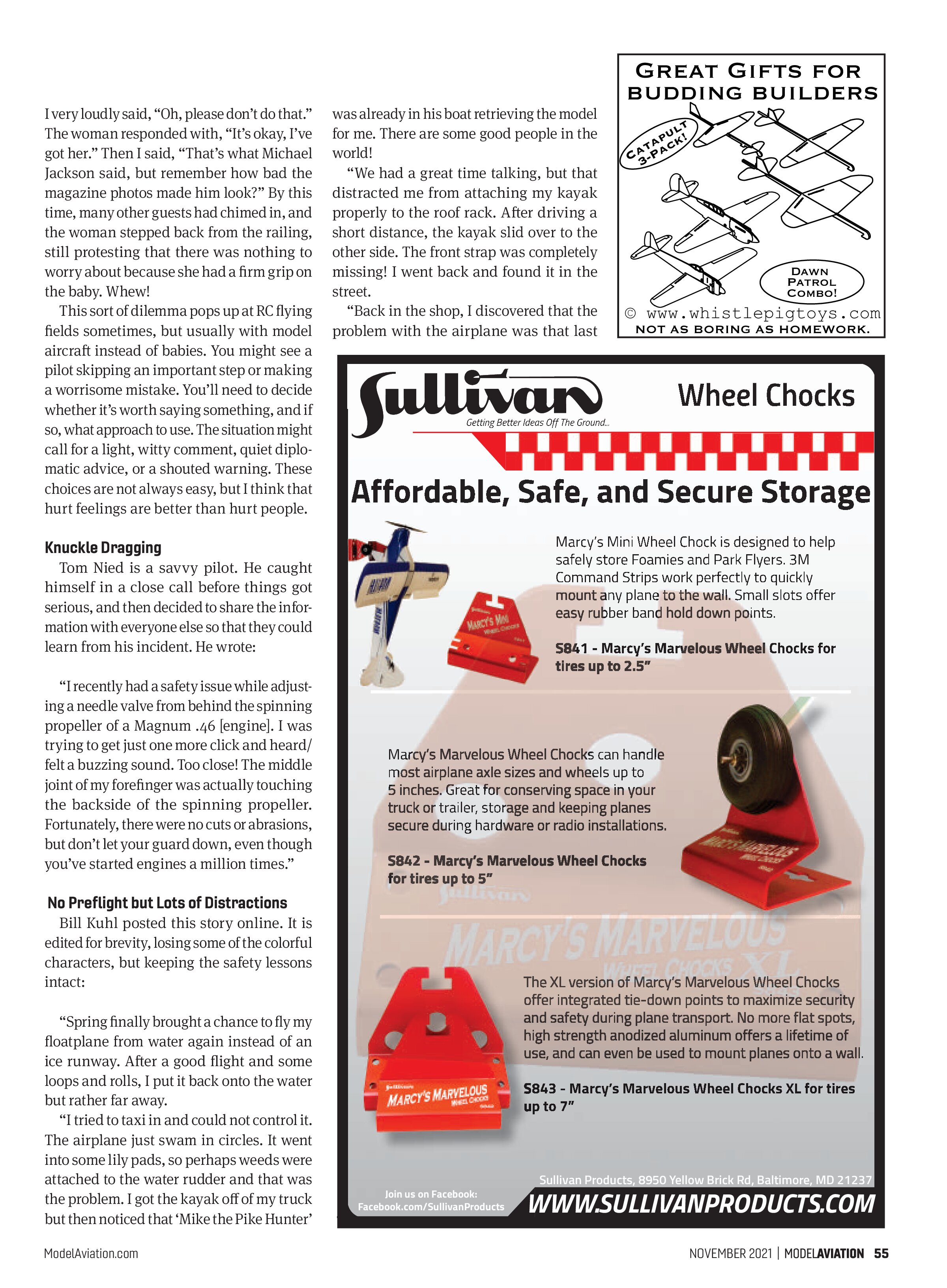
The prize for taking a guess at the mystery airplane is a digital set of plans for Will Woods’ TetherHawk. Will arranged a model aviation class at his assisted-living facility, and the TetherHawk was designed to be built by residents and flown in their limited air-space. Although the TetherHawk is optimized for short-tether RTP, it also performs well outdoors as a Free Flight (FF) aircraft.
You can use the hardware and balsa from a Guillows’ JetStream kit or upgrade to a high-performance propeller assembly and really burn up that circle. I helped a group of eager senior citizens build Will’s TetherHawk models. What excitement they showed when the test flights began! Check out the video listed in “Sources.”
Mystery Airplane
To get TetherHawk plans, simply take a guess as to the identity of this month’s mystery airplane. Send an email to my address at the beginning of the column.
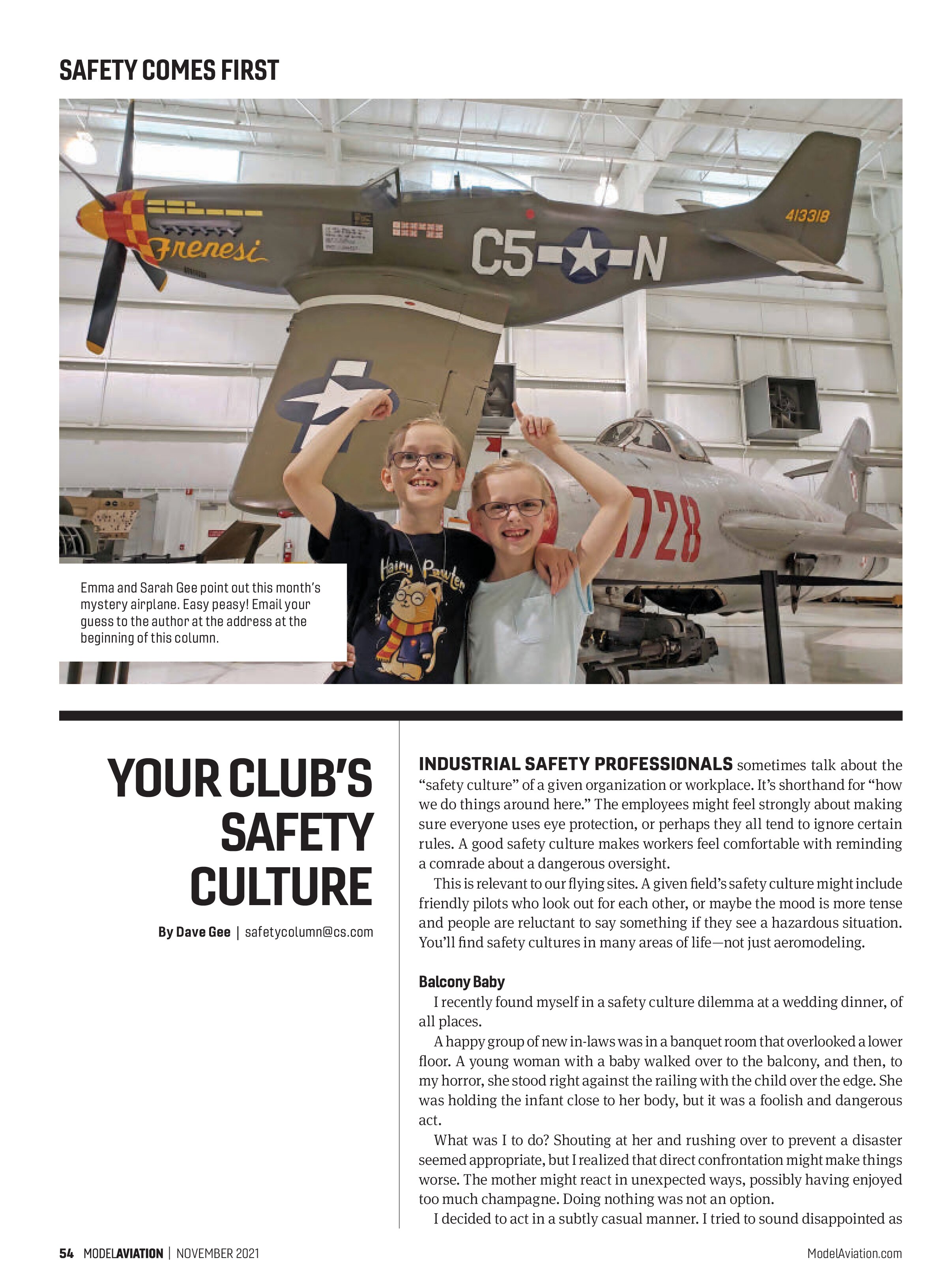
Could this famous aircraft be the easiest one so far? My nieces, Sarah and Emma Gee, pointed out that it is painted to represent the combat aircraft of ace pilot Lt. Col. Thomas L. Hayes Jr. You can see this fighter at the highly recommended Tennessee Museum of Aviation, which has a bunch of other swell airplanes on display as well.
SOURCES:
Will Woods’ TetherHawk in flight
https://youtu.be/N0OEVdZCZL0
Guillow’s
(781) 245-5255
www.guillows.com
Tennessee Museum of Aviation
(866) 286-8738
www.tnairmuseum.com