MICRO-FLYING
MICRO ROTATING RETRACTS
By Joe Malinchak | joemal@echoes.net

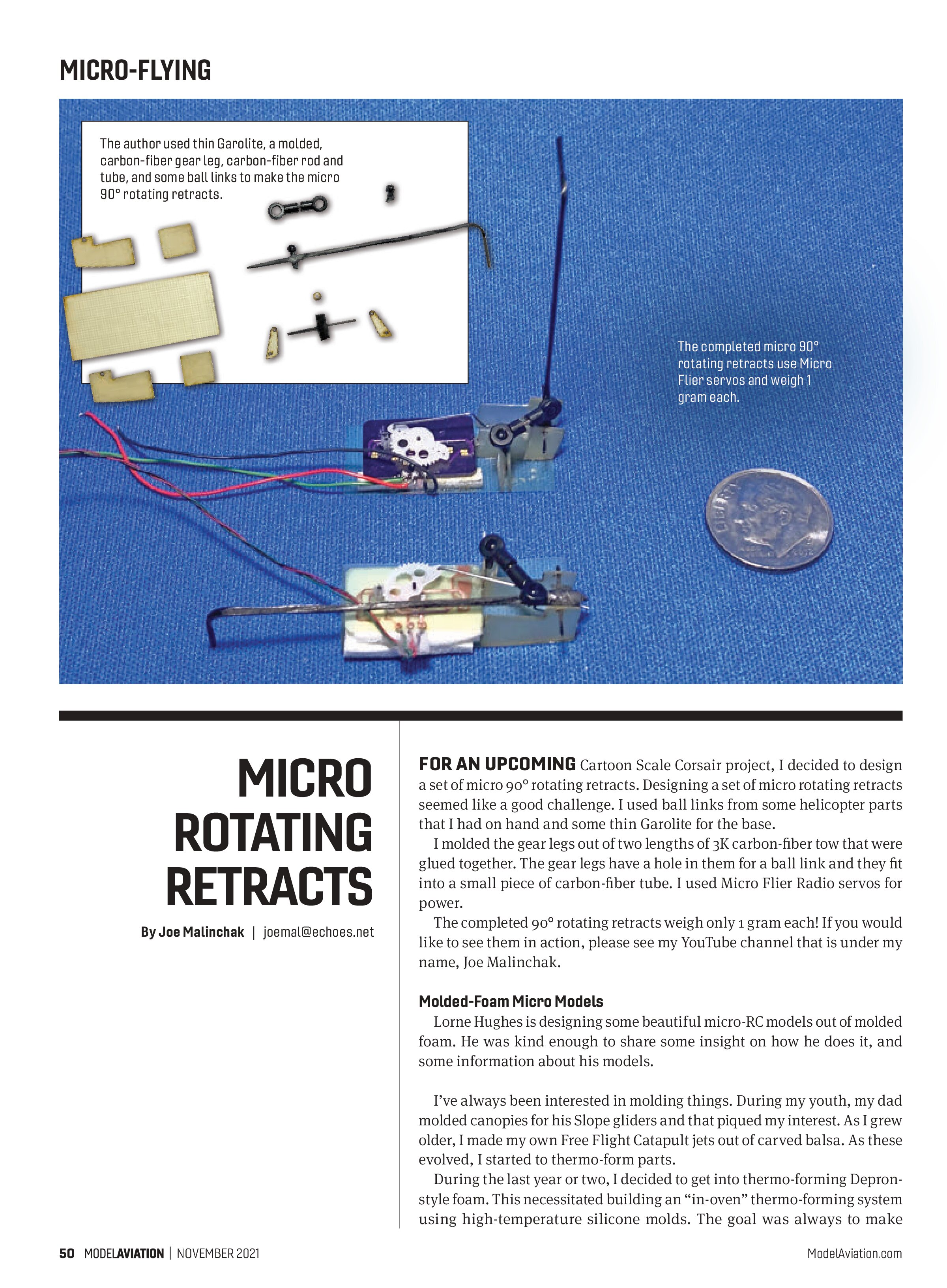
FOR AN UPCOMING Cartoon Scale Corsair project, I decided to design a set of micro 90° rotating retracts. Designing a set of micro rotating retracts seemed like a good challenge. I used ball links from some helicopter parts that I had on hand and some thin Garolite for the base.
I molded the gear legs out of two lengths of 3K carbon-fiber tow that were glued together. The gear legs have a hole in them for a ball link and they fit into a small piece of carbon-fiber tube. I used Micro Flier Radio servos for power.
The completed 90° rotating retracts weigh only 1 gram each! If you would like to see them in action, please see my YouTube channel that is under my name, Joe Malinchak.
Molded-Foam Micro Models
Lorne Hughes is designing some beautiful micro-RC models out of molded foam. He was kind enough to share some insight on how he does it, and some information about his models.
I’ve always been interested in molding things. During my youth, my dad molded canopies for his Slope gliders and that piqued my interest. As I grew older, I made my own Free Flight Catapult jets out of carved balsa. As these evolved, I started to thermo-form parts.
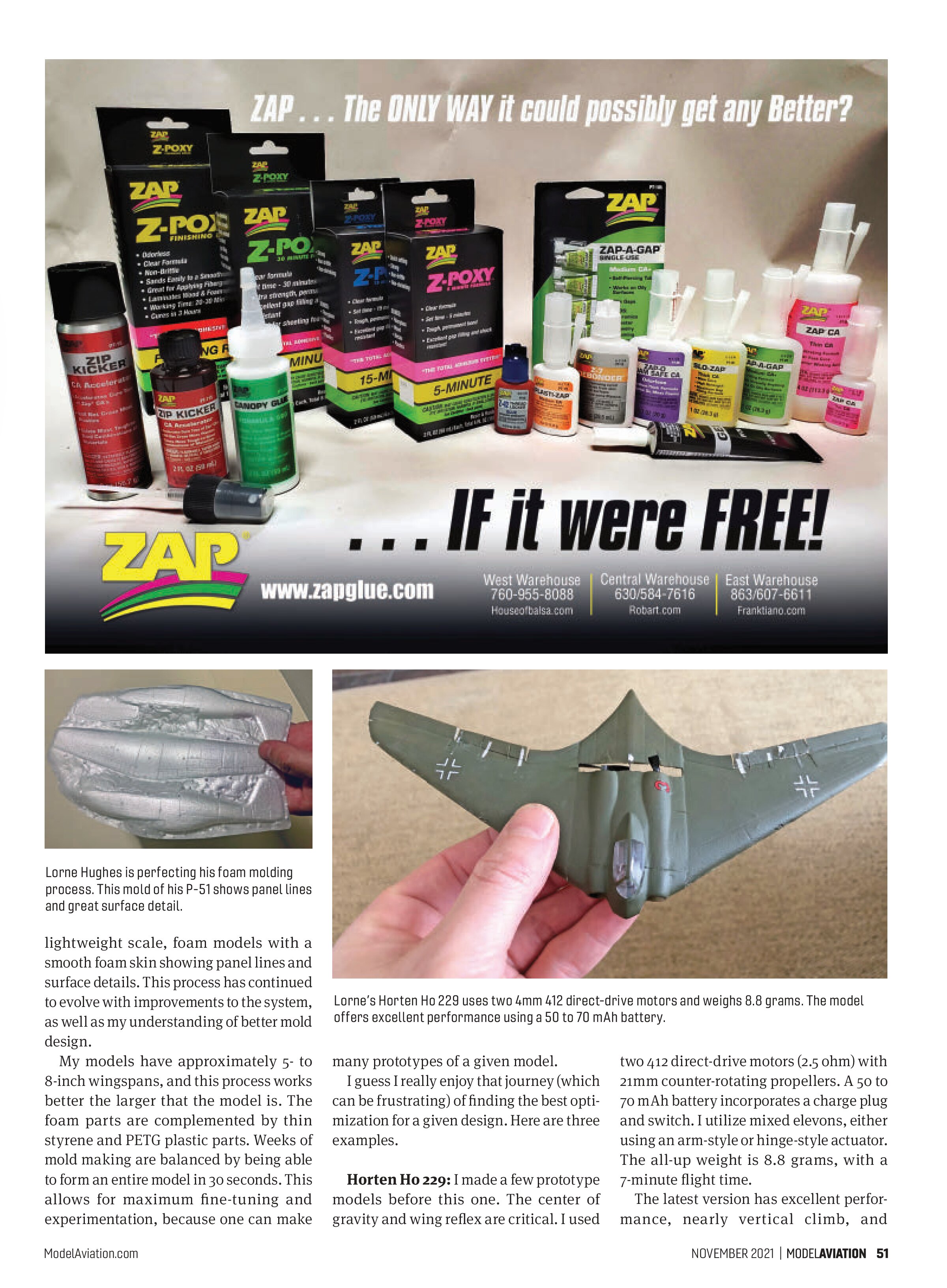
During the last year or two, I decided to get into thermo-forming Depron-style foam. This necessitated building an “in-oven” thermo-forming system using high-temperature silicone molds. The goal was always to make lightweight scale, foam models with a smooth foam skin showing panel lines and surface details. This process has continued to evolve with improvements to the system, as well as my understanding of better mold design.

My models have approximately 5- to 8-inch wingspans, and this process works better the larger that the model is. The foam parts are complemented by thin styrene and PETG plastic parts. Weeks of mold making are balanced by being able to form an entire model in 30 seconds. This allows for maximum fine-tuning and experimentation, because one can make many prototypes of a given model.

I guess I really enjoy that journey (which can be frustrating) of finding the best optimization for a given design. Here are three examples.
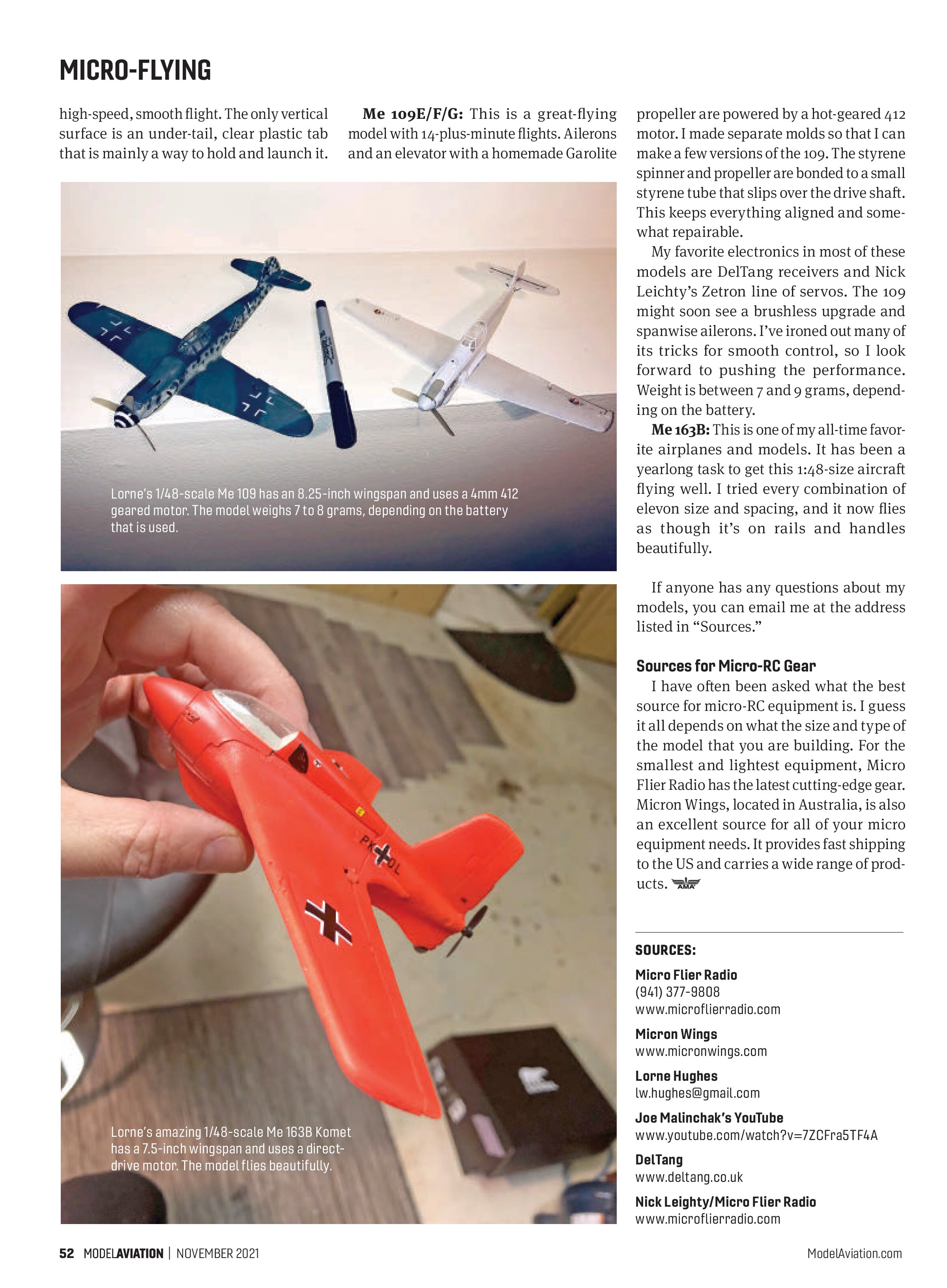
Horten Ho 229: I made a few prototype models before this one. The center of gravity and wing reflex are critical. I used two 412 direct-drive motors (2.5 ohm) with 21mm counter-rotating propellers. A 50 to 70 mAh battery incorporates a charge plug and switch. I utilize mixed elevons, either using an arm-style or hinge-style actuator. The all-up weight is 8.8 grams, with a 7-minute flight time.
The latest version has excellent performance, nearly vertical climb, and
high-speed, smooth flight. The only vertical surface is an under-tail, clear plastic tab that is mainly a way to hold and launch it.


Me 109E/F/G: This is a great-flying model with 14-plus-minute flights. Ailerons and an elevator with a homemade Garolite propeller are powered by a hot-geared 412 motor. I made separate molds so that I can make a few versions of the 109. The styrene spinner and propeller are bonded to a small styrene tube that slips over the drive shaft. This keeps everything aligned and somewhat repairable.
My favorite electronics in most of these models are DelTang receivers and Nick Leichty’s Zetron line of servos. The 109 might soon see a brushless upgrade and spanwise ailerons. I’ve ironed out many of its tricks for smooth control, so I look forward to pushing the performance. Weight is between 7 and 9 grams, depending on the battery.
Me 163B: This is one of my all-time favorite airplanes and models. It has been a yearlong task to get this 1:48-size aircraft flying well. I tried every combination of elevon size and spacing, and it now flies as though it’s on rails and handles beautifully.
If anyone has any questions about my models, you can email me at the address listed in “Sources.”
Sources for Micro-RC Gear
I have often been asked what the best source for micro-RC equipment is. I guess it all depends on what the size and type of the model that you are building. For the smallest and lightest equipment, Micro Flier Radio has the latest cutting-edge gear. Micron Wings, located in Australia, is also an excellent source for all of your micro equipment needs. It provides fast shipping to the US and carries a wide range of products.
SOURCES:
Micro Flier Radio
(941) 377-9808
www.microflierradio.com
Micron Wings
www.micronwings.com
Lorne Hughes
lw.hughes@gmail.com
Joe Malinchak’s YouTube
www.youtube.com/watch?v=7ZCFra5TF4A
DelTang
www.deltang.co.uk
Nick Leighty/Micro Flier Radio
www.microflierradio.com