Focal Point
Interested in sharing your handiwork? Visit www.ModelAviation.com for submission guidelines.
Mega Storm Launcher

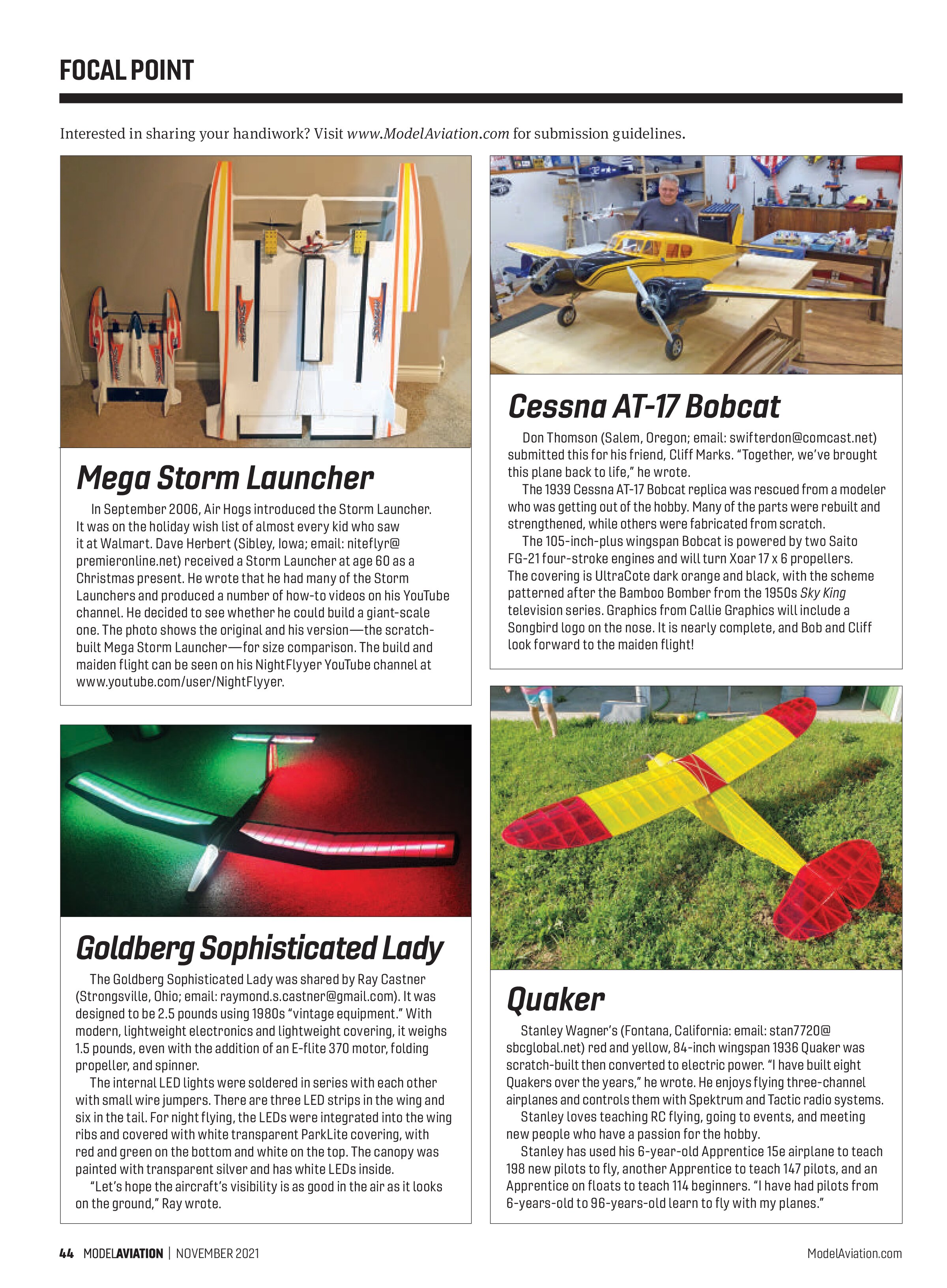
In September 2006, Air Hogs introduced the Storm Launcher. It was on the holiday wish list of almost every kid who saw it at Walmart. Dave Herbert (Sibley, Iowa; email: nitefly@premieronline.net) received a Storm Launcher at age 60 as a Christmas present. He wrote that he had many of the Storm Launchers and produced a number of how-to videos on his YouTube channel. He decided to see whether he could build a giant-scale one. The photo shows the original and his version—the scratch-built Mega Storm Launcher—for size comparison. The build and maiden flight can be seen on his NightFlyer YouTube channel at www.youtube.com/user/NightFlyer.
Goldberg Sophisticated Lady

The Goldberg Sophisticated Lady was shared by Ray Castner (Strongsville, Ohio; email: raymond.s.castner@gmail.com). It was designed to be 2.5 pounds using 1980s “vintage equipment.” With modern, lightweight electronics and lightweight covering, it weighs 1.5 pounds, even with the addition of an E-flite 370 motor, folding propeller, and spinner.
The internal LED lights were soldered in series with each other with small wire jumpers. There are three LED strips in the wing and six in the tail. For night flying, the LEDs were integrated into the wing ribs and covered with white transparent ParkLite covering, with red and green on the bottom and white on the top. The canopy was painted with transparent silver and has white LEDs inside.
“Let’s hope the aircraft’s visibility is as good in the air as it looks on the ground,” Ray wrote.
Cessna AT-17 Bobcat

Don Thomson (Salem, Oregon; email: swifterdon@comcast.net) submitted this for his friend, Cliff Marks. “Together, we’ve brought this plane back to life,” he wrote.
The 1939 Cessna AT-17 Bobcat replica was rescued from a modeler who was getting out of the hobby. Many of the parts were rebuilt and strengthened, while others were fabricated from scratch.
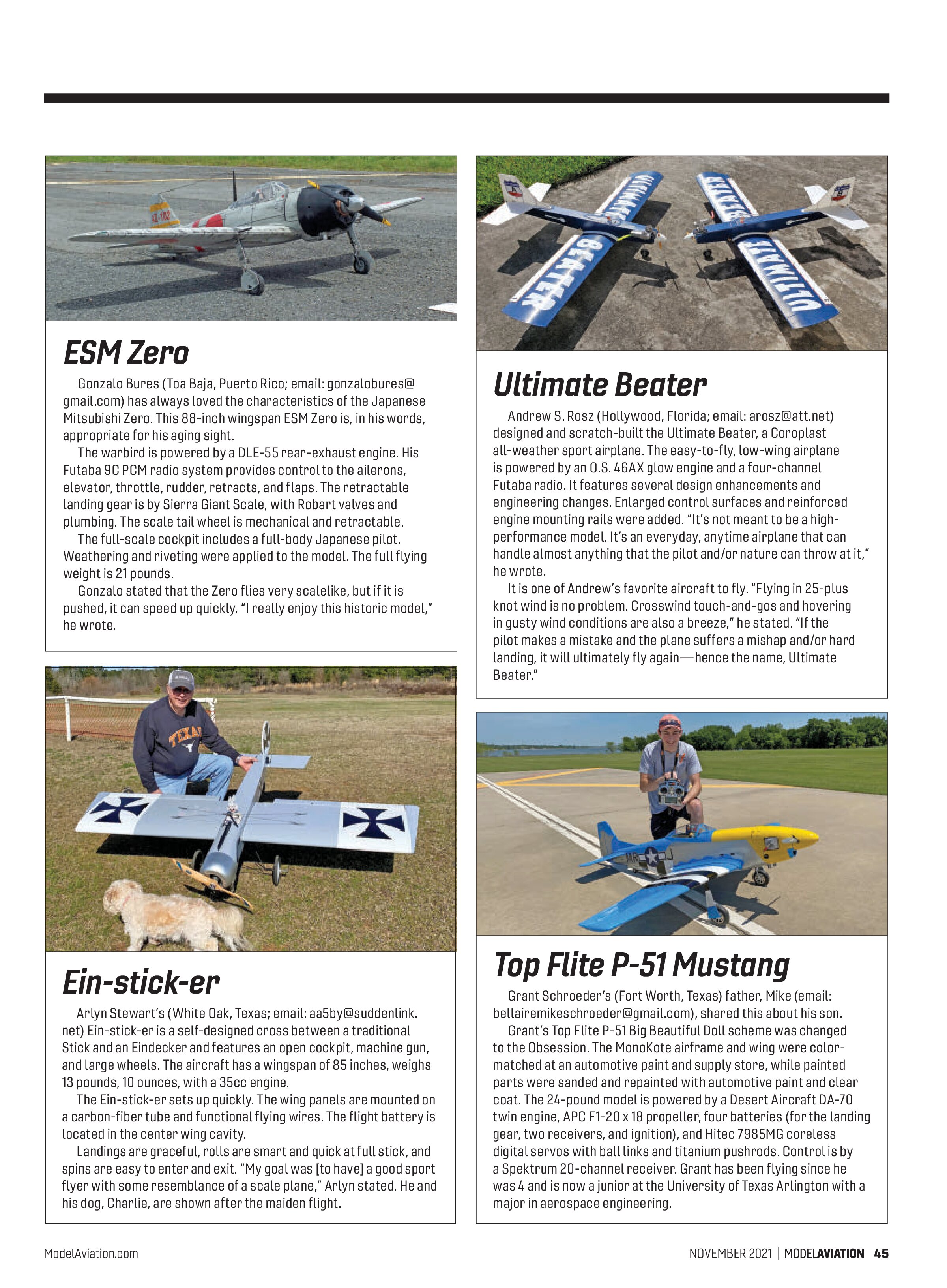
The 105-inch-plus wingspan Bobcat is powered by two Saito FG-21 four-stroke engines and will turn Xoar 17 x 6 propellers. The covering is UltraCote dark orange and black, with the scheme patterned after the Bamboo Bomber from the 1950s Sky King television series. Graphics from Callie Graphics will include a Songbird logo on the nose. It is nearly complete, and Bob and Cliff look forward to the maiden flight!
Quaker

Stanley Wagner’s (Fontana, California; email: stan/720@sbcglobal.net) red and yellow, 84-inch wingspan 1936 Quaker was scratch-built then converted to electric power. “I have built eight Quakers over the years,” he wrote. He enjoys flying three-channel airplanes and controls them with Spektrum and Tactic radio systems.
Stanley loves teaching RC flying, going to events, and meeting new people who have a passion for the hobby.
Stanley has used his 6-year-old Apprentice 15e airplane to teach 198 new pilots to fly, another Apprentice to teach 147 pilots, and an Apprentice on floats to teach 114 beginners. “I have had pilots from 6-years-old to 96-years-old learn to fly with my planes.”
ESM Zero

Gonzalo Bures (Tua Baja, Puerto Rico; email: gonzalobures@gmail.com) has always loved the characteristics of the Japanese Mitsubishi Zero. This 88-inch wingspan ESM Zero is, in his words, appropriate for his aging sight.
The warbird is powered by a DLE-55 rear-exhaust engine. His Futaba 9C PCM radio system provides control to the ailerons, elevator, throttle, rudder, retracts, and flaps. The retractable landing gear is by Sierra Giant Scale, with Robart valves and plumbing. The scale tail wheel is mechanical and retractable.
The full-scale cockpit includes a full-body Japanese pilot. Weathering and riveting were applied to the model. The full flying weight is 21 pounds.
Gonzalo stated that the Zero flies very scalelike, but if it is pushed, it can speed up quickly. “I really enjoy this historic model,” he wrote.
Ein-stick-er

Arlyn Stewart’s (White Oak, Texas; email: aa5by@suddenlink.net) Ein-stick-er is a self-designed cross between a traditional Stick and an Eindecker and features an open cockpit, machine gun, and large wheels. The aircraft has a wingspan of 85 inches, weighs 13 pounds, 10 ounces, with a 35cc engine.
The Ein-stick-er sets up quickly. The wing panels are mounted on a carbon-fiber tube and functional flying wires. The flight battery is located in the center wing cavity.
Landings are graceful, rolls are smart and quick at full stick, and spins are easy to enter and exit. “My goal was [to have] a good sport flyer with some resemblance of a scale plane,” Arlyn stated. He and his dog, Charlie, are shown after the maiden flight.
Ultimate Beater

Andrew S. Rosz (Hollywood, Florida; email: arosz@att.net) designed and scratch-built the Ultimate Beater, a Coroplast all-weather sport airplane. The easy-to-fly, low-wing airplane is powered by an O.S. 46AX glow engine and a four-channel Futaba radio. It features several design enhancements and engineering changes. Enlarged control surfaces and reinforced engine mounting rails were added. “It’s not meant to be a high-performance model. It’s an everyday, anytime airplane that can handle almost anything that the pilot and/or nature can throw at it,” he wrote.
It is one of Andrew’s favorite aircraft to fly. “Flying in 25-plus knot wind is no problem. Crosswind touch-and-gos and hovering in gusty wind conditions are also a breeze,” he stated. “If the pilot makes a mistake and the plane suffers a mishap and/or hard landing, it will ultimately fly again—hence the name, Ultimate Beater.”
Top Flite P-51 Mustang

Grant Schroeder’s (Fort Worth, Texas) father, Mike (email: bellairemikeschroeder@gmail.com), shared this about his son.
Grant’s Top Flite P-51 Big Beautiful Doll scheme was changed to the Obsession. The MunoKote airframe and wing were color-matched at an automotive paint and supply store, while painted parts were sanded and repainted with automotive paint and clear coat. The 24-pound model is powered by a Desert Aircraft DA-70 twin engine, APC F1-20 x 18 propeller, four batteries (for the landing gear, two receivers, and ignition), and Hitec 7985MG coreless digital servos with ball links and titanium pushrods. Control is by a Spektrum 20-channel receiver. Grant has been flying since he was 4 and is now a junior at the University of Texas Arlington with a major in aerospace engineering.