BRINGING A PROFESSIONAL AVIATION MINDSET TO REMOTE PILOTING
By Patrick Sherman
lucidity@roswellflighttestcrew.com

EVERY HUMAN CREATION that flies now exists on a continuum, from a SpaceX rocket ferrying astronauts to the International Space Station, to a $50 RC foamie that was purchased at a local hobby shop—but it has not always been so.
Fewer than 20 years ago, when model aviation was essentially the only outlet for civilian remote pilots in the US, the hobby existed independent of the broader aviation community. The only notice given to it by the FAA was a one-page list of common-sense advice that was written two decades earlier: the original Advisory Circular 91-57.
Much has changed since then. From passing the Part 107 Airman Knowledge Test for commercial UAS operators to The Recreational UAS Safety Test (TRUST), the recently inaugurated test for recreational pilots, training and certification are now a requirement at every level. These steps are necessary but insufficient. Would you willingly take a seat on a 737 that was being flown by someone who had passed the Airline Transport Pilot exam 5 minutes earlier? Of course not because real-world proficiency requires much more than passing a test.
The industry and the hobby are changing—and changing means more than knowing and following the latest rules. It means learning from our colleagues in the full-scale aviation community who, for many decades, have cultivated a professional mindset centered around safety. No matter what you fly or where, there are valuable lessons to be learned from them.
That’s Heavy
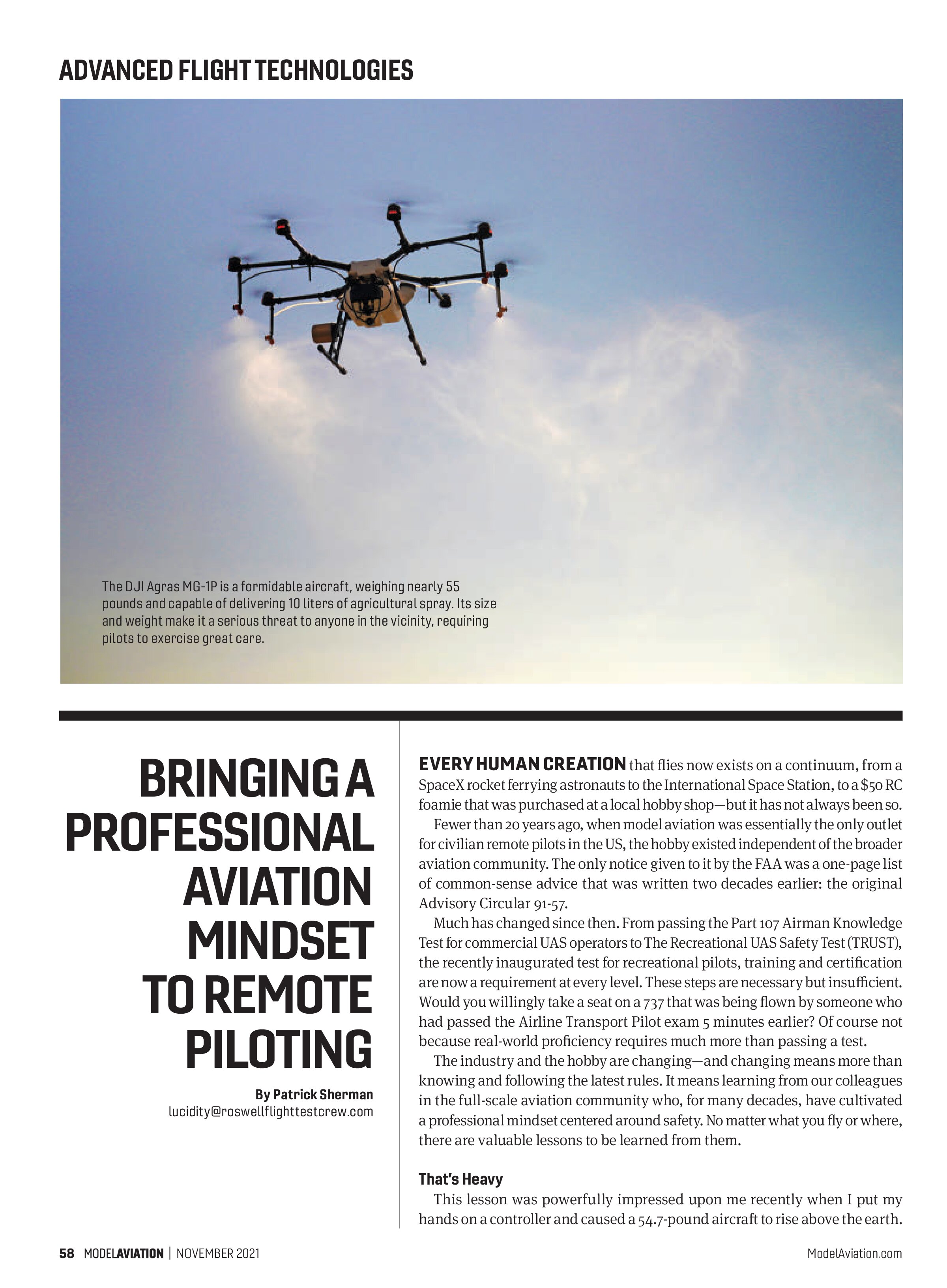
This lesson was powerfully impressed upon me recently when I put my hands on a controller and caused a 54.7-pound aircraft to rise above the earth.
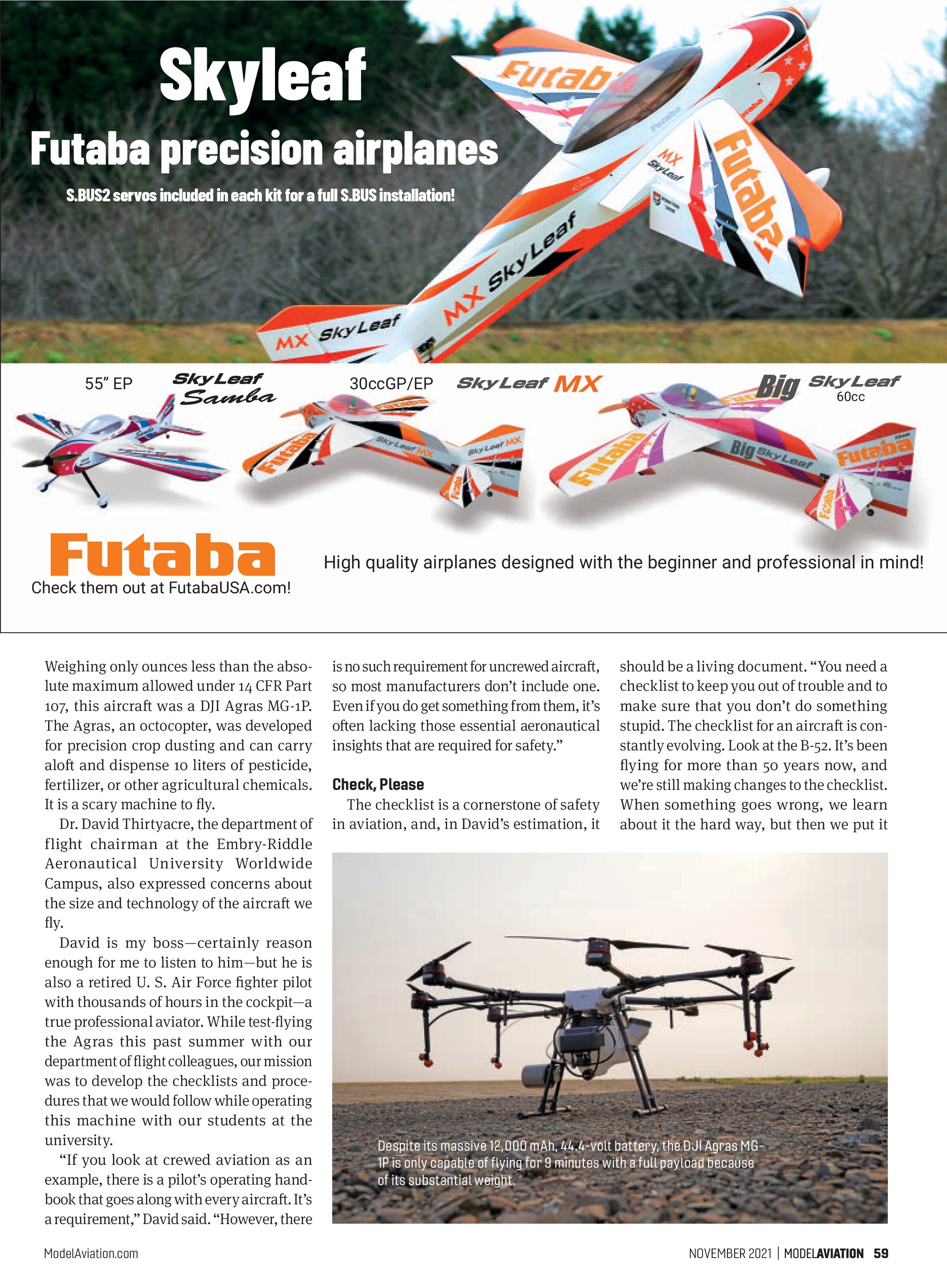
Weighing only ounces less than the absolute maximum allowed under 14 CFR Part 107, this aircraft was a DJI Agras MG-1P. The Agras, an octocopter, was developed for precision crop dusting and can carry aloft and dispense 10 liters of pesticide, fertilizer, or other agricultural chemicals. It is a scary machine to fly.
Dr. David Thirtyacre, the department of flight chairman at the Embry-Riddle Aeronautical University Worldwide Campus, also expressed concerns about the size and technology of the aircraft we fly.
David is my boss—certainly reason enough for me to listen to him—but he is also a retired U. S. Air Force fighter pilot with thousands of hours in the cockpit—a true professional aviator. While test-flying the Agras this past summer with our department of flight colleagues, our mission was to develop the checklists and procedures that we would follow while operating this machine with our students at the university.
“If you look at crewed aviation as an example, there is a pilot’s operating handbook that goes along with every aircraft. It’s a requirement,” David said. “However, there is no such requirement for uncrewed aircraft, so most manufacturers don’t include one. Even if you do get something from them, it’s often lacking those essential aeronautical insights that are required for safety.”
Check, Please
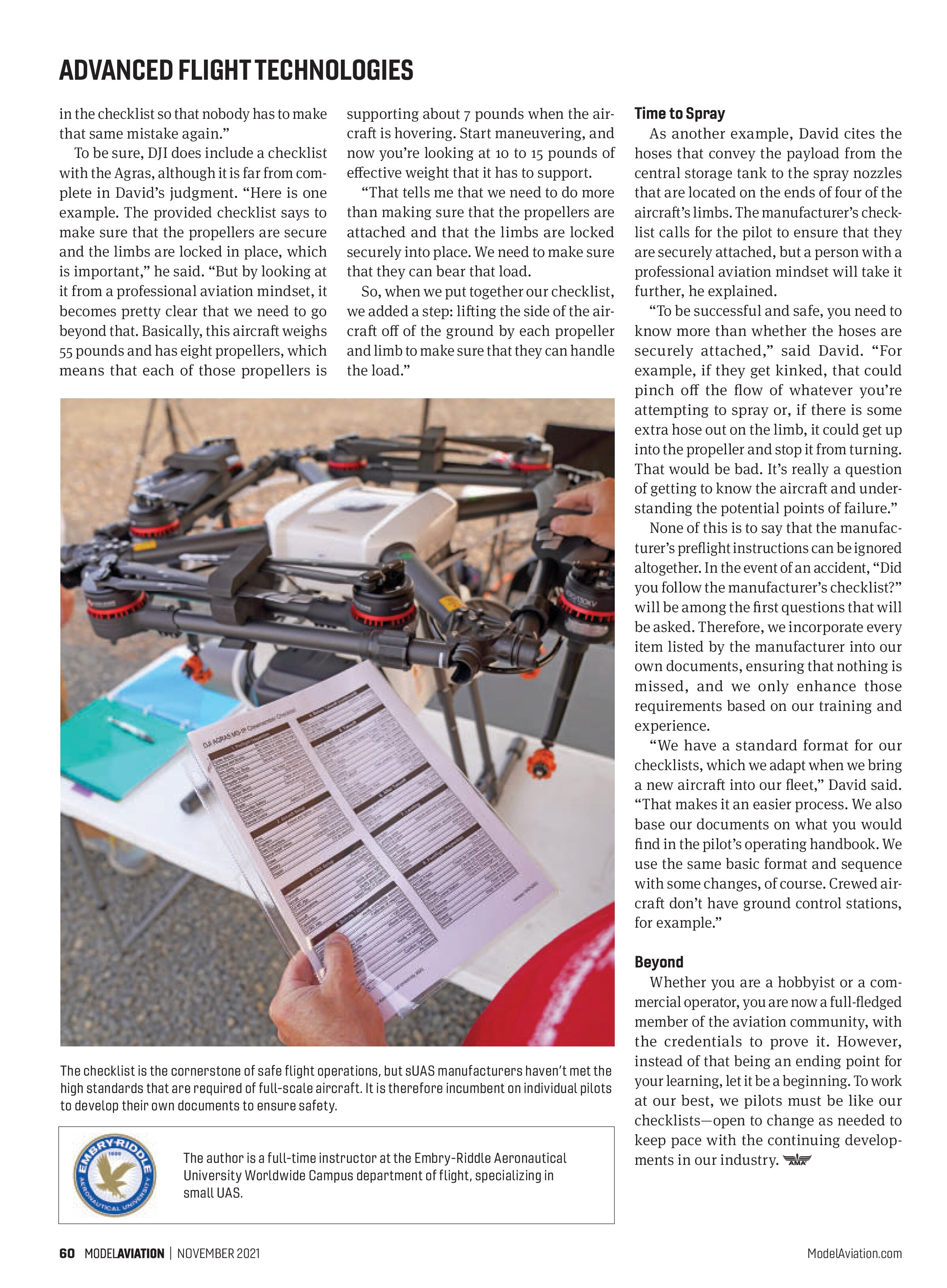
The checklist is a cornerstone of safety in aviation, and, in David’s estimation, it should be a living document.
“You need a checklist to keep you out of trouble and to make sure that you don’t do something stupid. The checklist for an aircraft is constantly evolving. Look at the B-52. It’s been flying for more than 50 years now, and we’re still making changes to the checklist. When something goes wrong, we learn about it the hard way, but then we put it

in the checklist so that nobody has to make that same mistake again.”
To be sure, DJI does include a checklist with the Agras, although it is far from complete in David’s judgment. “Here is one example. The provided checklist says to make sure that the propellers are secure and the limbs are locked in place, which is important,” he said. “But by looking at it from a professional aviation mindset, it becomes pretty clear that we need to go beyond that. Basically, this aircraft weighs 55 pounds and has eight propellers, which means that each of those propellers is
supporting about 7 pounds when the aircraft is hovering. Start maneuvering, and now you’re looking at 10 to 15 pounds of effective weight that it has to support.
“That tells me that we need to do more than making sure that the propellers are attached and that the limbs are locked securely into place. We need to make sure that they can bear that load.
So, when we put together our checklist, we added a step: lifting the side of the aircraft off of the ground by each propeller and limb to make sure that they can handle the load.”

Time to Spray
As another example, David cites the hoses that convey the payload from the central storage tank to the spray nozzles that are located on the ends of four of the aircraft’s limbs. The manufacturer’s checklist calls for the pilot to ensure that they are securely attached, but a person with a professional aviation mindset will take it further, he explained.
“To be successful and safe, you need to know more than whether the hoses are securely attached,” said David. “For example, if they get kinked, that could pinch off the flow of whatever you’re attempting to spray or, if there is some extra hose out on the limb, it could get up into the propeller and stop it from turning. That would be bad. It’s really a question of getting to know the aircraft and understanding the potential points of failure.”
None of this is to say that the manufacturer’s preflight instructions can be ignored altogether. In the event of an accident, “Did you follow the manufacturer’s checklist?” will be among the first questions that will be asked. Therefore, we incorporate every item listed by the manufacturer into our own documents, ensuring that nothing is missed, and we only enhance those requirements based on our training and experience.
“We have a standard format for our checklists, which we adapt when we bring a new aircraft into our fleet,” David said. “That makes it an easier process. We also base our documents on what you would find in the pilot’s operating handbook. We use the same basic format and sequence with some changes, of course. Crewed aircraft don’t have ground control stations, for example.”
Beyond
Whether you are a hobbyist or a commercial operator, you are now a full-fledged member of the aviation community, with the credentials to prove it. However, instead of that being an ending point for your learning, let it be a beginning. To work at our best, we pilots must be like our checklists—open to change as needed to keep pace with the continuing developments in our industry.