ONE OF THE GOOD GUYS
Photos by Joe Hass | joehass@gmail.com

JOHN HOOVER IS a quintessential modeler who was taught by his father the joys of aviation, according to Joe Hass, who submitted this “Viewfinder.” John continues a 40-year passionate and creative involvement in aeromodeling to this day. His designs first appeared in Model Aviation in October 1990.
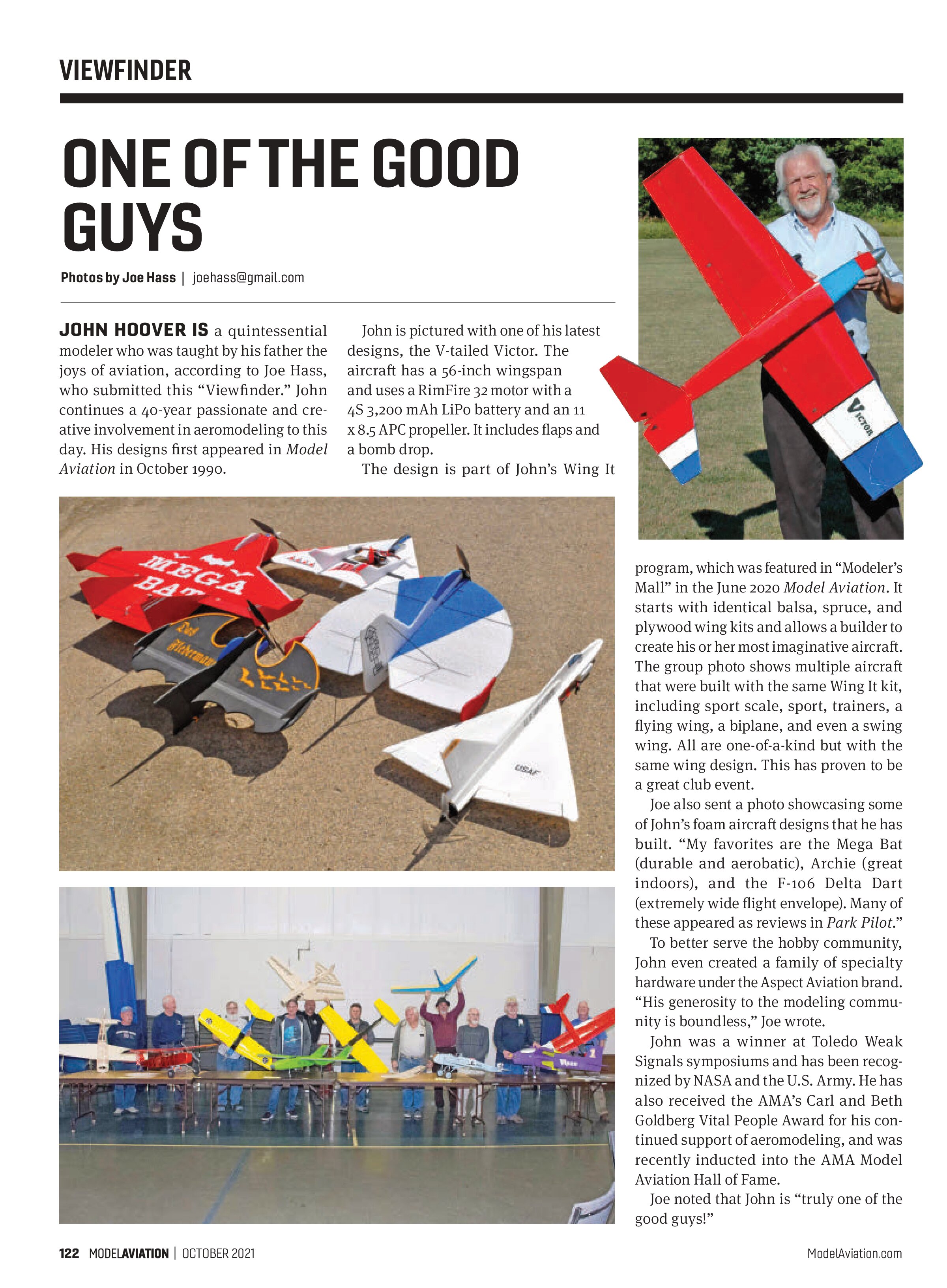
John is pictured with one of his latest designs, the V-tailed Victor. The aircraft has a 56-inch wingspan and uses a RimFire 32 motor with a 4S 3,200 mAh LiPo battery and an 11 x 8.5 APC propeller. It includes flaps and a bomb drop. The design is part of John’s Wing It program, which was featured in “Modeler’s Mall” in the June 2020 Model Aviation. It starts with identical balsa, spruce, and plywood wing kits and allows a builder to create his or her most imaginative aircraft. The group photo shows multiple aircraft that were built with the same Wing It kit, including sport scale, sport, trainers, a flying wing, a biplane, and even a swing wing. All are one-of-a-kind but with the same wing design. This has proven to be a great club event.


Joe also sent a photo showcasing some of John’s foam aircraft designs that he has built. “My favorites are the Mega Bat (durable and aerobatic), Archie (great indoors), and the F-106 Delta Dart (extremely wide flight envelope). Many of these appeared as reviews in Park Pilot.”
To better serve the hobby community, John even created a family of specialty hardware under the Aspect Aviation brand. “His generosity to the modeling community is boundless,” Joe wrote.
John was a winner at Toledo Weak Signals symposiums and has been recognized by NASA and the U.S. Army. He has also received the AMA’s Carl and Beth Goldberg Vital People Award for his continued support of aeromodeling, and was recently inducted into the AMA Model Aviation Hall of Fame.
Joe noted that John is “truly one of the good guys!”
EV2
Photo by Greg Hladky | hlad247@gmail.com
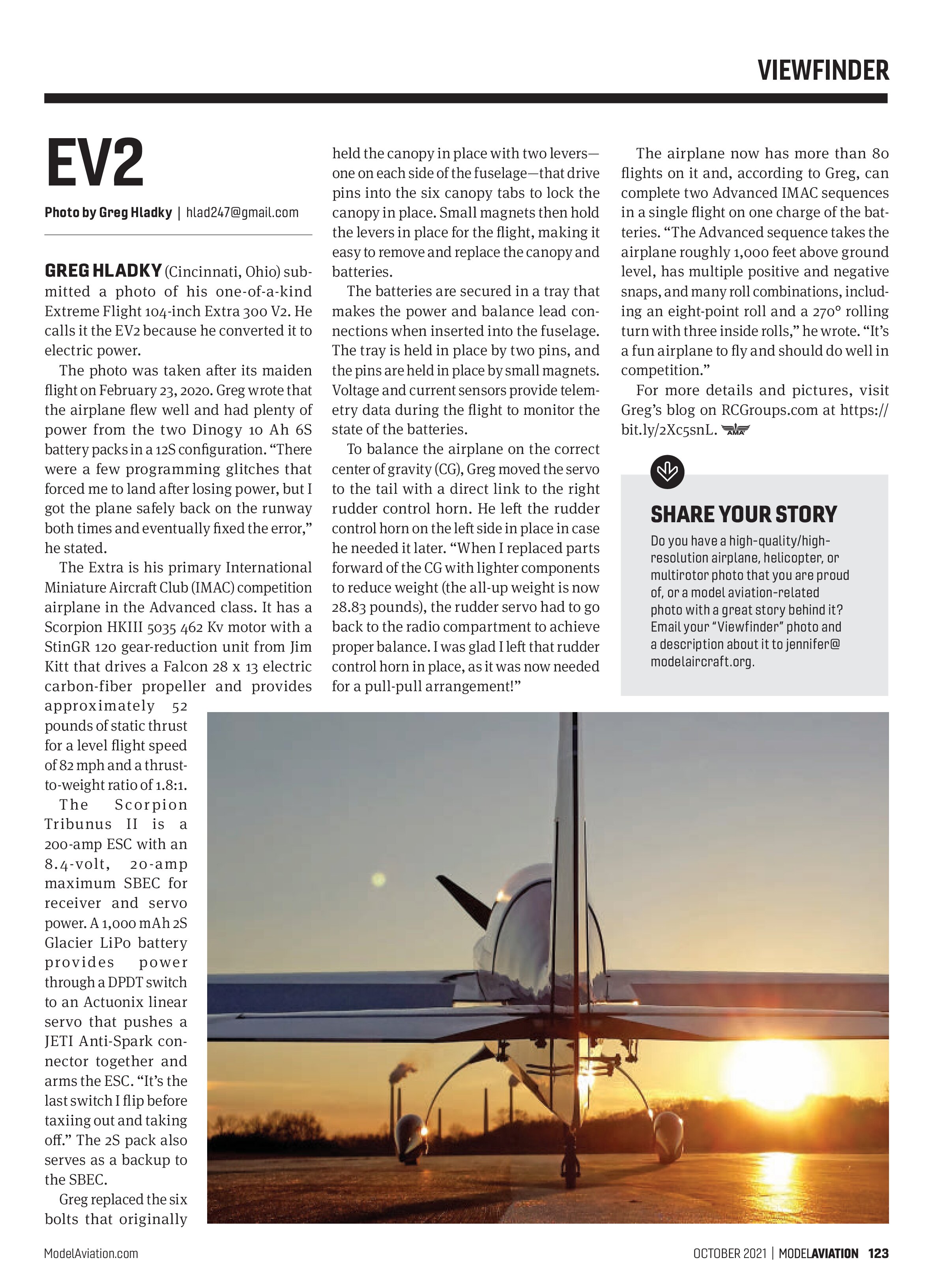
GREG HLADKY (Cincinnati, Ohio) submitted a photo of his one-of-a-kind Extreme Flight 104-inch Extra 300 V2. He calls it the EV2 because he converted it to electric power.
The photo was taken after its maiden flight on February 23, 2020. Greg wrote that the airplane flew well and had plenty of power from the two Dinogy 10 Ah 6S battery packs in a 12S configuration. “There were a few programming glitches that forced me to land after losing power, but I got the plane safely back on the runway both times and eventually fixed the error,” he stated.
The Extra is his primary International Miniature Aircraft Club (IMAC) competition airplane in the Advanced class. It has a Scorpion HKIII 5035 462 Kv motor with a StingR 120 gear-reduction unit from Jim Kitt that drives a Falcon 28 x 13 electric carbon-fiber propeller and provides approximately 52 pounds of static thrust for a level flight speed of 82 mph and a thrust-to-weight ratio of 1.8:1.
The Scorpion Tribunus II is a 200-amp ESC with an 8.4-volt, 20-amp maximum SBEC for receiver and servo power. A 1,000 mAh 2S Glacier LiPo battery provides power through a DPDT switch to an Actuonix linear servo that pushes a JETI Anti-Spark connector together and arms the ESC. “It’s the last switch I flip before taxiing out and taking off.” The 2S pack also serves as a backup to the SBEC.
Greg replaced the six bolts that originally held the canopy in place with two levers—one on each side of the fuselage—that drive pins into the six canopy tabs to lock the canopy in place. Small magnets then hold the levers in place for the flight, making it easy to remove and replace the canopy and batteries.
The batteries are secured in a tray that makes the power and balance lead connections when inserted into the fuselage. The tray is held in place by two pins, and the pins are held in place by small magnets. Voltage and current sensors provide telemetry data during the flight to monitor the state of the batteries.
To balance the airplane on the correct center of gravity (CG), Greg moved the servo to the tail with a direct link to the right rudder control horn. He left the rudder control horn on the left side in place in case he needed it later. “When I replaced parts forward of the CG with lighter components to reduce weight (the all-up weight is now 28.83 pounds), the rudder servo had to go back to the radio compartment to achieve proper balance. I was glad I left that rudder control horn in place, as it was now needed for a pull-pull arrangement!”
The airplane now has more than 80 flights on it and, according to Greg, can complete two Advanced IMAC sequences in a single flight on one charge of the batteries. “The Advanced sequence takes the airplane roughly 1,000 feet above ground level, has multiple positive and negative snaps, and many roll combinations, including an eight-point roll and a 270° rolling turn with three inside rolls,” he wrote. “It’s a fun airplane to fly and should do well in competition.”
For more details and pictures, visit Greg’s blog on RCGroups.com at https://bit.ly/2Xc5snL.