SMALL-FIELD FLYING

ADDING
SCALE
DETAILS
By Pat Tritle | patscustommodels@gmail.com
THIS MIGHT SOUND a little odd at the end of September into early October, but as I tap this out at the end of June, I can honestly say that “summer’s here!” The thermometer has topped out at more than 100° every day for the last three weeks, with no end in sight. The good news, though, is that up here in the high desert, nights and mornings are comfortable, so for those of us who fly Dawn Patrol, conditions have been great. In the afternoon, when the leaves are withering and the bark is melting off the trees—okay, the tree—it’s a great time to be in the shop working on new projects.
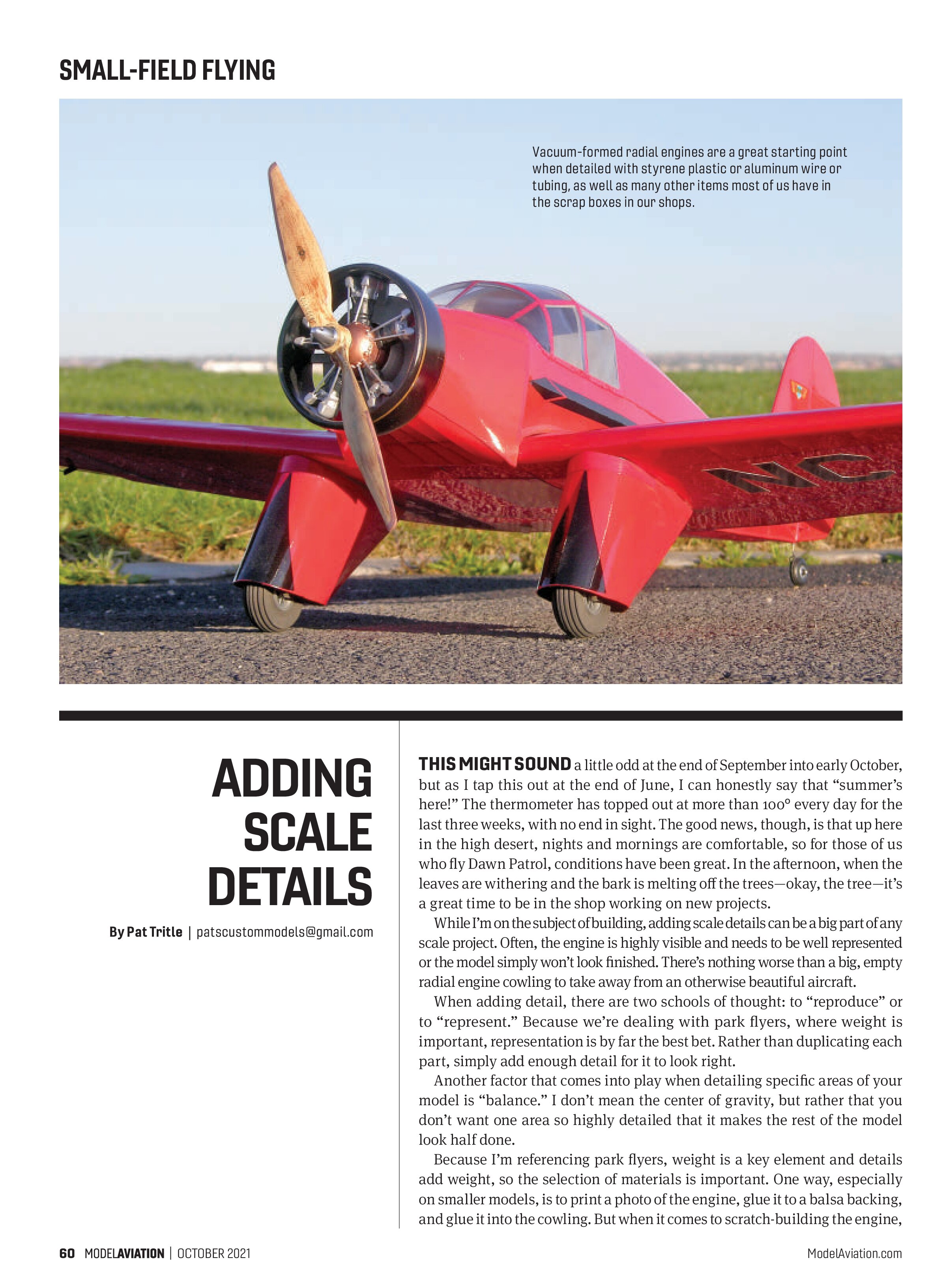
While I’m on the subject of building, adding scale details can be a big part of any scale project. Often, the engine is highly visible and needs to be well represented or the model simply won’t look finished. There’s nothing worse than a big, empty radial engine cowling to take away from an otherwise beautiful aircraft.
When adding detail, there are two schools of thought: to “reproduce” or to “represent.” Because we’re dealing with park flyers, where weight is important, representation is by far the best bet. Rather than duplicating each part, simply add enough detail for it to look right.
Another factor that comes into play when detailing specific areas of your model is “balance.” I don’t mean the center of gravity, but rather that you don’t want one area so highly detailed that it makes the rest of the model look half done.
Because I’m referencing park flyers, weight is a key element and details add weight, so the selection of materials is important. One way, especially on smaller models, is to print a photo of the engine, glue it to a balsa backing, and glue it into the cowling. But when it comes to scratch-building the engine,

I find that lightweight balsa or blue foam blocks, aluminum wire and tubing, and even soda straws and rocket tubes, do nicely in fabricating those lightweight details. Of course, starting with a vacuum-formed engine is also a great way to go.
The main thing is simply to turn your creativity loose and use whatever works. There is a time when weight is actually a plus, such as on World War I biplanes, where a short nose offers little in balancing the model. Because the engine is all the way forward, a little extra-heavy detailing is better than big hunks of lead.
From the Simple to the Complex
The variety of subject matter from readers this month is nothing short of incredible—and when I say simple, I don’t necessarily mean easy. Having built a few small models, I can tell you, they’re not as easy to build as they might appear to be.
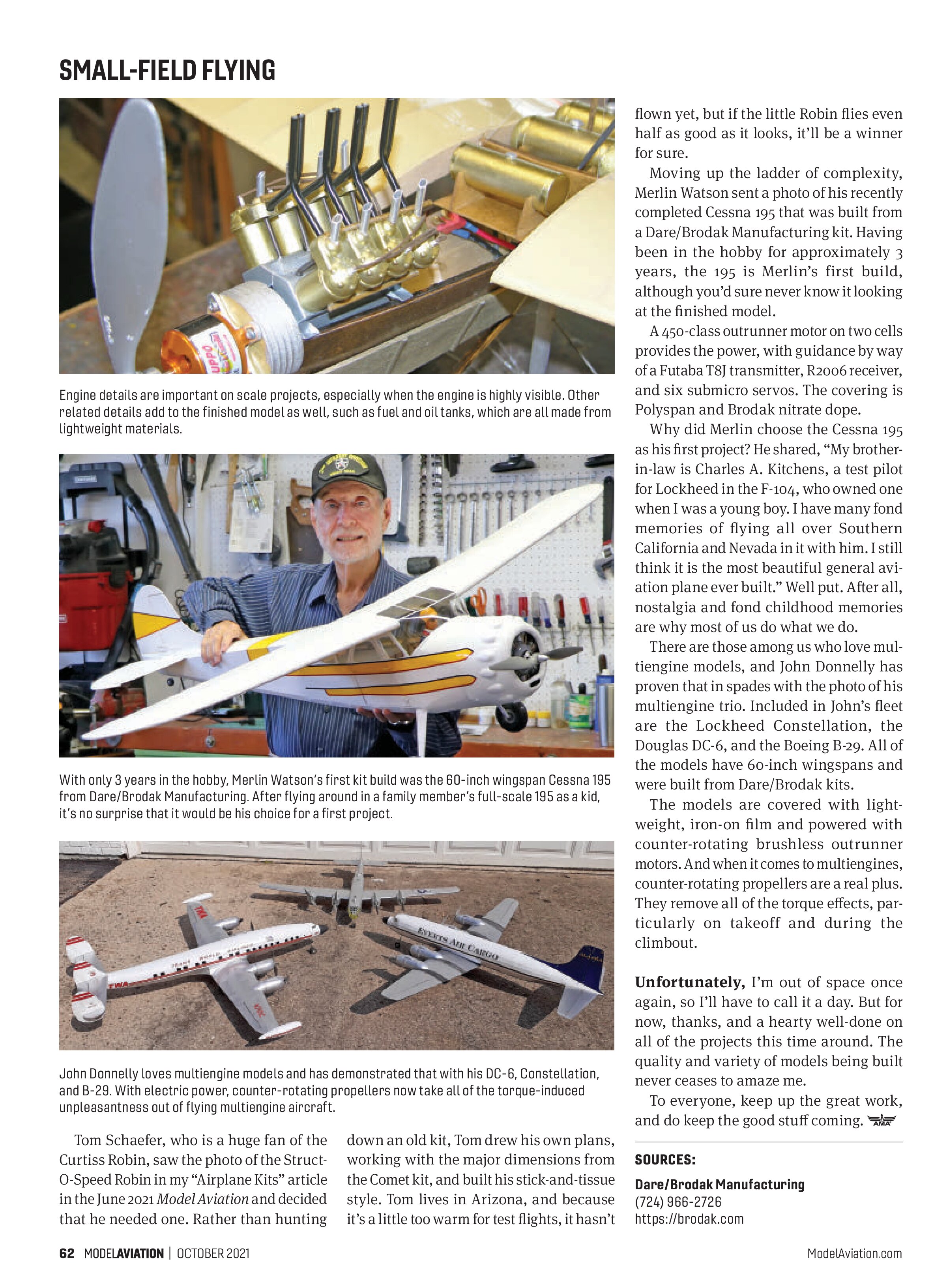
Engine details are important on scale projects, especially when the engine is highly visible. Other related details add to the finished model as well, such as fuel and oil tanks, which are all made from lightweight materials.

With only 3 years in the hobby, Merlin Watson’s first kit build was the 60-inch wingspan Cessna 195 from Dare/Brodak Manufacturing. After flying around in a family member’s full-scale 195 as a kid, it’s no surprise that it would be his choice for a first project.

John Donnelly loves multiengine models and has demonstrated that with his DC-6, Constellation, and B-29. With electric power, counter-rotating propellers now take all of the torque-induced unpleasantness out of flying multiengine aircraft.

Tom Schaefer, who is a huge fan of the Curtiss Robin, saw the photo of the Struct-O-Speed Robin in my “Airplane Kits” article in the June 2021 Model Aviation and decided that he needed one. Rather than hunting down an old kit, Tom drew his own plans, working with the major dimensions from the Comet kit, and built his stick-and-tissue style. Tom lives in Arizona, and because it’s a little too warm for test flights, it hasn’t flown yet, but if the little Robin flies even half as good as it looks, it’ll be a winner for sure.
Moving up the ladder of complexity, Merlin Watson sent a photo of his recently completed Cessna 195 that was built from a Dare/Brodak Manufacturing kit. Having been in the hobby for approximately 3 years, the 195 is Merlin’s first build, although you’d sure never know it looking at the finished model.
A 450-class outrunner motor on two cells provides the power, with guidance by way of a Futaba T8J transmitter, R2006 receiver, and six submicro servos. The covering is Polyspan and Brodak nitrate dope.
Why did Merlin choose the Cessna 195 as his first project? He shared, “My brother-in-law is Charles A. Kitchens, a test pilot for Lockheed in the F-104, who owned one when I was a young boy. I have many fond memories of flying all over Southern California and Nevada in it with him. I still think it is the most beautiful general aviation plane ever built.” Well put. After all, nostalgia and fond childhood memories are why most of us do what we do.
There are those among us who love multiengine models, and John Donnelly has proven that in spades with the photo of his multiengine trio. Included in John’s fleet are the Lockheed Constellation, the Douglas DC-6, and the Boeing B-29. All of the models have 60-inch wingspans and were built from Dare/Brodak kits.
The models are covered with lightweight, iron-on film and powered with counter-rotating brushless outrunner motors. And when it comes to multiengines, counter-rotating propellers are a real plus. They remove all of the torque effects, particularly on takeoff and during the climbout.
Unfortunately, I’m out of space once again, so I’ll have to call it a day. But for now, thanks, and a hearty well-done on all of the projects this time around. The quality and variety of models being built never ceases to amaze me.
To everyone, keep up the great work, and do keep the good stuff coming.
SOURCES:
Dare/Brodak Manufacturing
(724) 966-2726
https://brodak.com