YEAR-END
ASSESSING
AND
ORGANIZING
By Jennifer Reynolds | jensunshine3@gmail.com

DECEMBER IS TWO MONTHS AWAY. Although I don’t mean to rush time or the seasons, I often like to think ahead, all in the name of staying organized and assessing my flights to date. This is especially the case as I near the end of the year. It’s a good feeling to look back at past flying events and projects, tidy up, and consider new ways to add convenience to my setup, flights, and everything in between. It’s a process that’s both mental and physical.
Sometimes this is about taking time to do nothing more than think about how I could have improved a flight or to think about next year’s local events. Physically, I maneuver boxes in sheds or head to the store for an ideal container to house my electric aircraft’s batteries.
Of course, I’m always getting ideas from fellow modelers along the flightline, but at this time of year, it’s important to step back and take a breath.
A new season is on the horizon, and October is a good time to pause and reflect. What can I order that I might I want to try next year? What can I think about now? A new maneuver? Airplane? A way to hang airplanes in the garage? How can I build with more ease if the building bug bites me? What could I have done differently? Let off the throttle sooner? Give it more or less rudder?
Rudder Advice
You might recall that this year I confessed to using rudder for the first time while flying. I was thrilled at the difference it made, yet slightly miffed at myself for not having done this sooner. Model Aviation reader Daniel Mitchell shared some advice, which has helped me to mentally unclutter in terms of how I think about rudder.
“I’m glad you are starting to work that left thumb,” he wrote. He added, “As an instructor, I don’t mention the rudder except for guiding the airplane while it is on the ground. So, in a way, I’m perpetuating rudderless flying.”
He explained that instruction on rudder can be “sort of as-needed or serendipitous ‘advanced training,’” to which he acknowledged that it is “silly because the rudder is very useful.”
Daniel suggested the following:
“One nice trick with the rudder is to adjust alignment on the final approach. If the airplane is on a parallel axis with the runway but not quite on the centerline, I will feed in a tiny bit of corrective rudder to get the airplane shifted over to a better lineup. On many airplanes, the rudder gives directional change without much roll. Any roll can be removed with a tiny bit of opposite aileron. As you can imagine, this ‘cross-control’ thing should be practiced way up high before trying it on final!”
His advice might be considered rather novice to many, but for a rudder newbie such as I, it’s helpful to hear.
Wood Splitting Be Gone!
Daniel also had some great suggestions for keeping things going smoothly when building. A while back, I expressed frustration at building, especially when pinning wood in particular—darn splitting!
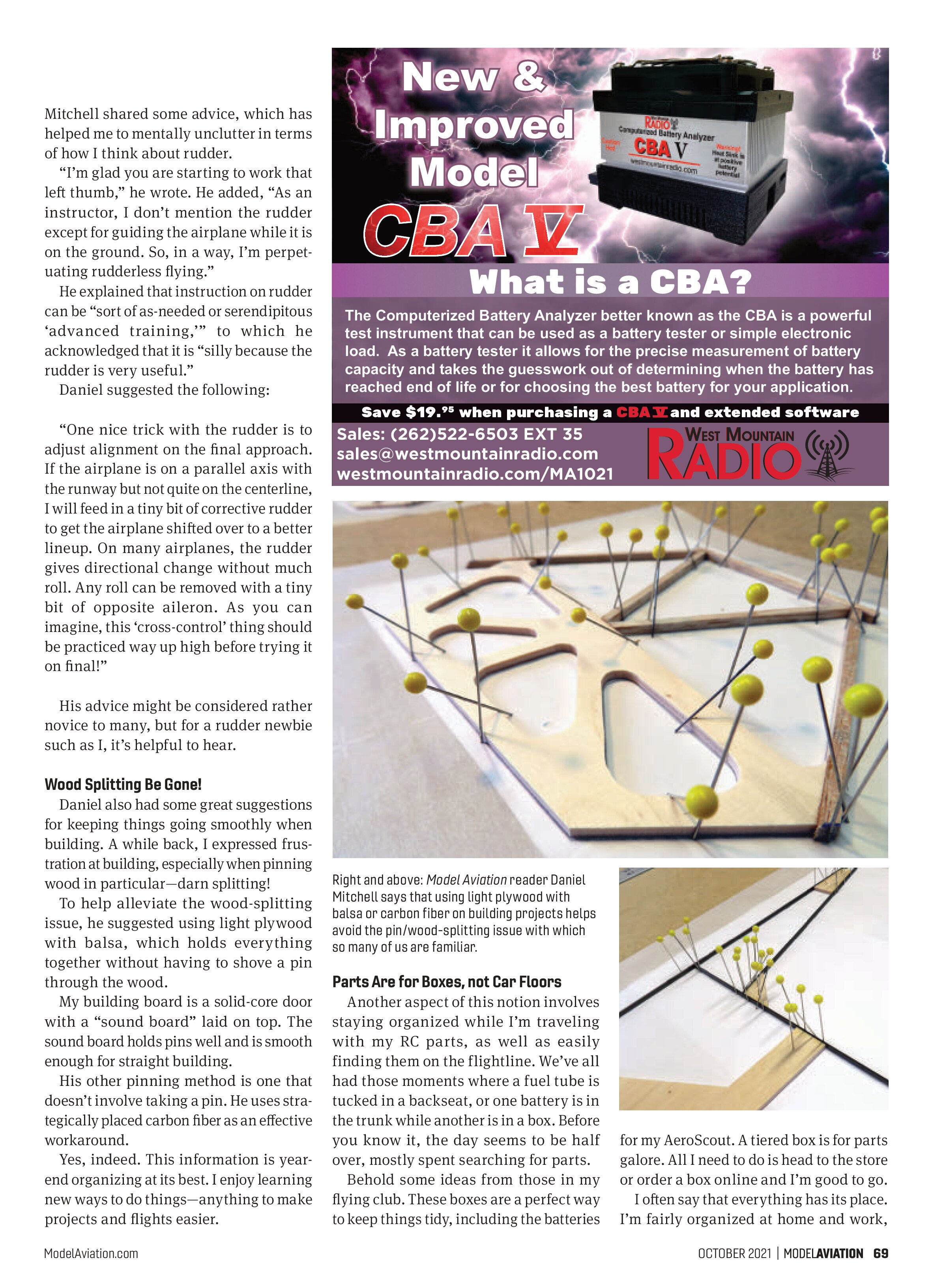
To help alleviate the wood-splitting issue, he suggested using light plywood with balsa, which holds everything together without having to shove a pin through the wood.
My building board is a solid-core door with a “sound board” laid on top. The sound board holds pins well and is smooth enough for straight building.
His other pinning method is one that doesn’t involve taking a pin. He uses strategically placed carbon fiber as an effective workaround.
Yes, indeed. This information is year-end organizing at its best. I enjoy learning new ways to do things—anything to make projects and flights easier.
Mitchell shared some advice, which has helped me to mentally unclutter in terms of how I think about rudder.
“I’m glad you are starting to work that left thumb,” he wrote. He added, “As an instructor, I don’t mention the rudder except for guiding the airplane while it is on the ground. So, in a way, I’m perpetuating rudderless flying.”
He explained that instruction on rudder can be “sort of as-needed or serendipitous ‘advanced training,’” to which he acknowledged that it is “silly because the rudder is very useful.”
Daniel suggested the following:
“One nice trick with the rudder is to adjust alignment on the final approach. If the airplane is on a parallel axis with the runway but not quite on the centerline, I will feed in a tiny bit of corrective rudder to get the airplane shifted over to a better lineup. On many airplanes, the rudder gives directional change without much roll. Any roll can be removed with a tiny bit of opposite aileron. As you can imagine, this ‘cross-control’ thing should be practiced way up high before trying it on final!”
His advice might be considered rather novice to many, but for a rudder newbie such as I, it’s helpful to hear.
Parts Are for Boxes, not Car Floors
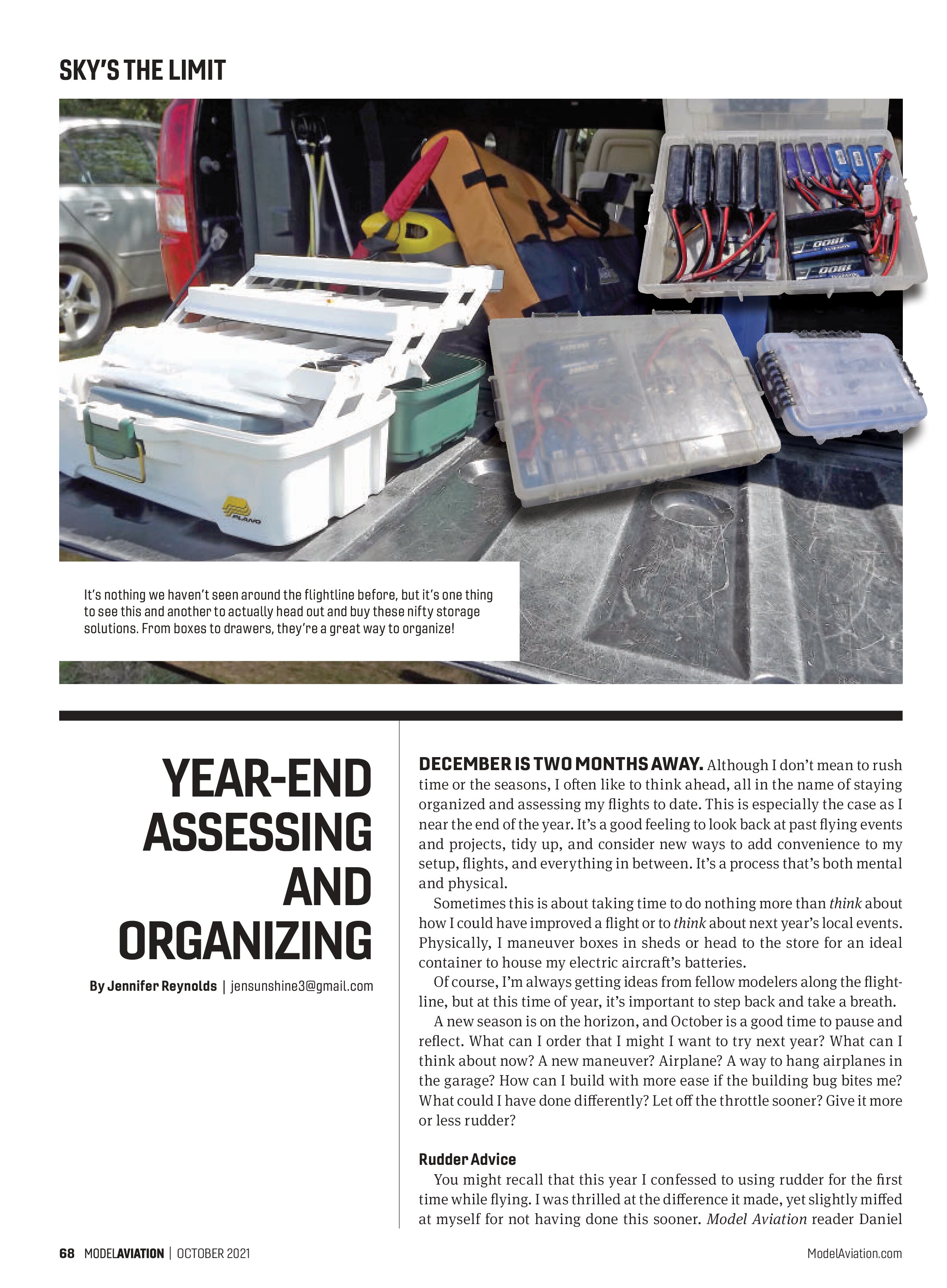
Another aspect of this notion involves staying organized while I’m traveling with my RC parts, as well as easily finding them on the flightline. We’ve all had those moments where a fuel tube is tucked in a backseat, or one battery is in the trunk while another is in a box. Before you know it, the day seems to be half over, mostly spent searching for parts.
Behold some ideas from those in my flying club. These boxes are a perfect way to keep things tidy, including the batteries

for my AeroScout. A tiered box is for parts galore. All I need to do is head to the store or order a box online and I’m good to go.
I often say that everything has its place. I’m fairly organized at home and work,

so why should flying be any different? Yet, it never fails that I find a screw in a drawer at home or something rolling around my car floor. These drawers are the answer to the cardboard boxes or tins that I sometimes use.
There you have it. From my mental clutter of thinking about how to perfect my rudder use, to the physical clutter of scattered airplane parts, there’s always a way to get on track. It’s the perfect time of year to assess what others have shared.
Whether they talk about it, email an idea, share thoughts on a social media forum, or show it at the field, why not give it a try? Better organizing translates to finding what we need sooner, which means having even more time to do what matters most—getting out there and having fun flying!
Smile Time
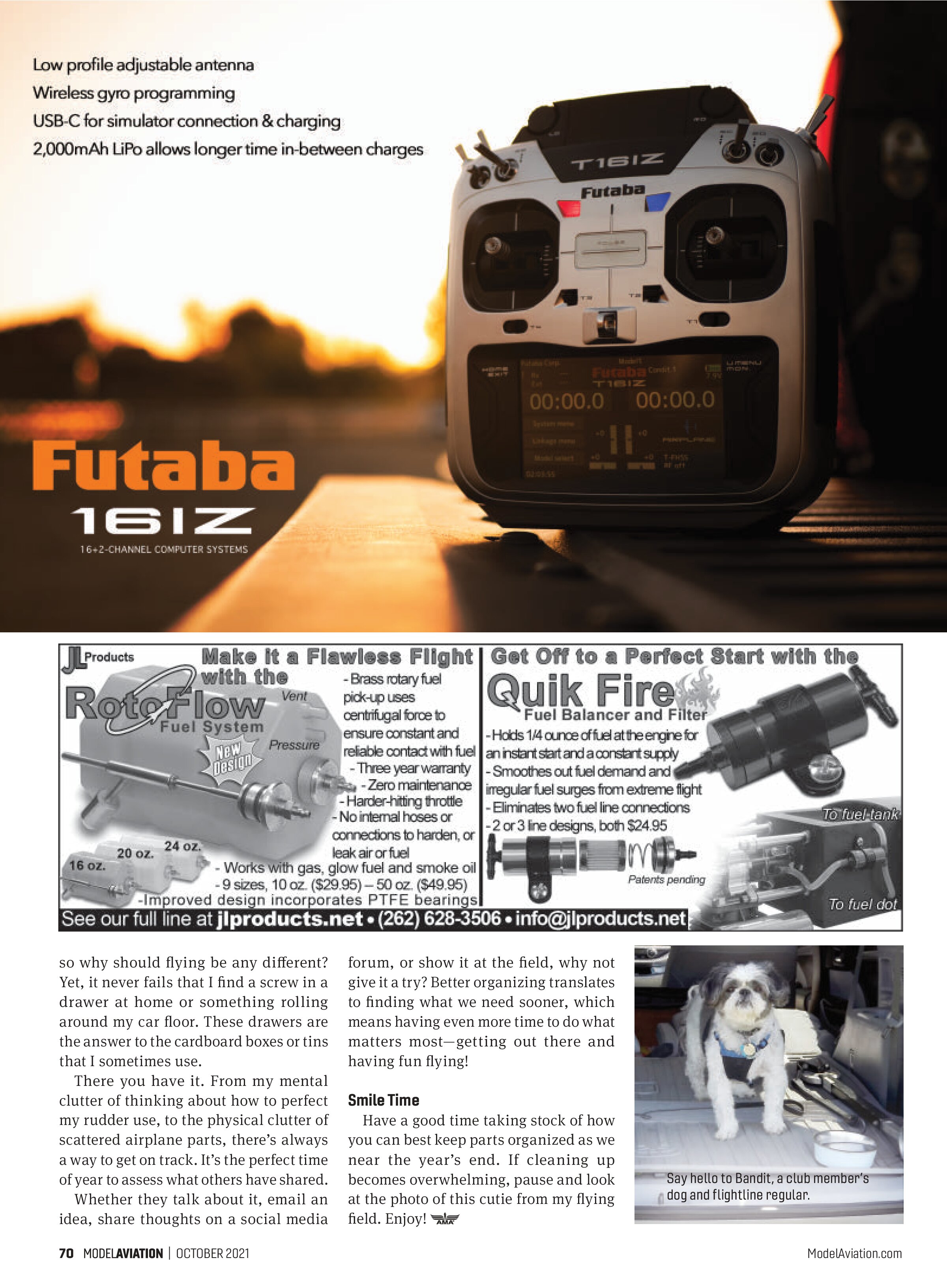
Have a good time taking stock of how you can best keep parts organized as we near the year’s end. If cleaning up becomes overwhelming, pause and look at the photo of this cutie from my flying field. Enjoy!