RC SLOPE SOARING

ALPINE GLITCH
By Greg Schutte | gshouty@yahoo.com
I RECEIVED AN EMAIL from a fellow pilot about a new Alpine Soaring site called SkyPark at Santa’s Village, located in Skyforest, California. My family was planning to go to California for a wedding and was going to be close to this new place. With my current lack of flyable machines, it was a good reason to get a new airplane.
I usually build my own aircraft, but I decided to see what was available on the market. I wanted a Slope Soaring airplane that would be big enough for Alpine Soaring, but small enough to easily transport. For Thermal Duration (TD) flying, my Allegra Lite sailplane is my aircraft of choice. It has been stretched from 2 meters to 100 inches in wingspan and flies like a homesick angel.
The wing is a one-piece design, so safely transporting it can be a challenge. It is also made from balsa, so landing on the side of a hill or threading it through trees could pose a problem.
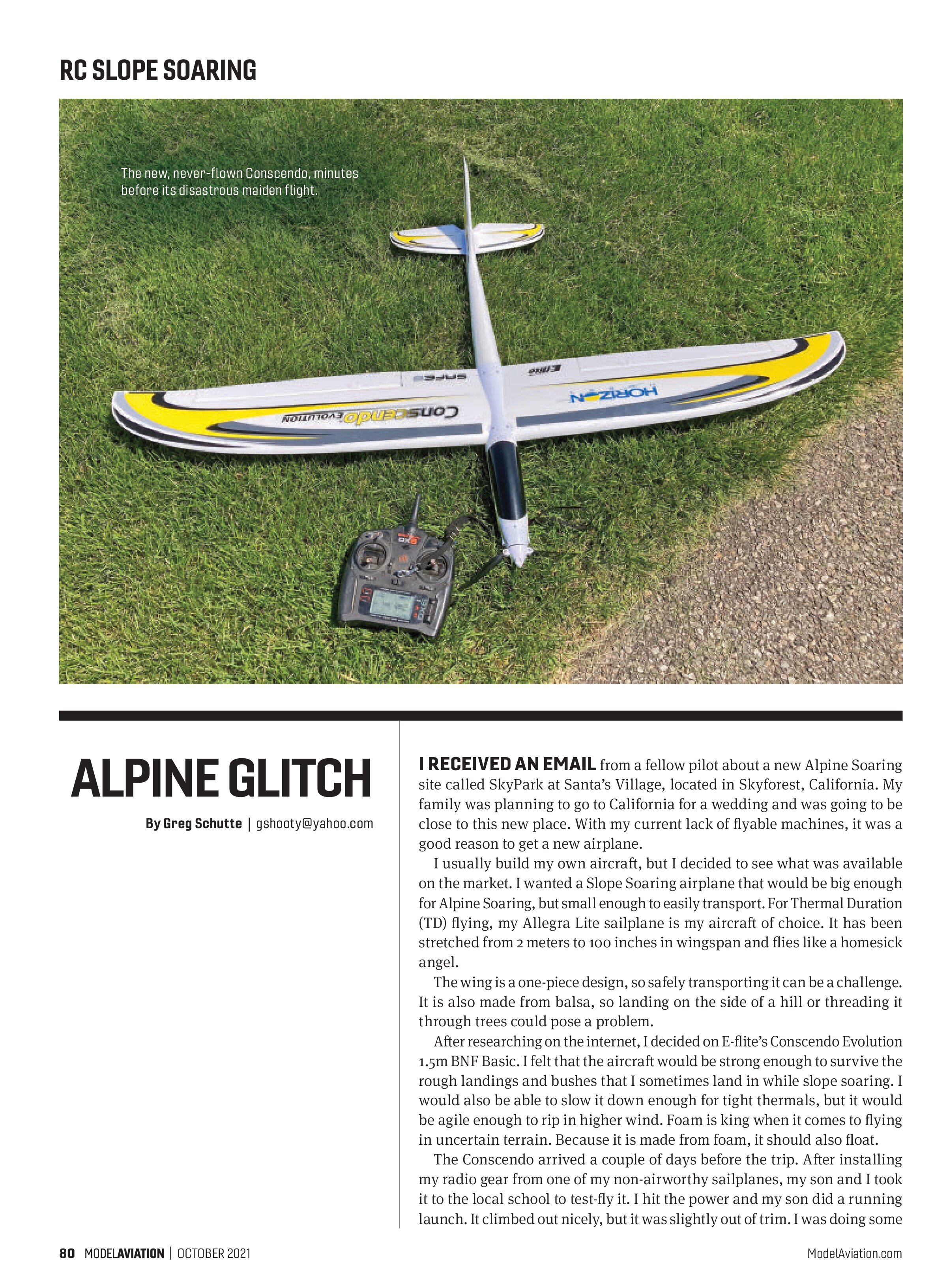
After researching on the internet, I decided on E-flite’s Conscendo Evolution 1.5m BNF Basic. I felt that the aircraft would be strong enough to survive the rough landings and bushes that I sometimes land in while slope soaring. I would also be able to slow it down enough for tight thermals, but it would be agile enough to rip in higher wind. Foam is king when it comes to flying in uncertain terrain. Because it is made from foam, it should also float.
The Conscendo arrived a couple of days before the trip. After installing my radio gear from one of my non-airworthy sailplanes, my son and I took it to the local school to test-fly it. I hit the power and my son did a running launch. It climbed out nicely, but it was slightly out of trim. I was doing some in-flight adjustment when I lost radio control and it went into a steep dive and collided with the gravel track. I was like—what just happened? I had been in the air for less than 10 seconds. I have test-flown many airplanes, and I did a radio check before I launched it.
Disgusted and with my pride hurt, I collected my newly bought and freshly crashed sailplane into my truck and headed home. This was the day before my trip to California. So much for doing any Alpine Soaring on this trip.
I had my first real experience with Alpine Soaring a couple years ago when some fellow Slope fliers and I attended a fly-in in Joseph, Oregon. That event had two main sites. One site was for TD, where we launched Thermal sailplanes over a golf driving range.
The second spot was the Memaloose U.S. Forest Service dirt airstrip that overlooks Hells Canyon National Recreation Center. The canyon is thousands of feet deep, and I was told stories about gliders that had sunk out and were down the hill waiting to be picked up—if you could get past the rattlesnakes and not fall to your death.

My airplanes at the time did not have motors on them, and the wind and thermals were not strong enough for my taste that day. In my mind, a good Alpine Soaring glider needs a way to get back up if needed. Playing with the wildlife or breaking an ankle is something I would like to avoid.
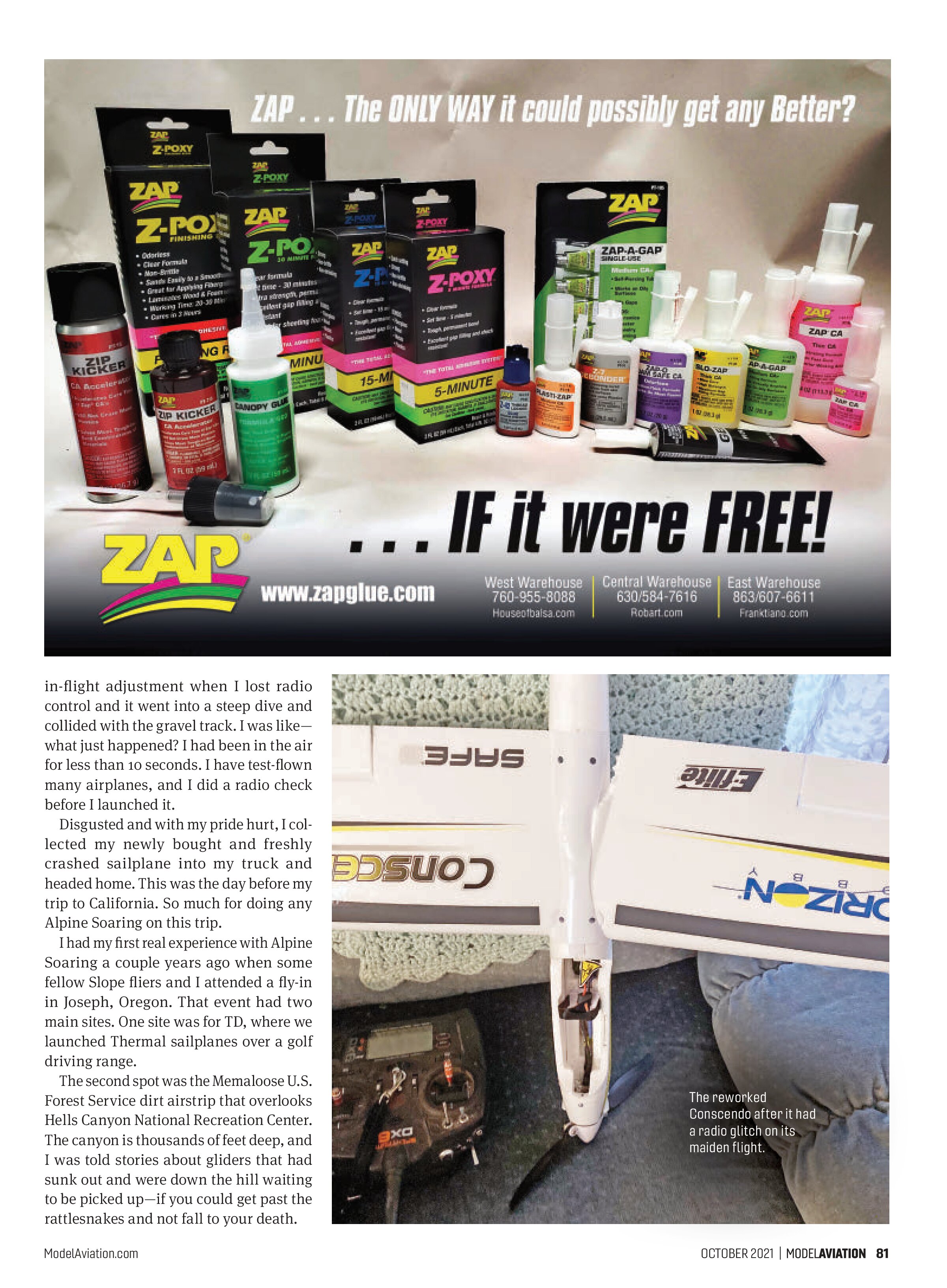
After getting back from my trip in California and stewing on my freshly broken sailplane for a week, I decided it was time to fix it. The crash had seriously bent the nose and broken one of the wing’s mounting bolt holes. After taking it apart, I was able to easily glue the wing back together. The fuselage, on the other hand, was badly bent at the nose. I thought about just replacing the fuselage with a new one, but I decided that would be the last resort.

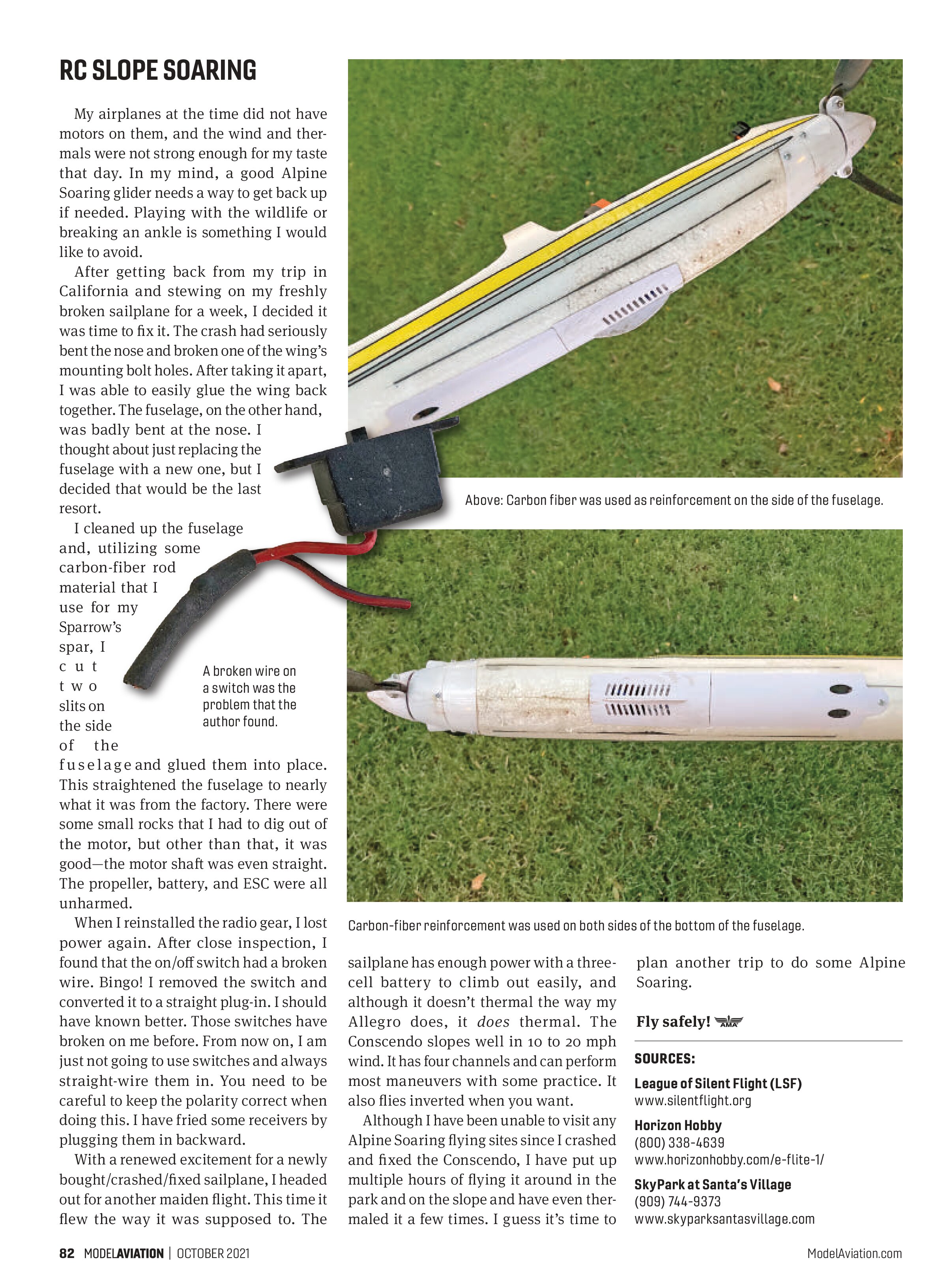
I cleaned up the fuselage and, utilizing some carbon-fiber rod material that I use for my Sparrow’s spar, I cut two slits on the side of the fuselage and glued them into place. This straightened the fuselage to nearly what it was from the factory. There were some small rocks that I had to dig out of the motor, but other than that, it was good—the motor shaft was even straight. The propeller, battery, and ESC were all unharmed.

When I reinstalled the radio gear, I lost power again. After close inspection, I found that the on/off switch had a broken wire. Bingo! I removed the switch and converted it to a straight plug-in. I should have known better. Those switches have broken on me before. From now on, I am just not going to use switches and always straight-wire them in. You need to be careful to keep the polarity correct when doing this. I have fried some receivers by plugging them in backward.
With a renewed excitement for a newly bought/crashed/fixed sailplane, I headed out for another maiden flight. This time it flew the way it was supposed to. The sailplane has enough power with a three-cell battery to climb out easily, and although it doesn’t thermal the way my Allegro does, it does thermal. The Conscendo slopes well in 10 to 20 mph wind. It has four channels and can perform most maneuvers with some practice. It also flies inverted when you want.
Although I have been unable to visit any Alpine Soaring flying sites since I crashed and fixed the Conscendo, I have put up multiple hours of flying it around in the park and on the slope and have even thermaled it a few times. I guess it’s time to plan another trip to do some Alpine Soaring.
Fly safely!
SOURCES:
League of Silent Flight (LSF)
www.silentflight.org
Horizon Hobby
(800) 338-4639
www.horizonhobby.com/e-flite-1/
SkyPark at Santa’s Village
(909) 744-9373
www.skyparksantasvillage.com