RC SCALE AEROBATICS

STARTING
A LARGER
ENGINE
By John Glezellis | jglezellis@gmail.com
IN MY AUGUST 2021 COLUMN, I touched on a few essentials that relate to engine installation and performance. With Giant Scale aerobatic models quickly becoming the new norm at the local flying site, whether owned by a sport pilot or an International Miniature Aerobatic Club (IMAC) competitor, safe operational practices are a must to prevent an accident from occurring.
Throughout this column, I will explore a few options for to how to physically start a larger engine. I will also look at general engine starting procedures and will conclude with a few ways that you can prepare for an event before the first competition flight of the day.
Without further delay, let’s begin!
Starting Options Defined!
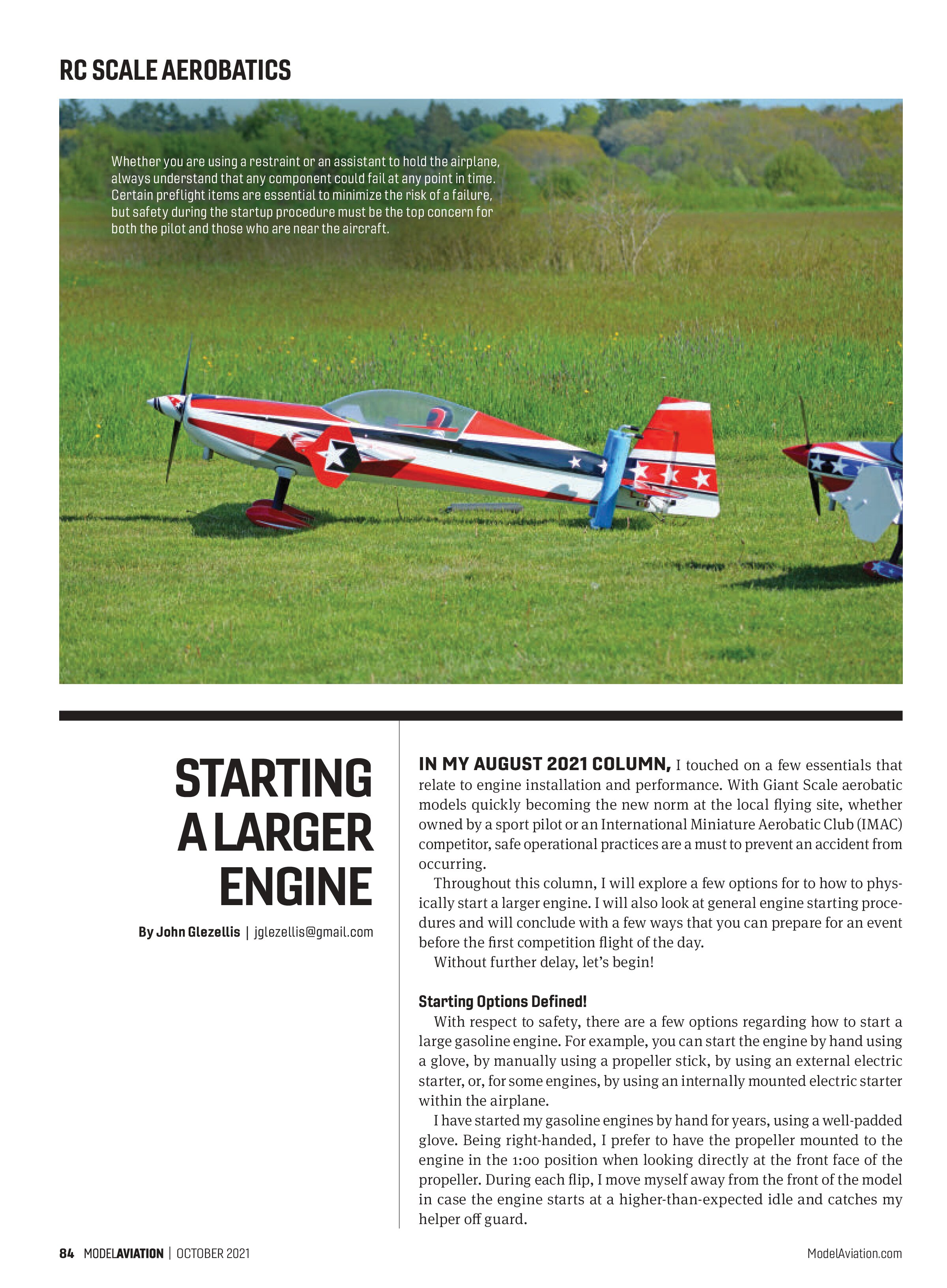
With respect to safety, there are a few options regarding how to start a large gasoline engine. For example, you can start the engine by hand using a glove, by manually using a propeller stick, by using an external electric starter, or, for some engines, by using an internally mounted electric starter within the airplane.
I have started my gasoline engines by hand for years, using a well-padded glove. Being right-handed, I prefer to have the propeller mounted to the engine in the 1:00 position when looking directly at the front face of the propeller. During each flip, I move myself away from the front of the model in case the engine starts at a higher-than-expected idle and catches my helper off guard.
Some pilots prefer to mount the propeller at the 11:00 position and offset themselves from the center of the model, for the same reason that I move myself away from the center of the aircraft with each flip. Propeller position boils down to personal preference.
If using a glove is not preferred, High Point RC Products recently released the Intimidator propeller stick. This product features an aluminum-core, 6-inch rubber surface area, and a CNC-machined rubber handgrip that results in a total propeller stick length of roughly 1 foot.
Another popular propeller stick option is the Rolling Chicken Stick, which features a 1/8-inch vinyl roller that keeps the starting stick from damaging the propeller’s trailing edge (TE). It rolls along the TE instead of sliding across it. Using a propeller stick is convenient because it is easy to store in a flight box, does not require a battery source, and keeps an individual’s hand farther away from the propeller.
Some pilots, however, are not comfortable with using a propeller stick, and they might prefer an external electric starter. Sullivan Products offers the Dynatron starter for engines up to 40 cc, the Megatron starter for engines up to 80 cc, and the Validus GRS starter for engines up to 350 cc.
I have only used the Dynatron and Megatron starters. Some pilots have reported using the Megatron starter on a 120 cc engine with great success, although it is advertised as only starting engines up to 80 cc in size. Regardless, use care and caution to ensure that the rubber cone does not slip on the spinner. It might take some time to become familiar with it.
There are many options for a battery source. Whenever I use an external electric starter, I tend to use lithium batteries that are also in some of my electric-powered

models—the battery types, cell counts, and connectors are relatively standard.
Finally, onboard starters are available for some engines and are safe to operate. On scale airplanes, nose weight is typically needed. The onboard starter provides another added benefit: weight! Because they add a fair amount of weight to the airplane, onboard starters are not often used in aerobatic competition where every gram counts.
As I mentioned, it all boils down to personal preference, and when it comes to safety, you must not fear your model. If an

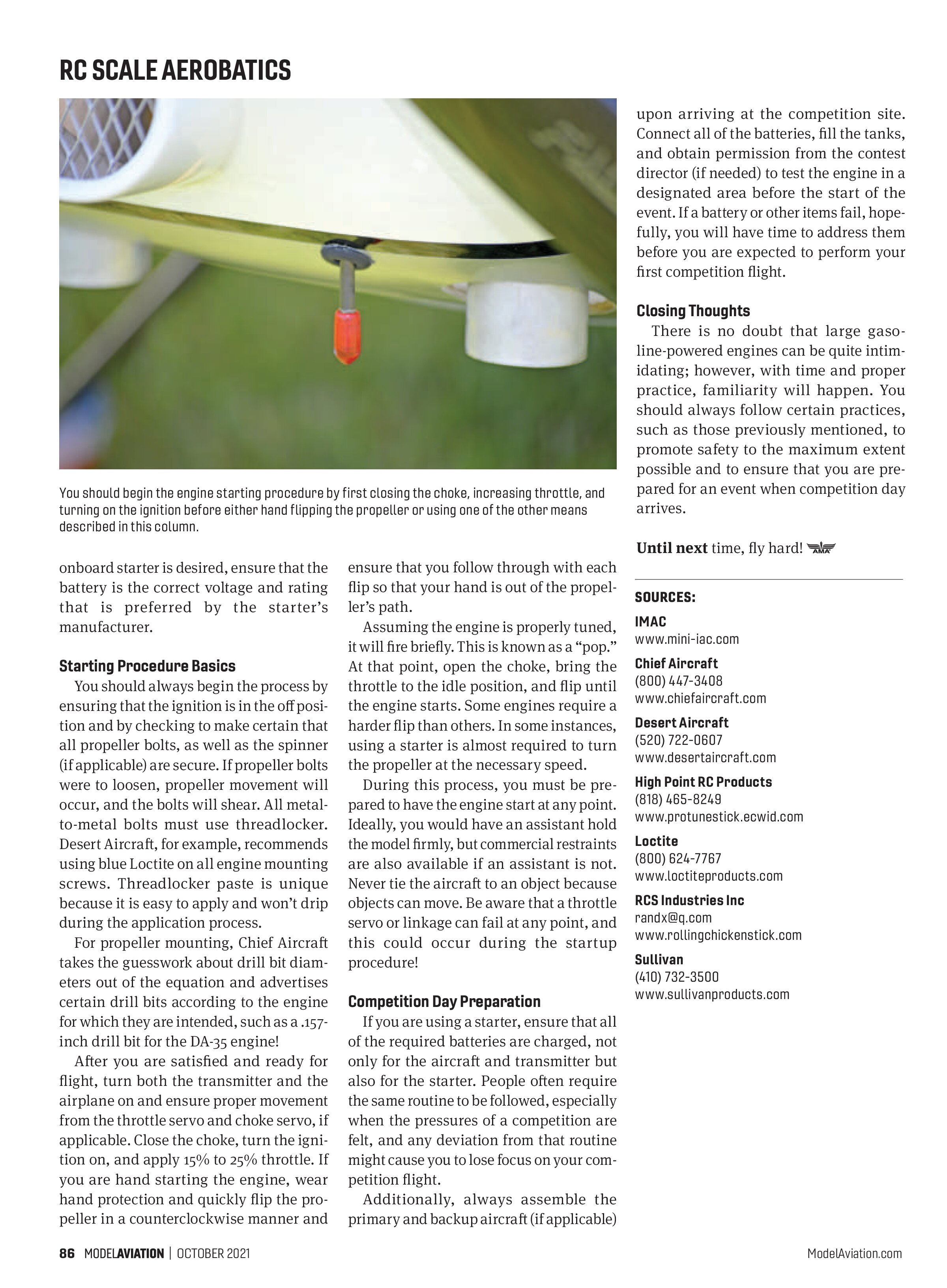
You should begin the engine starting procedure by first closing the choke, increasing throttle, and turning on the ignition before either hand flipping the propeller or using one of the other means described in this column.
onboard starter is desired, ensure that the battery is the correct voltage and rating that is preferred by the starter’s manufacturer.
Starting Procedure Basics
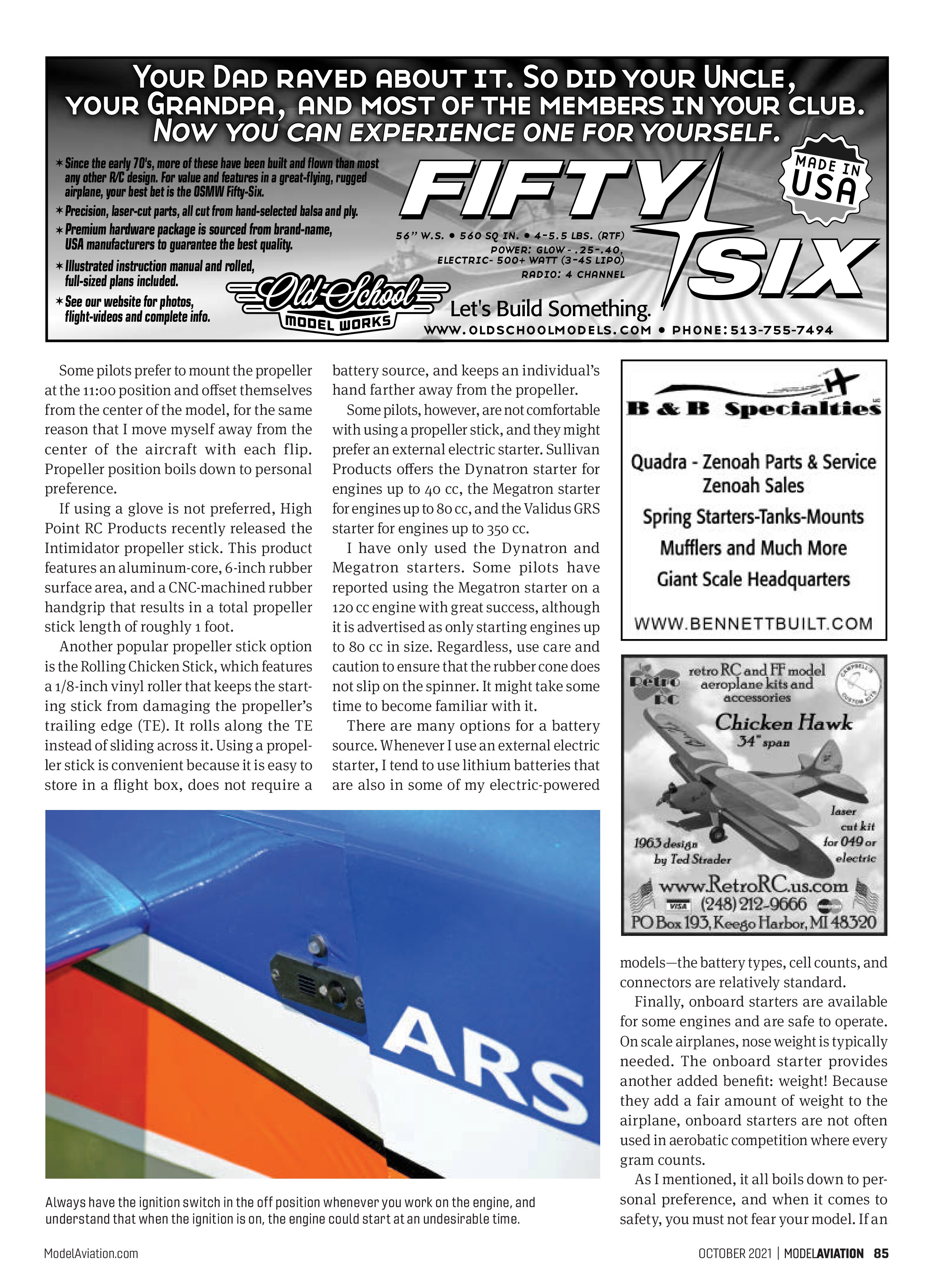
You should always begin the process by ensuring that the ignition is in the off position and by checking to make certain that all propeller bolts, as well as the spinner (if applicable) are secure. If propeller bolts were to loosen, propeller movement will occur, and the bolts will shear. All metal-to-metal bolts must use threadlocker. Desert Aircraft, for example, recommends using blue Loctite on all engine mounting screws. Threadlocker paste is unique because it is easy to apply and won’t drip during the application process.
For propeller mounting, Chief Aircraft takes the guesswork about drill bit diameters out of the equation and advertises certain drill bits according to the engine for which they are intended, such as a .157-inch drill bit for the DA-35 engine!
After you are satisfied and ready for flight, turn both the transmitter and the airplane on and ensure proper movement from the throttle servo and choke servo, if applicable. Close the choke, turn the ignition on, and apply 15% to 25% throttle. If you are hand starting the engine, wear hand protection and quickly flip the propeller in a counterclockwise manner and ensure that you follow through with each flip so that your hand is out of the propeller’s path.
Assuming the engine is properly tuned, it will fire briefly. This is known as a “pop.” At that point, open the choke, bring the throttle to the idle position, and flip until the engine starts. Some engines require a harder flip than others. In some instances, using a starter is almost required to turn the propeller at the necessary speed.
During this process, you must be prepared to have the engine start at any point. Ideally, you would have an assistant hold the model firmly, but commercial restraints are also available if an assistant is not. Never tie the aircraft to an object because objects can move. Be aware that a throttle servo or linkage can fail at any point, and this could occur during the startup procedure!
Competition Day Preparation
If you are using a starter, ensure that all of the required batteries are charged, not only for the aircraft and transmitter but also for the starter. People often require the same routine to be followed, especially when the pressures of a competition are felt, and any deviation from that routine might cause you to lose focus on your competition flight.
Additionally, always assemble the primary and backup aircraft (if applicable) upon arriving at the competition site. Connect all of the batteries, fill the tanks, and obtain permission from the contest director (if needed) to test the engine in a designated area before the start of the event. If a battery or other items fail, hopefully, you will have time to address them before you are expected to perform your first competition flight.
Closing Thoughts
There is no doubt that large gasoline-powered engines can be quite intimidating; however, with time and proper practice, familiarity will happen. You should always follow certain practices, such as those previously mentioned, to promote safety to the maximum extent possible and to ensure that you are prepared for an event when competition day arrives.
Until next time, fly hard!
SOURCES:
- IMAC
www.mini-iac.com - Chief Aircraft
(800) 447-3408
www.chiefaircraft.com - Desert Aircraft
(520) 722-0607
www.desertaircraft.com - High Point RC Products
(818) 465-8249
www.protunestick.ecwid.com - Loctite
(800) 624-7767
www.loctiteproducts.com - RCS Industries Inc
randx@q.com
www.rollingchickenstick.com - Sullivan
(410) 732-3500
www.sullivanproducts.com